Fukushima Daiichi: tsunami, meltdowns, and the radiation question
What does "Contested" mean?
A real, mainstream debate — experts genuinely disagree.
A magnitude-9 quake and tsunami caused meltdowns yet no confirmed radiation deaths — a striking demonstration that nuclear is safer than our fears, and that overcaution can be its own hazard.
Canonical explainer
2015-08-31 · Rod AdamsFukushima – The Price of “No Safe Dose” Assumption
A friend pointed me to a heart-rending piece in the New York Review of Books titled Fukushima: The Price of Nuclear Power by Michael Ignatieff. The piece is a first hand account of a visit to Japan’s Fukushima prefecture; it includes vivid descriptions of the devastation caused by the massive earthquake and tsunami that struck…
A friend pointed me to a heart-rending piece in the New York Review of Books titled Fukushima: The Price of Nuclear Power by Michael Ignatieff. The piece is a first hand account of a visit to Japan’s Fukushima prefecture; it includes vivid descriptions of the devastation caused by the massive earthquake and tsunami that struck the northeast coast of Japan on March 11, 2011. Here is an example quote:
…it was the visible force of the earthquake and tsunami that destroyed much of the town. When we tour the lower town, the sea becomes audible, white breakers pounding into the sand dunes on the horizon. The construction crews are building new tsunami defenses everywhere, but for townspeople, fishermen especially, who had lived with the sea and believed they knew its moods, the violence it inflicted that day still evokes awe and dread. In the photographs taken by the police days after the tsunami, there is nothing but wreckage as far as the eye can see: houses pulverized and here and there a fishing boat hurled out of the ocean. In the pictures, police wearing turquoise gloves, white decontamination suits, and goggles are poking the ruins with long poles in search of bodies. One hundred and eighty-two people drowned immediately when the tsunami struck, a little after 3:30 PM that March afternoon. A further thirty-two bodies were washed away and never recovered.
As heart-breaking as that selection is, the part that struck me personally can be illustrated by the leading phrase of that section, which I cut and relocated here for emphasis.
It is the invisible hazard of radiation that keeps Namie empty, but
Though some of my colleagues have described the piece as another example of how “the media” exaggerates the dangers of radiation, I read it differently. In the spaces between the words and phrases, I get a sense of an author who is confused between what he sees for himself in the patterns of the devastation, the vibrant natural life, the almost complete lack of human beings rebuilding their community and the tales he has repeatedly been told to explain why the former residents have been either unwilling or not allowed to begin the recovery process.
I lay the blame for the lack of recovery squarely on the people who assert that all doses of radiation, no matter how small, have harmful effects on human beings. They make the claim even if the harm is so small that it cannot be detected.
Unfortunately, these assertions cannot be dismissed as coming from devoted antinuclear activists; the activists are merely repeating information found in the work of award-winning scientists like Hermann Muller, Alfred Sturdevant, Edward Lewis and hundreds of others during the 60 years since they first loudly informed the world that all doses of radiation are bad.
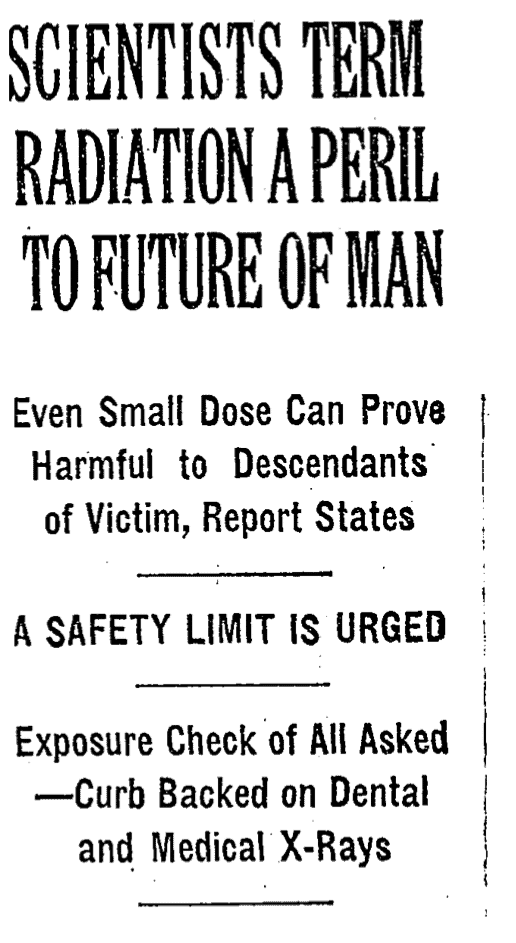
_From front page of June 13, 1956 New York Times. Right column headline._
In the intervening years, the “no safe dose” assertion has been propagated repeatedly by committees representing some of the most distinguished scientific bodies in the world.
As part of my intense effort to understand why so many people have so adamantly insisted that harm from radiation always exists, even if there is no way to detect it and even if there is evidence supporting the conflicting theory that low doses of radiation stimulate human immune responses enough to provide a healthy effect, I have just completed reading J. Samuel Walker’s excellent book titled Permissible Dose: History of Radiation Protection in the Twentieth Century, University of California Press, Nov 2000.
It documents the periodic controversies associated with establishing regulatory standards and describes how the activism, turf wars and bureaucratic infighting almost inevitably resulted in reducing the limits even in the absence of any evidence of harm to anyone while operating under the preexisting limits.
The only set of standards that seemed to actually improve human health were the tolerance dose guidelines issued in 1934. Nearly all of the rest were the result of public pressure and the desire to appear more protective while avoiding the accusation of “relaxing” standards on the nuclear industry, industrial equipment suppliers, industrial users and the medical profession.
Walker discusses many of the common theories about why the public has seemed to be so fearful of radiation. His list includes the silent, undetectable killer theory, the involuntary risk theory, the unbreakable link to The Bomb theory, the persistent contamination theory, the dread of the unknown theory, and the immediate and dramatic mass casualty theory. Here is what he says in summary of those frequently suggested explanations for the persistence of fears in the face of levels of radiation where there is no demonstrable danger.
Those considerations, taken alone or in combination, are helpful in understanding the bases of public fears about radiation and nuclear power. But they do not in themselves full explain attitudes toward radiation because they do not clearly distinguish it from hazards with similar characteristics. Other potential dangers to health, such as chemicals, electric shocks or ultraviolet rays, cannot be detected by human senses, at least until they cause injury or disease. Many industrial practices impose involuntary risks over which people have little or no control, such as producing electricity from fossil fuels, placing additives in food, and engineering genetic materials. A number of industries and activities have demonstrated capacity for causing “big event” catastrophes, such as toxic chemical releases, airplane crashes, or dam failures. In many of those cases, especially the dangers inherent in the production of noxious chemicals, the effects of long term exposures can be as uncertain, unending, and unfamiliar as those with radiation.
Most of those statements have been frequently discussed here on Atomic Insights by people who remain perplexed about the real source for the persistent fear of radiation that has resulted in more than 100,000 people in the Fukushima prefecture being forcibly removed from their communities and prevented–by police barricades–from returning to rebuild.
However, Walker takes a major step in helping his readers understand why radiation seems especially fraught with risk in the minds of so many people, including those in positions of decision-making authority.
The major ingredient that seldom receives sufficient attention is the historical context of efforts to ensure adequate radiation protection. Indeed, public attitudes toward radiation cannot be fully understood in the absence of historical explanation. The historical axiom that distinguishes radiation from other hazards of a similar nature is that after the end of World War II radiation hazards were perpetually in the news. They were much more visible than other hazards and usually depicted in a way that fueled public fears. As a result of its history, radiation achieved its unique standing among a plethora of agents that posed a direct threat to public health.
…
Those fears were given greater intensity and perhaps greater legitimacy by the fallout controversy of the late 1950s and early 1960s. The fallout debate called sustained attention to the risks of exposure to low-level radiation for the general population more than any previous treatment of the subject. It made radiation safety a bitterly contested political issue for the first time and it fueled already growing public apprehension of exposure. It also seriously undermined the credibility of the AEC, which received a great deal of criticism for placing the most benign interpretation on the radioactive consequences of nuclear testing.
Unfortunately, in 2000, Walker did not have access to the excellent root cause analysis research that Ed Calabrese and his associates have conducted about that early, highly publicized controversy. He did not know that the committee of geneticists led by Warren Weaver acted deceptively to conceal the lack of evidence for their assertion that all radiation is harmful and the extent of the uncertainties even among the hand-picked group of colleagues.
He did not realize the extent of the involvement of Rockefeller Foundation (RF) in fueling and oxygenating the controversy. He
What caused most of the confirmed harm at Fukushima?
- ✓A tsunami knocked out cooling at three reactors.
- ✓Reactor radiation caused no confirmed acute deaths.
- ✓The sweeping evacuation caused significant documented harm — a real debate.
✓ Active recall
1. What design feature did the Chernobyl RBMK lack that Western reactors have?
2. What caused most of the confirmed harm at Fukushima?