Caleb Brooks, Kronos MMR Project lead for University of Illinois
Concepts discussed
Auto-linked from the episode's notes and transcript.
Show notes
The University of Illinois-Urbana Champagne (UIUC) is planning to build a uniquely capable micro reactor project on its campus. For decades, the university hosted a traditional research reactor that supported important research projects and provided operating experience. But, like the majority of university research reactors, it did not produce any useful heat or electricity.
Kronos MMR!™ has a different focus. In its FAQ on the project, UIUC describes the purpose of the project as follows:
> [The project will] shape the future of nuclear research, move [our] campus to a cleaner energy future, create unique educational opportunities for our students, and develop a skilled workforce ready to address the urgent need for carbon-free energy technologies across our country and beyond.

Caleb Brooks is an associate professor in the Grainger College of Nuclear, Plasma and Radiological Engineering at the University of Illinois Urbana-Champaign. He is also the Kronos MMR Project Lead. He visited the Atomic Show to describe the project, its goals and the impact that it is and will have on the campus and nearby communities.
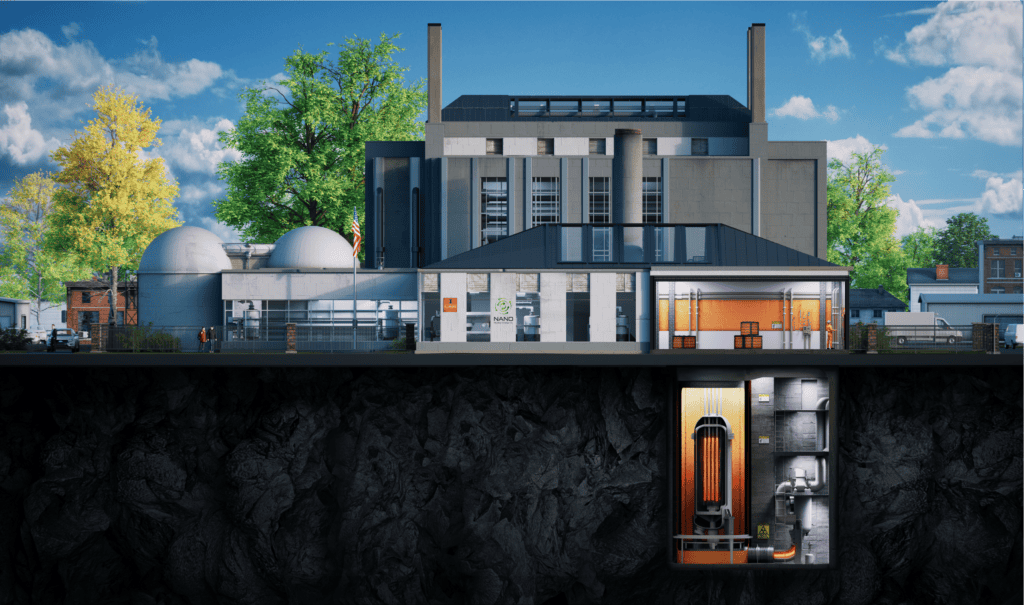
The Kronos MMR is a full scale, but power-derated, version of Nano Nuclear Energy’s high temperature gas cooled reactor. In commercial use, the reactor will be able to produce 45 MW of thermal power (~15 MWe). As a campus-based research reactor, Kronos MMR will be limited to operating at 10 MW thermal, a little less than 25% of what the reactor core will be able to handle. That limit is based on the current power cap placed on reactors licensed by the NRC using the class 104(c) process.
The lower power will, logically enough, mean that the reactor core can run 4.5 times as long before needing to be refueled. If it is operated at the somewhat lower capacity factor expected in an academic environment compared to a commercial environment, the time between refuelings will be extended even further.
Dr. Brooks explained how the research reactor classification was chosen to help the Kronos project move faster than it would otherwise move under a class 103 commercial license process. The University began its official engagement with the NRC in May 2021.
Though we did not get into details about the business partner situation during the discussion, some readers might recall that the UIUC micro reactor program began as a partnership with the Ultra Safe Nuclear Corporation. That entity ran into financial difficulties and declared bankruptcy in 2024, after it had done a substantial amount of engineering and design work for its 45 MWth high temperature gas cooled reactor that it called MMR®.
Nano Nuclear Energy purchased the designs and other intellectual property associated with USNC’s MMR, including the projects that the company had begun. Nuclear News published an article in April 2025 titled *UIUC and NANO Nuclear reboot plans for a FOAK research reactor *that provides more details about the transition and the plans to move the project towards completion.
During our conversation, Caleb indicated that the transition had gone reasonable well, but that the uncertainty during the period leading up to and immediately following USNC’s collapse had added about 18 months to the initially envisioned project schedule.
One of the primary topics of our conversation was the effort that the University has undertaken to build public support for the project. Given the campus location, this will be a pioneering effort showing how small and micro reactor projects can be accepted and located very close to customers, including residential communities.
You will enjoy this show. I promise.
Transcript
Read transcript
There's a way, a way such a better way today, today. The measure flies till the world, there's a better way, today, and there's a better way. This is right, Adams, and it's time for another atomic show. My guest today is Caleb Brooks, Associate Professor in the Nuclear Plasma and Radioological Engineering Department at the University of Illinois at Urbana, Champaign. And Caleb is the point person for UIUC's Research Reactor Development Program. How are you, Caleb? Doing great. Thanks Rod, great to be on again. Great to chat with you again. Yeah, I think we spoke when the project was pretty nascent. Phil Anoy as a faculty member. And my research group kind of classically studies thermogiotics and heat transfer. And that research kind of grew into more of the system level and component level analysis. And then ultimately into kind of to include also reactor systems and their deployment. My group focuses along with the thermogiotics, focuses on finding beyond grid scale electricity applications for a nuclear. And through that work is where I really I really saw potential in the smaller reactor technologies that are emerging, SMRs, small modular reactors and micro reactors. I really see particularly with micro actors, the ability potentially for those reactor systems that really change the paradigm of how we do all things nuclear, how we build them, how we deploy them, how we instrument them, how we operate them, which could really turn the tide for the economics around nuclear, not just in this country but around the world. So right now you are working on University of Illinois has selected a reactor technology and your proposed use of that reactor a little bit different from most university research reactors. Can you talk a little bit about the technology? the two selected and how the university intends to use that reactor. Yeah, that's right. So we had a University Research Reactor that operated safely for nearly 40 years in the heart of our campus. It was a trigger reactor and it was used very similar to the way that current University Research Reactor are used. It was really used to study how neutrons and gamelands interact with materials as well as kind of train folks around nuclear technology. And that effort is still very important and the existing Research Reactor fleet, National Labs and other universities. I think still do that mission quite well. What we are looking at is what are the new ways that a university deployed research reactor could advance the nuclear industry? And we see a lot of potential really through three mission areas. The first mission is to continue the training, education and engagement aspects that are needed around nuclear. I say a lot that nuclear all roads go through public perception. And this is going to be true of advanced reactors as well. We need to deploy these reactors in the location where not only do we train the operators and things like that, but we... enable the public to come and see and witness and understand what is new about these new nuclear technologies. And really demonstrate their ability to be deployed in new locations, again, not needing the miles of fencing and the armed guards and those pieces that are what most of the public thinks about when it comes to traditional or existing nuclear power. And then the kind of second mission there is research and development. So research and development is something that's done with existing research reactors very well. I think they're a bit limited in the ways in which they can advance the R&D needs of advanced reactors just because they've been doing R&D on those since the 60s. The current research reactors have done a lot of the advancement that is capable with those units. So what we're really looking at within the research and development scope of our mission there is to focus on really the reactor itself, the component optimization that's needed for a new reactor. We're focused on a commercializable technology. On our campus we want a commercializable technology deployed as a research reactor. So a lot of the research that can go into our... optimizing that technology, developing out the critical enabling technology and synergistic aspects of the technology for diverse and use application. That's the way we instrument it. Again, the way we operate it, certainly improvements in model simulation and understanding coupling of the reactor unit with other induced processes. And then kind of both of those, education and the research mission, underneath those two missions, we have this cross-cutting mission that's I think really critical and timely, which is the at scale demonstration. We plan to deploy this unit and utilize a thermal energy to demonstrate the ability of advanced nuclear to do a number of things that go beyond what our traditional or our current nuclear plate does. So the actual energy generated off the reactor will first get exchanged into an intermediate cooling loop that intermediate cooling loop is comprised of a solar salt. Basically it's a liquid salt that has classically been used in the solar community. So it's referred to as a solar salt. But that salt is just able to store a thermal energy at high temperature. So we'll have a large hot tank and a large cold tank. And so first the thermal energy from the reactor unit goes into that intermediate thermal storage loop. And then when we want to deploy that energy to its energy. your application, you run the hot side of the salt through a steam generator. It'll produce steam. And that steam will feed our existing fossil fuel power plant that the campus owns and operates. So our power plant on campus, it's a hybrid coal natural gas facility that can even run fuel oil and some other things, but primarily coal natural gas. And its responsibility is 100% of the steam needs of campus for our district heating system. And as a byproduct to improve the efficiency of the system, it produces electricity, a substantial amount of electricity for our campus. And so what our plan is, is the steam generated will integrate with that existing fossil infrastructure. So we will provide steam into the main steam header of our power plant, habit power plant. And from that steam header, it can run the steam just like it runs off of the coal boilers or the natural gas heat recovery steam generators. Really that cross-cutting mission of at scale demonstration, it's about demonstrating the ability of these new reactor systems to decarbonize existing fossil infrastructure. I think as we look at retirement of coal facilities or these other kind of important community jobs and infrastructure for our state and our grid, we want to demonstrate the ability to repurpose that infrastructure with a clean power source like nuclear. And then also do the demonstration around this integrated thermal storage and its benefits to matching loads on microgrids like we have on campus. Also we're doing the district heating. We can we've even cooped out potential hydrogen production for our local bus fleet which already deploys hydrogen fuel buses for campus. We've looked at integrating with director capture to demonstrate the ability to direct your capture to use a clean source like nuclear. So there's a lot of angles to that ask you a demonstration. I think it's really unique about our our project which feeds back into the education because now it's not just about educating the people who will operate the reactor or provide maintenance on the reactors. Also, training the people who will interface at the new uses of nuclear. You know, the folks that will be will be working where we're nuclear is providing process heat for various applications. It's training those folks as well. It's demonstrating the public, you know, that induced application is safe and reliable. And then the research piece is really at that can also be extended that interface of the coupling with other induced applications. I mean, you see like the really the breadth of activity that can happen through deployments on a university campus which is unique. So that's our current vision. It sounds like your research. reactors going to be almost uniquely suitable for cross or interdepartmental use with other engineering disciplines like mechanical and electrical and those being taking almost as much advantage of the heat source and figuring out new ways to use it as the nuclear engineers are for the reactor. Is that an accurate interpretation? Yeah, you know energy is upstream of a lot of things. Right? And, you know, we see data centers have a huge focus right now and there's a lot of discussion around the kind of data energy nexus. We've had a large high performance computing asset on campus. We're university Illinois has known for its computational capability. The university is in charge of this quantum arc that's going on in Chicago. So there's a lot of activity already happening around that. This is just one example of an application which then we say we'll have this reactor unit. How can we expand this kind of sandbox into testing and demonstrating at scale the integration of the energy with the technology in the case of data centers or maybe hydrogen production which is so And in some ways, it's kind of fallen out of popularity recently, but Director Capscher, you know, all these other technologies that really have energy at the core challenge of their scalability. We can then provide this very unique opportunity to demonstrate that scaling as you get to the more commercial scale in developing out those needed components to see it really be widely deployable. Can you tell us a little bit about the specific technology that you all are using to make this thermal energy or heat up your salt? What is the reactor itself? That's right. The reactor is the Kronos MMR. It's a technology that's developed by Anano nuclear. Anano nuclear has been a great partner since we've come together earlier this year. They are the owners of the IP. We've been working on that technology now for four years or so. And it's really, we see that technology as right-sized for what we want to do, these activities I mentioned, and then also the kind of the profile campus. And then beyond that, really, there's a lot of potential for that technology to be widely deployed. So the reactor that the Kronos MMR is capacity of about 45 megawatts thermal with multiple years of operation before the need to refuel. And because of it that size, I think that size is doing this delicate balance of still still needing to pack a punch, but you want to make it small enough such that you don't need to have all of these auxiliary kind of safety systems in place in the case of, you know, an accident scenario. We want to be at a small enough size, such that in the case of loss of power or a case of some sort of accident, all of the residual energy, the decay heat of the reactor, can be easily dissipated to surround the structures into the ground, you know, lay from the reactor, and ensure that there's no potential for fuel melt or radioactive release. So at these smaller sizes, you can really eliminate a lot of the costly and burdensome to maintain and regulate additional safety features like we've seen fail in the case of three mile in the case of Fukushima, where the loss of diesel generators, so they couldn't pump water in to the reactor or the case of three mile island where where a valve got stuck open and then the operators actually chose to turn off those safety systems. Basically, we're at a size that's small enough such that those those auxiliary systems are not. needed in order to maintain the the safety characteristics of the system. Yet still they're able to pack a punch for various and use applications. This allows us to shrink the footprint of the deployment substantially. And now that they have the safety basis that is inherent in their size and we can also talk about their fuel form but but largely in their size. Now you can start to look at new paradigms for reactor operation. Now you can make think a strong case that the reactor can still be safely remotely monitored or maybe even one day autonomously controlled. And that is a way that we can really change the economic paradigm of nuclear. One of the things I like to remind people is that essentially all reactors have always been autonomously controlled or remotely because very few reactors allow any operators into the containment system itself. So you always had to have a communication to the reactor from outside. Really the only question is how long is the communication pathway? Yeah I like that. Yeah and I think it's also a matter of the importance of that distance and pathway to the safety basis of the technology. Of course we know existing fleet is very safe. They've operated very very safely. And And that they are the cleanest, safest form of energy that currently are grid relies upon. But we can go even further with these new technologies because of a change in our approach in terms of the size or scale of the reactor and then also improvements in the robustness of the fuel form, which then alleviate the requirement for various regulations, which can then enable new streamlined approaches to operations. You mentioned robust, I believe you all use what the DOE calls the most robust nuclear fuel form available. And what is that? Yeah, I really like to try so fuel approach. So try so fuel, basically in principle, is it a change of philosophy? Now try so fuel has been used as currently used in reactors. It's not like our deployment will be the first to use it. It's a technology has been developed for some time, but it's fundamentally different than what the current nuclear fleet uses. And its consequences that the overall approach to protecting the environment and ensuring no radioactive release environment is fundamentally different. So in the case, just maybe perhaps oversimpl... in the case of the existing fleet, we see that there's a reliance on a ultimate reliance on a large concrete containment structure. So there's defense and depth that is inherent to the way that we approach safety within nuclear, but ultimately, radioactive material that's produced through the vision event is contained from release to the public, ultimately through a large containment vessel, a large containment structure, reinforced, multiple foot, the concrete reinforced structure. In the case of Trisophule, it's really a change of approach, is saying we are going to contain the reactive material at the point in which it's generated. So vision is gonna come along, and it's gonna split atoms into new isotopes, and those new isotopes will be radioactive. And the approach with Trisophule is to say, we are gonna encapsulate that fuel, which is very, very small, like the tip of a lead pencil is the fuel kernel itself. We code it in different carbon layers. One of those carbon layers, the silicon carbide, is extremely robust, thermally, mechanically radiation resistant. It has this robustness such that it can... and retain the efficient products that are generated through that vision event. So instead of relying on a large containment structure, the approaches that we're gonna contain all vision products at the point in which they're generating. And so it really changes the way that you can go about construction, the way that you can think about reactor various reactor scenarios. And even all the way out to what do you ultimately do with the fuel if you want to, if you want to just store the spent fuel indefinitely, then again that silicon carbide coating of the trisophule can be very robust even over the long term to ensure protection from the environment and public from the time spent producing energy and efficiency. Okay, now one of the things, it's always kind of slowed down the development and the deployment of nuclear is that as you said, they're all often very big, kind of scary looking remote, and remotely-sided units where people can come in and say we're scared and we don't want it, but there hasn't really been anybody that says, okay, there is some risk, but we really like it. and it does all of these things for us. Many people in making decisions say, what's in it for me? And if they can't answer that question, they will let people oppose. How are you going to address this? What's in it for me response from a community? And what are you doing to make it so your community which seems to be very accepting of your project? What have you done to make them so accept them? Yeah, there's a lot of angles to this. And it goes back to my earlier statement that all roads and nuclear go through public perception. And the figure that I've heard about our current fleet is that it can, that up to a third of their operating costs can be in the physical security of the unit itself. So we spent the current fleet is spending up to a third of its operation costs in the very thing that undermines the message that the reactor unit is safe. The armed guards and the miles of fencing and all of these things that go into the physical security of the asset also undermines the messaging that this reactor unit is safe. And so I think that this change of paradigm to go smaller, which means you don't need these auxiliary systems that could perhaps be constant. That could perhaps be compromised by some external force. really enables us to rethink the way that we do physical security. And the universities have been actually a great example of the way that you can deploy small nuclear devices in populated areas without safety incidents. And we like to continue that reputation and continue that legacy that the universities have shown since the 60s where vision technology after demonstration proliferated out amongst the university. And so one of the things that we do, and we're really excited to do on campus is to talk with the public about what is different about nuclear. I think in the state of Illinois, of course it's the largest producer of nuclear power in the country. There's a lot of literacy, a lot of understanding in the general public about nuclear been a fact of a bill of noise for a long time. But we want to, we, we expect excited about the opportunity to communicate with them all the things that are new about nuclear, you know, the new fuel forms, the, the benefits to going smaller, not just from a safety perspective, but also from an economics perspective. And a real opportunity to change their life, right? A real opportunity to re power a historically fossil power power plant that was important. to the community for jobs. It was important to the community for just the taxes and everything surrounding that community. Now perhaps we can have both. We can have that facility be clean and we can still have that community thrive with new energy if we can demonstrate the ability to integrate nuclear power, new nuclear power with existing fossil infrastructure. So a lot of opportunities which take this nuclear power, which is typically think is thought of as this far off thing and be this thing that is much more approachable to the public. I think the simpler the system, the easier it is for them to understand it and see the development, the design, and how the safety basis can be improved through this approach. So yeah, we really enjoy those discussions with folks around campus, folks in the local community. We have open to the public meetings once a month. And we get a lot of folks come from all around the area. A lot of folks will reach out through email and will engage through emails or through teams or Zoom calls. We love to do that. We're very excited about this project. We think there's a lot of opportunity to change the world through this technology and through the demonstration of it. And I think the big thing that comes around in these conversations is they think, oh, it's so new. And this technology is so new. That's one of the hesitations we hear from people is like, is this really the place? Is it campus really the place to do something new like that? That's what Canada is supposed to do, right? But I also remind them that advanced nuclear, it's not in the proof of concept stage. We've proved the concept many times. I mean, all of the advanced reactor concepts that are currently being pursued, whether it's so-called reactors, heat pipe reactors, molten salt reactors, pell-bed reactors, those have all been proved before. We've had demonstration reactors. We've, in the case of H.T. jars, we've even deployed those commercially before. Where we are right now is we are in a proof of packaging stage. Okay, we have a technology that we've demonstrated to be safe. We've demonstrated that we understand how it operates. We understand the physics. Now can we package the technology in such a way that it can be widely deployable and really transform the energy landscape? And that's why our project, I think, is so critical is because it takes all the pieces needed to do that proof of package stage, which, which new nuclear is, is desperate for. You mentioned that, you know, you talked about your showing that the reactors don't have to be. far off in terms of being physically close. Now there's another objection to advance nuclear in the fourth dimension, which is the dimension of time. How far off is your reactor from being started and actually operating? Yeah, you know, I think there's there's perturbations that come with being at the bleeding edge of of any new development. Our engagement with the nuclear military commission has been has gone extremely well. They've been terrific in time we review of our topical reports and and giving us feedback, which is which is reasonable and well incorporated into revisions. So so far we've had a really good experience with the the necessary stakeholders. Still a lot of stars to align. If those if those stars continue to align and we could be operational and then the late 2029 kind of timeframe. And again, I think it would it can be done through our deployment as fast as anywhere else if not faster, given the precedent that we have for for fuel, which challenges commercial deployments that the opportunity we have to license it under a research reactor, which is a much more prototype friendly licensing approach. And then again, yeah, the strong public support that we find in our local community. to drop one of these down and really change the world. I know that this is early to mid May, and it's a time of very busy time for academics like yourself. So I want to be respectful of your time. Is there anything that you really would like to share with the audience that we haven't covered yet? There's lots more I'd like to talk about maybe some time in the not too distant future, but at this point, what you got? Yeah, so we've got a website. You can search Illinois Micro-actor demonstration project. We'll be revamping it here very soon to add some more information, some more updates that have been coming out this year. So have a look for that website. Feel free to reach out to me. My email is csbrox at Illinois.edu. We'd love to engage with folks. Anyone interested or have questions about the project, we're here to respond. So check out the website and reach out to us if your audience has any questions or any thoughts. That's great. And I presume you probably haven't opened or tuned your research group for a good solid, hard-charging grad student, right? Always looking for good people, grad students, undergrad, even. even technical staff, research scientists, postdocs, all those folks are needed. We're really working at the cutting edge, lots of really amazing things happening along the way, even leading up to the deployment. So yeah, if there's some strong folks out there that are excited as much as we are, I haven't reached out. I hope you enjoyed this episode of The Atomic Show. This is Rod Adams. I've been here, host for The Atomic Show, for more than 15 years. As the publisher of Atomic Insights, I've been speaking with experts in analyzing nuclear energy for more than three decades. About half a decade ago, it became clear that investing in advanced nuclear developments could provide exceptional returns. Successful investors, facing Silicon Valley agreed. While I'll continue to produce new content, Atomic Insights is now a part of the Nucleation Capital, a venture capital fund that specializes in nuclear and nuclear adjacent emerging companies. As a managing partner at Nucleation Capital, I'm expanding my access and digging even deeper into nuclear energy companies. My partners and I are working hard to select ventures with extraordinary promises success. They're building the advanced nuclear sector and helping to expand our clean energy options. We're investing our own money in diversified portfolio of ventures and enabling investors like many of you to take advantage of our diligence and selection processes. We use an establishment. software platform that allows us to offer full featured investment subscriptions starting as low as $5,000 per quarter. A four-quarter subscription will get you exposure to between four and eight ventures. We encourage longer subscriptions with greater diversification by offering a discount on our fees for eight quarters or more. If you are an accredited investor who wants to learn more about how you can participate, please visit our website at Newclayton Capital that's Newclayton Capital all one word dot com. Our fund and all of the information you need to subscribe is available online. You can also subscribe to our newsletter, Newclayton Insights and join our pro-nuclear investor network where you get information about syndicated investments in selected companies. Limited partners in the fund get discounted access to syndicates, but they are open to other angelless members. If you would like more information, we're happy to help. Please spread the word.