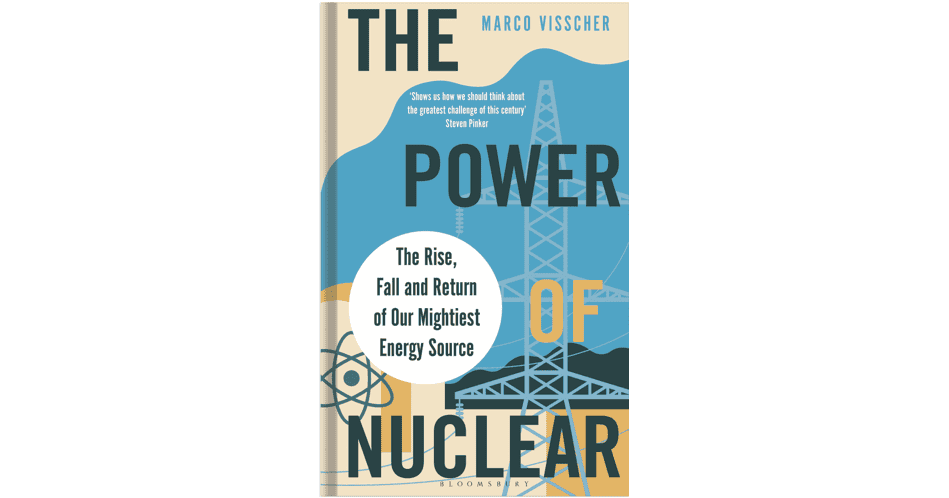
Marco Visscher – The Power of Nuclear
Concepts discussed
Auto-linked from the episode's notes and transcript.
Show notes
After many years as an independent journalist with an antinuclear bent, Marco Visscher began questioning his long-held beliefs. He realized that the accepted alternatives to fossil fuel were not actually reducing fossil fuel use so much as they were limiting the rate at which it was increasing. He began acknowledging that nuclear energy was a large source of CO2-free power that was worth a deeper look than he had been giving it.
As he moved past the information sources that had provided his animosity towards nuclear, he found out that there was a deeper, more interesting story to tell about the power source and its history.
He decided there was a book in what he was learning. That book, initially published in Dutch in 2022, is called *The Power of Nuclear; The Rise, Fall and Return of Our Mightiest Energy Source.* In late 2024, the book was published in English. As longtime readers might imagine, my favorite part of that subtile is the “Return” part.
Aside: Encouraging and participating in the return of nuclear energy growth is the focus of my professional life, both at Atomic Insights and in my role as a managing partner at Nucleation Capital. End Aside.
In some ways, the arc of Visscher’s book reminds me of the narrative arc of Oliver Stone’s *Nuclear Now*. It starts with the history of radiation and the development of the atomic bomb and ends in the modern era with the recognition that nuclear energy offers a clean and capable new energy source that might gradually displace fossil fuels and their dominance in our society.
During our discussion we talked about nuclear energy opposition, the role of nuclear fear, the inability of the nuclear industry to effectively communicate its positive story, other energy alternatives and the potential to achieve the tripling of nuclear capacity that has been envisioned by a growing group of countries led by the U.S. the UK, France, South Korea and Japan..
Aside: After reviewing the show, I realized that I should apologize to both listeners and to Mr. Visscher. I spent way too much time talking about the involvement of the Rockefeller Foundation in creating the basis for the “no safe dose” of radiation model and its effect on public fears. It’s an interesting part of nuclear energy’s history, but there are many other important stories worth telling. End Aside.
Transcript
Read transcript
There's a way, a way such a better way today, today The measure falls till the world, there's a better way Today there's a better way This is why that, I'm saying it's time for another atomic show My guest today, or joining me today on the atomic show is Marco Vicha, who wrote a fascinating book Originally in Dutch, called the power of nuclear, the rise, fall and return of our mightiest energy source As someone who's been focused mainly on the US over the years, I was fascinated to see a view from outside the US Looking in and focusing quite a bit on US activities in nuclear since we've been kind of important in the history of this technology But Marco also brings us some insights into what was happening in Europe during the same period of time Marco, welcome to the show Thanks, Rod. Thanks for having me. It's an honor to be here Good, I'm glad you're here and why don't you give us a little bit of a background about you Why you wrote this book, what encourage you to do that and what have you done in other endeavors Before writing about nuclear energy? Sure. I've worked as a journalist for about 25 years Most of that time as a freelance writer Focusing on many many different topics in fact I started my career in journalism at an alternative independent magazine in the Netherlands and I wrote a lot about sustainability and the environment clean technology And I didn't like nuclear power a bit In fact, I stumbled upon an article I wrote back in the year 2000 It's almost embarrassing to read it The last sentence of my piece was something like it's time to destroy the nuclear industry Before it can destroy our planet or something like that And it was referring to you know the zillions of deaths due to Chernobyl accident there It Rereading it. I noticed that despite lack of knowledge. I just I thought I knew everything about nuclear right and it was it was bad Over the years I wrote more about Wind energy and solar power biomass hydrogen etc. And nuclear was just never On my mind. It was it was never the solution, right? I think that changed a bit around 2010 or so when Stuart Brent spoke out in favor of nuclear power in his whole earth manifesto I Notice it when he had this Change of mind about nuclear, but also other topics in his book But still I I wasn't totally convinced I guess I was prepared to acknowledge that nuclear power does have a role to play in the short-term energy mix of the future but it was you know it was by far Not ideal or so because the future in my mind had to be all renewable, right? Then a couple years later Think it was around 2017 or so. I published a book only in Dutch on on renewable power Where are we with our energy transition? How are we doing? Is it feasible still and all the way at the end of the book? I had to conclude that we were kind of falling short and they were that we were in need of Clean zero carbon power source available 24 seven And I wondered whether that source could be nuclear power But I was still very Cautious. I was saying that the waste problems still hasn't been Solved and that there was no solution in sight I was saying that there was no public support for nuclear power anyway so I Still I wasn't interested so much in looking into nuclear power and that only changed when the Dutch government Open up for the idea of having one or two nuclear reactors built in the Netherlands So I thought okay, this is now the time for me to look into it and Pretty soon. I should say I was convinced that there are so many benefits And I was able to ease my mind if you will about the waste problem for instance or about safety I'm sure we'll go into that later on But I fairly quickly Changed my mind. I really wondered why did it take me so long to change my mind to look into nuclear power And I thought okay, well, this is maybe the time for me now to write a new book and write a book on nuclear power And I can try to convince my Green friends and my left-wing friends of you know the wonders of nuclear power But when I started writing I Think I got bored fairly quickly because I felt this was so predictable and I know books have been written Making the case for nuclear power And I just thought I Shouldn't be doing this. I'm much better at telling stories and I noticed that I got most excited about About the history I guess of nuclear Technology about the way it was introduced Into the world and by all the emotions that nuclear power arouses right whether it's Fear or whether it's enthusiasm and I thought I should really look into this and write my book a much more original book I think telling these stories of how we How we came to think about nuclear power really it's not so much what should we do with nuclear power? But what is nuclear power doing to us? that's a terrific story in itself I like storytelling and storytelling that's something that Many in the nuclear industry itself have not been very good at as a matter of fact was It's pretty obvious to Yeah, because those of us who studied the history is that those who have been opposed to nuclear energy have told much more Interesting not necessarily true, but interesting stories about nuclear Yeah, I sometimes think that The opponents of nuclear power may understand the potential of nuclear power much better than the proponents I think it's the opponents who really see that nuclear power is such a revolutionary Source of energy that can change everything Whereas proponents tend to be more focused on you know very technical very practical use and and maybe they even think I will sooner or later Other people will discover how wonderful nuclear power is and they just and they leave it at that whereas opponents Are I think more aware of what nuclear power really is? Yeah, you're right And and you're right that the nuclear industry is terrible at communicating right? You know, I've never seen I've never seen an industry that is so reluctant to communicate basically I was surprised even that some nuclear firms have a PR department just because we never hear from them, right? Yeah, one would think they don't exist just a look at the actual journalism that comes out because as you know haven't been as harmless Most industries work hard to get their own stories out And they do it not just by talking to journalists but by buying time Through advertising to Communicate their story in their own words Hmm, and sometimes I Might not be so much for an independent journalist But I think that Journalists that work for major media Although they may have a firewall between these fails Ad advertising sales team and the journalism I don't I do suspect that they read their own newspapers and see who's Buying time and actually paying their salaries Yeah, or just look at the websites of nuclear firms A lot of them are so much focused on safety. They say safety everywhere basically But any communication Expert knows that if you shout safety People read the exact opposite, right because why Just bang on about safety if it's safe, right But nowhere do nuclear firms say We are so proud of producing clean Zero carbon electricity 24 seven With the lowest ecological footprints with you know very little resources etc. They don't tell that story Why I never understand that would you have an idea, right? Well Well, you know, I had a conversation I had in fact many conversations over the years with people, but one of them Still stands out of my mind and keeps coming back to me. I had a post talking to a lady who was the VP vice president for communications for the Southern company, which is a large Electric utility company in the US which operates I think now it's up to eight Nuclear units, but also has a very large fleet of coal and natural gas plants And I asked her why their company doesn't spend more time telling people about the benefits of nuclear Mm-hmm and her response was we cannot talk about the benefits of nuclear In comparison to the disadvantages of coal and natural gas Right, we can tell people nuclear is pretty good, but we certainly can't say that it's better than coal right at gas because They have a portfolio right? Yeah, yeah, it would be bad for for their other power plants Yeah, and when it came wrapped out to it nuclear provided at that time about 30% of their electricity Coal was more like 40% of natural gas was 20% and so you know it Was an interesting dichotomy there. They didn't have very much at all wind and solar at the time so one of the other things that You mentioned that it comes to my mind and you being a journalist I've heard this so many times as people say hey the public doesn't support nuclear so I guess it's not something that we need to talk about And My my questioning to the people that write that is don't you think that your words Have something to do with whether or not the public except nuclear Yeah, no bullet yeah journalists write fairly poorly about nuclear energy. Don't they it's always There's always this sense of danger lurking whenever they write about Nuclear power so when there was this innovation with Was it these floating reactors? They could be you know offshore Close to coastal cities where you know a lot of electricity is is used It seemed like a great idea But then they talk about a floating Chernobyl in that kind of thing that's just common practice among journalists what I noticed what I heard from other journalists Focus on on energy at a newspaper desk say They say they get letters from anti nuclear people Even when they're talking in neutral terms about nuclear power so even And I guess there are also worried about criticism from their colleagues when they don't show they are very critical of nuclear power. But it is very different when a journalist writes about nuclear power as opposed to writing about wind power, for instance, which is seen as more natural, seems like the future. Well, this is how I wrote about wind and nuclear power, right? So we all have our biases. And I guess in, you know, right wing media, it's exactly the other way, right? Nuclear is almost treated saintly as a solution to everything, maybe by way of, you know, maybe even poking fun of the left wing progressive mainstream media or so. And then they would denounce everything about wind power. So I guess it's the other way around as well, depending on which newspaper you read, I guess. Well, we'll get back to that one in a little bit. I'd also like to know how your left wing anti nuclear environmental associates and colleagues have responded to your book about nuclear energy. Mostly positive, I should say, I know a friend of mine, we sort of are our friendship froze a little bit. I'm afraid. But, you know, these things happen, I guess. I think because my friends weren't surprised by the book because over the past years, I've been talking about this maybe more than they would like to hear, in fact. So I was over the years able to persuade them anyway and share my enthusiasm before they would read my book. So today, it wasn't so much of a surprise. And I should say, in one on one conversations, it is much easier to make people change their minds eventually, not in one conversation. And by the way, it's never so much my idea to change people's mind, right? And certainly not in the book. I wouldn't have started my book with a whole chapter on the atomic bomb. If I would, you know, want to make people enthusiastic about nuclear power. But I think in one on one conversations with someone, you know, I do think it is possible that people would drop their resistance eventually. But it takes time. And it may need more than, you know, a bit more positive press or even a book, you know, for people to change their minds eventually. Yeah, it's a lot easier to make people afraid of something than it is to make them lose their fear and support it. Yeah, it's just a challenge in human psychology. Yeah, I don't do it. I see, and I see pro nuclear advocates use fear, but then focused on climate change. But I say, oh, you fear nuclear power. No, no, no, you should fear climate change. That's that's much, much worse. I don't, I never like that way of arguing sort of, yeah, blowing up for this year. There isn't a segment of the pro nuclear crowd or is that really a movement yet? But there's just a lot of people talking about it. They call themselves the abundance movement. Because what they believe nuclear really brings is the ability to free us. And these ideas go all the way back to the beginning, as you found out in the 1950s of the beginning of nuclear energy, where nuclear power plants really do have a fuel source that is essentially in human terms inexhaustible and can produce all the power, not only that we need, but all the power we want to expand human prosperity and desalinate water for places that are dry and for even running carbon capture machines to reduce the carbon, as I see it to inventory in the atmosphere and maybe gain the climate patterns back to something more common, more known to us. That abundance idea. And one of the interesting kind of things that you, there's a thread through your book about some of the background of those who have fought nuclear most effectively. You mentioned EF Schumacher, for example, who is the smallest beautiful author and you always wanted to get people to work back and maybe even approach life like the Buddhists do. But you mentioned also where he worked. Yeah, yeah, the coal industry, right? He had a really high position actually in the British coal industry. Yeah. Yeah. I didn't know that by the way. When I worked at the alternative magazine that I worked at, you know, in the year 2000 when I wrote how terrible nuclear power was, I never knew he worked for the coal industry. He was an environmental guru. It seemed like such an odd thing when I found out. Uh huh. Well, maybe it's not quite so odd because if nuclear succeeds, that means coal doesn't succeed. And a lot of people lose a lot of money. And I'm not talking about the workers who maybe need to transition and go to find something else to do with their welding skills or their steam plan operational skills. I'm talking about the people that own and operate the coal mines. Yeah. I'm talking about the people that tax the coal revenue, those who ship coal from place to place, those who move it on railroads and and those kinds of things. That's a tremendous economic gift if you stop using coal and using nuclear. Yeah. Now it's obvious that nuclear power is a competitor to coal and natural gas and not too much a competitor to solar and wind, for instance, because they're they work on a on a different level. Right. So that makes a lot of sense. I found a quote. I think it's in the smallest beautiful book by Eva Schumacher, um, saying how people could worry about air pollution coming from coal plants. If the atmosphere is full of radioactive particles from the nuclear power plants, it's those kinds of, you know, remarks were all over his book. He his job was basically to to bring down the deposited vibes about nuclear power. And he succeeded pretty well, I think, right? Yeah, he did. And many people seem to forget though part of marketing, winning an election, even winning a market, winning customers is to go negative on your competition. The going negative on your competition is just as effective as sometimes more effective than selling a positive message about your own product. Hmm. Many call it, at least if you don't know about it in Holland, but in the US, many campaigns, the the two candidates focus more on the negative of their competitors than they do on their own positive. Yeah. I did notice that in your last presidential elections. Yes. And embarrassing indeed. Well, it's been happening for many years. I think people may be just paying attention more to US politics from your side of the ocean than they have in the basket. It's pretty bizarre. He says, well, anyway, I won't get into a political discussion, but you ask your book. You also mention things like Herman Mohr and his studies of fruit flies. And the fact that when he did join the National Academy of Sciences panel and for help to produce a report from the genetics committee that was published in the New York Times on January 12, 1956. You mentioned that that study was funded by the Rockefeller Foundation. But what you didn't mention, maybe you didn't know, was that Herman Mohr started receiving grants from the Rockefeller Foundation to support his work and his family and his living. As early as 1930, very soon after he first published the study that said that radiation causes genetic damage to fruit flies. His right after, or right after, will work. Well, let me take that back. When he came back from Europe and beginning of World War II, he didn't have any job. He'd been in Russia for 10 or 12 years. And wasn't really in the most strongest position to negotiate for a job. A former colleague of this, it was working as a Rockefeller Foundation, it's done. Got him a job working at Amherst College as a professor slash instructor. And that job lasted until the end of the war when the Amherst College regular professor were coming back from war and they needed to have their jobs. So he got fired. He got let him go from Amherst. And he was, here he was, 56 years old, had no pension plan at a young wife and a child that was, I think only two or three years old. And he was out of a job. Miraculously, he received it and offered from the University of Indiana. And the Rockefeller Foundation, not only provided a grant to the University of Iowa, pay his salary, provided a big enough grant to pay his salary plus several research associates and a laboratory. And the University accepted that, you know, accepted him into A. If you're going to give him a grant, we'll take him. One year later, he became a Nobel Prize winner and they thought, wow, we've made a really good steal here. Because every University wants to have a Nobel Prize winner on this staff. Sure. Yeah. One of the, you know, to me, one of the connections there is this oil stoked foundation did a lot to help make people fearful of nuclear energy. And that's what I write in my book. And I I draw on your research actually at, I know you've written quite some blog posts on your Tom McIncites website about Herman Miller and Rockefeller Foundation. And I, that made a lot of sense to me, it's almost business sense, right? That the Rockefeller Foundation would produce a report to hold the development of a competitor that was, you know, that was promoted by the biggest government in the world, the most powerful government in the world. So I was found that very interesting. I should say I was, I was always doubtful whether to mention even more links just because I know the Rockefeller Foundation supported many scientists. And I don't think Herman Miller was alone in receiving. grants like that because that's what the foundation did much more often. Are you aware of that? Or the Rockefeller Foundation up until maybe 1960 or so was a bigger supporter of all sciences, at least, of... Exactly. ...on its just like biology and physics and medicine, all that. Then the US government was. They had a huge impact on science. And science education. And in many cases, strong scientific progress. I have about 45 posts on atomic insights where I draw connections between the competitors of nuclear energy. And the messages that have been created to bread, fear, uncertainty, and doubt about nuclear energy. And this isn't a small thing because the oil and gas industry is a industry where a single relatively small company, like ExxonMobil, can earn something as large as $400 billion in a year, depending on how the price of oil goes. And there's some of the knocks, the national oil companies like Aramco or the gas-promp or some of the other really big equinore from Norway. Some of those groups can get closer to a trillion dollars. And that's a trillion as a number that most people can even conceive. But that's what they do when the price of oil is sufficiently high. Now in times when that price of oil drops, their revenues drop accordingly. And what can make the price of oil drop faster than anything, an oversupply? Right. When the supply of oil is too much, prices drop dramatically. Which means to say it's the price of energy. I mean, it's the supply of energy increases rather dramatically. The price of oil can drop rather dramatically as well. It didn't happen with natural gas. So in fact, natural gas is even more volatile compared to supply. of oil. I mean, I think that you in Europe, what is you having at a certain time? Natural gas prices were 15 or 20 times as high as you were here in the US during your recent energy conditions. Because we have three imports quite some. Yeah. Well, part of the reason I do import was Germany shut down 17 large nuclear plants. Oh, yeah. Right. Yeah. So there's a connection there. And as you point out, there was a chancellor of Germany named Gerhard Schroeder who helped convince the public to convince the government, convinced everybody that they needed to set down nuclear and build renewables instead. Yeah. Though I feel like the decision to face out nuclear power was indeed when he was in charge. It was in the final days of his coalition government with the green party. He left pretty soon after announcing the nuclear face out. And then he quickly started working for Russian companies producing and selling fossil fuels, ironically. But I feel it wasn't so much straighter who was making people in Germany afraid of nuclear power. Very much part of the agenda of the green party wanting to leave a legacy basically, right? For having been part of the government. And this is what green parties do when they enter government. Right. This is what happened in Belgium as well, for instance, around a year 2000 when they managed to get something written in the constitution of the country that no nuclear power plants could ever be built in in Belgium. Well, that's a pretty unusual thing to write in a constitution, right? Yes. And constitutional territory is a difficult change. Yeah. Yeah. And in the Netherlands, I mean, our only neighbors are Germany and Belgium and we look with, you know, astonishment at what they're doing. Germany has closed down all their nuclear plants. Those were plants that functioned perfectly well. They never had any problems with it, right? Yeah. And seemed to make so much sense to make nuclear power plants part of their, and a key window, their effort to bring down carbon emissions, but they closed them. And in Belgium, where what was it, 70, maybe 75% of all electricity came from just two nuclear power plants, seven reactors in total. They want to get rid of them as well. It's, it's, it's, it's just crazy. I think in the people in the Netherlands don't really understand this in Belgium. They want to build these natural gas plants. And they say, oh, it's only temporarily, right? Everything in life is temporarily right for a long, doesn't make sense to build that kind of infrastructure. Yeah. Well, didn't you find that some of the people pushing for that planet, Belgium had strong connections to the natural gas industry? Yeah, the energy minister there, Tina from the staff. She, she had founded a law firm and together with her business partner, partner. They were working for companies in the energy sector. Many of them were involved in fossil fuels. And because she was by then the face of the green party, having been in parliament before as a, as a young up and coming politician, she could write op-ed pieces, not signed by the green party or so, but signed by Tina from the style, who was then working for a law firm. But still that may, I guess that East people up to, to other ways of producing electricity and sort of working, working politics through writing these op-ed pieces and her lobby efforts basically indeed. Yeah. Hey, you mentioned earlier that you saw that wind and solar don't compete with nuclear. And I agree with you. They definitely serve different functions and do different things. Yeah. But for some reason, some of the people in the green slash environmental movement, like Amory Lovins, for example, very adamantly believe that that nuclear and renewables can't work together and that any money spent on nuclear is money that can't be spent on renewables. And so I think that Greta Tumbert has the same comment in your book that, you know, if you, if you need to reduce CO2, there's no sense wasting any money on nuclear, you need to spend it all on renewables. That sounds a little like competition to me. Yeah. But it's clever from their perspective because by making nuclear, the competitor to renewables, they win more easily, right? Because no very few people like nuclear power and are willing to stand up for nuclear power. It has changed a bit over the last years, right, with emerging pro nuclear movement or abundance movement, as you call it. But still pitching renewables versus nuclear power is in the, is in the public mind. I think a very smart thing to do, but it doesn't make sense. They can work together. Nuclear power should provide base load electricity and wind and solar can just add electricity when, you know, the wind blows and the sun shines. They do not compete nuclear competes with fossil fuels. So, but I think if renewable advocates would go along would accept that narrative, the correct narrative, they think they will be in a disadvantage there. And some, some people who don't like nuclear, they would use any argument right to attack nuclear regardless of the facts. This is what we have been seeing for decades on that, right? Yeah. So, pitching renewables against nuclear is just one of their tactics to, to, to influence public opinion. Another tactic used by the opponents of nuclear energy is to complain it costs too much. But as you point out, your book part of the cost is driven by adhering to a regulatory construct called as low as reasonably achievable. Alara. That construct means that if there's something that can be done to reduce radiation dose and it just costs a little more money, then that money should be spent. In my opinion, the basis for this construct is the idea that there is no safe dose of radiation. An idea that was kind of new up until 1956, when the New York Times and later Science Magazine published work from the National Academy of Sciences, biological effects of atomic radiation that concluded that all radiation was bad and that it caused genetic damage. The effort to produce that report was requested and 100% funded by the oil soaked Rockefeller Foundation. And as we discussed, Rockefeller Foundation was very large in an influential among the scientific community and among the science education group. And so it was easy for them with the imprinterer of the National Academy of Sciences to make that the standard within educational systems within the science communications. So it was no nothing controversial to say to believe that all radiation was harmful up until some people started asking about it, probably closer to the 1980s than before. I think I'd like to push back a little bit on that Rockefeller Foundation narrative. I think we should be, we shouldn't be giving it too much attention here. There was always a suspicion of radiation even before nuclear power existed. We were afraid of radiation, right? So when radioactivity was discovered by Marie Bury, even before then, there was these folk legends about people being harmed by rays coming from your eyes for instance or something like that. Some evil power when radioactivity was discovered. And afterwards it was used in X-ray machines for instance. But doctors got these terrible diseases because they would test the machinery by holding their hands right in front of the machine. And people were afraid of radiation because of all these terrible forms of deformities would appear in people working with a radium for instance. I think that suspicion of radiation was always there. You could find it in comic books from the 1920s when some super villains possessed some kind of radioactive force that would destroy the enemy, meaning the good people and could destroy the earth. Of course, the opposite was also true, right? Because in comic books, you could also find superheroes who had this positive radiation around them that could annihilate the enemy, the villains in the story. So it worked both ways, I guess. But the fact that radiation, I guess it's a sign that radiation messes with our minds and the idea that any level of radiation is harmful and should be avoided, is all speaks to that deeply rooted suspicion of what radiation can do. And the Rockefeller Foundation may have supported that idea to some extent. And I think also at some point, the resistance to nuclear power was so much ingrained in society. And the fossil fuel industry was obvious that they remained a really powerful industry. That it wasn't needed anymore to support environmental groups or incense or any other groups to attack nuclear power, right? I just think we shouldn't overestimate the role that the Rockefeller Foundation played apart from that big report in the mid 1950s to which Herman Miller contributed to the report we were talking about that gained so much prominence in the media and really obstructed the development of nuclear power. I try to make sure people understand something. I'm not trying to say that the Rockefeller Foundation is the sole source of this kind of information because they were a non-profit foundation, a long lived one, but it's over 100 years old. But there's just a single point of data. There's an awful lot of what I actually try to refer to as fossil fuel interest. And we have a hydrocarbon-based economy. I think the energy industry is somewhere north of $6 trillion a year in total, associated with the energy industry are banks and railroads and shipping companies and pipeline companies and steel manufacturers, all of whom have an interest in maintaining that hydrocarbon economy. There is, as some of the people you mentioned here, book. There are some people on my side who say, hey, the people that fight nuclear are those who want to go back to nature who don't like humans very much who think that we should all live in an energy poor way and be at peace with nature and raise our own food and that kind of stuff. I say, yeah, there may be some of those in the opposition. But the people that have the money and have the ability to communicate and have higher, effective PR groups within their organizations, they have whole marketing departments and all that so they understand the importance of energy to the economy and they understand that a new almost unlimited competition that has all the features that you and I like being emission-free using very small amounts of material, using not a whole lot of land, not needing a whole lot of transportation to move fuels from place to place. All of those things are a threat, an economic threat and it's very easy to use very small amounts of money to support nonprofit groups. Not groups are generally pretty hungry for money. Who supports? Who provided Greenpeace with the resources they needed to do all of the capital-intensive protests and they did down their own boats or ships. They moved from place to place. Where did that money come from? Is it just from people that have too much money? They just want to spend it on flan's feet or did some of that money come from individuals, foundations and dalmon's that said, what they're doing is good because it helps to overall protect our current way of doing things. We don't have any proof of that, Roth. I haven't seen any proof of that. I've got 45 articles on a time against sites with some of that proof. Going back, E.S. Schumacher was a member of the coal industry. He didn't need to be supported by the coal industry to do his nonprofit work. He wasn't getting paid. It's a salary by the coal industry. The people that you mentioned in Belgium, a lawyer who works for the oil and gas industry, get our sugar, who yes, his anti-nuclear thing happened just as you got ready to leave office. And three weeks later, he got a job with gas truck. That is it. They're all in my book. But the Greenpeace boat, for instance, I haven't seen any proof that Greenpeace is supported by the fossil fuel industry. That's my point. I think we shouldn't be going too far at least. I don't want to get into that story because I don't support that story. Yes. Well, I'll send you something. But anyway, one of the things that's happened recently is there's a growing support for nuclear and for its ability to be a part, not a complete solution. As we know, nuclear plants have their disadvantages. They like to operate all the time, even if it's really windy outside and the wind guys want to put their power on the grid, even if there's a low spot in the power demand, but it's a nice, pleasant, mild day. There's no need for eating and cooling, all that stuff. The nuclear plants really would like to run all the time. So, yes, that's a bit of a problem. There's some other disadvantages. Yes, we have to handle our waste, which as far as I can I'm concerned, we have handled it very effectively for 70 years. Nobody's ever been hurt, but yes, it costs me. Yes, there's some political controversy about it, but it is something, at least we don't dump it into the atmosphere for everybody to just share. So, because of some of the advantages, there's been a group of, I think it's about 25 or maybe a few more countries that have agreed to that we should have a goal of tripling nuclear capacity by 2050. What do you think of that? Do you think that there's any way to build the support necessary for that kind of huge change? Well, I know about that pledge. I think we should be realistic. It's not a pledge to triple nuclear energy capacity. It's a pledge to see if countries can work together and help the world move closer to a goal of tripling nuclear capacity. It's a very modest promise if you look at the words. I don't mean to be cynical. This is probably how politics work, but I'm not bursting with enthusiasm or so when a pledge like that comes out. It's it is just words, just like many pledges made during climate summits. Over time, we know by now that most of these pledges are just words. And I don't consider the fight for nuclear to be one or so. pledges may help, but we're still facing massive struggles, a liberalized energy market, for instance, is not the greatest condition for building nuclear power plans that require investments for which constructors need to go to the private market where high interest rates are charged. Building a nuclear power plant is right now just very, very expensive. And I know that we can make it much cheaper when governments, you know, provide this guarantee and the interest rate will go down substantially. But governments have shown to be unreliable and not very much forward looking either. So I, I, I worry that if we focus on these kind of bits of positive news that we think, ah, nuclear is, is back again. I think we'll need a lot more than that. And that's why I'm, I'm maybe more enthusiastic about the pro nuclear movement. I know it's mostly individuals, it's small groups like, um, as generation atomic, for instance, there's a model for nuclear, there's the radiant energy group and, and we planet. I think I'm not active on Twitter, but I do think they are. There's, there is something happening. These are people who stage protests whenever a nuclear reactor closes. There are protests on, on the street marching for nuclear power, showing that there is public support. And that's another thing. I've seen so many opinion polls in so many different countries showing a wide majority support for nuclear power. This is, um, well, it touches on something we talked earlier about in our conversation here, that there is, I think many people will think that many people are against nuclear power. They will be surprised to look into those opinion polls by, all by established opinion, uh, polling agencies. I've only looked at the established ones. Um, but it, it is a surprising fact. And another thing that makes me more optimistic than these pledges from the world leaders is that big companies are now speaking out. You know, we, we, we need electricity for their data centers, for instance, whether they, you know, uh, when they're Amazon, Google, there are these AI companies, um, when they are interested, I think that is they're, they're being more pragmatic and probably more willing to go all the way to, to, to, to materialize those nuclear plants. I, maybe I've become a little bit more skeptical, maybe too skeptical of politics where things just move so slowly when it comes to nuclear power. I understand why some people eventually, um, sort of turned their back state. They see that, um, that it's, it's just very hard to get nuclear power really off the ground. There's maybe not the positive story you may expect. I mean, I'm all in support of nuclear power, but I sometimes find it hard to see the, um, um, to see a real change, um, how do you say it? And a sort of a new era in which society really supports nuclear power. Does that make sense? I don't see, I don't see a, an appreciation of signs and technology, for instance, that I don't see an appreciation of a high energy planet that we are already on, and that we will need so much more energy, in poor and emerging countries for people to prosper and for societies to industrialize. And if that's lacking, I think we can, you know, all of us can support an individual technology that we like, such as nuclear power, but we will need much more than that to really get it off the ground. That's what I wanted to say. Yeah, I, I agree with you. Um, one of the things that I want to try to plant in people's minds more firmly is you talked a lot about the effects of adhering to allara on the cost associated with building a nuclear plant and this schedule, it took to build a nuclear plant and how that helped to slow down and eventually stop orders because customers weren't all that excited about something. It cost so much and took so long. What if we could reverse some of those? Uh, a danger to some of those designs and reduce the amount of equipment that we put in, and going back to something more simple without all of the extra stuff that was added to adhere to a lot. I mean, I think that that might be as big of an impact and additional impact as helping to address the cost of capital. That makes a lot of sense, because indeed, there are so many layers of safety right now that they don't make nuclear plants anymore safer or so. It just keeps going on. But I don't think there will be a politician willing to stand up and say we should relax those regulations, get rid of some of them that aren't necessary, because it just looks very bad, right? Would you say something like that, honey? Yes, in the US, specifically, if you read an act called the Advanced Act, which was passed last summer, it tells our regulator to stop adding unnecessary burdens on nuclear energy. and also told them to revise their vision statement to regulate, to enable the use of nuclear energy and radioactive materials to improve the common defense and security and the environment. And that act was passed in the US Senate 88 to 2, and in the US House of Representatives 393 to 13. So yes, I do, and of course the President signed it one day after it reached this desk. So I do see a whole host of part of a politician on a bipartisan basis here in the US at least, who recognize that we have in fact added unnecessary burdens and that we should not only stop that, but maybe go back and undo some of the stuff we've added before. That's interesting to hear, I was not aware of that, and it sounds very un-European. European politics is so much ingrained with that principle of what's the word is the cautionary principle to many Europeans. It would sound reckless to relax standards, safety standards. So, and I'm European. So, I think it would be very hard to get something like that passed in Europe where should add here, the Germany is a big play, of course, in anything that's with European legislation. So it's a good thing to hear that in the US politicians have recognized this, and that things may change indeed. Well, it may help us improve our energy dominance, which I guess are current leaders seem to think it's something more striving for the idea is important. And many people who don't study much about cost and economics and whatnot, don't seem to understand. One of the things that happens if your product is going to take a long time and go over budget and over estimated cost, estimated time. Interest rates that will be charged to borrow money for a project that has that kind of track record are going to be very high. And of course, if you have high interest rates and your projects over schedule, the cost addition is incredible. Some of the plants that we built here in the US in the late 1970s and early 1980s, the cost of the interest on the plant was two thirds of the total cost of the plant. Because at that time interest rates peaked at 20%. I remember that very clearly because that was the time I was finishing college and getting ready to go out into the world and the interest rate on my first house was 13%. People think 6% as I these days. Yeah, yeah. The white chocolate. Anyway, when the interest rate to that high, it's in the doubling time is pretty short. I think it's something like five years to double your cost or double your money depending on which size of transaction you're on. So, I think in general, we're not very good anymore in big infrastructural projects, right? So if the Americans would have to build a bridge for instance or Europeans for that matter, it building a bridge has become so complicated, I guess that many of those kind of infrastructural projects will run over time and over budget. And this is happening with nuclear power plants as well, right in France and Finland and in Georgia. What's the name of the plant? The vocal plants? Yeah. Yeah, that's true. The only big infrastructure projects that we seem to be any good at, at least in the US and maybe in Europe, is building sports stadiums. I think it's kind of a sad thing. We somehow managed to build enormous arenas for watching football games. Maybe we can learn something from these bills. Yeah, anyway, there's a few things. We've been talking for an hour now and I want to give you the opportunity to do anything or cover any topic that we haven't covered. Obviously, your book is extensive. It's got a lot of great stuff and I really endorse this book. It's, first particularly for those who've always looked at nuclear from a US perspective. It's an important thing. I'll say at one more time, it's the power of nuclear, the rise, fall and return of our mightiest energy source. And it's Marco Vischer, V-I-S-S-C-H-E-R. So I endorse that book thoroughly. Marco, final words for you. Final words. Wow. God. Thanks so much for having me on your show. It was such a pleasure to talk about so many different things. The only thing I want to add, well, maybe it's just a rehearsal here is that it's so much fun to be writing about. something that is both technological and cultural and political. I think so many things come together when you really look into nuclear power. It was a pleasure for me writing a book like this. And yeah, I hope I hope your listeners will enjoy it too. And I hope you write more about nuclear power. I don't know what you're getting to learn journalism opportunities are in these days. He did articles or just as good as books. In fact, they need to be more effective. I'll give you a great read of more and more. All right. Hey, Marco. Thank you very much for your time. I appreciate it. I think that you've done some great work. I'm glad that you found that the topic is as interesting as I have written about it since. 95 or so. Take care. Enjoy the rest of your day. This episode of the Atomic Show is brought to you by Nuclearation Capital. We're a venture capital fund focused on selecting ventures with extraordinary promise. They're building the advanced nuclear sector and helping expand our clean energy options. We're building a portfolio of ventures on behalf of investors like many of you. We don't just take funds from the large institutions that typically allocate to venture capital. We believe that regular investors should have access to the opportunities in modern nuclear for their own portfolios. We allow people to subscribe on a quarterly basis starting as low as $5,000 per quarter. A four quarter subscription will get you exposure to between four and six ventures. If you are an accredited investor and would like to learn more about how you can participate, please check out our website at nuclearationcapital.com. That's nuclearationcapital all one word dot com. Our fund and all the information you need to subscribe is available online. You can also subscribe to our newsletter, nucleation insights, and join our pro nuclear investor network to learn about select syndicated investment opportunities. If you have questions, we're happy to chat. Please spread the word.