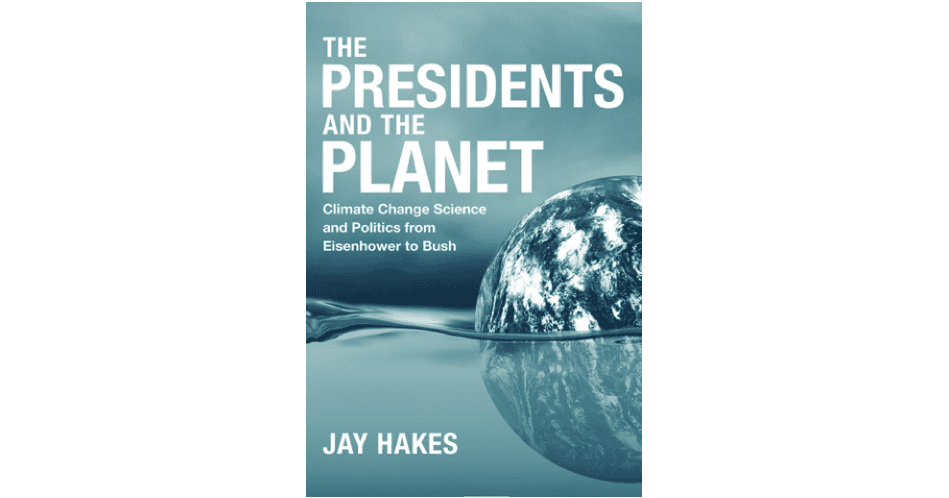
Jay Hakes, Author of Presidents and the Planet
Concepts discussed
Auto-linked from the episode's notes and transcript.
Show notes
Jay Hakes, an accomplished author and historian, visited the Atomic Show to talk about his recently published book, *Presidents and the Planet: Climate Change Science and Politics from Eisenhower to Bush*. Sometimes referred to as “the untold story of climate change,” Hake’s book is an enlightening jaunt through a history discovered during long days in archives and Presidential libraries.
Though some of the most vocal proponents of climate change action tell a history story about a public and political understanding that begins sometime during the 1980s, with the actions of people like James Hansen, the truth that Hakes discovered was that presidents Eisenhower, Kennedy, Johnson and Carter and their staffs knew there was a growing body of science indicating that increasing atmospheric concentration of CO2 was a significant problem.
Hakes and I talk about the period when scientists were actively trying to determine if the atmosphere was warming or cooling and the long term confusion, some of it purposeful, that has resulted from a debate that was generally resolved by the end of the 1970s.
We spoke about the odd period during the Carter Administration when there was both significant concern about the risks of atmospheric CO2 and an active program to increase coal consumption while slowing nuclear energy development to a crawl. Interestingly, Carter gave the power generation industry a chance to defend nuclear power before he produced his energy plan, but there is no evidence that the industry even mentioned nuclear’s lack of air pollution or greenhouse gas emissions.
Hakes’s research showed that much of the early science and political communications about climate change originated from the Atomic Energy Commission (AEC). His research also showed that the AEC involvement led to a lengthy period when groups that classified themselves as part of the Environmental Movement took little or no interest in effectively addressing climate change. They believed it was something that only nuclear cheerleaders cared about.
Sadly, we now face a bit of an opposite problem. Some vocal nuclear proponents have come to the conclusion that climate change can’t be much of a problem since so many of its activists remain adamantly opposed to using nuclear energy as a powerful tool in the effort to limit the impact of climate change.
Like many nuclear energy supporters, I believe we lost a lot of time and added a much larger quantity of CO2 to the atmosphere than we would have if we had continued deploying nuclear power systems. The solution to that lost time, however, is to press forward.
Transcript
Read transcript
There's a way, a way such a better way today, today. A major voice, tell the world there's a better way, today there's a better way. This is Rod Adams and it's time for another atomic show. And this guest today is terrific. He is the author of the presence and the planet. Climate change, science, and politics from Eisenhower to Bush. How do you know? Do you believe that we've been talking about climate change since the 1950s? It's not just dated from 1988 testimony. So this is going to be something that I think most people can learn a lot from. Jay was the head of the Energy Information Agency and he also served as the head life brain, I guess, for the Carter Presidential Library for 13 years. Jay, welcome to the show. Thanks Rod. It's great to be here. And I got to tell you, I've been reading your book and highlighting furiously as you talk about all the various times where presidents and their administrations have been told about climate change. And it's also interesting to me how many times people said, well, you know, we don't need to do anything just yet. Or still uncertain what's happening. Exactly. It's a much longer story than people think. And it's important to realize that because it kind of informs us as we're making decisions in the current environment. Yeah, it's also interesting just how many different approaches to solving the problem or even identifying what's really happening have been tried. And I'm also curious to talk a little bit more about the period in which there was some question. Is the planet cooling or is the planet warming? And maybe talk a little bit about where that confusion came in and how it affected whether or not we were going to respond. And maybe even how it affects us today. Yeah, that's an interesting story. And I figured someone needed to kind of explain clearly what happened. The greenhouse gases that go into the atmosphere have a strong effect on the earth's temperatures, but they're not the only factor. There's things like a volcano can cool the earth because it puts all sorts of particles in the air that keeps the sun from heating the earth as much as it might otherwise. And also when you're like burning coal, you're also releasing sulfur dioxide and other things that have a cooling effect. So it gets a little bit complicated. So sometimes the earth of the temperature of the earth can go down for a little while, even though the longer term is clearly upward. And so basically from about 1969 to 1975 or 1976. There was confusion whether the planet was warming or cooling. Then they figured out that the carbon dioxide stays in the atmosphere for over a hundred years. So for dioxide, which is the cooler, is not up there for very long. So over time, the warming factors outweigh the cooling factors. So I would say after, say 1979, there really weren't any prominent scientists who thought the earth was cooling. But it did during the whole time of particularly the presences of Richard Nixon and Gerald Ford create some confusion and say, well, what are we going to do about it? Well, I'm not sure that they said because maybe they're sexually cooling. Do you, did you in your, in your research ever come across any proof or documents that indicated that perhaps there were some people selling confusion purposely emphasizing the idea that there might be cooling as a way to insert some uncertainty into the discussion. And I'm thinking in fact, in the case of there might be some people who really didn't want any serious action to be taken. Yeah, I think that's important point to clarify. I would say basically from this period from say 1969 to 1975 or maybe even a few years later than that. A lot of credible scientists said, well, it might be cooling and they could point to data. They had models that were flawed, but some of them produced that. So I think at that point it was kind of an honest mistake. But what happened was after the science got settled, then a lot of people kept saying, well, we don't know whether the earth warming or cooling. So to the extent that the argument was made say later than 1979, I think it was just so in confusion and not really based on any factual basis or sound science. I mean, even recently, occasionally some people that just say, well, the scientists don't even know whether there's warming and cooling. But we've got you can just look at the line graph on world temperatures since the Industrial Revolution started in roughly 1880 and the trend is strongly up. Somewhere about 50 years ago, there was some scientific discussion as to whether or not there was a stronger cooling effect or warming effect. But as you noted, that means even today there are people that say, well, scientists weren't sure. So scientists can't play this in the scientists. They're never quite sure there's always uncertainty. And we should just keep doing what we're doing rather than take any action on it, which of course, with something like CO2 being put into the atmosphere, the longer you wait, the more inventory you have to try to figure out what to do with. That's a very good point because we focus on emissions, but the really big issue is the accumulations in the atmosphere and what those amount to. And so carbon dioxide has a very gradual effect, but it's like a big boat. It's hard to turn around. But in recent years, there's been interest in carbon capture. But you're talking about huge volumes that would have to be captured and then sequestered. And the question, you know, is that cost effective. So it's better to act early and look for the solutions that are most cost effective to deal with the problem. Yeah, my view, carbon dioxide removal is just plain hard. It's even if it can be the cost can be brought down. It's just really hard sort of like having a very nice clean pool and decided to decide you're going to put a little stuff in it and how long does it take to filter that stuff out once you've put it in there. It's really hard sometimes. So it's very, it's very diffused in the atmosphere and that's what, you know, as you're suggesting it's not an easy task. Yeah, I mean, I have some old experience in my work history of removing carbon dioxide from atmospheres. But that was when carbon dioxide concentrations inside my submarine were about about 10 or so times what they are in the atmosphere. And so the the scrubbers that we had could work pretty well at that point. And we were getting to the point where if the scrubbers weren't working very long, we would get to the headache part of carbon dioxide. It was nowhere near in the the Earth's atmosphere. So, let's go back and just kind of start at the beginning. Who was it? When did we start figuring out that carbon dioxide in the atmosphere might be causing a problem. And I don't necessarily need to go back to when there were some sciences identified. If you had carbon dioxide it would cause a greenhouse effect. Who was it to sort of bring this to the attention that they were really adding to the carbon dioxide. But there's one person that stands out in my book and I think most people read it say it's really interesting to learn about this guy Roger Ravel. And so let me just talk a little bit about him. He was a very famous oceanographer and he was in effect the Navy's chief oceanographer during World War II. And one of the aspects of that is he knew a lot of scientists because during the wartime, you know, a lot of the top scientists in the country were working on war related things. So when Ravel spoke, people listened and he gave a paper in 1955 at the American Association for the Advancement of Energy, Advancement of Science, excuse me. And then he published paper two years later and basically he said that scientists had been assuming that carbon dioxide would just end up in the ocean and not really accumulate in the atmosphere. And he understood oceans very well and he said, well the chemistry of the oceans is they can only accept carbon dioxide gradually. So a lot of the carbon dioxide is emitted or sent back into the atmosphere. And the theory was confirmed soon afterwards because a colleague of his named Dave Keeling actually got a substantial amount of money to measure the carbon dioxide in the atmosphere. So by 1960 we had Keeling's data and Ravel's theory and the two of them were very respected. Once they did that, there was a pretty strong case that this was something that people should pay attention to and they did. So you had people in the late 50s who knew Ravel like Teller, the inventor of the hydrogen bomb. And he started talking about climate change and some of the scientists at the Atomic Energy Commission started talking about climate change and they'd almost every case you can find they learned about it from Ravel. Now people had talked about it before but they didn't have Ravel's stature. So he's really the guy that kickstarts what we call modern climate change science. I seem to recall Ravel's name from the work that Al Gore did when he did the inconvenient shoes wasn't he an inspiration to Al Gore. Yes, that's a really interesting story because most of Ravel's career was spent at the Cripps Scripps Institution in San Diego, which is now part of the University of California San Diego. But they didn't pick Ravel as their chancellor and he sort of had been expected by everybody to get it. So he ends up going to Harvard for a while. 1968 one of his students is Al Gore. And I actually have talked to both of the teaching assistants from that course. I was able to obtain the syllabus from that course that has Al Gore's name on it. So only one lecture was about climate change. And I've talked to other people that took the course and they don't remember that lecture but it was there. And I go and remember it because he said, you know I'd been raised since I was a kid to believe. that human activities just weren't huge enough to change the whole, you know, the earth's climate and other things. And he said, I learned from Ravel that I had to change my view about that. So he always treated Ravel as a hero. He entered, you know, he had him testify before Congress, he mentioned him in convenient truth. Now, when Goer ran for Vice President, one of the interesting stories in the book is pertinent people then tried to undermine Ravel's reputation to hurt Goer. And that's one of the unpleasant facts of history that that sort of thing would go on. But that wasn't an interesting story. But he had at Harvard, he had the future president of Pakistan in his course. He had future UN officials who worked on climate change in his course. So he just, he was an amazing guy because he met Eisenhower face to face. He met John Kennedy face to face. He met Lyndon Johnson face to face on multiple occasions. So he's kind of this renaissance scientist who, you know, people listen to and it just, you know, happen that he probably personally saved us 15 or 20 years trying, you know, finding out about what climate change really was. You mentioned that he had a relationship, I guess, a mentoring relationship was killing. Now, killing is a name that anybody who's interested in climate change has heard before. He's famously they called the killing curve, measured it monoloa. But can you tell us a little about this guy killing and how he became expert at measuring things and got so persistent that he did it for the year after year after year? Yeah, I always get hesitant to use the word obsession. But Charles Dave Keeling was obsessed with carbon dioxide in the atmosphere. And to do it right, you have to find a place that isn't contaminating by a lot of other pollution. So Roger Revelin, the late 50s, was the head for oceanography for the whole planet for the international geophysical year. So he had access to a lot of money and he made sure that Keeling had funding and then he hired him to work out in San Diego. And he developed a way of doing it that was so thorough that his work has never been questioned. Now, like a good scientist, he'll occasionally say, well, you know, in the early years, I didn't get this quite right. But so he's very honest scientist, but no one has really challenged the idea that carbon dioxide is in the area that stays there for a long time and we have exact measurements. And so that it's a very impressive line graph and it's called the Keeling Curve. Now, one thing that Keeling discovered before Revel discovered it, Revel thought that the carbon dioxide would be close to the place where it was emitted. But what Keeling found out was it was very well mixed in the atmosphere. So you could measure pretty much anywhere in the world and the measurement would be essentially the same. So that was Keeling's finding and that's good and bad news. I mean, it sort of says, well, the whole world has to walk break to solve this problem and the world hasn't always proven itself to be wise enough to do that. So, but Keeling's intellectual contribution is huge and Revel is more complex. He was in Renaissance a guy who was interested in a lot of different subjects. And then at the end, some people were alleging that he was critical of gore, which was not true, but it got circulated. So Revel had somehow lost a little bit of the luster that I think he deserves. No one questions that what Keeling has done is a monumental achievement. And his son actually teaches at Mafir, asthma atmospheric sciences at the University of California, San Diego, around. And so it's kind of a family tradition. How did Keeling determine that the or verify or prove, I guess, or substantiate the idea of the CO2 level measured on a mountain in Hawaii was representative of the CO2 level around the world? Well, initially they had enough money to set up a measuring station in Antarctica. And then they also collected samples from airplanes. So the original research plan was to use multiple methodologies, but they all were producing the same thing. So at that point, they decided that the Hawaiian site would be adequate. I think I remembered something in your book about a period where ExxonMobil gave or carried instruments around the world on one of their tankers. Yeah, that was a brief. The project, the Exxon was quite aware of this. Of course, particularly in those days, Exxon had something that was quite under the quilment of Bell Labs. They had a lot of scientists working there who were treated like academics and they could study whatever they wanted. And so they figured that climate change was going to be a big factor. So they sent their people to Columbia University, to San Diego to learn more about it. And to play the role of contributing to the science, I think this tanker did more miles around the earth than any other vessel. But it was a short-term project and they didn't stick with it and it didn't produce that much. But yeah, they got, that would have been in the early 1980s. And maybe they were learning too much and they said, well, maybe we'll just put our hands over our eyes and cover our ears and maybe we'll all go away. Yeah, I think they, the company sort of like many companies in the mid-80s, they decided that some of their research wasn't producing short-term profits. So they just did away with it. It didn't put more pressure on the government to do the long-term research. Some of the work that's done in the government may not pay off or 30, well, some of it may never pay off. It's done to see what works. But in industry, they used to take the longer-term view. And so a lot of the early work on solar energy and other things was done by Bell Labs did a lot of the early innovations in solar technology. But then the phone company got split up and they didn't have as much money to spend on science anymore. Yeah, they did have the phone company. They did have a pretty good reason for researching solar energy based on the number of switches and other gear that was out in the boondocks. Yeah, I ran into this. I was traveling with a member of the Public Service Commission in Georgia down to South Georgia near America. And it's America. And I think it's just like about seven miles from planes where Jimmy Carter grew up. And there's an e-mail in a small town outside of America and said, this is the first commercial application of solar energy. And it was, they were using it for switches out on experimental basis. And here it's sitting in this museum which, you know, very few people visit. So I made note of that that, you know, they were finding practical uses for it. But at that time it was just too expensive. They used it for the Voyager space program. And because they needed to generate, you know, electricity and space and, you know, cost was no object. But for commercial uses, it took many, many decades for solar to sort of cross the threshold and become cost competitive. Oh, I don't know about that. It was cost competitive for the calculator I had when I was in college. Oh, really? Yeah, solar was working well at very tiny, you know, calculators don't draw a lot of power. Right. But that's when I call in the book, niche uses. Oh, yeah. For instance, if you have a radio tower or a light somewhere that's far away from the electric grid, yeah, it's cheaper to put a solar panel there than it is to hook up to the grid. But now, you know, you get the big solar farms and they're part of the electrical system. Yeah, it's solar panels have gotten far cheaper than anyone expected looking from the 1980s. Yeah, that's manufacturing. Yeah, MIT did a study a few years ago. And in the previous 40 years, the price of electricity had come down 99%. And when I write that, I always put, this is not a typo. This is actually the case. And it's still gone down since. And so I think that's instructive, not just for solar. I think it's an indication that technology can solve a lot of problems, but we got to start early because it's not going to progress maybe at the speed that we wish, but over time, it can produce wonderful ways of getting win-win situations. Yeah, it takes starting early and it takes sticking to it. Right. Because just because you invent something and start working on it, if you don't keep up, that you don't drive the cost down, you don't get practice, you don't get the reps that you really need to make things get cheaper and cheaper. Because in many cases, it's not based on really changes in the technology of the product. It's changes in the technology of the production that drives down the cost. Yeah, back this would have been probably around 2007 or something like that. Before they were as cheap as they are now, I lived a few blocks from Georgia Tech and they invited me over to their lab to show me what they were doing on the solar cells. And my general feeling was if there are 100 people around the country who are doing this, that they go to work every day and they're trying to improve the efficiency of these cells and reduce the cost, we're probably going to work this out. And then once it gets close to commercial viability, then the companies, they're interest explodes and they do a lot on the production side to really make a lot of additional cost reductions. Yeah, I think I have no idea what the number is, but I think one of the things is driven the cost of solar down is probably hundreds of thousands of workers. and Chinese factories doing little incremental improvements over a lengthy period of time and finding new ways to put machines together and just producing so much more that drives down the price. It's that cumulative production that works. Right. So what are the reasons? Go ahead. I've given a number of lectures in China not in recent years, but when I've gone over there, they seem to be paying very close attention when I talk about what technologies I think are going to be important in the future. And I was able to talk to very high-level government officials after my talks at the universities and other places. And so that's one case where having an international problem on climate change actually can be an advantage because technology can cross international borders. Now, currently, both the Biden and Trump administration seem to lean towards more protectionism in the United States, but with trade can actually be one of the factors that brings down costs. Another reason that I really wanted to talk to you was there are people, and I'm one of them, who have often wondered about those who profess great great fear and concern about climate change yet they refuse to listen when we say, well, what about using nuclear? And your book has nuclear in it 177 times. You talk a little bit about how the the issue of climate change relates to nuclear energy and the atomic energy to that. Yeah, I think this is one of the most interesting aspects of the book because the environmental organizations were very slow to pick up on the climate change issue. So if you look at the 1950s, even a lot of the people who were promoting nuclear energy were citing the importance of climate change and understanding it. And when Johnson, President Johnson came out with his environmental program and climate change was part of it, but he sort of focused on other things. The group within the government that was pushing hardest to say, hey, we need to take climate change into account and work on it was the Atomic Energy Commission. And there was a guy named Alvin Weinberg who's pretty famous in Atomic History. And he argued that it wasn't fair to not consider climate change because if you didn't, it made coal look like it might be a more economic choice. And if you took that and to make sure that you were comparing apples and apples, you had to include the climate change factor. Well, this was not reciprocated by the environmental groups. And I would just say kind of bluntly that they were more opposed to a nuclear than they were crow doing something about climate change. I think this changed somewhat in recent years, but for a long time, this was the, what I call an embarrassing period for the environmental groups. Because if you say, you know, there are no greenhouse gases emitted from carbon dioxide and you're concerned about climate change, why would you rule out that option? And yet that's what they did. And then the sad part of it was eventually the nuclear industry, because they associated when the environmental groups did get involved in climate change, a lot of them were well-offed in environmental support. Maybe it's not so important. So it, what should have been really a positive relationship, didn't flourish to say the least. I think in recent years, most strong climate change people realize that that has been a mistake and you can't be ruling out CO carbon energy production by blocking nuclear. Yeah, there's certainly a number, a large number of individual people, including folks like James Hansen and Tom Whidley and George Mombio and Mark Lina, Stuart Brand, who've all come to that conclusion that you can't really be serious about addressing climate change if you refuse to accept that nuclear is a good tool. But it's hard to find any of the major environmental groups who've made the same choice. Well, I think it is more true of scientists. I would be hard-pressed to think of someone that's in the upper echelon of climate scientists who has a strong anti-nuclear position. I think the groups have moderated their opposition. I mean, it's kind of crazy just politically because if you don't, nuclear still has to prove itself on a cost basis, the capital cost of construction. But if you rule it out at the start, no one's going to listen to. So it's a big blunder. And I think the groups have made some progress, but they're probably still not where the climate scientists are. And again, from my point of view as a former factory general manager and student of how you drive costs down, if you don't start, I don't even try to build nuclear, they will never get less expensive. And it will always be very expensive to try to start over again and build up the capabilities to build. This brings up a related point that I sort of get to in the book. You need mass production to drive down costs. So say you have a choice between building 2,000 megawatt plants or you're going to build the same amount of power, but do it in increments of 200 megawatts. If you're using the smaller plants, you can be mass producing the parts, make them modular and then bring them to the site. And you can also build them much quicker, which reduces your financing costs. Now I was on an advisory group that proposed this in the mid 1980s and in my work at the looking at the Bush administration, which is Bush the father from 1989 to 1993. His scientists all said, we're, you know, nuclear is the way to go, but we need to move to smaller plants. And when I said this to some of my nuclear engineer friends, they said, you don't understand economy as a scale. I think I do. I think you don't understand financing risk. And so this is something that's going on. I certainly wish we, I think now there is an understanding that smaller plants that are mass produced in modular form is what we're looking for. But it sure would have been good if we figured that out 40 years ago. Well, unfortunately, even today, that's a huge topic of conversation among those of us who prefer nuclear or certainly want nuclear to succeed as a tool. I can't tell you how many people are on the side of, well, big plants are always cheaper on a per kilowatt basis. And I say, well, if you can get a bill, maybe, if you can get them built in a reasonable period of time, maybe. And if you can sell all the power that they produce all the time, maybe. But, you know, the electric system doesn't necessarily need all the power all the time. And there's lots of places. You know, I'm powering the United States. Our electricity demand in the United States has it been really growing very rapidly. You know, houses are housing codes are more strict and appliances are getting more efficient. And, you know, so the market for building very many large plants would be somewhat limited. Now, coal has been dropping pretty precipitously for a while. And natural gas is filled most of that gap. And we've managed actually to keep, even though the number of nuclear reactors has gone down, the production is good because our state steady because they operate so much more efficiently. One of the packs that was actually in my last book, but I repeated, was in the 1970s, the operating nuclear reactors were getting operating about 56% of the time. Well, they should be operating 100% because it's cheap to run them once you have them built. So now, you know, we've been in the over 90s for a long time. So, and they can sort of raise the capacity of existing plants. So, you know, nuclear sort of held in there at 19 or 20% for a long time, even as we've lost some of the older reactors. Yeah. And we, there was a period, unfortunately, where we shut down about, I think it's 13 plants over a 10 year period, 10 or 12 year period, because they were no longer affordable for the owners to operate. And it wasn't because they were their costs were going up. It was because the price of electricity in the market was going down. You know, there were periods of time in some markets and some places where the congestion on the transmission lines were such that a nuclear plant might be having to pay for the privilege of the grid taking into electricity. The price is just an interesting price. Yeah, I heard that issue was raised at the Tulane Energy Forum a week or two ago. And unfortunately, I wasn't on the stage at that time. My talk was later. And I don't think it got resolved there. So, one thing about nuclear is the French, we're going to go 100% nuclear. So, they turned a mine and off. And that's the way that they were designed. Here, both coal and nuclear are designed so they don't stop and start that much. But they're now as a solution to that, that helps solar and it helps nuclear. And that's batteries. Georgia Power just announced last week that they were building 65 megawatt battery farm. And they were going to be building a bunch of them of even larger size in the coming period here. A battery can respond to something on the grid within 0.2 seconds. And ultimately, it helps intermittent power like wind and solar. But it also could help nuclear because if you have enough battery storage, the nuclear power is always going to have value because it's going to be a cheap supplier of power based on fuel costs. So, it all the power would end up getting used. So, the batteries right now, to me, are the most dynamic part of our energy future. If they get bigger. and cheaper. They can solve a lot of problems, both for automobiles. You know, it's the battery that enables you to use nuclear power to run an automobile. And this was incidentally first discussed in the 1950s. So their scientist, someone said, he was touched by him before the joint committee on atomic and one of the questioners said, well, could we actually build a little power plants in the cars? And I think he was surprised to get that question. He said, well, you know, nuclear requires shielding and it's kind of heavy. So it's probably not going to work in the in an automobile, but we could generate nuclear electricity and have batteries in the car and do it that way. So this was said, I think in even 1959 or 1960. So people have been thinking about it for a long time. Yeah, I am a big advocate of the fact that batteries match very well with very firm power, just like they match well with intermittent power. Because I use batteries a lot. And most of us do. I've got phones and fans and speakers. And I think I can look around my office here in account it does and rechargeable batteries. But I like having some place where I can always plug in and charge it whenever I want to. And so that battery looks like an inventory. It looks like it looks like a warehouse that I bought for factory. And I was running the factory because the factory worked best if it was producing. And I couldn't sell the product all the time. But if I stored it for a little while, the customer would come and say, Hey, I really need some of this. I got it for you. Yeah, I mean, batteries are going to improve the reliability, the grid and the age in which we live. That's extremely important. And also enables you to buy power or cheap and sell it more expensive. Yeah. And so I'm very excited about what's going on in batteries. Yeah, I like having a place to put that cheap power that nobody wants. Exactly. Have it save it. Because you know later in the day somebody's going to want it. Right. Yeah, so that's the same. So the atomic energy commission and people like Alvin Weinberg and a few others recognize that the pollution-free nature of nuclear energy was a valuable sign. But I think you I think I found it in your book. There was a time when there was some maybe testimony or some behind the door behind the door meetings where you've had say the industry talking about various options. And they mentioned nuclear as an option. But they didn't say that it was a clean option. They didn't try to emphasize that. Right. These are meetings that were held early in the Carter administration in 1977 when he was developing his energy plan. And I don't have a transcript of the entire meeting, but I have very detailed notes. So the environmentalists came in for a couple hours. And they spent a lot of their time attacking nuclear power. And then the nuclear industry came in. And as you say, according to the detailed notes, they didn't mention the environmental benefits of nuclear. So I think that was a missed opportunity. Because I think if they'd mentioned it would have been in the notes. And it sort of symbolized the overall situation where the two sides should have been talking to each other, but you know, they were ships passing in the night. When I read that, it reminded me so much of a conversation I had with a person in a communications area for the southern company. This was probably 15 years ago. And she told me that they could say good things about nuclear, but they were to never ever say good things about nuclear in comparison to coal. She said, Rod, we operate a lot more coal plants than we do nuclear plants. And we can't be pointing the finger at coal is being bad and nuclear being good. Yeah, I think that at some point, I, you know, this is a speculative theory. But I think in effect that was kind of common that the nuclear and coal industries kind of had a pact. Because in a sense, the biggest threat to nuclear was the idea that coal was clean and cheap. And they should have been competitors, but they actually joined together on some of the groups that were opposing climate change action. And I think that's a very important observation, observation on your part because, you know, to me, one of the best arguments for nuclear is that it doesn't pollute the way coal does. In your book, you talked about the fact that orders for nuclear plants stopped way before Fremont Island. What was going on that caused people to stop being interested in buying new nuclear plants? Well, one was low utilization rights. They were shutting down for repairs and whatever. So as I mentioned earlier, I think number was something like 56% of the time they were running. Well, that ruined your economics on a plant that should be running over 90. The other thing was there was kind of a shock value. In the early history of nuclear, you had this intense competition between general electric and western house. So, you know, when they, when Rick over was developing the first nuclear subs, there was one, the Navy was working with Westinghouse, the other one they were working with general electric. And both of them had reasons to underestimate their costs because and I think in some of the early bidding, they were willing to build plants below cost in order to get market share. And they were being asked about this by congressional committees, which I found in the records and saying, oh, no, we're going to really reduce it. So I think that the cost issue had been kind of oversold because of this competition between these huge, huge companies. And so there was kind of a shock value that occurred when the price started to go back up. And also, I think there was a mistake made to invest too much into the breeder reactor, which was not going to be needed for decades. And that money could have been spent on trying to reduce the cost and increase the reliability of the light water reactors. So there were a lot of things going on. Some of it would be political opposition. Some of it was just technical and economic issues. But well before Remyel Island, there were more cancellations a year than there were new orders. So to look at three, you know, in three mile island, when you look at it, there was the meltdown inside the plant, but the containment vessel held. So there was really no significant contamination outside the containment vessel. So you could argue in one sense, the three mile island actually vindicated having double safety systems worked. I mean, you shouldn't have had the meltdown in the first place, but even if you did have it, you know, you got these big thick concrete walls. So, and, you know, ironically now the three mile island plant looks like it's coming back. We'll see what happens. Well, yes, the unit that wasn't damaged, there's a two unit station and unit two is the one that got damaged and formatted and that plant was never going to come back. But you know, one operated until 2019 before it was shut down for those economic reasons I talked about. The price of electricity on the grid got so low that the, the kind of steady cost of nuclear wasn't making any money or making enough money because one of the things people don't recognize about that those nuclear plants may have been making some money. But if nuclear plants don't make a good good amount of money, there's just too much trouble. It's not easy to do easy to deal with regulators and do it all the things you have to deal with. If you're not making any money, you may as well say, well, heck, I can make more money and put in my putting it in CDs or something. Yeah, yeah. That's the way investors think. So, you know, that's you have to deal with that reality. Exactly. So, the, the presidents who started to make a big I don't know, changes in the way they worked because of climate change was a little bit surprising to me how some of them talked about climate change and advocated for coal and gas and others basically thought that climate change is important and they should use all the tools in a toolbox and they actually made some some headway. But the ones that did one and the ones that did the other a little bit surprising. What was so? Yeah, it's very complicated. In some ways, I could write a book that gave simple answers, but I try to tell it like it was. So, you know, it was very interesting because I, you know, when I started the book, I knew that Lyndon Johnson had issued some reports on climate change, but I thought that was it. So, I'm, I'm going through, uh, Ravel's archives out in San Diego and I'm trying to read everything there and I find a letter from President Kenny's speech writing office thanking him for his help on a speech. Yeah, I said to myself, I thought I looked at all of Kennedy's speeches. So, I went back and looked at it again and Kennedy said we have to study the relationship between the atmosphere and the oceans because that determines our climate and what he was talking about was Ravel's article and carbon dioxide, how much ended up in the ocean and how much ended up in the atmosphere. And so I found that eventually I found it in three different Kennedy speeches and in one of them, before the National Academy of Sciences and Kennedy's up there and his academic uh, garb and sitting behind him is Roger Ravel, the great climate scientist. But at that time, you know, it was, well, we got us, this is something we've got to study. And then Carter, um, comes in and he, he believes that we have to eliminate dependence on foreign oil that it's going to take that nuclear can do some things, but it's not going to be a sudden panacea. So we're going to have to use coal. So he's in this contradictory position where he's advocating coal, but he's also making some of the investments that made possible the, the success of solar that we've enjoyed in this, um, century. So when things really gets moving, is in the second term of Ronald Reagan. And this would come as a surprise to a lot of people like many things in my book, but it three things happen. in Reagan's administration. And I noticed this, you know, we got our first effective appliance efficiency standards. Well, that's something that you'd really want if you're trying to prevent climate change. He also, the US led the world in the Montreal Protocol, which protected the ozone layer. And that has a climate change factor involved. And then the United States helped organize the intergovernmental panel on climate change. This all happened in Reagan's second term. Now there's a couple of things going on. One, Margaret Thatcher, over in the United Kingdom, she's a chemist by training. She understands climate change. So she's giving speeches about how important it is to deal with climate change. And that carries some weight with, she called it Ronnie with Reagan. And then the other thing is there was still a very strong coalition, pro-environment coalition in the Senate, particularly, but also the House, between the Republicans and Democrats. So when they would send a letter to Reagan on climate change, it would be precise. If there were 12 Democrats, there'd be 12 Republicans. If there were 14 Republicans, there'd be 14 Democrats. Every letter was coming. And they actually overrode Reagan on a couple of environmental vetoes, where Reagan beat an environmental legislation, and it was overturned because of the bipartisan coalition. So I think that comes as a big surprise to a lot of people. But those are three significant steps. And then in the Bush administration, things start to go backwards. In a sense, because he was pro-environment on a lot of issues. He was strong on acid rain and sulfur dioxide and he continued Reagan's efforts on protecting the ozone layer. But he had a lot of people on his staff who were skeptics of climate change science. So as the evidence is getting more persuasive, the idea behind the scenes is almost getting more negative. So that's a whole interesting story in and of itself. I mean, people don't, President Bush, 41, was only in office for four years, but I have several chapters on him because there's all sorts of interactions going on within the White House and people are having all these arguments. And then in the Congress, the bipartisan coalition starts to fray and fall apart. It's an interesting story. Then I have a last chapter arrived, summarized everything between 1993 and up till a year or two ago. Because the publisher said, they might want me to write another book. And I said, I'm getting a little old. I'm not sure I want to write another book. But I'll write you along, chapter that brings things up to date. Yeah, it looks like you were almost one of those times where you're writing on a piece of paper and you get in the last few words or last few letters and you didn't even have room for it. So you have to compress those last decades in no single chapter. Yeah. Well, my original plan was to go through the 20th century. And then I, you know, most publishers, my publisher had a limit of 120,000 words. And so I decided I was going to do things very thoroughly up to Bush 41. And then, you know, I've tried to connect the dots because a lot of people who were involved in the 20th century lived on into the 21st century. So I cover no, no, Ravel had died in the 1990s. But killing, I think, in 2007, Wally Brooker, who is another prominent scientist at Columbia, he lived for a while and Hanson, of course, is still with us. So I use that as kind of the way to tie up things at the end. And then I tried to, I didn't know whether to end on a positive or a negative note. So I decided I'd end on a positive note which was the progress of solar. So I've got a picture near the end where I actually gave the keynote address at this event. But it's the dedication of a solar farm on Jimmy Carter's property in planes. And it comes in 1970, which is the year that Southern Company who was taking the powerful Carter's arm, Georgia Power. They really got serious in the whole industry said, hey, solar's gotten to the point where these solar farms make a lot of sense economically. So that was a triumph. But it was also important to realize that this had been, you know, decades in the making. I mean, Carter had put a lot of money in this photovoltaic energy. And the breakthroughs by the Bell Labs that they moved from backing tubes to transistors using silicone in the mid 1950s. So it's a long journey and the grass climate change and you have to get that timeframe kind of right. Yeah, one of the real pine or earlier, earlier pine years of solar energy was a guy who is named Farrington Daniels. And he was actually set up a solar research institute at the University of Wisconsin in the early 1950s, like 1952 maybe sponsored by the Rockefeller Foundation. And I happened to, you know, think Farrington Daniels is a really interesting guy because he was a Manhattan project scientist who famously tried to, at least famously within the nuclear world, tried to build the first power producing, electric power producing reactor right after the war was over. But his project got canceled. And he thought of solar as the poor person's nuclear energy. He advertised it. So anyway, I have run across to him, but sounds like a pretty perceptive. Yeah. Well, he was amazing, made in the large foresight. But I always thought it was weird to have a solar and research institute in Wisconsin, and Farrington's, you know, it doesn't seem like the most sunny place to, right? Well, there's a book that I would highly recommend called How So Or Energy Got Cheap. And it's a detailed look at that subject. And the fellow that wrote it teaches at the University of Wisconsin. So maybe he's following in the tradition there. It could be, all right, Jay, I really appreciate your time. I think that it's been a, I really enjoy listening and talking about history and figuring out all of the interactions that sometimes surprise people, those who are living today may have forgotten that early conservatives were leaders of the conservation movement or conservation philosophy. Because that's what conservatism sometimes is about, conserving what exists. And so, but then things change and it's become more of a liberal thing. And some of the people who really care about addressing climate change and want clean energy, just can't get past the idea that they hate nuclear for some reason unbeknownst to me. But anyway, the interactions are interesting. What I'd like to do is offer you the opportunity to summarize either our conversation or your book or give somebody the preview of your next book. Okay. Well, I think one of the premises of my books is that not everything that we know can be found on the internet. So someone has to go sit on these hard chairs and these archives and go through paper documents to really tell the story the way it happened. And so now if you're writing a book by climate change interview people, well, a lot of people, you know, rebels been dead for, you know, long time, 30 years. So that's lesson number one. But to the listeners, be a good chair, I've done the work for you. So you don't have to go sit through the archives. And I think also if we want to know where we're going, we've got to know where we come from. So one perspective I have is someone's going to look back and say, how did the human animal do dealing with this climate change problem? And, you know, we'd all kind of hope they'd say, well, we did a pretty good job on that. So we're now up to, you know, getting close to one and a half degrees centigrade. And that's not evenly spread. would be better if it was. But we're currently on the way to probably 4.5 centigrade without some really, pretty exceptional changes in policy. And for those who don't think of the metric system, that's about 4.5 Fahrenheit. You know, I've argued that Europeans do more on this because they know what the metric system numbers mean. United States, most people don't. So I would just say the book's got terrific reviews from the blowers if you go online. You can find those. And I think it's a history that we need. My wife doesn't want me to write another book. But if I do, it will probably be about the development of the automobile and its impacts, both from a historical standpoint and how we sound the automobile problem. Right now in the United States, the biggest source of greenhouse gases is the transportation sector. So if we start powering cars with electricity and zero or low carbon sources of power, then that starts to improve pretty rapidly. So I always enjoy our interactions because we're interested in the same things and always trying to learn new information. And I think that's what makes it exciting. Some people refer to my book as the untold story of climate change science and politics. And I think that kind of fits. And filling in those gaps is gonna make us all a little bit wiser about how to move ahead. Again, thank you very much. And I will mention that there was one scientist who realized that if he wanted to communicate with the public, he needed to talk in the earlyies of the American public. We needed to talk in Fahrenheit. And that was James Hansen, as you pointed out in your book. So sometimes as scientists, you've got to use the language of your audience, not necessarily the language that you've been taught as a scientist. And absolutely. So, Jay, take care and good luck on your next book. Fascinated to read about the history of the automobile. And also I appreciate the idea of charging your batteries with clean electricity. So that's a good thing. All right. Take care. This episode of The Atomic Show is brought to you by Nucleation Capital. We're a venture capital fund focused on selecting ventures with extraordinary promise. They're building the advanced nuclear sector and helping expand our clean energy options. We're building a portfolio of ventures on behalf of investors like many of you. We don't just take funds from the large institutions that typically allocate to venture capital. We believe that regular investors should have access to the opportunities in modern nuclear for their own. portfolios. We allow people to subscribe on a quarterly basis, starting as low as $5,000 per quarter. A four quarter subscription will get you exposure to between four and six ventures. If you are an accredited investor and would like to learn more about how you can participate, please check out our website at nucleationcapital.com. That's nucleationcapital alloneword.com. All of the information you need to subscribe is available online. You can also subscribe to our newsletter, nucleation insights, and join our pro nuclear investor network to learn about selected syndicated investment opportunities. If you have questions, we're happy to chat. Please spread the word. The world is a better way to date.