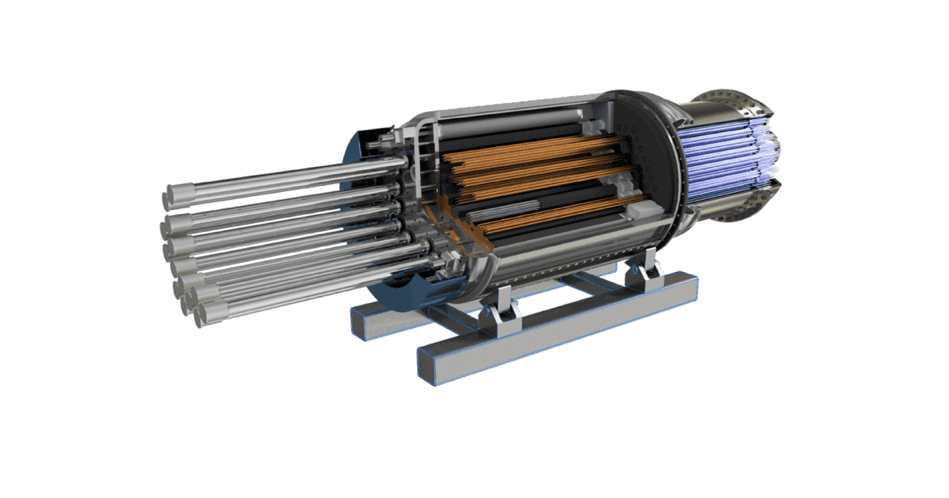
Westinghouse’s eVinci micro reactor
Concepts discussed
Auto-linked from the episode's notes and transcript.
Show notes
Westinghouse’s eVinci is a 15 MWth, 5 MWe micro reactor. Westinghouse often refers to it as a nuclear battery.
Unlike conventional nuclear power plants, eVinci uses no water and doesn’t produce steam. The eVinci is not “just another way to boil water.”
There are no pumps in the system that moves heat out of the reactor. Instead, the system uses ~24′ long heat pipes to transfer fission heat to a heat exchanger.
That device serves the same function as a combustor (burner) in a fossil fuel heated Brayton cycle gas turbine. Atmospheric air is compressed and sent through the heat exchanger where it gets hotter and more energetic. That hot, compressed gas gets expanded through a turbine, causing it to rotate. The rotating turbine is connected to a generator that produces electricity with an efficiency of about 33%.
An eVinci will use an open air Brayton cycle gas turbine like those that are in a wide range of commercial applications. Gas turbines are not only well-understood devices, but they have a diverse supply chain and an experienced workforce with tens of thousands of builders, operators and maintainers. They are often manufactured by the thousands.
In another departure from the conventional way of doing things, eVinci uses rotating control drums instead of insertable control rods to adjust core reactivity and operating temperature. Shutdown rods are used during transport and to provide a secondary means of shutdown.
The fuel is TRISO coated particle fuel with high assay, low enriched uranium in the particles. The reactor operates in the thermal neutron spectrum with graphite as the moderator. The core isn’t in a pressurized fluid.
With its simple controls, small size and passive safety case, the eVinci is designed to be able to operate autonomously. Each core will last eight years or more.
Leah Crider, Westinghouse’s Vice President of Commercial Operations to the eVinci micro reactor, visited the Atomic Show to provide a system overview and to answer questions about the reactor, its history, its future, its applications and its potential impact on the energy market.
I think you’ll learn something from this show. Please participate in the comments and let us know what you think, especially if you have questions that were not addressed during the show.
Transcript
Read transcript
There's a way, a way such a better way today, today. The measure falls till the world, there's a better way, today, and there's a better way. This is Rod Adams and it's time for another Atomic Show. My guest today is Leah Crider, who is the vice president, commercial operations, or the even she microreactor. That's Westinghouse's little reactor that's designed to be essentially a nuclear battery with heat pipe cooling and all kinds of new innovations, and should be tested at Idaho sometime. We'll find out when. Leah, welcome to the show. Thanks, great to be here. So tell me a little bit about Leah Crider, and then we'll ask about the eventually reactor and how you got to where you are in terms of being the VP for operations. Alright, so I am a mechanical and aerospace engineer by nature and by training. I got transplanted into the nuclear industry 20-some years ago because I thought it was such a fascinating technology. I spent most of my career working on light water reactors, which are actually a great technology, but when I heard more about the even she microreactor and the way that it operates, this nuclear battery concept, and thought that it could really change the paradigm in where we can deploy nuclear energy and bring safe, reliable power. I thought that this was an opportunity I really wanted to be a part of, which is how I got into this role today. So tell us a little bit about the event she when did the project start? Where is it going to be deployed? How powerful is it? Absolutely. So we're about four or five years into the heart of the project. I wasn't at Westinghouse when it started, so I'm missing an exact timeline. If you want to go back in time, it really started back when Mr. Erickson was working on heat pipes out at Los Alamos National Lab, but I'm not sure he envisioned this incarnation. The even she microreactor is a 15 megawatt thermal, so that's about five megawatt electric reactors so much smaller than what you would think about a typical nuclear reactor. And it's also a typical in a number of other ways. One of the things I used to describe it for people who know something about nuclear is be many things it is not. It's not cooled with water. We use heat pipe technology and then we have air cooling on the other side of that. It's not pressurized, which helps with our safety case overall. You don't have to dig a big hole in the ground to be able to deploy it. It's not just a vision not having operators on site for this reactor because it's designed to run autonomously and it's extremely safe. So you can imagine future deployments where it's able to run in remote regions without having that additional support. So the vision for this reactor is quite different than what you would think of with a typical large light water reactor. When we recall there is some lineage, some ancestry between a little reactor called the kilopower reactor, crusty and eventy. Am I remembering correctly or maybe that was before your time? A little bit of both on that. We do have some throwback to to crusty. In fact, in our new eventy micro reactor hub in Pittsburgh, we have a picture of crusty on the wall. A very good reference. It was I think designed really for space travel, which is one of the applications of our astro eventy products line. Astro eventy is very similar to even she but much smaller and not fluid by air. It's a little hard to come across air if you're out in order. It's got to have radiators instead of forced conduction cooling. That is a more likely scenario. Yeah, there's there's not any fluid up there to cool with air is a pretty good coolant. So okay, the reactor is 15 megawatts thermal. The heat pipes and heat pipe for those who don't really understand what heat them. are. Maybe you can explain a little bit about what a heat pipe does in terms of moving heat from one place to another and how it works and what's inside of it. Yeah, absolutely. So heat pipes are a technology that is used a lot in aerospace and also in some small electronics. So you may be using them and not even be aware of it. The way we use them to help us cool a nuclear reactor is that it's essentially just a pipe and we have hundreds of them in each eventy micro reactor. And in each one it's hermetically sealed. There's a wick and there's a working fluid. And what happens is inside the core you get all of the heat from vision and it vaporizes the working fluid. That will then travel to the cold end of the heat pipe and that's where your heat exchanger is so it'll give off its heat and then it turns back into a liquid form. Using capillary action that liquid will then go back into the hot section of the core to be vaporized again. So they're really neat because you don't have to have the pumps motors etc that you might associate with circulation of some kind of coolant. And you get some robustness because there are hundreds of them in the core. So should anyone fail for some reason you have others that can take up some of the slack. Okay, so you said that the the ultimate cooling is with air but does air flow across the cold end of your heat pipes or is there something else there. Yes, and yes, so we do have the heat pipes inside us leave to prevent any contamination but fundamentally the air is flowing across the heat exchanger and getting its heat from the heat pipes. And if you want to produce electricity with this system, what's the mechanism for doing that? Do you have a turbine in there? Yes, so our power conversion system is based on an open air Brayton cycle. So if you think about a much smaller version of a jet engine that is what we're doing. So the nice thing about that is that this technology exists and exists in many sizes and it has a long history. So we like the open air Brayton cycle for that reason. Yeah, it's not only something that's been developed, it's something that's in wide commercial application with a whole long supply chain and well tested, well operated, well flexed on a continuous basis right. Absolutely. And so we may make some tweaks for our specific application but the technology is at a high readiness level. What kind of turbine inlet temperature will you be able to achieve with your heat pipe reactor? I don't have an exact answer for the turbine inlet temperature but the heat pipes themselves are somewhere between 700 and 900 C. Okay, so the turbine inlet temperature will be something a little bit lower than that but not too far. Just a little bit of a delta T to get the heat to move from one to another. Yes. Yes, that's a little bit lower than the modern Brayton cycle gas turbines but it's certainly well within the realm of what's been done many times before. It seems like you'd be even able to use a very simple Brayton cycle because there's no need for blade cooling and some of the other modern sensations that are done to enable really high temperatures to be used. Yeah, that's the idea. It should be a lot less complicated than like a big fan on a jet engine that's got rotational speeds that are high and has to be made of composite lay up. This should be a much much more basic system. Yeah, the blade materials for high performance jet engines or something that's quite specialized but when you get down to the lower ones. So does Westinghouse still have a division that does brake and cycles or is that something that got separated over the years is Westinghouse morphed? So I've been with Westinghouse for less than a year right now so I don't have institutional knowledge myself dating back that far but we do not have that capability today. So we're working with a company that does have a great deal of experience in specialized design of these power conversion systems. So it's very good to tell us a little bit about the regulatory path or the event. What where is what who's going to approve the first one how are you going to get that through licensing what kind of testing program might you need to have. So I think our main testing program is also our first licensing effort. We are part of the program that is run by the National Reactor Innovation Center or ENRIC. They have a program to test in the dome facility at Idaho National Lab dome is short for design of micro reactor experiments. They selected three vendors to test in that facility and have been working with us for a couple of years now. And we are making great progress with them that goes through the Department of Energy Licensing Progress. So we have submitted our I've got to get these acronyms right. We've submitted our PBSR and we're working on our PDSA and that will be the the final documentation that is required to be able to do that testing. So that test will be on a scaled version of the commercial reactor. So just a piece of the size and thermal output. But we'll be able to learn a lot from that test about that will validate the codes and methods that we've put together to license the commercial reactor. On the commercial. Yep. I was going to say, so this the scaled test will still be a critical reactor. Not a electrically heated version. Is that correct? That's correct. We are also doing tests with electric leaky did versions. We have ever so creatively named those electrical demonstration unit one and electric demonstration unit two. unit one tested four. It must be a bunch of engineers. We are definitely a bunch of engineers over here. We have lots of acronyms and some of them are more creative than others. With those tests our electrical demonstration unit one, we completed our second phase of testing with that on four foot heat pipes back in March. And now we're looking forward to doing additional tests on 12 foot heat pipes, which is what we're doing some of what we're doing with electrical demonstration unit two. We have successfully heated up a 12 foot heat pipe. We're really excited about how well those 12 foot pipes have been performing, especially because they were manufactured with our new automated fill system, which allows us to get the working fluid in there without having any dudes in white coat. Touching things, which is a lot of the manufacturing history at the national lab scale. So being able to manufacture these heat pipes in a repeatable and automated way is really important to us. Yeah, you said you had hundreds of them in each reactor. So it sounds like you're going to have a fairly high volume requirement. Yes. And those heat pipes are designed to operate above eight hundred. your 50c. So I'm told that's about three times hotter than the coffee you pick up at Starbucks. Okay, that's interesting. Now, you said you've manufactured 12, is that the commercial size of commercial length? No, that's the size for the test reactor. The commercial length heat pipes will be about double that. Okay, now these heat pipes are fairly thin tubes, right? Is that, I mean, I envision them as being not too much bigger around than say a few riders. Am I wrong? You're pretty close. The order of a fuel ride is about right. I'm not sure if they're a little bit bigger or a little bit smaller. And then inside the tube itself is a wick. And that wick material is where all the magic happens. Okay, so you're going to be using these 24 foot long tubes out is that mean your reactors roughly six feet long or now I'm sorry 12 feet long or is the heat pipe more than half outside of the reactor. No, you're about right on. It's about half and then the other half is inside the heat exchanger. Okay, I'm seeing that. So you're going to go through the DOE approval process or I think that's what it's called to get your first one up and running and collect data. How long will that need to operate in the dome? I think I've read that there are three at least three already in line for using that facility. I'm not sure what the order of the line is. But that's correct. DOE has not announced the order yet. And so we're all keeping that information to ourselves. But it should take once it's actually operating it should be in there between six months in a year for gathering all of our operational data. And then we'll take it down, move it off and take the data and run as one might say this data will be asked with our licensing processes. We are licensing both in the US and in Canada. So working with both the NRC and the CNSC in those two countries. And they are working together via their collaboration agreement on some of that documentation. So I am very excited that I can share with you. We've submitted seven licensing topical reports to the NRC that are under review. We've gotten approval for two of those which are related to our control system. And we have gone and talked to the ACRS, the Advisory Committee on Reactor Safeguards. So that was also a good milestone for us. Among those seven, two of the more important ones are the ones around the principal design criteria and the fuel design methodology. Italy, you mentioned the control system, which reminded me I needed to ask, how does this reactor get controlled? Are there control rods and what direction are they coming from? Great question. So all of these 23-ish foot-long heat pipes are horizontal. So we don't have any sort of gravity driven effects here. Like you might think about with control rods going from the bottom or the top. So the main controls for any change that we would want to have come from control drums, which you might have seen on some other designs. So these are larger tubes around the outside that can provide additional reflection or additional absorption. So you can imagine that if they're all rotated with maximum absorption, then the reactor is not going to operate. And in fact, that's one of our safety cases. So that provides a lot of the control. We can also, in the event that we needed to shut it down, we can use shut down rods, which are an alternative to the control rod or the control drums. I'm sorry, you've got me saying control rods now. The shut down rods then are a diverse means of being able to shut down the reactor independently. Yeah, I'll take a little aside here for those of you who've known me for a while. Listen to the atomic show for a while. You might remember that back in the 90s, we had a design for a reactor that used control drums. That was for atoms of atomic engines, but that's just a little aside. But yeah, the control drums are a great idea when you don't have the ability to get in and out of the very well. Or you just don't, you know, we don't want to have things going in and out of our core. That goes back to that nuclear battery concept. We want you to get your reactor, turn it on, and eight years later, we'll bring you a new battery. Now, if the, there's variations in power demand, does your reactor have a system that where you produce as much energy as the power system might ask for? Yes, so we can load follow and it's near instantaneous load following one of the advantages of the heat pipes in combination with the Brayton Cycle Power Conversion System. Really does a great job in being able to keep up. In fact, this was one of the challenges in designing the autonomous controls because if you really want to load follow, humans are not fast enough. You can't see process and then execute a move. So you've got to have a control system that would do that. So I tease my control system team that I want the reactor to have three buttons. Go load follow and stop. Well, that's good. Given the goal and let's have a figure out the correct way to get there. I mean, control systems that control the spin of a turbine are something that's been available for a very long time. Back in the day when I was operating a steam plan, it was literally a system that included spinning leg weights that moved the nozzle, the throttle nozzle up and down. It worked faster than a human could because as you said, it's difficult for us to give the fine tuning necessary. Yeah, and I think we look forward to a world where we want to rely largely on carbon free energy. We're going to have micro grids where people are trying to take advantage of renewables and solar and wind and you're going to want this base load capability. But also sometimes you may want it to dial back so that you can take advantage of other forms of energy that are available for you too. And the more we think about locations that don't have a big grid or don't have a stable grid. Here in the US, we're pretty lucky outside of hurricane season. We all expect to be able to put the light switch and the lights come on, but not everywhere is quite that lucky. I think this is where the micro reactor has real opportunity to make an impact on people's lives in a way that they don't have access to today. I also like smaller reactors as a way to reduce the pressure for ever larger and longer transmission launch. It's reactors allow you to put energy close to where the customer is rather than having that generate energy and giant facilities and move it over wires. Yes, and I think if you look at like remote mines or people who live in remote communities maintaining those transmission lines can be quite expensive. So this also may give you a more cost effective option for these types of things. We've also talked about the potential in the long run to be able to put these micro reactors on some kind of a floating vessel. If you did that, you could deploy them to places like for disaster recovery where you stage them somewhere further away and bring them in after a crisis happens and you can provide that power to whatever is left of a grid or some other means of deploying a micro grid more rapidly maybe even than a diesel just because you have access over water. What is the vision for how you move your reactors to whatever location they're going to be? I mean some smaller reactor producers talk about putting everything in a single container. Others have various modules that they put they move. Does it move by rail, air, ship or all? So our primary mode of transportation is going to be the whole reactor in a specially designed container. You can't just put it in a cargo box if you especially if you have fuel inside it. And so that container then can go on a barge. It can go on train. It can go across a road. So you have some options for how you would actually access the location. So that's all very site-specific. We look at where are we going and what's the most effective way to get there? Then there's also a container for the electronics and the power conversion system. But the actual nuclear part all comes in one package. Okay. So complete power system with foundations, everything may require several packages but can all be moved via traditional movements and you don't necessarily need a special rail spur or whatever. Right. You would not have to arrive by rail. You do need some reasonable type of path to get there. You're not going to go over a good path? Yeah. We've talked about siding as nice that we don't need to have a large water supply nearby and we don't have to do deep excavation and some of the team used to say we could site it anywhere. I was like, well, we're not putting it on a volcano. So let's dial back where to most locations. But yeah, so every path specially figured out. Have you as the commercial operations office thought about using these as say a propulsion source for something that folks? So I can say that this is an interesting point to think about and certainly has some technical merits here in the US. We are subject to controls known as ITAR and so the ability to talk publicly about anything related to nuclear propulsion is limited by that international traffic and arms regulations. But from a technical standpoint, we've been using forms of nuclear reactors to power propulsion for some years now. So I think it's an interesting place to explore. Well, just last week, the ABS American Bureau of Shipping release a set of rules for nuclear propulsion and nuclear platforms. So there is a discussion happening. I'm not sure exactly if the people discussing it and these are pretty big organizations. If they're discussing it without understanding ITAR, they're just real, it's not a problem. I don't know. So anyway, it is a good question of how to technically deep you can get on it. So I can say, I believe that nuclear power to move ships is good, but I can't tell you any details as to whether eventually you would do that or how. Okay, without getting into the nuclear side of it, do heat pipes have any issue with orientation? In other words, do they still perform well no matter what direction they're facing? So I think our heat pipes are somewhat unique in the length and specificity around them and we are doing some testing around that question. You may or may not know because I haven't said so on this podcast, but we have two separate contracts with space agencies, one working with NASA for a fission surface power, which is power on the moon and you can imagine power on the moon might eventually translate into power on Mars. And the other is working for the Air Force Research Laboratory for power on satellites. And clearly in those places, we're working with different parameters around gravity and, or, yeah. And so we do have a testing program to ensure that the heat pipes will work for those applications. Yeah, we're g equals zero. The acceleration of gravity is very low there. Okay, that's good. Now, I also read that Westinghouse has set up a whole new facility just for eventually folks. Can you tell us about that? I sure can. I'm sitting in it right now in fact. So we have opened the even two microreactor hub here in Pittsburgh, Pennsylvania. It's in a burrow of more or less downtown Pittsburgh called Etna. We've got a great location at 51 Bridge Street. So if you think about Pittsburgh as the city of Bridge's, we're pretty high up on that list. So this hub is a really great place where we've co-located a number of the folks that are working on the event she project. We do have folks at other sites, a number of people in Canada and some other locations that are supporting the project. We've got a lot of the engineering and manufacturing team here in Pittsburgh. The heat pipe manufacturing for our first reactor deployments will all be in this building. The building itself has a really cool history. It's a 1900s building that used to have a machine shop here. We've uncovered some film footage and captured some stills from way back when. And so it's been a really great revitalization story of taking this old machine shop, really turning it into a modern production shop with a modern office area and being able to have our whole team here working together in Pittsburgh to finish up the manufacturing and work on all of these design and licensing aspects. Sounds like a cool facility. I've always enjoyed working in converted industrial buildings. I worked at the Washington Navy Yard for a period of time. And they had gone through a number of these real heavy duty manufacturing facilities where they built guns and all kinds of armor and whatnot. And some of the buildings even still had huge overhead cranes inside the building. And they had to figure out ways to creatively use the struts and all that stuff. Those are neat buildings. So you have a lot of exposed brick inside. We do. We have some old concrete. If you come visit us, we can go have lunch on the roof. I'm told it's always sunny and atna. It's going to be on the floor. So it's passing this nift test. Can you see the three river stadium from there? I don't know that you can. But I'm sitting in one of the hotels that's closest. And I ran by the Pittsburgh Steelers Acreshire Stadium early this morning. So we're not too far away. OK. Yeah. I like it. I've been in Pittsburgh a number of times. The river certain bridges are pretty cool. So you say you're close to the bridge. You're on Bridge Street. Yep. We've got a number of bridges that I can see out the window. Very good. It's been really nice about this location is proximity to a few different universities that we've been working with. Like Carnegie Mellon and Penn State. So it's been good from that perspective as well. Do you have a number of interns working on the project? We do. A bit fewer in number right now than during the summer. We opened this hub facility in March. And we were still doing a little bit of some of the heavier construction, not in the office area over the summer. And funny story. Interns actually show up at the office every day. And our parking lot was a little smaller than our number of people showing up to work. So we've rectified that and really enjoyed having the intern support. In fact, you may have seen one of our interns, Gabriel. He was the first guy this year to appear on college game day with the iHeart Nuclear Energy Sign. Uh-huh. I continue to see those signs in the background. I look for them every week. I have yet to see it myself while watching college game day. But I do always see the screen cap with someone circling the iHeart Nuclear Energy Sign. It warms my heart every Monday. Yes. Yes. I did see two or three different ones, actually, the last time I watched. And I interesting. Either that or the person was moving around. I hope it's different ones. Yeah. OK, let's see. Oh, what kind of fuel do you use for the e-lynching? What's the fuel form? A very important question. So we use the trisophial form, which DOE notices the safest. And one of the reasons that we use trisophial is because it serves as what we call a functional containment. So each piece of uranium and its vision products are all trapped. That's what prevents us from having to have the big concrete structures that you see on the big light water reactors. So in the terms of being a micro-reactor, this trisophial fuel form gives us really good safety and allows for a very small size. Yeah. One of the things that is not often mentioned in terms of the big containment is part of that containment. It's not just that you're trying to retain vision products from typical. It's also trying to retain vision products that happen to be in an environment where it's very hot water that really wants to be steamed. And so if there's a problem, those vision products could be, they have a pressure source. It moves them quite a long way. You don't seem to have anything that would turn from liquid to vapor and move vision products, even if it was outside of a trisophial particle. That's right. That's one of the basis of why we think that the heat pipes are a great cooling mechanism, because they reduce the need to have that level of pressure ization that you would have in a light water reactor. And you don't have any pumps to move your coolant. So you don't have any safety-related electrical system. Is that correct? I believe that's correct. It's a big potential cost reduction there. All right. So I am about out of, go, do you have an idea when somebody's going to be able to open up the catalog and say, I want an eventually reactor and I want it now? Well, I'm happy to work with you if you want an even energy microreactor. The now is a little bit harder. But we're looking for our first commercial deployments, 2029, 2030 in North America. Sounds great. All right. I'm going to allow you the opportunity to riff here and tell the audience whatever it is you want to tell. But I haven't asked you. I think one of the things. About the event you go. I think one of the things we didn't talk about when we were talking about testing was the manufacturing testing. So we talked about how we were doing electrical demonstrations and making sure the heat pipes were going to perform and the nuclear test reactor out at Idaho. But it's also really important that we can make the things effectively. So one of the more fun tests that we did was to assemble a core that's a full-size circumference with all of the graphite blocks and all of the canister around it to make sure that that was going to work too. So I think it's important that we look across the board at all of the aspects of being able to deliver the design, the licensing, the manufacture, ability, and do all of these different forms of testing. I think more importantly, when we come back to how micro-reactors can make a huge impact in the world, if we think about places that really require resilient power, where you're going to turn it on and just know that it's going to work. It doesn't matter if it's sunny, it doesn't matter if it's windy. You're going to get that power. You can think about defense bases, remote communities, industries that are operating on the edge of the grid or far from a grid. We talked about potential maritime applications, disaster relief. We can talk about data centers and building up different sorts of critical infrastructure. I think the number of applications and the spaces that we can reach are just very different from what we've seen with light water reactors and in terms of contributing in some small way to saving the planet, every micro-reactor is a little less carbon and a little more energy security. So I think that the advent of advanced reactors and micro-reactors is really going to make a difference in the way we live our lives. Sounds good. I will take the option of asking you a follow-up question. When you talked about the manufacturing of your core and the containers around it, do you use any additive manufacturing or is it fairly traditional construction? It's currently fairly traditional. We've done a little bit of additive manufacturing to see if we could replicate it and we could, but it wasn't cost effective. So if you have an additive manufacturing expert that can help us get that to be the most cost effective, we'll definitely do it that way. Yeah, sometimes additive manufacturing is actually more effective for small volume production and just prototyping than it is for doing how you're going to do things over and over again. Yeah, and I will say we've used a lot of additive manufacturing in the trial and error and what does this look like, phases? I was thinking more of the, how are we going to make the final product phase? Yep. You know, I understand. Many people talk about the additive manufacturing as a real game painter, but it is in the prototyping stage. But not so much when you try to do high volume manufacturer because it's hard to get the machines moving fast enough to do that. We're forward to how that technology developed. looks to. I think that it, along with things like artificial intelligence, we're just going to see breakthroughs that we haven't imagined yet. Yeah, and I know that we're doing things in nuclear that many people refuse to believe that we can do, but we can. So that's that's the good thing about our our little niche of technology. There's some amazing things available from that. Two million times worth of energy density improvement. All right, Leah, thank you very much for your time and hope wish you all the best and enjoy the this winter in Pittsburgh. Thank you for important and the most excellent questions. Hi, you're welcome. This episode of the Atomic Show is brought to you by Nucleation Capital. We're a venture capital fund focused on selecting ventures with extraordinary promise. They're building the advanced nuclear sector and helping expand our clean energy options. We're building a portfolio of ventures on behalf of investors like many of you. We don't just take funds from the large institutions that typically allocate to venture capital. We believe that regular investors should have access to the opportunities in modern nuclear for their own portfolios. We allow people to subscribe on a quarterly basis starting as low as $5,000 per quarter. A four quarter subscription will get you exposure to between four and six ventures. If you are an accredited investor and would like to learn more about how you can participate, please check out our website at nucleation capital dot com. That's nucleation capital all one word dot com. Our fund that all of the information you need to subscribe is available online. You can also subscribe to our newsletter, nucleation insights and join our pro nuclear investor network to learn about select syndicated investment opportunities. If you have questions, we're happy to chat. Please spread the word.