Andrew Harmon, VP Natura Resources
Concepts discussed
Auto-linked from the episode's notes and transcript.
Show notes
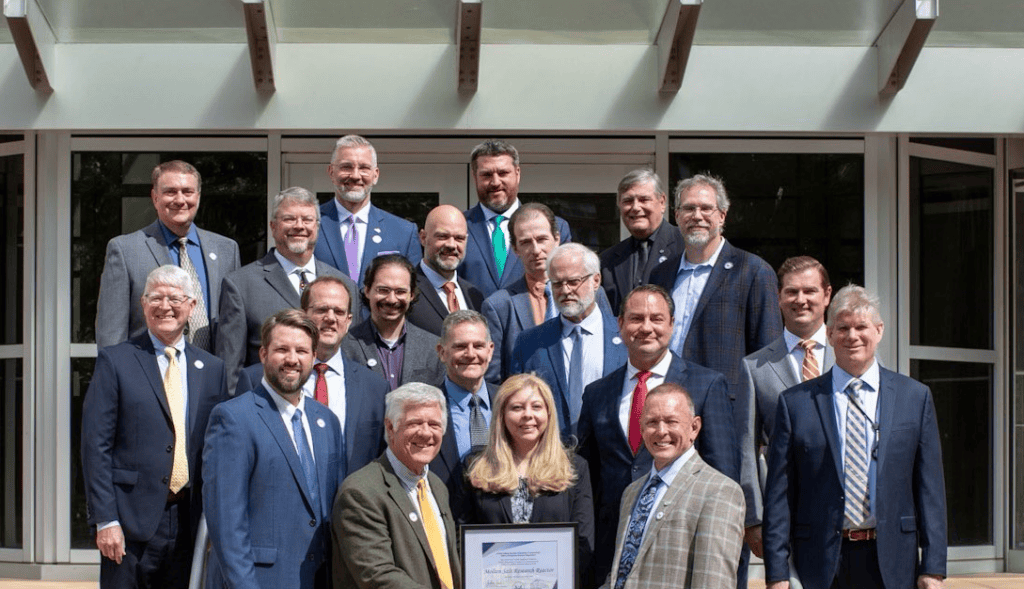
The US Nuclear Regulatory Commission issued a construction permit on September 16, 2024 to Abilene Christian University (ACU) to build a molten salt research reactor. This marked the first university research reactor approval in 30 years. It is the first liquid fuel reactor ever approved for construction by the NRC and only the second advanced reactor approved since the NRC was created in 1974.
Aside: The first advanced reactor construction permit was issued to Kairos for its Hermes in December 2023. End Aside
Natura Resources is the technology supplier for the important new facility. Andrew Harmon, Natura Resources Vice President of Operations and Business Development visited the Atomic Show to fill in some of the backstory about the project origins, the decision to pursue a research reactor as a step towards their ultimate goal of supplying a large number of factory-produced 100 MWe molten salt reactors, some of the major successes and challenges along the way and the level of community support that the project has attracted.
Developing a major new technology in a heavily regulated industry takes more time and resources than many might imagine. In this case, it involved a consortium that includes four major university partners, an enthusiastic group of local donors, a driven energy entrepreneur with a career spent moving expeditiously and safely, a supportive Department of Energy and a growing team of innovative engineers and developers. It also required significant cooperation and engagement with the NRC.
I’ll stop there and let Andrew fill in the details. I think you will enjoy this show. Please participate in the comment section. Respectful discussion and debate are welcome.
Transcript
Read transcript
There's a way, a way such a better way today, today. It makes your voice tell the world there's a better way, today there's a better way. This is Rod Adams and it's time for another atomic show. My guest today is Andrew Harmon, Vice President for Operations and Business Development for Natura Resources. And for those of you who not familiar with Natura Resources, they are the supplier, the owner of the reactor, is going to be built at the Abilene Christian University. Welcome to you, Andrew. Thank you, Rod. Glad to be here. Yeah, I hope I explained your relationship to the Abilene Christian University reactor correctly. But if I didn't, please correct me. Yeah, sure. Yeah, so we're the technology owner, developer of molten salt reactors. And specifically the Natura MSR1, which is the reactor design, Abilene Christian University is using for their engagement with the NRC and just recently, as of last week, received their construction permit. Which happens to be the first liquid fuel, advanced reactor ever reviewed by the NRC. Now, interestingly enough, your construction permit doesn't involve building a new building. Is that correct? That's correct. So that is a prime example of Natura's and Abilene Christian University's partnership and focus on doing things in parallel and moving into the moving in a speed, you know, we're committed to moving in a speed that maybe the industry hasn't seen for quite some time. So the building that will house this reactor was actually completed last year in September 20, 2023. So that building, we use the ACU as an ACU on building. They use the NRC code that I don't believe has ever been used before, but citing a reactor in a pre-existing multi-use facility. So that's what we built. Started construction in March of 2022 and filed the construction permit with the NRC in August of 2022. And, you know, had opportunity to complete that building. And now we have that building ready to go. So the heart of that building is a research bay. The research bay is 120 feet long, 50 feet wide. And then inside there has a trench that is 80 feet long, 50 feet wide and 25 feet deep. It's shielded with four feet of concrete and all sides. And so that that research bay gives us what we need to be able to bring our molten salt reactor to site and drop it in, I believe it'll be one of the first to factory fabricate and bring it on site. It'll definitely be the first to be done in the research reactor space. Now, I've been reading some stuff about your reactor. Is it true that the trenches you talked about actually has one side that has movable concrete blocks that you could bring stuff in sideways rather than necessarily coming in from the top? No, so the the the trench that I described the 80 feet long, 50 feet wide 25 feet deep. It's fixed. So it will not be moved. However, the reactor vessel will only take up about 25, 30% of that trench. And so we will have removable walls, you know, concrete blocks standing up between the primary reactor vessel. And the secondary system such as kind of the heat rejection and systems that are going to kind of take up the center of the trench. So if you if you oriented the reactor on one end, you'd have reactor block you'd have our concrete blocks shielding from kind of the primary reactor and then secondary systems. That's what I was was reading about it and quite understand or visualize how that was working. Yeah, so to give you a little bit of perception of kind of the size we're thinking this reactor. My other design it is about 10 feet wide about 20 to 25 feet tall. I don't know the exact dimension of it right now. I'll have thought my head. But yeah, it's it's about that size. So in the in a trench that's 80 feet long, we've got plenty of room for additional systems that will actually be housed down in the trench. How much power will your initial reactor, the MSR and SRR one produce how much heat. So that'll be one megawatt thermal. So that's a limitation with the NRC it's classified as a research reactor with the NRC for us. It's kind of a pilot or demonstration reactor. And so that cap was put on us by by the NRC for a liquid fuel design. A liquid fuel research reactor was limit was one megawatt thermal. Our commercial systems are being built to 100 megawatts electric. And so we're designing those reactors to be 100 megawatts electric, which is going to be around 250 megawatts thermal. Physical size difference between your research reactor and a commercial version in terms of just the reactor, not supporting systems. Yeah, so the reactor vessels we're anticipating the commercial reactor, about twice as wide and about twice as tall. So we're looking at something within the confines of about 18 feet wide and 40 feet tall. Okay, so four times as much volume. That's correct. Roughly speaking. Okay. Interesting. So that is that reactor also transportable or the just the reactor? Yes, that you know, our reactor design process, one of the constraints that we're putting into that process is can it be truck or rail or put on a rail. And we have to be able to meet that requirement in order to scale. And so we are focused on mass deployment of these reactors. And so we need these to be able to be transported by road or rail. And so yes, we are limiting the size of those vessels in order to accomplish that. Yeah, when you were talking about the speed that you guys are working at, I think I heard Doug Robinson call it the speed of business. Yeah, you know, Doug Robinson is our founder and CEO has brought a culture with him from the oil and gas industry. He spent. an entire career in the oil and gas industry and it's kind of in nuclear as a second career here. And so yeah, it has a mentality of performance that is, you know, we have to perform and in the nuclear industry. That starts with an NRC license and so we aggressively pursued that we, you know, it goes back to the strategy. And so the reason it was built on this whole starting with a pilot demonstration through the research reactor program with the DOE and and license under the research reactor with the NRC. So the strategy was built to successfully license a liquid fuel molten salt reactor and then leveraging the data and experience of operations in order to design the commercial and operate the commercial system. So when we started on this journey that was that was not a popular path. I will tell you there was plenty of reactor companies telling us we were moving entirely too slow and that using a research reactor as a pilot or demonstration was never going to be able to catch up with the rest of the industry. I think what we've seen is our original assumption was correct in that this could be used as a path to commercialization and really should be. And so the original conversation that really kind of set an a tour off on this trajectory was was a conversation at the DOE. Our founder Doug Robinson and and ACU president, Dr. Schubert and the director of the next lab rusty tab Dr rusty towel all three of them were at the DOE laying out a plan for how we're going to get to commercialization by utilizing a research reactor. And they the response from the DOE was overwhelming. And support saying you've got to do this we've got to be China we've got to be Russia. What can we do to help and so that that was kind of the the the original start of this project. We told them from the very beginning, they told them we need it salt and fuel. And they said how fast can you get started and we said as soon as you commit to salt and fuel. And 11 months later they gave us a letter of support programmatic letter of support for the fuel and salt. And that was when Doug stood up to our resources and got started on this. And so that was November of 2019. I think we had Doug had a or agreement signed with all four university partners by June of 2020 and we were off to the races and so that's really the the start of this. And the four partners yet and this podcast. I don't think we did. I mean, I may not have mentioned them. So yes, our four university partners are the University of Texas at Austin, Texas A&M University Georgia Institute of Technology and obviously ablin Christian University, which is going to be the host site for that research reactor. And so, you know, the expertise needed across multiple disciplines. We've been able to leverage researchers from all four universities to to put together the preliminary design of this research reactor. We moved that they're also supporting the detailed design work. We were working with Zachary nuclear engineering to complete the detailed design of the Naturi MSR one. And that that phase we are anticipating be completed with the detailed design by second quarter of next year. And so that's a step that we believe few reactors new reactor designs have ever accomplished. And so we're excited to be approaching that here and you know that's kind of the next milestone that we're looking ahead to. Have any of your other partners industry or academic partners expressed an interest in having a similar research reactor at their own facility, since research reactors have a value all of their own to universities. Yes, so we've had some conversations with a variety of universities even outside of our partnership that have expressed interest in our research reactor. Probably the most notable one or at least the one that's been catching headlines is Texas A&M, Texas A&M University announced in the I guess started the summer. And so they announced the an opportunity at their relis campus to bring nuclear reactors and so they they have a that announcement is for commercial power and so they want electricity on the grid. And so it's a little different focus. But kind of that they've opened the opportunity from they've said all the way from one megawatt to one gigawatt. So quite quite the range there that they they've asked for and so we'll see how that turns out there. currently open RFPs for the work there at RLS. So obviously, Texas A&M University is very interested. I would say the other university partners are excited to expand the scope and work that they can do in the space. And so looking for partnership opportunities, but not specifically asking for a research reactor. But I do think there are uses for this in Atari MSR1 beyond just the one at ACU. We will need to be able to train operators and need reactors for them to be trained on. So advanced reactors, there's not really a training program right now for advanced reactors. And so we've got to provide those opportunities so that could be a possibility. But that really hasn't been deterous focused is trying to expand the use of the Naturim MSR1. It is a stepping stone for us to get to the commercial systems. And so that has been our focus. If there are other opportunities that pop up the allow for us to expand the use of that we're open for conversations. But we are committed to scaling that technology to a commercial scale system in providing electricity and water and medical isotopes is really central to our mission. Other steps between your MSRR and your commercial version. In other words, is you taking in intermediate steps between one megawatt thermal and 100 megawatts electric? So there'll be a variety of R&D needs that we will have to do. There's been numerous projects of R&D that we've been doing at each of the four universities to support the design and licensure of the research reactor, the pilot. And there will be a number of R&D tasks that are still needed to support the commercial reactor. But a large percentage of those will be able to be accomplished with the research reactor enabling. And so we believe we'll have the data necessary to support our licensed application for the commercial system to the NRC using the pilot. And so yes, there will be other R&D tasks, but we do not envision the need for an intermediate step in there for in terms of size of the reactor. Okay. Do you have any expectations or any concerns about the power generation portion of this or is it gonna be a very standard thing and getting the heat from the reactor to a way that converted into electricity is not necessarily something that nuclear engineers thank much about, but power engineers do? Absolutely. So we intend to work with existing energy companies to be able to assist with that process. And so one thing that's central to Natura that I should mention is Natura is not trying to vertically integrate every aspect of our other reactor technology. And so we do not intend to own the every aspect, every system, every component on this thing. We are looking for partners. We're more about the mission and the accomplishing the N goal. And so if there are companies that can provide technologies or engineering or support along the way, we are looking for those partnerships. We think we can get there, get to the N goal faster and more efficiently by using existing companies and technologies. So in your question about kind of heat transfer and then the conversion to electricity, that is more of a known market and known technologies are out there for that. And there are new ones coming that are in development. So that's not Natura's focus at this point. We are engaging commercial partners. Zachary group out of San Antonio has sort of an immense experience in that space outside of the nuclear reactors. But as far as the heat conversion, energy production, they've got experience there. And other industrial partners that we are talking to have that experience. And so we intend to leverage that. Well, we'd like to say that our focus is really around the nuclear island. That's a terminology that's kind of in the industry. But really focused on the heat production of the nuclear reactor and then look for a variety of technologies that can potentially convert that heat to electricity. Or the desired need in a, maybe an industrial facility if you just needed the heat. Right. So could you heat directly? You also mentioned medical isotopes is a potential use for your reactors. Will Natura own an operate facilities? Or are you going to be supplying the technology or licensing and technology? How's that part of your model working? Yeah, our business model is built on licensing structure. And so we intend to license our technology to EPC firms that need to build, that would build and construct these reactors. And so yeah, it is not Natura's expectation to to building and struct every component. That goes to kind of the model that I was talking about before. There are very experienced EPC firms. And honestly, it's maybe not even EPC is even, you know, I know there's conversations in the industry that is engineering procurement and construction actually the right terminology, you know, in the future. So we'll see about that. And we believe that there's a significant number of EPC firms out there that can build and construct quality reactors. And we plan to partner with those and license the technology in order to bring the mass deployment of these reactors. Okay. As I understand the process, the NRCs giving you a construction permit gets you most of the way towards an operating license because you have to do a full safety about or an inter preliminary safety evaluation. You have to have an environmental impact assessment, all those things. How long do you think it'll take you to get the the operating license? Now, as you have a construction permit? Yeah. So we anticipate submitting the operating license for that research reactor early next year. We will need the detailed design completed. And so like I said, second quarter of next year, we anticipate being able to complete the detailed design and shortly thereafter be able to submit the construction permit or excuse me, the operating permit. So this is a two part license the NRC part 50. So we have the first permit that we received last week was for the construction of the reactor that allows us to move in the construction activities and then the operating license can be submitted any time. But we anticipate early next year, mid part of next year will be when we would submit that operating license. We are anticipating an 18 to 24 month review on that. So we, the NRC was able to review our construction permit in under 24 months. And so we're anticipating a similar review with the operating license. That's terrific. Has your company started any fabrication yet? I know you really can't have hold of groundbreaking since the building already exists and the ground was broken a while ago. But have any components started to be fabricated? That, no, they have not. And so we were, you know, those activities really couldn't start until we had the permit last week. We don't anticipate though that to start right this minute but we are excited to move into that phase as quickly as possible. Because your molten salt reactor is not a high pressure system, it seems to me that your pressure vessel construction is not quite as long a lead time as it is for light water reactor. Is that correct? Yeah, we operate extremely low pressure. We actually will, we will actually introduce pressure in order to move the salt in the system. That's how low pressure we are. And so pressure, we compare it to a garden hose. And so yes, significant reduction in pressure. And that's one of the major safety features of using molten salt over a gas or water as a coolant. Yeah, it's not just a safety feature. Just manipulating very thick pieces of metal takes time. And absolutely. And the forging process that's required for those high pressure vessels is a complex task. And it definitely could be a limiting factor to certain technologies in the ability to scale in the future. Yeah, and my former employer used to call those long lead time items. Yeah, yep, that's definitely a case. And you know, that's part of the complexity of the nuclear industry in this, you know, as Doug has mentioned, I think, from the US Nick presentation back in April, is, you know, he's almost hesitant to call it an industry at the advanced nuclear industry. He's really not an industry until we have products to sell and tour deploying them in the marketplace. But that's, you know, the supply chain fuel, you know, including fuel development, as well as the technology development is all pieces of this that have come together to really flourish as a new industry. One of the things it has been attractive to many people about molten salt reactors for the last almost 10 years now, is the fact that they don't require fuel fabrication. It's basically a chemical process instead of a fabricating process, but also that the fuel forms can be, or fuel isotopes can be fairly flexible to how they mix it up. Sometimes some user, some are using actinides from used fuel, some are using enriched uranium, some even thinking about plutonium isotope. What is your driving fuel? Our fuel will be uranium. And for the pilot demonstration, it will have an enrichment of just under 20%, 19.75 I believe is what we're targeting there. And I think it's important to note that in our commercial design, we're actually targeting LAU+, so something in the five to 10% for our commercial system. And that's a design decision that we have chosen to make based on the future availability of the halo and so are the limited availability of that. And so we, as I mentioned, designed this research reactor, I don't know if I mentioned it here or not, but we designed this research reactor specifically with materials and fuels that the NRC is used to dealing with. So we are not targeting, sometimes we call it a utopian reactor that has all the exotic materials that the NRC is not blessed yet. We know the lead times in qualifying those new materials can take significantly a long time. And so we're starting with materials that they've seen before, that are nuclear qualified with the NRC. And so that starts with our steel, but also with our fuel form. And so there are a variety of R&D opportunities that are going to come along with us. in terms of different fuel forms, different moderators, different steel. And we're excited to explore those in an R&E phase in the future. But really, we are focused on deployment. And what is available to us now? And factoring that into our design parameters. Sounds to me like you guys have made some smart decisions. When talking about the materials and the fuels, is your reactor a thermal reactor? Yes, it is. And is it being, you know, your neutrons being thermalized by saying graphite? Yes, our moderator is graphite. We're stainless steel, constructed vessels. And uranium fuel. OK. And since your power level is very low, it seems to me that you probably have a reasonably long life for those components, because you're not massing them up with too many neutrons or too much corrosion from fission products. I know that some of the molten salt reactor designs that I've reviewed over the years have a fairly short life for some of the components, particularly the graphite. Is that correct that you guys don't have an issue with that because you're low power? Yeah, I don't have the technical expertise to answer as far as what our expectations are for the graphite specifically. But I can tell you as the system as a whole, we've licensed this for five full power years at the NRC. So given that it's a research reactor, we do not anticipate running at full power for five straight years. We are going to be running tests on this and ramping it up, ramping it down, testing it in a variety of scenarios. And so we will focus on the data we need, specifically for the commercial reactor design and for the licensing of the commercial reactor to begin with. And when we have the necessary information there, then we can start kicking this thing around and really experimenting the limitations of it. But as far as the materials that we are using, we anticipate the five full power year license that we're getting from the NRC to last for potentially 20 calendar years. And so we anticipate utilizing the five full power years over 20 years with this research reactor. Yeah, and of course, it's not often said, but if you get a license, it says five full power years and you're getting close to the end of that, you can always submit a new license application or an amendment to the existing license or actually change those limitations. It's just like the initial 40 year license during, it's right, it's fairly gonna fall off the edge of the year, it's 40 years. Yeah, so that's exactly right. And so as we collect additional data and information from this reactor, it will give us the data necessary to explore the possibility of an extended license for the research reactor. But more importantly for us, that's going to give us the data necessary to extend the life of our commercial reactors oftentimes, we'll be able to look at the degradation in the research reactor and predict the and have the necessary information to give the NRC regarding our commercial systems. And so we definitely have R&D plans incorporated into this design to allow us to give us the information necessary for how are the materials holding up in the environment. And so that's why you need a research reactor. Exactly, that's where I was going. That's exactly what we need that research reactor. So there's lots of studies in R&D that has taken place. So what is, how do these materials hold up in a radiation environment? How do they hold up in a high temperature environment? There are very few experiments that are exposing them to both at the same time. And so oftentimes, when you get in front of the NRC and the engagement there, data is your friend. The more data you have, the more successful you're going to be, in my opinion. So having that research reactor, have an operational data from that research reactor to be extremely valuable for our commercial design and licensing process. Yeah, and it's also very valuable to verify and validate your computer models and codes, it will obviously be important as well. Yeah, so that's one thing in the licensing process for the research reactor. You have your models and your codes and you put air margins on those. And based on the uncertainty, you can put those air margins out further. And so you have the ability to do that on a small pilot or demonstration. But putting those air bars on a commercial system just drives your economics into the ground. And so that's one of the necessary pieces to be able to tighten up the future design, the commercial design, tighten that up as much as possible so that we can increase our economics which will obviously lead to larger deployments and faster scaling, which is our ultimate goal. So that's justifying the, that's kind of the central strategy of the research reactor deployment as a demonstration of pilot. Yeah, I agree with that. So has your phone started ringing off the hooks and you guys should construction permit from the NRC? I will say, we've been, we've been feeling a few phone calls. We have a joke around here when people ask us what we're up to, sometimes the responses we're just trying to get the phones to work. And in the last week, that's maybe been the case because yes, we were excited about the news last week and being able to announce that to everyone. And we wore thrilled with the response that we received from the nuclear industry and supporting industries from financial to the industrial utility, there was a broad level of support we're excited about our accomplishment. And so that was very exciting to see. Did you get some letter or expressions of interest from the other side of the equation? The customers. Yeah, so we've been engaging with potential end users and customers for several years now. And so that's not something that's started fresh. And so many of those people that we have been working with definitely reached out via email, phone calls, text messages, voicing their support. And so yes, we have had potential end users and customers engaged from the beginning. And so we want to make sure that we are designing our commercial system to be commercial ready for deployment. And we want to make sure that the product we're delivering is maximizing the use and efficiency for our customers. And so that's been central to our development and deployment strategy is early engagement with those end users. Did you see any reaction as a result of the rather enormous deal announced on Friday, I think? Between Microsoft and Constellation for data center power? Yeah, I think that's a huge market signal of that there's a premium value put on clean, reliable delivery of electricity. And so if the technologies that have the ability to be dispatchable and reliable and clean, there's a premium put on that. And I think that was maybe the biggest announcement that came out with that is the premium put on that type of power. And I think it's market signal for other developers. And so that's encouraging. We want to see moving the ball forward. And so advancing towards commercial deployment and the necessary steps you have to take. And so there is physical R&D that's required. There are simulations and all the different engineering steps that are required to design these systems and move them through the design phases towards construction. And then you've got to be licensing with the NRC. And so if you wanted to play in the United States at least. And we would say arguably, if you want to display to deploy in the free world, maybe starting with the NRC is not a bad idea. And so that's where we've started. But we need to be able to point to successes in the R&D, successes in the design, successes in the licensure, and ultimately for us success in the pilot and demonstration. It's not unique. And with new technology development, you see this in other industries. And so it's not a unique process in that you go through these design steps towards a mature technology. I think the uniqueness here for the nuclear industry is the regulatory authority and kind of how difficult that has been for many companies to work their way through that. And I think for us, working with the NRC has been a positive experience. So there's a lot of, there's a lot of criticism out there regarding the NRC that you can hear and say that that is limiting deployments. I think until the NRC is challenged with construction permits, it's hard to say that they're the limiting factor. Because so far, we've seen them successfully licensed, the Cairoist reactor, and then now the Natura MSR1 at Adlink Christian University, successful licensure. So we're seeing them do their job when quality applications are submitted. They're reviewing them in a timely manner and getting them back. The next phase that as we move into kind of scaling with the NRC is what does that look like when we bring a reactor design that's been previously reviewed and approved? What does that review process look like? I think it's encouraging to see that the Cairoist reactors two and three are accelerated review as we move into further deployments for our reactors we anticipate that will continue to streamline with the NRC. Pretty obvious to me that the more the NRC understands these new technologies, the quicker they can make decisions about them. It's just straightforward experience and learning curves. Absolutely. Yeah, so our engagement with the NRC for this construction permit at Adlink Christian University, I believe they had 94 reviewers on it. And so that was something that as we are educating them on our reactor design and specifically molten salt reactors, they are getting the experience needed for to evaluate future reactors and our commercial design in the future. And so when we bring them a larger system in the future, I think though the groundwork that we've laid in reviewing the one megawatt reactor will pay dividends in the future in comparison. So the other thing is the NRC's been very timely in their review. They told us they would get it done under two years. They successfully did that. They estimated it was going to take 15,000 hours and they came in under that. And so under time and under budget is what they announced last week at the Simon's Air Money. Well, that's always good news to hear. And I agree with you. I've heard an awful lot of people complaining about the NRC's slowness and reviewing applications. And I say, can you look at their list of applications that they're reviewing right now? There are none. Nobody submitted any. So don't say they're being slow. Yeah, I think that's a technical point. We've, you know, they are committed. It sounds like, you know, we've hosted now three of the four active commissioners here in Abilene had the opportunity to walk them through our facility, tell them about our plans in future. license applications that we anticipate sending their way. And so they are absolutely excited about where this industry is headed and committed to reforming as necessary to meet the demand. So what does the student body at Abilene Christian think about having a reactor being built in there on their campus? Yeah, so far it's been very positive. And so I say so far we've been at it now. I think publicly probably five years. Maybe six that publicly has been out that Abilene Christians looking to build a research reactor on their campus in Abilene. I led a lot of the engagement with the city. Prior to me working at Natura I spent four years as an advisor to the next lab as they were standing up their molten salt R&D. And so had an opportunity to engage with the city of Abilene. They've supported the work at Abilene Christian University twice now. And so with over three million dollars committed out of their local economic development funds. And so there is broad support there that require those. Those two grants required city council approval locally. And then obviously the student body at ACU, I believe has embraced the excitement around new technologies and innovation in a space that has not seen innovation in quite some time. Does ACU have a nuclear engineering program? They do not. And so that is definitely something that has been talked about and continue to talk about. And what that looks like in their future. And standing a variety of supporting degree programs that will accompany the research reactor. The other question I have for campuses that are investigating nuclear technology is how about students outside in Abilene's case. They don't have any new clean engineering students. But is there interest among political scientists, for example? Absolutely. That's something that I think being on campus at Abilene Christian University with this project has been exciting because it's really been an interdisciplinary effort. And so under the Natura sponsored research effort at ACU, we've had everything from business majors to engineers to chemists to. There's a variety of others that kind of in this other not even non-stem fields like I mentioned business, but other like you mentioned polysilon others. And so there has been a significant interest. And honestly, the program that is being run out of Abilene Christian University. We've had sponsored work from Natura resources to a variety of universities that aren't even in the in the four can member consortium. And so, you know, we've had students working under Natura at Abilene Christian University for the summer. There's a 10 week program and we've had a I don't know the number off top of my head, but I would say more than probably two dozen different schools that have sent students to work for a 10 week period of time in Abilene. Interesting. It gets my final question is, is there a name on the building? Did somebody donate money to I mean, because that happens all the time on college campuses, right people want to have their name on. And on a building. Yes, so the building on campus is actually called the Dillard Science and Engineering Research Center. So oftentimes referred to as the CERC, which is kind of the acronym of Science and Engineering Research Center. But there is a name prior to that is Max Dillard. Max had a special connection to the university and to the university president believes in the work that we are doing. And donated the money to put his name on it. And we're very grateful for that. And the other donors that contributed to that building. So that building is an ACU on building. They raise the funds necessary to support the construction of that facility. And so there's a variety of donors that supported that effort. There was even a local group of kind of retired individuals from a variety of backgrounds that are honored in the lobby of that facility called the founders lobby a variety of individuals being represented there that have had a large amount of support for this project for a very long time. Very cool. Andrew, is there anything that you'd like to tell people that I haven't asked you about? Sure. Maybe the last thing I'll close with is just kind of the performance driven approach that Natura has taken through R&D and the pilot demonstration into the commercial design and construction that we are working towards. So this performance driven approach is something that we pride ourselves in and we are working tirelessly day in and day out to bring this technology to the marketplace and we have taken this approach that I think is efficient in terms of time. And so we believe we've also been an efficient in our use of capital. And so it's kind of taking a different approach that is resulted in being able to move. As I mentioned before, move the ball forward in this space very efficiently. We pride ourselves in being the most efficient reactor developer in terms of time and money. And so we are working to de-risk the concerns of new technology deployments and development and doing that at every step of the way from the supply chain to the construction to licensing. We're taking a very targeted approach to de-risk this and attract the necessary capital to complete the mission in the end with mass deployment of molten salt reactor technology. So very excited. I want to thank you for having me on today. I really appreciate the interest that you have shown in our project but not only our project but the broader industry as well and bringing a variety of experts and bringing attention to a much needed technology. Well, thank you for the kind words and you're welcome. And I just for a reminder to the listeners I've been speaking with Andrew Harmon, the Vice President for Operations and Business Development for Natural Resources. Hope you all enjoyed the show. This episode of the Atomic Show is brought to you by Nuclear Creation Capital. We're a venture capital fund focused on selecting ventures with extraordinary promise. They're building the advanced nuclear sector and helping expand our clean energy options. We're building a portfolio of ventures on behalf of investors like many of you. We don't just take funds from the large institutions that typically allocate to venture capital. We believe that regular investors should have access to the opportunities in modern nuclear for their own portfolios. We allow people to subscribe on a quarterly basis starting as low as $5,000 per quarter. A four quarter subscription will get you exposure to between four and six ventures. If you are an accredited investor and would like to learn more about how you can participate, please check out our website at nucleationcapital.com. That's nucleationcapital alloneword.com. Our fund and all the information you need to subscribe is available online. You can also subscribe to our newsletter, nucleation insights, and join our pro nuclear investor network to learn about select syndicated investment opportunities. If you have questions, we're happy to chat. Please spread the word. Thank you. Thank you.