Trey Lauderdale – Founder, Atomic Canyon
Concepts discussed
Auto-linked from the episode's notes and transcript.
Show notes
Atomic Canyon is a six month old company that is developing AI tools to improve the efficiency of routine tasks associated with developing, licensing, building, owning and operating nuclear plants. Their first product, called Neutron, uses AI to modernize searching the Nuclear Regulatory Commission’s 52 million page collection of publicly available documents that are currently accessible through the somewhat cumbersome Agencywide Documents Access and Management System (ADAMS).
Trey Lauderdale, Atomic Canyon’s founder, spent the first 15 years of his career in the digital medicine field. At an inflection point in his career, with the freedom to live anywhere, he created a decision matrix to help him and his wife choose a place to live and raise their two young sons. San Luis Obispo, CA earned the highest score, with an excellent public education system as one of the contributing factors.
After finding their home and moving towards closing the purchase, Trey and his wife learned via real estate disclosure documents that they would be living within 10 miles of the Diablo Canyon Nuclear Power Plant. As members of a generation who learned most of what they new about nuclear energy from The Simpsons, they were initially leery.
But they quickly realized that the plant’s skilled, dedicated and well compensated employees and its property tax payments were major reasons that the schools and other aspects of the community had earned such high scores on the “place to raise our children” decision matrix.
After becoming a member of the community and conversing with local nuclear professionals, Trey decided to learn as much as he could about nuclear energy and the nuclear industry. He recognized that he and his skilled colleagues could build tools that could address obstacles that slowed work and added costs.
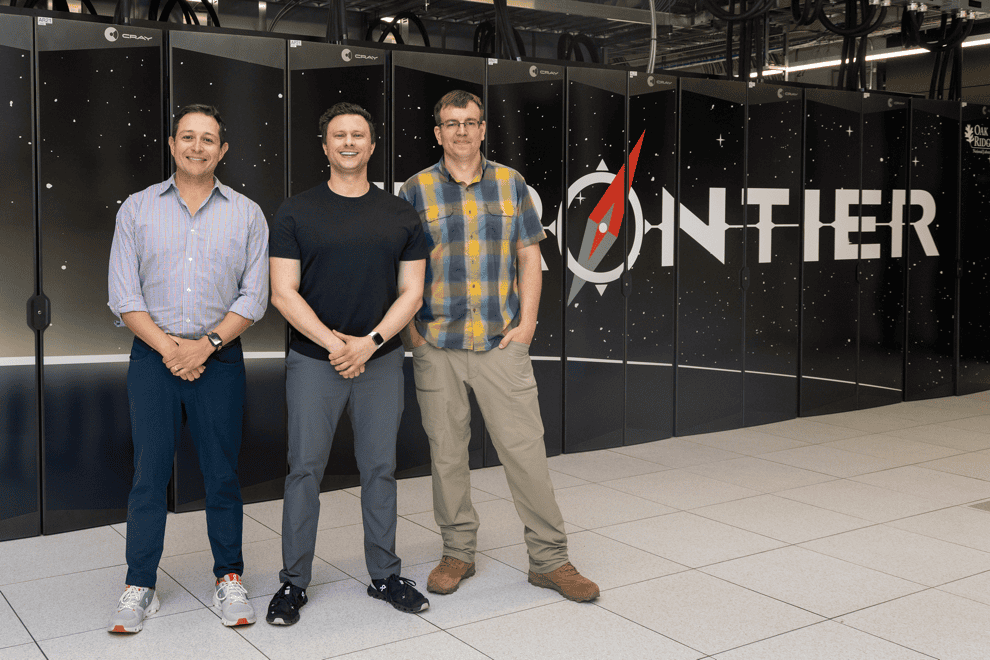
Atomic Canyon has just announced a cooperative project with the Oak Ridge National Laboratory (ORNL) that will train ORNL’s Frontier – currently the world’s fastest supercomputer, capable of more than a quintillion calculations per second – how to understand nuclear terminology. The resulting model will not be trained on proprietary or safety related information on the design and operation of nuclear power, but it will help analyzing the deep library of regulatory guides, inspection reports, and other publicly available documents to assist in increasing safety and accountability.
The products (models) created by the partnership will be open source and available to become part of the toolbox for other developers.
Trey and I had a fascinating conversation. I think you will agree.
Left to right in photo: Trey Lauderdale, Atomic Canyon CEO Kristian Kielhofner, Atomic Canyon CTO Richard Klafter, Atomic Canyon Lead AI Architect Tom Evans, ORNL Research Scientist Photo Credit: Genevieve Martin, Oak Ridge National Laboratory
Knox News provides a local perspective on Atomic Canyon’s project using Frontier: *AI for nuclear plants? ORNL supercomputer’s new task is no sci-fi – it’s a clean energy win*
Transcript
Read transcript
There's a way, a way such a better way today, today. The measure boys tell the world there's a better way, today there's a better way. This is right at him's end time for another atomic show. I guess today is Trey Lauderdale of Atomic Canyon and Trey and his company are going to be entering into a partnership with Oak Ridge National Laboratory. They are bringing artificial intelligence to some key areas of nuclear operations and nuclear license development. They are automating search and taking care of something that's been a long issue with the finding out documents in the nuclear world because the NRC's got this great database with a terrific name called Adams, but it's one of the hardest databases in the world to search and let's really skill that. So Trey, welcome to the show. Hey, Rod, thanks for having me happy to be here today and also thank you for all the work you do advocating for the nuclear power industry. I know you've been at this for many decades and greatly appreciate the work you've done and all the pods have found them incredibly informational. So thank you for everything you do. Thank you. Tell me a little bit about atomic canyon and maybe a little bit about your show. Yeah, so atomic canyon, we are almost six months old, so we are an early stage artificial intelligence startup bringing the latest generation AI capabilities to the nuclear power sector. By background, I've been in technology for about 15 years. Almost all of that has been in the digital health or what used to be called back in my day, the healthcare IT field originally started a company named Bolt, BOALTE. We were the first ones to bring iPhones into hospitals. Excuse me, to improve clinical communication. We went through the whole life cycle of the company of venture capital private equity had a whole bunch of top academic medical centers and other health systems deploy the solution eventually sold the company to a company in Hillram Hospital Bed manufacturer ran their digital business a couple of years. Eventually, we sold that company as well and they spent the last few years doing a lot of angel investing, advising, startup work mostly in healthcare IT and kind of fell into the nuclear space about six months ago and they've absolutely fallen in love with the ability to leverage AI to improve nuclear power operational efficiency. So really excited to be here. So how did you get attracted to nuclear? What was your intro? So it's a funny story. So my wife is from California. I'm from Florida. And after the sale of the company, we decided we were going to move to California. We wanted to be closer to her family. So we moved out west and I'm an engineer by background. So of course I did ready engineer would do. I put together an excel sheet of all the different attributes we would look for in a city where we'd want to live. And after spending a lot of time going back and forth, we settled that San Luis Obispo, California on the Central Coast would be the perfect place to live, right combination of perfect weather, great schools. We have an eight and a four year old. So we wanted our boys to have a great place to grow up. I'm a big fan of small town living and it was right in between San Francisco and LA and being in tech. We could get to either of those tech hubs relatively quickly. So as we were getting ready to sign the paperwork and close on our house, notice there was a disclosure form that said we were buying a house 10 miles from a nuclear power plant. And immediately my wife and I just oh my goodness we can't live by a nuclear power plant. Have you seen the Simpsons? There's going to be three-eyed fish and green news flow and everywhere and three mile island. And so we almost decided not to go to San Luis Obispo, but we did a little research and we quickly discovered that everything we thought we knew about nuclear was just totally wrong. Everything has ever died from nuclear power in the United States. It's completely safe to live 10 miles from a nuclear power plant. And after doing just a little bit of research, you quickly realized that you could be completely safe living by a nuclear power plant. So we ended up moving to San Luis Obispo and as I'm sure you know, Rod, if you live in a town, especially a small town that has a nuclear power plant, they are a key tenant of the community. They pay a whole bunch of taxes which is one of the reasons we have such great public schools in San Luis Obispo, but also their employees are a part of the community. My eight-year-old, his basketball, was coached by an engineering manager at the Oblok Canyon. So being a curious guy and being in tech, I would ask all of these people I would meet just you know through chance encounters what they did at the nuclear power plant and my goodness like as you start talking to people about nuclear power. Number one, you pick up on the passion and the excitement they have for what they're doing in the pride and the sense of ownership. But also you quickly realize number one, the science of nuclear is just unbelievable the ability that humanity what we've done in our ability to take atoms and split atoms and create heat use that heat to enable a turbine to move around and then enable that to create energy and right in our backyard, almost 10% of the state of California. The energy is being produced right there at the Oblok Canyon. It is a modern day miracle that we have been able to harness the power of the atom and do it in such a way that the use by product is spent fuel. I mean, you can fit in the cascade like it's really is quite incredible. So we'd walk through the science and I'd ask a ton of questions and everyone was so generous with their time. And then I'd ask, well, you know, being an IT guy, can you talk to me about some of your IT systems and you'll walk me through the day to day of searching for all these documents. And I quickly realized that while the science of nuclear power is just incredible, there's been a tremendous amount of regulation and there's been a tremendous amount of documentation of all of these processes and all the work that occurs. And that's when it really dawned upon me that, you know, especially with my background in artificial intelligence, that there's a tremendous opportunity here. And I don't know if it was because I was around people in nuclear or if it's just, you know, nuclear is going through a resurgence. I felt like at the same time as I was becoming educated by my community about nuclear, I was just seeing article after article about nuclear power plants staying open, nuclear power plants reopening commitment from the United States Biden administration to triple nuclear production by 2050. I mean, suddenly it just felt like nuclear was everywhere. And again, I don't know if it's because I was becoming more educated about it. Or if there was just a moment in time where nuclear is becoming part of our culture again. But I started to realize I think there's just a tremendous opportunity to leverage artificial intelligence and take this data set of all of this documented regulatory information and leverage that to start training AI models. And then enable us to have a scenario where nuclear power becomes a thought leader and one of the kind of top users of artificial intelligence to drive efficiency and help these individuals do their job better, faster, cheaper, safer. So that was really the kind of beginning of the company was just being around a nuclear power plant and being exposed to all these wonderful people that go in day and day and help us provide clean, reliable safe energy to our community. So that's been a long story, but it happened fast. This company we started November Thanksgiving of this past year and really the introduction was all from having exposure to people in the space by living near a nuclear power plant. You've already created one product for the nuclear industry. I think you call it new China. Is that correct? Yes, that is correct. And that product digested a whole bunch of documents out of the Adams database. Can you tell us a little bit about the challenges you had in using some of the documents that are in the database, but maybe we're created and scanned in an era way before even word processing was the same. Oh yeah, no, absolutely. So a quick background with once we decided, hey, there could be something with artificial intelligence in the nuclear space. There could be an opportunity here. The first thing I did was call up my best AI technologist business partner is named Christian kill off. We've got a ton of work together whenever I did anything in AI in healthcare, whether it's computer vision or automatic speech recognition, any modality. I mean, he's just one of the most naturally gifted AI technologists and architects I've ever worked with. I called him up and said, Chris was over Thanksgiving break. We're getting into nuclear and he kind of laughed. He's like, well, it's a weird way to reference a radiology company, but okay, I was like, no, no, no, I'm talking nuclear power. And he was like, okay, I'm intrigued. Tell me more. So we quickly decided we were going to do a project and work in nuclear. And the first thing we needed was data because if you're going to start training AI models and you're going to build an AI company in nuclear, you need access to a data set to start building out this set of capabilities. And we searched and we quickly found the NRC, the nuclear regulatory commissions, atoms, repository of data. And we went and he just started downloading the documents. And as we were downloading them, I figured, you know, probably should reach out to the NRC. You just let them know what we're doing because I'm new to nuclear and I don't know is this against the rules. Are they going to get curious about who's this person downloading documents. So went onto the website and just cold outreach to the NRC and they quickly took a call with us and they have been just absolutely fantastic. They shared that. You know, it's been a journey for them for the past 10 years they have been working on digitizing these records and I think a lot of people take for granted. You know, some of these documents that are in the Adams website, these are microfiche and these are documents they had to scan and they had to do all of this investment. You tens of millions of dollars to convert these from a physical format to a digital format. So the NRC, you know, tremendous kudos to them for having the foresight and the vision to digitize these records knowing that eventually one day someone to be able to leverage these in a more useful format. So we were able to download 52 million pages so everything we could access from the NRC Adams website. We then had to use a series of artificial intelligence models. So things like optical character recognition computer vision because if you think of these documents again, it might have been a document that was used, you know, a typewriter was used to create it somewhere 20, 30 years ago that it was put on microfiche and it was scanned to make it a digital format. So these aren't necessarily pristine, beautiful PDFs that are properly formatted. A lot of these documents are quite challenging to actually get the information out of the documents. So we leveraged AI to be able to understand and ingest all of that data set. We put that in a really kind of robust AI centric database and then we put a user interface in front of that that enables more of an AI based search application for against this atoms, you know, database documents. We also built a slight software mechanism that enables us almost instantaneously we guarantee about five minutes. Whenever the NRC publishes something new, we immediately grab it, we ingest it and we add it to our database. And this is a totally free product. We put it out about a month ago. It's the neutron search application and anyone who is in a nuclear industry, whether that's a nuclear power plant, small module reactor, anyone who's looking to find information on this website can reach out to us, we'll get them all signed up and set up. And really the problem to be solved is you are correct. So the atoms database. We call it Adams Kung Fu. There are some users that have been using Adams for 10 or 20 years. They've gotten really good at being able to put specific keywords and search for information and a user-friendly format. Newer users of Adams. There's some time it takes them to figure out how to use that application. So our goal and the problem to be solved here is make it so it's easier for anyone to find information on that Adams website. And from there, after launching the product, we have gotten a ton of feedback from users and people that want us to add other features and functionality. So we think it's a great foray in a way for us being new to nuclear to number one demonstrate that AI has a place in nuclear operations and nuclear power. We believe that this regulatory space helping people find and search for documents. It's a great place to start from AI. From an AI perspective. But we think there are tremendous, tremendous opportunities throughout the entire, I'd say, nuclear supply chain. So everything from mining, milling, refining, enrichment, fuel fabrication, the reactors themselves where we started spent fuel storage. When you think about AI, the computer has been reinvented. So the ability to leverage different modalities of artificial intelligence across the entire supply chain, I think is a once in a lifetime opportunity for AI to be introduced into the nuclear industry in a safe, reliable manner. And we're super excited to be part of this ecosystem to help ideally bring lots of AI applications and encourage lots of AI companies to enter this space. You've recently announced a partnership with Oak Ridge National Laboratory to use one of the fastest super computers in the world. Or maybe even the fastest super computer in the world today frontier, there's always a race going on for that kind of stuff. Tell me a little bit about what you think that a partnership is going to allow you to do and what kind of expanded capabilities is going to give you. Yes. So as anyone who's in AI knows, this is a journey and we always need to be constantly improving our product or technology and coming from a previous technological transformation and we've often a bit of tangent to answer that question. So when the smartphone was released, when the iPhone was released in 2007, it was a great product. It was really transformational, but every year it would improve. There would be the app store and more applications and advanced GPS and better cameras and really somewhere around I'd say iPhone five or six after five generations, wow, that technology was just unbelievable. And you were seeing these improvements happening every year. In artificial intelligence, the rate of change is just unbelievable. I mean, it's like every month, we are seeing a year's worth of improvement in smartphone time. And I think the rationale behind that is developers are able to use artificial intelligence to code faster and better. And hence you have this like upward cycle of AI enabling AI to be built faster, which is really quite incredible. And if you look at the latest release from Open AI and chat, GPT four and the latest announcement about what they're doing, like every week or every month, there is just more and more incredible capabilities from an artificial intelligence perspective being released. So when I look specifically at nuclear, we've been able to stand up our system relatively quickly. We're seeing great results from a search capability. But one of the problems we quickly discovered is nuclear is incredibly complicated. There are a lot of really technical words. There's technical jargon. There's acronyms. You sometimes see, you see acronyms that stand for different things at the same acronym, incredibly complex and technical space. So as we were running our different artificial intelligence models and doing some fine tuning, we quickly realized we needed to leverage a supercomputer to train AI to understand a lot of these words. And everybody comes and says, hey, Trey, can you guys go build us a chat GPT for nuclear? Can you build us an LLM? Everyone loves to go straight to LLM. I'm in nuclear. In nuclear, we're going to need to go a little slower. And we're going to need to be very thoughtful and pragmatic about what we're doing. Because in AI, there's a term that's used, which is hallucination, which is a fancy way of saying that AI makes stuff up. That is not good in nuclear. We do not want hallucination. Excuse me. So with Oak Ridge, what we're doing is we're actually leveraging the data set. We have from the NRC. We're using frontier, which at the time of the press release is the world's fastest supercomputer. So throughout humanity and civilization, that is the fastest computer that mankind has ever made, which to me is just unbelievably awesome. Like we get to use the world's fastest supercomputer and we're leveraging this to train what's referred to as sentence embedding models. And my CTO could spend hours talking to you about the technology, but at a very high level, these sentence embedding models and the training we're doing is enabling the artificial intelligence to start to understand the syntax, the context of these nuclear words, which therefore becomes an unlock to not only help our search application go faster and work more accurately, but separately, it becomes a key building block to enable ourselves and the overall industry to start building some of the generative AI capabilities that everyone wants. Everyone wants the LLM, the chat GPT. We believe this building block of the sentence embedding models will be a key foundational element to enable, whether it's open source LLMs or closed source LLMs, to be able to better understand the nuclear words and then help the entire industry advance in a more safe, reliable way from an artificial intelligence perspective. And a key tenant that we have in this partnership with Oak Ridge is we are going to open source this work. So from our perspective, we're using government documents, which are the NRC documents that are publicly available. There's no national secrets or anything in there. These are all available documents, no sensitive data. We're using those documents, plus we're using a government resource, which is Oak Ridge National Labs in front of your supercomputer to train this really foundational AI model. And we're going to open source it that way every company, every startup that's coming into nuclear AI, and large companies that need to make their AI more nuclear enabled. We want everyone to benefit from this technology. Because again, it is going to take an army of AI developers different companies to tackle the hundreds, if not thousands of use cases of artificial intelligence that will need to get applied across the nuclear arena for us to really unlock the value of nuclear. And kind of the last point to that, and one thing I'm just so excited about is when you look at this space. So AI is just incredible. Like coming from health care, I have had the opportunity and the privilege to see AI change the lives of doctors and patients. There are doctors who have said, Trey, using this AI capability, it gives me one or two hours back every day. And that matters. Because I can get home and I get to go home and spend time with my family, or I don't feel burnt out. There have been doctors who have said, we can doctors and nurses. We can stay in this profession because AI is enabled us to do more with the time that we have and provide better patient care. However, and again, AI is being used across so many verticals. There is a dark side of this AI, which isn't used as a ton of power. Like every single call that's made to open AI, or Google Gemini, and these services, it uses so much electricity. It uses a lot of GPU. So while AI is going to be transformational across nuclear and many verticals, we have to figure out how we make sure we provide clean, reliable, and safe power to these data centers. And you see Google and Microsoft and everyone talking about, we're going to build data centers that are going to need gigawatts of power. It's really easy to say the words, gigawatts of power. But if you've been in a nuclear power plant, you know what a gigawatt of power looks like. And I love solar. I love wind. I love batteries. I love all these other sources. There is no better power source for gigawatts of clean energy than nuclear power. But I feel we're going to need to get really good as an industry at leveraging artificial intelligence to unlock a lot of these operational efficiencies and help us be better at getting through regulatory work and having AI as an agent to help us get that done. And then leveraging AI to improve quality and efficiency. There's already other companies that are doing this. I think it is going to take a whole industry of us to help really unlock the power of nuclear as we go forward. So that's a bit of the Oak Ridge project, as you can tell. We are so excited for the opportunity to partner with Oak Ridge. They've been fantastic. And the opportunity to serve the industry assembly. So you said that atomic candy is just six months old. and you've got several products and projects you're in to develop. What is your revenue model? So as we go to market and we're not ready to announce any of our partnerships with power plants or SMR vendors. But we've in essence are taking a version of neutron, which is the free product. And we're enabling that to be kind of an enterprise product for nuclear power plants or SMR. So if you think about a nuclear power plant or someone who's building an SMR reactor, there's a lot of proprietary data that those plants will have. So a nuclear power plant will have an order of magnitude more data than is currently available at the NRC Adams database. So we have an enterprise version that can go behind the firewall. It can go on premise if necessary. It can go on a private cloud. Or if a nuclear power plant has a cloud partner, we're completely cloud agnostic. So Azure AWS, GCP, we don't really clear who the cloud provider is. Our product can go behind the firewall. In just all the internal data that a nuclear power plant has and then enable almost like internal record management system to let the nuclear power plant find their information and a more robust and easy format. And we feel that combined with the publicly available neutron starts to build the foundation of being able to find the right documents faster. Because we've seen a nuclear power plants. Their data rich, but in some cases, might be information poor. Because they can't find the right documents. It's so hard to search internal databases. So we believe this becomes a foundational element, the search capability. And then as we complete the Oak Ridge product and we have more generative AI capabilities, you can quickly see this becoming a generative AI application in the regulatory space to help all of these regulatory teams inside nuclear power plants streamline these processes and get the many hours of work done more efficiently. I know that you are really excited. You can send some great information. I also know that your public relations folks have got you scheduled with a lot of tightness. So that's probably going to be the end of our discussion here. But I really love to have you think about coming back and telling us some more as time goes on. And as you get through some of these week by week advances in AI. Oh, no, Rod, it would be my absolute pleasure. And we'll have some more exciting announcements coming later in summer in default and would love to bring some other partners on. So you can hear directly from some of the individuals that we're not yet ready to announce how they're starting to use AI because I do believe going from what we've been building to having different plants and other. share their experiences. I think it'll help make this real. And again, six months into the journey, but could not be happier to be in the space. And thank you again, a big fan of what you do. And your recordings have helped us. And I'm sure many other entrepreneurs come to speed. So thank you for what you do. It's greatly appreciated. Well, you're welcome. And everybody else, you welcome to this episode of the tonics show is brought to you by a new creation capital. We're a venture capital fund focused on selecting ventures with extraordinary promise. They're building the advanced nuclear sector and helping expand our clean energy options. We're building a portfolio of ventures on behalf of investors like many of you. We don't just take funds from the large institutions that typically allocate to venture capital. We believe that regular investors should have access to the opportunities in modern nuclear for their own portfolios. We allow people to subscribe on a quarterly basis, starting as low as $5,000 per quarter. A four quarter subscription will get you exposure to between four and six ventures. If you are an accredited investor and would like to learn more about how you can participate, please check out our website at nucleationcapital.com. That's nucleationcapital all one word dot com. Our fund that all of the information you need to subscribe is available online. You can also subscribe to our newsletter, nucleation insights, and join our pro nuclear investor network to learn about select syndicated investment opportunities. If you have questions, we're happy to chat. Please spread the word.