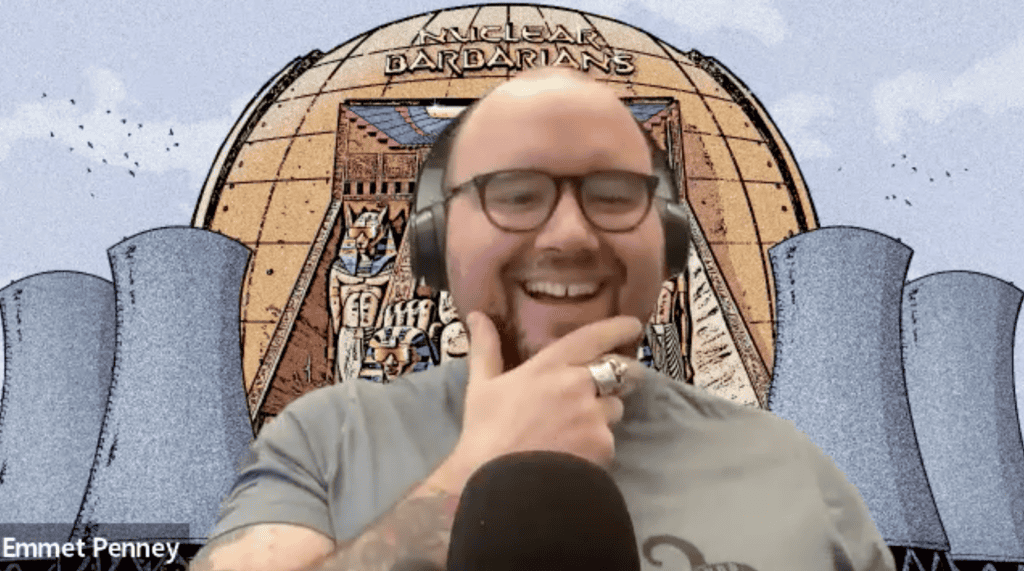
Emmet Penney, Pronuclear Poet
Concepts discussed
Auto-linked from the episode's notes and transcript.
Show notes
Emmet Penney is an unlikely, but effective pronuclear advocate. He earned his degrees in fine arts and great books and worked for several years as a professional poet – along with working in a bookstore as a way to keep paying the bills.
He gradually transitioned from poetry into writing thoughtful essays on a variety of topics. One of those pieces caught the attention of Michael Shellenberger and began the process of converting Emmet into a passionate, erudite pronuclear advocate who reads voraciously about all topics that interest him. That attribute has given him a remarkable depth of understanding about the nuclear industry, its history and its prospects that is not complicated by the detailed engineering education that often leads to confusing public communications.
Emmet and I engaged in a wide-ranging conversation that touched on such diverse topics as why the Environmental Movement chose to take action that was harmful to the environment by focusing its attentions against nuclear energy and how the republican notion of an economy of small holders conflicted with the liberal notion of rapid technological progress and corporate management. (Notice that words like “environment”, “republican” and “liberal” that are written with lower case letters do not mean the same thing as when written with capital letters.)
I thoroughly enjoyed the conversation and expect that you will find it engaging as well.
Transcript
Read transcript
There's a way, a way such a better way today Today, the nation's voice tells the world there's a better way Today, there's a better way This is Ride Adams and it's time for another Atomic Show Today, I have another movie, Star Guest, Mr. Emmett Penny, who was at Star at Robert Bryce's recent mini-series on electricity and the importance of electricity in the world And it is a publisher of grid-brief and all around commentator on nuclear from a tremendously well-read perspective And welcome to the show Happy to be here, man, thank you for the very flattering introduction I like to flatter people, it tends to get them off of a step and I can come and add them from another perspective Hey, I've been very interested in some of the things I've been hearing from you and reading from you I know that you've been recently writing about some topics like the UAE's recent announcement They're going to, well, they haven't really made you an announcement officially, Reuters may have formed They're going to move forward on another four-unit power plant similar in size to the one they had just finished at the Baraka station And I also was really intrigued by your recent article about the historical underpending of Earth Day and the environmental movement And I thought I'd start with that one So why is it that the US is enormous industrial power with everybody excited about driving cars and having watching machines and maybe even having second homes and big families How do we get into the mode of being influenced so much by environmentalism? I think that's a great question. I still feel like I have more to do to fine tune this argument So I'll just play a little humility at the outset here and ask for the audience's generosity and listening to what I have to say So I tend to think of things in sort of broad historical and often cultural traditions And I think America has a bunch of different cultural assumptions and operations in operation at the same time And they often conflict And I mean, I think we can feel that palpably in our politics today But it hasn't always looked exactly the way it does today And I've been taking a look at some of the early American ideas of commerce and manufacturing and things like that And I think when you look at that, you look at America around the year 1800, let's say So we're looking at I don't know the first Jefferson administration, I guess One of the things that you pick up is that there is this great ambivalence about manufacturing Not just from Thomas Jefferson, but even from more balanced personalities like James Madison who thought that corporations were, you know, unnecessary evil at best And you find a population that is in many ways highly suspicious of any type of project, even if it would elevate their way of life That centralizes any power whatsoever And a lot of that has to do with America's relationship to the king and sort of the off-ramp to colonial status And the term for this is sort of the lose the Republican tradition lowercase are And it's very interested in a few things, it's very interested in rule of law, not by law, equal application of the law And it's also highly suspicious of centralized power and commerce That often runs in detention with the other strand of American thinking and living, which is the liberal tradition, which is very pro commerce and manufacturing for the most part Now I get it, I get a break in real quickly Am I necessarily being confused by current uses of those two? Yes, yes, yes, yeah, that's why I said lowercase would do we're doing lowercase are lowercase L It's best if we don't think about this in our vernacular today These are old political philosophical terms that terms that totally predate are completely annoying politics today So let's just, I'm so glad you brought that up because that's so important to bear in mind Because otherwise it can, it can, it can confuse us and has confused me before I started really digging into this So some of that really starts to change Especially after the industrial revolution, there's great apprehension about some of these things, you know, what, what is The telegraph going to do to our everyday life, there's panics about that, that's our first experience with large scale electricity But generally over the course of let's say the latter half of the 19th century and especially into the opening of the 20th The idea of progress that governs America changes from a republican political idea Again lowercase are of progress which is mostly like I said political and has to do with democratization and increasing in the punishment of the population and self-governance towards something that is technological and about improving our living conditions today Now this is really favored at the opening of the 20th century because it works especially after electricity As you said, people are getting washing machines, people are emerging from private poverty that is incredibly bone crushing And they're very enthusiastic about it and I think we also need to remember that if we jump forward just a little bit to it after World War II There is a big sense of relief, hunger is in living memory, real, real hunger during the depression and also the tragedy of back to back world wars So there is a sense, there's this sort of great optimism that these cataclysm have happened and that we're being rocketed into a new future Now a few things start to happen towards the mid century is people start to notice some of the environmental consequences of this great industrial scale up that we're experiencing as a nation in the post war era And it starts to make people anxious and they start to turn to 19th century or earlier thinkers from this Republican tradition And they start to question the sort of corporatist managerial society that has emerged after World War II One way that I like to talk about this is at the beginning of World War II, so when Franklin Delano Roosevelt needs to go to the Senate after Pearl Harbor to give his speech They need to put him into an armored car but the only one that they have on hand The only one that they have that the federal government has is al-Kapones, which the Department of Treasury has recently confiscated Right, so that's how small the American federal government was at that time And then if you jump forward just a few years suddenly Americans are learning after Hiroshima and Nagasaki That their government is apparently capable of this incredible level of destruction that no one had even dreamt of before So you have to understand that this fills a bunch of apprehensions And then you combine that with a few other things the civil rights movement which was rectifying a serious it was finishing Reconstruction basically after the Civil War it was finishing the job 100 years later To achieve greater freedom and equality for black Americans who were denied that But it also meant a weakening of the legitimacy of American institutions to do so rightfully They had to do that because they're a set of legitimacy problem and then you put the Well because some of those institutions had been at best to get with them unjustly Absolutely, like I've said they had to do it It was not to go if it needed to happen for America to live up to its own promises now You combine that with the response to the Vietnam war which was seen as this big Incorporatist Blood-soaked cash grab you can look at what people were saying about like DuPont chemical and their production of day palm and stuff like that And there starts to be a sense that these managers these people who've created this order might not have the public interest in mind the way they advertise that they did in the New Deal era And so the environmental movement has can have these claims to legitimacy and they're take a look at the environment Right it's the cities are choked with smog think about the wilderness you remember when you were a kid and what happened to it You know and then they draw on this almost older cultural tradition that has all these most folk ideas about the way politics should work This Jeffersonian I Panch it for decentralization and they start to say well maybe all of this growth wasn't worth it if it meant surrendering a certain level of our freedom If it meant putting our lives under the yoke of a managerial administrative state And so they start to look for other options And by the time stagflation and the energy crisis and all of this on you know bring this whole edifice down in the 70s basically There's a wide open field for them to say well growth was a lie it was always going to lead here We're consuming more than we need and more than planet can bear there are too many people they can't consume all of that And also take a look at the incredibly Bella coz governments and corporations that have been eating up all the profits from this while screwing over the everyday American And these are some of the claims that the environmental movement are making that seem very common sensical to people at the time Sure, there are very extreme iterations of this that almost can't be rendered in good faith But I'm trying to do so here so that I don't come off of the demagogue while I critique them because I think it's important to understand why smart well-meaning good faith people We're completely convinced by this framework if you can put yourself sort of in their binoculars as they're surveying the Vista of the American future You can understand why they had great apprehensions others is lying from the cultural critic Christopher Lash that really sums up I think what happened to also managerial self-esteem We said, you know, we used to have all these guys who were talking about like running the world system, you know, and created a world and by 1979 he says all these people despair of governing even New York You know, like you know with all this crime and that's decay, you know, so there's also within this managerial edifice there is a colossal loss of self-esteem about what works And we see that in places like the utility industry where they lost their annual demand growth which used to be almost guaranteed which created the financial rationale the business rationale for commissioning huge power plants usually coal and definitely nuclear And so they have a hard time making their case to rate payers and things like this so even when we go down to like more, let's say, nitty gritty stuff of everyday life, like your electricity bills. We can see how the collision of these traditions and ways of thinking were born out in people's everyday lives. Yeah, well, one of the things that people forget about that era was nearly every time a utility completed one of those large power plants, whether it be cold or nuclear. The next thing they did was they went to their public utility commission and made a new rate case that resulted in increased rates for their customers. Because they couldn't, in most cases, pay for during the course of construction. But every time they did that, they made the rate case. And that gave legitimately a message to their consumers that building new plants caused rates to go up. Yep. Yeah, absolutely. If that's the message your utility told you, then the obvious, logical answer is stop building new power plants. Well, and then once the demand growth goes away, you can reasonably ask, why are we even doing this? Do we need all of this new capacity? Yeah, that's very true. And so if it increases your bill, then you want to stop doing it. Any action that's causing pain, stop doing it. And the growth in the consumption was related to economic growth and during the stagflation era, economic growth stagnated, we stopped to be making more things. We were making about the same things as before. And maybe doing it a little bit more efficiently. So it wasn't a need for large amounts of new power. I think that's right. And I think, some of these things were just external pressures. I mean, Europe recovered. And so now that Japan recovered, there was new global competition that wasn't going to stay dormant forever. Right. We were no longer the only manufacturer's left because the decimated industries came back. That's right. Hardly with our health, of course. Yeah, absolutely. And those are some of the boomerangs returning to the tosser. That can be hard to catch. Yeah. And of course, this kind of leads me to one of the very common threads of discussion amongst people involved in nuclear these days is, hey, if we knew how to build large plants in the past, why don't we just build large plants in the future? And part of the challenge I have with that argument is, did we really build them all that well in the past? Yeah. Yeah. Yeah. I mean, many of the real struggles that some of the utility companies had by the late 1970s, even before the events of Three Mile Island and the NRCs reacting to it, there was some serious cost overruns and serious schedule challenges that caused, in some cases, the utility company needed to build something else as well as a nuclear plant because they had planned on the nuclear plant being up and running to meet demand. And it was delayed for a couple of years. Yeah, they also abandoned some of the manufacturers and utilities abandoned their traditional approaches to building. It's sort of the way that Samuel Insol, the first huge utility magnet, who is the protege of Thomas Edison, approached it, which he called the the grow and build. And it's very simple. It was just economies of scale. You want huge economies of scale and repetition. And so what you're going to do is you're going to build the biggest plant you possibly can and get as many people to use its powers you possibly can so that you can drive down the cost while for consumers while growing your consumer base, which allows you to recoup your money. And the engineers at places like General Electric and back back of Wilcox, they had these relationships with the utilities. Well, what they would do is they would say, OK, so the next time we're going to build X type of plant, we're going to scale it up just so because we don't want to get outside of our institutional knowledge for how to pull this off. Right? So we want to know that a few things happen in the host war era that start. It puts some real challenges on that. First of all, demand really took off. And so they were like, well, we need to go even bigger beyond what we're normally comfortable with. And we're even going to use some new alloys that the Air Force discovered during World War II for turbines, but nobody had ever tested those before really. And also we're going to start using some digital design elements to help us figure out how to do this. And what it meant was that some of the builds started to get for lack of a better term. You could say innovative, but you could also say experimental compared to what people had grown used to. And that really started to put them behind. So that triggered some of these things where these bigger units, both coal and nuclear just wouldn't come online so they'd have to commission something else on top of it. Like you said, yeah, and building the biggest that you can build did change a little bit from the time of Sam insult to the time we got into the mid 1970s, because the potential size of certain things like pressure vessels and turbines got to be pretty significantly larger than what insult had available to them, which meant that all the other things of the project got to be. That to be enormously large and complex, making it much more difficult to manage. You know, humans have a certain amount of managerial capabilities and you can extend those with some tools and and percharts and those kinds of things. But at some point you get to the point where you're pushing the boundaries of what people can really hold together. Or pushing the boundaries of what the average person and all together and you only get the really good people being able to do it well. Yeah, that was another well, I'm glad you brought that up because that was another issue that started to trouble both the utilities and some of their manufacturers. And one of the things that started to happen. So electricity is operationally very complex as it was then still today, which is why it's so little understood by so many people. You know, I feel like I'm learning something new every single day. I obviously don't have a technical background, but I know people with technical backgrounds that are still completely humbled by its complexity. And so the utility industry did a lot at the opening of the 20th century to institute engineering departments and higher ed so that they could handle they could grow a workforce that could handle some of these issues. But by the time you get to say about 1960, one of the things that you see in the trade publications amongst utilities from that era and this extends even into the 80s and the 90s, you'll see these countless op eds from managers saying, you know, we're losing the cream of the crop from these programs that we created to aerospace and electronics. And we don't really know what to do with that skill gap now. That's a really that's a real challenge for us. And I don't know that what if they ever really came to a solution for that. I'm not sure that they did one of the real topics that is rarely discussed is the fact that power engineering, the big stuff, the transformers and generators and big transmission lines, that engineering curricular or number of graduates from that type of electrical engineering is pretty small. You have a much larger quantity of engineers and perhaps, as you say, the cream of the crop going into electronics and the smaller size, you know, making chips as tiny as you can and the micro stuff, which is big, it's a big difference between that and a, and a transformer that can, you know, serve on a 500 KVA transmission line. So yeah, the big scale stuff, I mean, it's still valuable. And I'm not at all saying that we shouldn't build big plants. I'm just saying that sometimes people think that they're a, because we've done it before, they're a slam dump to do it again, do it. And if you've got to, you got to really stretch to get it done right. And then the next thing is, if you build just big plants, you have to do what Insol said and, and gather all the consumers you can to use that. And that's not necessarily the easiest thing that we'll have to do anymore. No, I mean, it'll be very interesting to see what happens with this database computation demand that everybody's anticipating, whether it's completely hype or not. I mean, of course, we'll have to see predictions are always fragile. I wonder if this changes some of the calculus for both large and small scale nuclear for people when they look at wanting to shell out for guaranteed base load with bilateral PPAs and power markets and stuff like that. And in taking some of those generators off of the main grid, whether or not that creates incentives for other entities to commit to new nuclear build just to figure out how to shore for liability concerns. For non industrial or commercial consumers. I think that remains to be seen, but I think that one of the strongest cases that I hear for SMRs is that, you know, and I've heard this from you, you're intimating towards it now is that, you know, not every consumer is the same and that there are a lot of places where an SMR makes way more sense for consumers than an AP1000. You know, yeah, I think that one of the aspects I've heard recently and one of the best explainers of this to my years has been Jitter Shaw is that all nuclear plants work best if they're at least paired and often if they're put together in a four pack because many things get more efficient when you repeat them or when you share the infrastructure after you've got them built. And we've seen that I think Jessica Loveran studies can show that in almost every case, a two-unit site has a lower cost per megawatt of capacity than a single-unit site with the same technology. And that has been repeated over and over again. And so that sounds right to me. If you're talking about an area of the grid that has, say, 1200 megawatts of coal capacity made up of often three, 400 megawatt generators, it'd be on the first blush. I mean, so well, you could replace that with an AP1000, but you would place it with an AP1000 rather than a pair or a quad. And that's another reason why I like the idea of going small, especially when you start to look at reliability, issues, and the rules within most grid areas to make sure that you can handle the loss of your biggest unit instantly with a scram. So if your biggest unit is a 1200-megawatt plant or a 1600-megawatt EPR, the backup or the spinning reserve requirement is pretty huge. Yeah, I think, yeah, you're making me think about the results from Mysos latest capacity auction where prices increased by about a third, first spring and summer. And there's not a lot on offer from their neighbors in addition to retirements. And that's part of why the prices are going up. So I think that there's also that element too where you also have to think about what's available to your neighbors and when it's available to them and what you can count on and things like that. So I think you're right that there are a lot of different ways to skin this cat and consider what could be the most efficacious way to go forward. I mean, I have to say, I used to be a sort of done-in-cruigared myself. I used to be way more confident about anything I had to say about nuclear from a technical aspect until you actually sit down with people who know something. And you're like, all right, I'm just a baby. I'll just shut up then. So now the way I approach this in my head is I'm rooting for everyone. I want everyone to win, but I don't expect anything because I don't even think I'm smart enough to know how to expect what will happen in a nuanced way. You know, I've had to take like this maximum step of humility in trying to understand how all this works. Yeah, I also am rooting for everyone, but my history of competition didn't come from sports where there was a winner and a loser. I was a swimmer. And so you go to a competition of a swim meet and you might have 50 or 100 swimmers and there could be 75 of them consider themselves winners because they did better in that meet and they've ever done before. They said a personal record. It may be fewer than that, but you can also watch and see that of those group of swimmers the top eight or 10 or 20 all did pretty darn well and they could go on and do good things on the places. I believe that we've got an awful lot of players in the game today and there are many different strategies being offered and many different customers being targeted. And then when you open up your view and see just how huge the energy industry is, there is opportunity for many of them to succeed and maybe not succeed in the biggest way. They may not be very many that turn out to be the apples of the nuclear world, but I believe there's going to be a lot to succeed. And that's kind of the way that tech is. There's an awful lot of suppliers in the technology business that many people have never heard of. That's all a big five. Yeah, that's right. I think that's right. So I think, hopefully we will be walking into some exciting times that are also fun rather than exciting times that are just sad. Well, that's one of the things we need to do is make nuclear fun again and make it exciting so that we do have some of the cream of the crops saying, I want to do something in nuclear while they're still in middle school or high school and getting excited about the really cool things they can imagine with the incredible gift that Fis and Bringsus of giving us two million times as much energy per unit mass as oil, which is the best of the hydrocarbons. Yeah, absolutely. I mean, I think that people like Isabel Bemicki and Grace Stanky and plenty of others are doing a great job of turning especially young people onto nuclear. And I think we're going to see more of that. And so I hope that really does bring some young people into the fold who want to make this their life's work. I think we really need that. And I started off this without really giving you a chance to tell people who you are and where you come from and how you guys into. It's a nuclear. You know, we've gone for a while now. I said, wait a minute. These people don't really know where your skill set is. Yeah. So like I said, I don't have a technical background. I am a humanities guy. So I attended Bennington College for undergrad where I studied mostly poetry and music recording. And I eventually later on in my 20s got a master's degree in the great books from St. John's College in Santa Fe. And I think like many people in my generation, all I knew about nuclear was the Simpsons I was a huge Simpsons fan. And I remember just knowing basically nothing about it. Like Fukushima happened and it seemed really scary. That was the year I graduated college. But I wasn't really curious about energy then. I had very different concerns in my life. Most of which were getting a job and how do I become a better poet. As we're sort of the two questions I was asking myself immediately after graduation. Yeah. Did you want to get a better job as a poet or just get a better job? I was at least smart enough to know that those two things probably wouldn't go together. And what happened was after a while I hung up my spurs when it came to writing poetry. I was just done for various reasons that don't need to be gotten into here. And I started to write essays, especially sort of cultural commentary and political commentary essays. And I wrote one while I was working at a bookstore in Santa Fe. I was insanely broke. I didn't even have a working cell phone at the time. And I wrote this essay called Lecture Porn, The Vulgar Art of Liberal Narcissism. And this was immediately in the wake of Trump's election. And I was sort of critiquing a certain type of I thought very scolding Democrat. And I was critiquing them from the left as I was a card carrying socialist at the time. And I got a DM on Twitter. It was my first article that more than my five friends read. And one of the people who wasn't my five friends was Michael Shellenberger. And he DMed me and he said, what are you doing right now? I really liked your piece. What are you doing? And I lied and I said nothing. Of course I was working at the bookstore. And he was like, great. What's your number? And I was like, oh no. What am I going to do? So I just gave him the bookstore's number and then I went to talk to the shipping guy. And I was like, hey, can you cover the front register? Some dudes going to call me about this piece I wrote. This was a friend who I was really grateful for because he really liked my writing and he really thought I could go somewhere with it. So he was like, yeah, he was like, absolutely. I'll cover the front. And so I basically talked to Michael for like an hour while I pretended to take an order from Penguin Random House. Anytime my boss would come by, I would just really quickly write down like Moby Dick, five copies. Look at scrapbook paper. So it looked like I was actually doing my job. And he was like, so what are you interested in? And I'm sure I said all sorts of pretentious political philosophical things. And he was very blunt. He was like, yeah, I don't care about any of that. And I was like, oh, okay. And he was like, what do you think about nuclear? And I said, I don't know that it's bad. I was like, do we still even do that anymore? And he was like, look, he's like, what if I told you everything that you'd heard about it was wrong? And I was like, I mean, I know almost nothing about it. So I'm willing to believe that. And he was like, why don't you go read this book by leaf fill-ups? He's also a socialist. And he was like, watch my TED talk. And then we'll have another conversation. And Michael and I had, you know, I read that book. I watched his TED talk. I read a few of his articles. I was like, oh, okay. So like, I was very much a climate pessimist at the time. And so I thought, oh, there could be an answer here. You know, this would be really relieving. And it seems like nuclear creates lots of union jobs. It seems like I could, it aligned with my values in a way that I had never thought. it did before. And he invited me out to the environmental progress headquarters. And so I went there actually after I was a delegate at a national democratic socialist of American meeting. And I remember sitting in on the climate and energy sort of working group session while I was there because I was just like, oh, now I'm nuke-pilled. I, you know, it's time to bring everyone the great news. You know, like we can solve this. And as soon as I sat down, it was incredibly de-growth oriented, like it, hostile to nuclear, not even skeptical. Just dismissed out of hand. And I thought, whoa, what is happening here? I was like, this is fascinating. I was like, it's story. It was that when I look at that, it's really the beginning. of me starting to question many of my political allegiances and beliefs. And so then I went out to environmental progress where I met Maddie Hilly, then Sir Winski and Mark Nelson, Mark Nelson, like read me the riot act of the importance of like industry and understanding how materials work to understand. He'd very much overwhelmed me at the time. He was even more excited than he is today if you can believe that. And he can be a little overwhelmed. Yeah, yeah. And then, you know, and Michael was very persuasive. And then a few, and he and I maintained a friendship. And then a few years later, a job I, a company I was working for fell apart. And I just signed a lease. And I talked to Michael like a month before that. And I was like, I live in California now. I don't know what I'm going to do. So I just called him. And I was like, hey man, do you want to hire me? And he was like, yeah, actually, I do. I'm about to write a book. And that ended up being a apocalypse and ever. And he wanted my help with some of the sort of overarching philosophical claims in it. It's like one of the few times where I can say that my masters and basically like classical philosophy got me a job. Because I was like, oh, yeah, I was like, here's how you'd want to argue that. And like I can track down the citations for this type of thing. And of course, they're all his arguments. I'm only there to help him be his best self, especially towards the end of that book. And then after that, it wasn't too long after that that I was working on my own, doing my own thing and Texas melted down. You know, like the, the black ass. My dad was living in Texas. And I only knew about nuclear and renewables. I didn't know anything else about the power system. And that's when I got very curious about the grid. Because Meredith England's book had just come out. I had just become acquainted with Robert Bryce, who's now a dear friend and mentor. And that's when my whole life changed. Because I realized that there was... I was a place for someone like me with my skill set who could do a sort of historical, sometimes political, sometimes cultural explanation for how we got to a place where the grid is so messed up. And that's what I'm working on now. And right now you've been publishing grid brief for a while, right? Yeah, we launched officially like two weeks before the outbreak of the Ukraine War. So that was really like drinking water from a fire hose. I had to really upscale myself faster than I have with anything. I mean, I, I don't know if there is an hour of the day where I wasn't thinking, thinking we're reading about or writing about energy for probably that first year in and. Lot of deep reading. Yeah, I mean, that's the only, the edge I have is that I want to do a lot of potentially thankless homework and that I like reading. You know, and I like reading primary sources, you know, so I think, um, you know, a lot of it's just about being consistent. That's really what I've learned. Like any talent you have can only get you so far. When it comes to trying to understand anything like this or to write about it publicly, you have to be crazy or dumb enough to want to be a writer into your 30s and then like a lot of your competition just drops out because they're rational people. And then you have to be willing to really put your library card to work. Yeah, check out a lot of books. I want to go back a little bit to the environmental, uh, discuss her. And part of that is because I always considered myself growing up to be an environmentalist with a small e kind of like to talk about your Republicans, your liberals with small letters. And that came from being the son of a farmer. Some of you grew up on a farm and being very careful about the world in which we live. Having two parents who were depression era children who taught me how to recycle and create mulch and what do you call that stuff when you're at? Anyway, I'm losing it. But we camped every summer. We went to national parks throughout the country. We were very careful about composting. That's the word I was trying to do. Yeah. But we had, we had a compost bucket in the kitchen from the time I was aware of the world. Um, so I was always an environmentalist. And the thing that I always get confused about was how the environmental movement with the biggie took aim at nuclear power over other forms of power generation because as my dad taught me very early in life, the nuclear plant that his company was building didn't even need a smoke staff. And I'd always thought that was pretty cool. I didn't grow up in an era with the symptoms. In my time, 1970s, when you were looking at say the US News and World reports, list of academic majors for high school kids that they put out a list of every year, there's not number two on the list with nuclear engineering. As one of the really hottest areas to study and it was just a confusing thing to me as to how that got turned around. And it happened gradually before through my island, before there was any accidents. At the time when the route, the safety record of the industry was in, was, was incredible. And so it was incredible today because through my island didn't cause any harm to anybody. But that was, has always been one of the driving forces to my research was how did, it come about that the environmental movement decided that they were going to fight nuclear power. What have your thoughts on that? Yeah, so I was actually visiting a friend. And I had stumbled across a back issue of Mother Earth News that had three different really important articles in it. And one was how to build your own wind turbine for $400 or less. And then there were two interviews with Barry Cominer and Wendell Berry. And I think there's a lot in both those earlier issues of Mother Earth News and especially the whole Earth catalog that can unlock a lot of how people came to these conclusions. So I talked about the loss of institutional legitimacy and how people started to see big American corporations is basically spot welded to the American war machine. Nuclear had a tragically terrifying and lethal introduction to the world for a lot of people. And it's taken, I think, up until maybe my generation, especially the generation after, to decouple its relationship with the bomb. And so I think a lot of it's that is that there is a response to these big corporations who have all these managers and engineers who are ruining everything in these people's minds. And what if we had alternatives to that? So I think what's important is that the values of the environmental movement at the time extend beyond just the raw calculus of things like emissions. And they have a certain somewhat, I don't know, I hesitate to use this word, almost libertarian content that is really about a sort of self-reliant agrarianism and unplugging from these larger systems that you think have basically become corrupted. And then we look at sort of the other side of the biggie environmental movement, which is the law fair side. And the way that they were born through the rise of people like Ralph Nader, Nader's Raiders, all of that, and the NRDC and the Environmental Defense Fund and stuff like that. You know, these are all Ivy League lawyers. And what they see is they see an American state that has basically been totally captured by corporate interest. And what they want to do is to be a huge problem in the courtroom for both major American industries and the government at large. And they see that as the way to reduce the industrial intensity of the country to make it a safer and healthier place to live. Well, and they also see it as a great source of revenue for themselves. Oh, of course. Yeah, we would not have, this is my hot take. So I'm just spitballing here, but it is my belief that we would not have ecology departments in any major American university if you couldn't sue the hell out of anybody who wants to build literally anything. Yeah, because that's how a lot of these people get their funding, they get their jobs outside the NGO sphere. So I don't know if you've ever had this experience. I met some lawyers when I was growing up who considered themselves to be entrepreneurial lawyers and they would find big targets and go out on a limb to create lawsuits and litigate with the expectation that they were swinging for the fences. And if they won, they were going to get a big payoff and it would make their firms. And they were doing that with fairly similar thoughts to some entrepreneurs. They would swing to the fences looking for big payoff. And that also, of course, was enabled by some of the legislation, the laws like the Clean Air Act, the Clean Water Act, and the law that created the natural environmental, I guess it was natural environmental policy at NEPA. That trio of laws provided a tremendous avenue for lawyers' attorneys to get big payouts for their non-profit organizations, of course. Absolutely. And I think that's a big thank. And I think it's really important to take a look at how they might have been seeing the world while they were making this decision, is that these were the upper crust of American society. They didn't want to enter the world of their parents. And so they were looking for a way to improve America without going into the corporate sphere or without becoming a regulator or without saying they were trying to find this other way to express their values through their profession. And so when the consumer interest movement, as it's called, arrives, this is the perfect venue for them to do this. And the idea was, Ralph Nader used to have this phrase called insecure power. The idea was that these consumer interest groups, these non-profits, didn't have a ton of money, even when they got their original investments from the Ford Foundation or whoever, they didn't have a lot of money, especially compared to some of their other Ivy League peers. And that meant that there was something on the line for them, where is if you were a corporation, you had huge coffers, and if you were the government, you had almost an exhaustable coffers. And so if more of the consumer interest could be put deposited into holders of insecure power, they would be highly motivated to get the best outcomes possible because the idea of losing was devastating. It would have just cleaned them out. They would have lost all their donors. They would have done all these things. That totally changes once you get into the 80s and especially the 90s and early 2000s, when these become huge tax havens, basically, for billionaires who want to throw their weight around without having to run for office or donate to someone who's running for office, but they want to discharge their will onto the American political regime. And that's when it goes from insecure power to insanely secure power for these lawyers. And now they're not accountable to anyone, but they're pain masters. I mean, whoever pays the Piper picks the tune, and that's what we're dealing with now. Yeah, Robert Bryce has written some interesting pieces recently about the what is he called it, the climate industrial. Yeah, he also calls it the anti industry industry. Anti industry industry. That's who he has gone through and totaled up the annual income from these groups and it's pretty enormous. Of course, I've also, as most people know, I've also pointed out just how many of those billionaires that invested in the NGOs that have strong anti-nuclear position have a relationship with oil and other hydrocarbons, not necessarily oil companies. Let me clear that to anybody who's listening. I don't blame the oil companies who per se, but people who care about their wealth and power, which people who have a billion dollars always care about wealth and power. It wouldn't have accumulated if they didn't. And their wealth and power's derived from selling oil. gas at profitable prices, have a big interest in suppressing nuclear because I heard a phrase recently, well, we all want clean sheet power. And I say, not all of us want clean sheet power because cheap power doesn't, it's in profitable power. Hmm. Well, it's interesting, right? It seems like there is starting to become a divide in the fossil fuel industry itself and who is overtly nuclear friendly and who is quite about it and perhaps against it. And so I think it'll be interesting to see how that shakes out. You know, and we might be in a surprising situation where we see some ong forms firms buy their own SMRs. I mean, I would be surprised if it happened. So I think that the map for everybody is about to get a lot more complicated when it comes to this, especially because I think that we are going to see some major desensists roll through the environmental movement as well. I think the contradictions of their energy policy are shearing and it will start to cleave them apart between those who can be realists and pivot towards nuclear and those who for reasons of path dependency or money can't. So yeah, that's what I see on the horizon. I agree. And again, as I try to emphasize oil companies, although also in some cases a very overtly have called themselves energy companies, have strong motives to have the best energy products available, not necessarily controlling markets. That's something done by traders and bankers and others, people who are in the business of producing reliable energy as their product have a real strong interest in taking a hard look at how nuclear can help them or nuclear fission can help them do their business better if their business is creating and delivering energy. As I just had a talk with Doug Sandrich, who's the guy who put together an owner they called oil and he asked executives, he's who I had in mind. I love dog. Yeah, it's a great guy. We had a good conversation and he at the end of the discussion, I mentioned in the notion that some of the entrepreneurs I'm talking to are talking about things like synthetic fuel production using nuclear electricity and heat. And in some cases the abundant raw materials are available on ocean going platform because there's all kinds of hydration out there for the hydro part of the hydrocarbon and then there's carbon and the ocean has a higher concentration of carbon dioxide than the atmosphere does. So it's a little bit easier to extract CO2 from the ocean. And he didn't really hadn't really thought about the synthetic fuel area. But man, if your business is taking petroleum crude crude oil out of the ground and separating it into the various components and handling each of these different hydrocarbons and the long hydrocarbon chains and creating products wouldn't that be a good business to be and to create synthetic versions of the same stuff. You just didn't pull it out of the ground. Yeah, absolutely. I mean, I think there could be huge potential for that. I've interviewed Noah Rhettberg about Saint-Gille's a lot. I've talked to some other people who are interested in nuclear for an application for that. And I don't think that I know enough about it to say what's what. But what I can say is that if some of what I heard is correct, I mean, you could just really take off. The thing about synthetic fuel is it fascinates me is I like the knowing that we can use all of the capital, not money capital, but the physical capital that we've developed over the years, both physical and intellectual capital in building machines that burn hydrocarbons. There's how many, what is it, over a billion cars on the road today, how many trucks and buses and ships and airplanes and all those things at low hydrocarbons. And it'd be great if we had a clean hydrocarbon and you'd go in there and stop messing up the the earth's ability to shed off the solar energy that arrives every day. That's the real problem with global warming is we've got this greenhouse really is the greenhouse causing us to get hotter. And the weather and whatnot is disturbing to me. Even if there's something exaggeration, I certainly want to quit experimenting with the only atmosphere we have. Yeah, I think that I think what we're going to find is that they're going to once we once we have a lot more nuclear, so many more options are going to be available to us just because we'll have so much cheap low carbon energy to use. Yeah, in some ways it's going to be a little bit like the tech industry where at one point controlling the number of calculations or the megabytes and all that was it was worth keeping that under wraps. You can charge high price for it. Eventually, they figured out that we just had to keep doing it better and better because they got cheaper and cheaper and just figure out how to get people to use more and more of it. Yeah, processing capacity and storage capacity has exponentially grown, but so has the demand for. Yeah, I you know, it's these things that I I think are excited, like I said, exciting parts of our future. When I think about this stuff, I'm I'm filled with hope. You know, I don't have a sense of foreboding about the future. That doesn't mean I think we live in the best of all possible worlds. If I did, then I wouldn't have hope. You know, because I wouldn't need it. Because you only wanted to go. We only had one way to go would be down. It was a vegetable problem. Yeah, absolutely. So I think I you know, I think there's a major concerns that America will have to deal with with reliability, but I you know, these are all solvable problems to me. I think that's one of the most important things that I have to tell myself to keep in mind is that these are all solvable problems. Yeah, it's a lot of you should have solved the politics. Yeah, I mean, sadly, we will also have to navigate some of this politically, you know, which is the for sure demoralizing, but that's the way it goes. You know, I think we need to be out there advocating for these things and trying to persuade people and then, you know, beating our opponents, you know, it just has to be. Yeah, I agree with it. And one of the great things about the vision that you have and maybe the vision that I have is it a world that has plenty of clean, reliable electricity will also have plenty of clean available water. And maybe there'll be a few less things to fight about. One would hope. One that we can only hope, Rod. Or we could say that if we do have things to fight about, they will be less high stakes and probably dumber. And so hopefully more harm. Let's. Yeah, we could just fight about football seasons or whether football and hockey should be played at the same time. I don't, you know, whatever. There's always things to fight about. But at least we won't be fighting about whether or not we can feed our children and move from place to place and have actually clean water to drink without causing river blindness or whatever. Hey, yeah, you know, I guess out in the West and the US, it's always been something to the effect of oil is for selling and waters for fighting. But maybe we can get to the point where we don't have to fight about water. And that would be a wonderful place to be. And I've thoroughly enjoyed our conversation. Do you have any final words for the audience here? Thank you so much for having me on. And thank you everybody for who's listening for your time. If you're interested in more of these types of things, you can check out my sub stack, which is nuclear barbarians. If you Google it, it will pop up. I've interviewed Rod on that show. And it's also where I do some writing about some of these overarching historical philosophical trends around energy and infrastructure. So if you're interested in that, go scope it out. I highly recommend nuclear barbarians. It is a well, the thought provoking source of information about energy and nuclear from a guy who is deeply observant, but not necessarily tied into the industry. So thank you very much, Emmett, for your thoughts and your time. And talk to you soon. Sounds good, brother. Catch you later. This episode of the Atomic Show is brought to you by Nuclearation Capital. We're a venture capital fund focused on selecting ventures with extraordinary promise. They're building the advanced nuclear sector and helping expand our clean energy options. We're building a portfolio of ventures on behalf of investors like many of you. We don't just take funds from the large institutions that typically allocate to venture capital. We believe that regular investors should have access to the opportunities in modern nuclear for their own portfolios. We allow people to subscribe on a quarterly basis, starting as low as $5,000 per quarter. A four quarter subscription will get you exposure to between four and six ventures. If you are an accredited investor and would like to learn more about how you can participate, please check out our website at nuclearationcapital.com. That's nuclearationcapital all one word.com. Our fund and all of the information you need to subscribe is available online. You can also subscribe to our newsletter, new police and insights and join our pro nuclear investor network to learn about select syndicated investment opportunities. If you have questions, we're happy to chat. Please spread the word. Ooh, there's a wave such a better wave today. Today, now reach your voice to the world. There's a better wave. The wave is the atoms wave.