Ron Faibish on Space Nuclear Power
Concepts discussed
Auto-linked from the episode's notes and transcript.
Show notes
In the past few years, there has been a strong revival of interest in using nuclear fission energy to power space travel and planetary exploration. There have also been new developments in radioisotope thermal generators that will make them more widely available with greater energy density. Though there has been interest in using nuclear energy in space since the earliest days of the Atomic Age, financial support has waxed and waned with changing program priorities. George Bush was president the last time there was this much investment in space nuclear power.
Members of the US Nuclear Industry Council that have an interest in developing and deploying space nuclear energy systems created a working group to help them cooperate in ways that further their common interests.
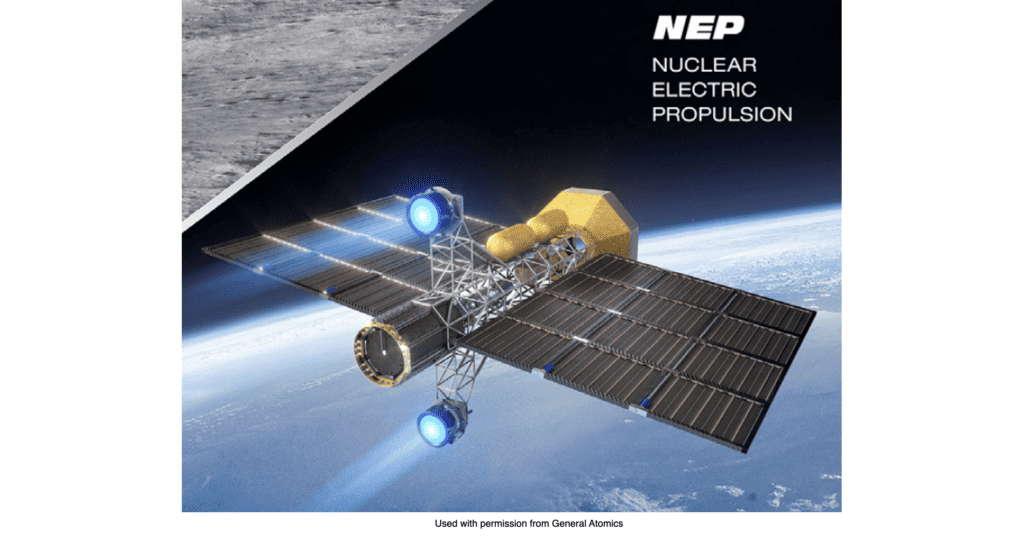
Ron Faibish, chair of US NIC’s Space and Emerging Technologies Working Group visited the Atomic Show to talk about the nuclear systems being developed for space power and propulsion. We discussed propulsion options including nuclear thermal rockets and nuclear powered electric propulsion. We talked about the power requirements for early applications and about the materials technology improvement that will enable better performance.
You should enjoy the visionary nature of this episode and the way space explorers are planning to use technologies that are well advanced on the TRL (technical readiness level) scale.
Please take the time to share your thoughts in the comment section. Reader contributions add significant value here.
Transcript
Read transcript
There's a way, a way such a better way today, today. The nation flies till the world, there's a better way, today, and there's a better way. This is Rod Adams and it's time for another atomic show. My guest today is Ron Fabish, who, among other things, is the chair of the Space and Emerging Technologies Working Group for the United States Nuclear Industry Council. And that's why I have them on the show today. How you doing, Ron? I'm doing great. Well, thanks for having me. We've known each other, known every other for a long time. Can you give just a brief status on where you are today? What's your full-time job and what's your involvement in nuclear space activities? Sure. So I've been in the nuclear business for over 22 years now. Most recently now is the senior director of strategic development at General Atomic's electromagnetic systems, where we have both the nuclear division and the space division. I'm with the strategic development division and my main job is to think about a long-term strategy, short-term strategy, and get some programs growing within the company in the area of nuclear technologies and materials. But as of late, Space Nuclear has been dominating the agenda to some extent. General Atomic has quite a few technologies that are very applicable to Space Nuclear. Over the past six years since I joined GA, this area has been emerging. And now it's right for technology development and implementation, both for propulsion in space, and power on the surface of the Moon and Mars, for example, and power on orbit for various applications, both commercial and defense. So we are very excited to leverage our long-time experience with the advanced nuclear technology systems. We have been participating in the Space Nuclear arena for several decades now. But this seems to be different. There seems to be quite a bit of momentum in this area, and lots of applications that are very relevant for this day and age. So we're very excited to advance technology forward and to answer what both the defense and commercial sectors need in the Space Nuclear area. As you pointed out, nuclear has been going to space for quite a while. Many decades is a matter of fact. Why are people interested in using nuclear energy technologies in space? What are some of the advantages that nuclear brings over any other alternatives? I think the bottom line is efficiency. When we talk about propulsion, we have two types, electric and thermal propulsion. Thermal propulsion, you basically use a nuclear reactor to heat a propellant like hydrogen, a very light propellant that affords you very high thrust for a short duration of time that as much higher than what a chemical rockets can produce, the conventional way to prepare. It gives you much shorter transit times in space. And a nuclear reactor can operate for several years as we know from experience on Earth. So it provides reliability, sustainability and speed to those type of long term missions and long distance missions. Nuclear electric propulsion relies on typical nuclear power. Similar to terrestrial power that we have right now to provide power conversion to powering and propelling and in smaller thruts, but for a very long duration of time with very high efficiency burning of the propellant. So both technologies have a role in propulsion in space, both on orbit and to get to certain planets or moons around us. When it comes to vision surface power, this is the just power to provide power, for example, for the lunar surface. So we have a lot of experience with providing power on Earth. Now we want to transpose that or map it into systems that are applicable for space. In the moon, there is a new interest in exploring the moon, of course, and leveraging resources on the surface of the moon and creating a human habitat for the first time and eventually on Mars. So you can imagine nuclear power for sustaining power for over 10 years. In some instances, it would be very beneficial even when the moon is dark and spots are dark and solar power cannot be applicable. Nuclear can basically provide power and propulsion for that matter, 24-7 in an efficient and reliable way. So I'm going to ask a dumb question that I know the Institute, but maybe not everybody does. Why can't you use something conventional? Why can't you just burn something in space? Well, you can. We are doing chemical propulsion, but you need to carry a lot of propellant and you need to replenish that propellant like oxygen, hydrogen, and things such as that, or methane, or ammonia. And those combustion chambers are not very efficient as nuclear power and nuclear reactors can provide. Nuclear has a very high efficiency in the way we convert the energy of neutrons into something that can be propelled or powered in space. It is a system that requires very small amounts of propellant compared to the chemical propulsion or the traditional propulsion. And in the power of the power side, it can provide a very long sustained burning of nuclear fuel that other technologies just cannot offer. So duration, sustainability, mobility, and logistics are drastically improved with nuclear technologies in space. Why haven't we used nuclear more in space already? We have demonstrated nuclear fission and radio isotope thermal generators dating back into the 1960s. So there have been attempts that there was an ebb and flow in government research and development into this. We were on the cusp of launching and nuclear power systems in the 60s. And actually, this country did launch a nuclear power reactor. It's called the Snap 10a in the late 60s. There was the only US nuclear reactor to be launched in space. So we did power a system in space very low power levels of, you know, in the kilowatts range for about 44 days, if I got it correctly. But that was shut down actually not due to nuclear failure, but other mechanical failures in the system were electrical failures. So we do have experience with launching nuclear matter. As you said, radio isotope thermal generators have been launched for many, many years. However, the bigger systems require more development and more investment. So one problem we had is different government priorities. Sometimes Trump, the development of nuclear fission power systems, such as propulsion and power that we're talking about beyond our TGs. And that lack of sustainability and development and decision and decisive decision to deploy the systems hampered such deployments over the last few decades. And emerging, especially national security needs in space these days that really has gave momentum in the past few years, as I said, to disrenew the interest and hopefully now with sustained funding and government interest and partnerships within government and industry that are very, very important for the first of a kind type systems. We can make it happen. There are a lot of new players in the space industry outside of NASA and the federal government. Are they also investing in space nuclear power, nuclear propulsion? Yeah, so, you know, the industry itself is very interested. So there are obviously immediate national security and government applications that the government is interested in. The industry sees a new economy in space that we can leverage. So the large aerospace companies and new camera aerospace companies and then nuclear vendors themselves, for example, are very motivated and we're investing our own type of internal monies to advance systems and matches we can, start in short or full demonstration and deployment because this is really needed with partnership with the government. So the answer is absolutely there is interest in industry and other international organizations as well. So this is not confined to the US. We have interests around the world and that goes through some of our competitive needs that we have in this country to get there first. While both our competitors and adversaries on multiple levels try to achieve the same thing. What are some of the specific areas in nuclear where you're trying to extend technological limits more than you do here on Earth? Things like higher temperature fuels, what else are important in space? Well, absolutely. I mean, so you have systems operating in space and this is operating in an environment that has no oxygen, has no air. So a lot of things have to operate autonomously. Especially when you talk about power system on the surface of the moon, that introduces controls that are different. They're going to be different from the controls needed here on Earth. And that requires quite a bit of development. We already know that autonomous operations exist but when comes to nuclear power, there is some complexity there that needs to be addressed. It's not by all means insurmountable. It just needs to be developed and I think the development is going on as we speak. And for that we need those partnerships with the government to get there. In terms of materials, I think materials is the biggest challenge when we talk about propulsion. We need to provide, like you said, very high temperatures to the nuclear reactor. That requires very innovative materials. We have solutions. We just need to prove them out. Test them. One thing that we don't have in this country is ground facilities to test, for example nuclear thermal propulsion system. You have to shoot the hydrogen through the, or flow hydrogen through the reactor, which basically heats it up and propels the space vehicle. This is very difficult to do on Earth because we just don't have the infrastructure to do. So we try and very innovative ways to reduce the testing requirements on Earth and get this to space and do some of the critical testing that we cannot do augmented in space. So that's another challenge to design that path. And I think there are some good ideas there. And then we have a facility for testing nuclear rocket engines in jackass flat someplace. In the Nevada test site, I believe that's what they call it, the nuclear security test site. Yes, we did. And actually, there is infrastructure still existing. It's supported the NERVA programs. It's a nuclear rocket program of the 60s and 70s. So those facilities there is some infrastructure still there. I heard just recently there was some fuel cells that I not feel excuse me hot cells to test nuclear materials and do some experimentation and development ceiling existence there so With some investment some of those facilities can be brought up back to lie up up and running again And but there needs to be some investment to get that going again in that area and the desert area and other areas of course the government has to agree to provide those facilities for these activities But if that decision is made I think that we can leverage some existing space and and facilities Upgrade them with some investment and get some programs going again. I believe that the Nevada test site was Recent experience with testing a nuclear reactor if I'm not mistaken the crusty System that was built and tested was actually tested there in Nevada Absolutely, so yeah, the one kilowatt Casti heat pipe type reactor was tested. It is You know, it was not a full-on system. It was just tested for criticality the chief criticality over there Obviously, they never got to space and and I think there's a lot more work to be done to get it special space ready as mentioned before but the One single heat pipe type reactor was demonstrated We feel want more power of course. We need to scale it up and it's still developmental work to be done and and Questions to end to be answered and of course that's part of the development path and demonstration venture demonstration, but that is true that we have demonstrated something that could be Eventually launched into space to provide some low-level power on orbit And maybe on and maybe on the surface as well Yeah, what kind of power levels are The projects working on it if you got say a power of base On Mars. What's the power level expected? So for in habitat of about a few people fall four persons In in space to sustain for a period of time. We need about 40 40 kilowatts electric power and that power is just to support the habitat and some You know elemental needs for sustained sustaining life If you need more than that to let's say start mining In the moment producing water then we're talking about hundreds of kilowatts Into the megawatt range of power That is not for seen as needed in the next in the foreseeable future first I think the need is to demonstrate something at the 10 to 40 kilowatt range So in the tens of kilowatts to show that this can be done it can support some You know basic operations for example on the surface of the moon When it comes to propulsion we need you know hundreds of megawatts in terms of thermal propulsion So those are big reactors And and that would would require to be launched But of course the main purpose is to prepare rather than to power There are options out there where you can do both at the same time and there's several missions Well, this is going to be important When you need to prepare and power at the same time. So then the power requirements would increase Depending on what you are carrying with you. You work for GA general electronics. So they're involved. I think bw XTs there and read recently that US NC ultra safe nuclear corporation had delivered some Special fuel for the program. Are there any other big players in the vending Side of the equation. Yeah, so you name some of the few nuclear vendors that are participating Ex-energies also one more and Westinghouse is another one and and the other Smaller ones start a company that are interested in this for example. I am aware that xeno power on the RTG side They're very interested in Radio isotope thermal nuclear generators of different types so the terrestrial type vendors Very much committed to see Technology deployed each each one of us has a different solution Sometimes they are similar sometimes they're very different in type and how we convert power and what type of reactor we use But the eventual goal is to deploy something that makes sense for the specific application at hand what kinds of things do traditional nuclear vendors expect to learn from participating in space nuclear Obviously, there's not a whole lot of customers up there. So what are you going to bring back to earth? So I think you know we on earth as you know we are we are struggling as is to deploy advanced reactors There is the economic aspects of it. There is a licensing aspects of it. We are facing Existing challenges in that as well in space You know the safety is still very important as you launch, but then once you get the Design you build safety and and and Sustainment into the design so if we are able to do that and bring that experience back to earth I mean we can do anything and you can show the public beside the fact that you are accomplishing a mission which is very important to provide habitat on the moon or to provide propulsion in space You can show that hey, we can do that in space bring back that experience that will you push yourself to the limits of technology back to earth And I think it will be very helpful to give momentum to technology development here on earth And they both feed on each other I think in a very positive way You mentioned that you've been in the nuclear industry for about 20 some years and that you've been involved Were you been a GA for six years? He'd been in nuclear space application the whole time or Were you and other parts of the business? No, well so other parts before me obviously folks have GA itself has been participating since the late 50s since the inception of the any nuclear type of application including space so we We supported various Programs that started and ended including the snap DNA where GA Was responsible for providing the fuel for example, which we make today It's the trigger like fuel. It's a research reactor UZRH uranium's aquarium hydroid fuel the same one of the safest fuels on earth if not the safest Because it's passively safe inherently safer would say So we are making this fuel today actually we we re-established the line to make the fuel a year ago in France Together with famitrom is our partner And we are making this fuel to fuel the research reactor so if people are Remember GA is responsible for deploying some 66 reactors around the world the trigger reactors There are based on this very safe fuel that was developed in San Diego Back when in the late in the mid to late 50s. So the involvement both from the power and proportion has been For the past you know six decades If I count correctly mind-volving in space as others of the nuclear in more of the new camera companies like Ex-energy us and see I would say Really went up in the last five to six years since there was a renewed interest In space power and proportion Given all the experience that our companies have We have a lot to offer in terms of advancing the technology for what the needs are today So you mentioned there's a lot of new interest a lot of Excitement about space. What are the budgets doing? How much has the US government and other governments Decided to invest in this area? That's a very good question To get something going in terms of a first-of-a-kind deployment. It's clearly over a billion dollar per system I don't think it matters what it is at the end of the day when you tally up all the costs I think it's going to be hundreds of millions to You know one or two billions per First of a kind depending on what the application is of course now that kind of money is not I'm due is not beyond the reach of the US government but so far You know we see We definitely see increase investment from both the DOD NASA and DOE But this has to be sustained so as you know in this country. I think We are Government money is appropriated every year by Congress and that has to continue and I think increase What a dramatically sustained in a sustained way in the coming years in order for us to see Some of these technologies deployed so do we have enough money? I don't think right now There's a clear path to funding Both propulsion and power to the amount that it needs But we're hopeful that with the increased interest and need for these technologies that we're going to See the government investing investing the money that is needed To partner within the street to get some of these things deployed. What do you think is going to be first? Propulsion Or rocket engines or Enough power to power a base So it's a very good question. You know both are needed for different reasons What can come first? Both need substantial amount of investment to get there Some people say efficient surface power since we are leveraging existing technologies on earth and Tailoring them tailoring those technologies to the surface of the moon and eventually Mars that that may be is a lighter lift But it still requires a lot of money to get those systems mature so There is ongoing programs and DOD both to support nuclear thermal propulsion nuclear electric propulsion and efficient surface power I think I think we need all three for different reasons And I think it all depends on where the money is going to be bested Initially and I think that's something that still needs to be decided Do you see the resources involved as being complementary or are they competing with each other? I think they're complementary because the missions are different You know nuclear electric propulsion is for more more oriented to powering system and co-pedding system in cis-fluidos space It should space between the earth and the moon For slower type of thrusts But for very prolonged missions Well, we can provide vocal propulsion power nuclear thermal propulsion For NASA it's seen as the right now as what they're investing in for emission to mouse given the very high thrust To propellant need ratio that it has And nuclear power is purely a power for the source of the moon something that You know, obviously Is needed and then can you I forget what was the question to begin with as I was coming through the technologies No, you're doing good I just asked if the if the programs would be complementary or Oh, yeah, putting with each other. It's not necessarily done first Sounds like they could all be kind of delivered about the same time if resources are involved. Why? Also, that you're now reminding, well, another point I want to get, the technology readiness level for nuclear electric and nuclear thermal portion. Some would argue is pretty similar. It is really depending on who wants to deploy what first. For vision surface power, like I said, leveraging a lot of existing technology, the TRL, the technology readiness level is high. But when it comes to power conversion space and autonomous operations, that's where we need more development and demonstration before we're ready to deploy. So it really depends who you ask, which agency you ask, or what they need. And that would dictate the development path. One of the things that people like about nuclear thermal propulsion is its ability to get to their faster. For a Mars mission, for example, what's the difference in transit time between a conventional chemical rocket and a well-suited nuclear thermal propulsion rocket? It really depends on what all bit you're looking at, what the permission you're designing, and I'm not going to get into that. But we see periods of over a year with the mission to Mars with chemical propulsion. When you have to replenish the propulsion, the propulsion first, you can get up to two years, maybe, to get to Mars, depending on the architecture you use. Whereas with nuclear thermal propulsion, it's nine months or less, depending on what type of thrust and what type of orbit and mission architecture you design. So we cut transit time by at least a factor of two, if not more, with nuclear propulsion. So that's very significant for exposure of astronauts in space, to space radiation. I think that that is the main driver of getting things quicker, obviously, supplies, food, rations, and things such as that to keep people alive. While there's a man mission to Mars, it's something that is also very important. So everything that we can do to reduce the amount of time to use the exposure in space radiation, it needs to be done. I think nuclear can really help with that. I personally would be much more worried about running out of food and getting a little too much radiation. That's just me. That's your view. I'm the advantage where I really don't care that much about a little bit more exposure. Hey, Ron, this has just been great. I want to offer you the opportunity as the chair of the space working group to share any information that we haven't had a chance to cover. No, I think we covered pretty much everything very well. I think the landscape is still emerging as the working group indicates. I share the stakeholders that we have are very interesting. There's some these stakeholders that work together in the past, but they're reconvening to make things happen. So we have government, we have industry, we have NGOs all looking into making this happen. The purpose of, for example, the United States nuclear industry council, the US-NIC in creating this working group is to help us convene a clearinghouse of information exchange and opinions and how we can get things on track and keep them on track. I think there is, like I said, good movement forward, but we need to sustain funding. We need to sustain the mission in mind. Why this is important to us? Well, for example, China continuously invests in this technology. They are actively investing in megawatts, kilowatt-sized systems for space, both from propulsion and power side. And the US needs to up-the-game and be ready to be responsive to any such competition that is also on the national security level. So I think by convening the white people to talk to each other, the nuclear vendors, the aerospace companies, the government, the NGOs that all support to do this. And then educating and getting Congress and the other agencies involved to understand the importance of what we're doing. This is something that's very important to do. So some of the opportunities to get the world out is exactly what you're doing here with the atomic show where we can explain what we're doing. Why we're doing it? And why this is important to everyone, both from Earth and in the future space, travelers, to be to know of and actually to make happen. I just realized I forgot to ask you an important question. Does a space nuclear propulsion system going to use halo or dilithium crystals? Very good question. So it's going to use halo. We are not going to any exotic materials just yet. Halo is important to space nuclear. Just as it's important to rescue nuclear. And we do need to secure a supply of halo fuel, high essay, long-rich uranium fuel for the systems. I think every single design that I know of, as far as I know, uses halo. Now, there is also an opportunity to use HEU, high-rich uranium. But given recent presidential directives and authorization to launch such systems, hey, Louis, seen as a much easier lift in terms of getting launch approvals for systems. So this is where the community is going, and we do need hail. Yeah, hail is an easier political lift, but is a technical lift high-enriched uranium as a much lighter reactor. But I think that depends on the system you build. And I just make a comment that in some of our calculations, we showed that it's encountered in the 10% to 20%, or in the not in an order of magnitude, but just in percentage is difference in mass. And really depends on how you design the system. So sometimes the performance, the safety of the system, and how you design it makes more sense to do with hail over an HEU. So there are classes and minuses to both. There is no doubt that HEU will be the goal to, if everything else is equal. But you know, the more you look into the design, hail has advantages and you can minimize this advantages and get something to do the mission and by not compromising any of the performance parameters that you need. So I think it's actually a very healthy path to pursue in order to launch something in the very near future. That's great. Hey Ron, thank you for your time. I wish you the best of luck. And I'm gonna go back and watch a few more episodes and start track to think about work factor, fors and fives and maybe faster vehicles, but anyway. Congratulations. I'm excited for what you're doing. Thank you very much, Ron, for this opportunity. And I look forward to future episodes where we can discuss progress and actually demonstrating testing and launching the systems and making them real. So this is exciting. Wouldn't that be exciting? I'd love to talk about actual hardware. So we'll go to that. Hopefully in the not too distant future. Sounds good. My guest was Ron Favish, chair of the Space and Emerging Technologies Working Group for the US Nuclear Industry Council. This episode of the Atomic Show is brought to you by a new creation capital. We're a venture capital fund focused on selecting ventures with extraordinary promise. They're building the advanced nuclear sector and helping expand our clean energy options. We're building a portfolio of ventures on behalf of investors like many of you. We don't just take funds from the large institutions that typically allocate to venture capital. We believe that regular investors should have access to the opportunities in modern nuclear for their own portfolios. We allow people to subscribe on a quarterly basis, starting as low as $5,000 per quarter. A four quarter subscription will get you exposure to between four and six ventures. If you are an accredited investor and would like to learn more about how you can participate, please check out our website at nucleationcapital.com. That's nucleationcapital alloneword.com. Our fund that all of the information you need to subscribe is available online. You can also subscribe to our newsletter, nucleation insights, and join our pro nuclear investor network to learn about select syndicated investment opportunities. If you have questions, we're happy to chat. Please spread the word. There's a way, a way such a better way today. Today, the measure boys tell the world there's a better way. Today, there's a better way. You there's a way such a better way today. Today, now reach your boys tell the world there's a better way today there's a better way.