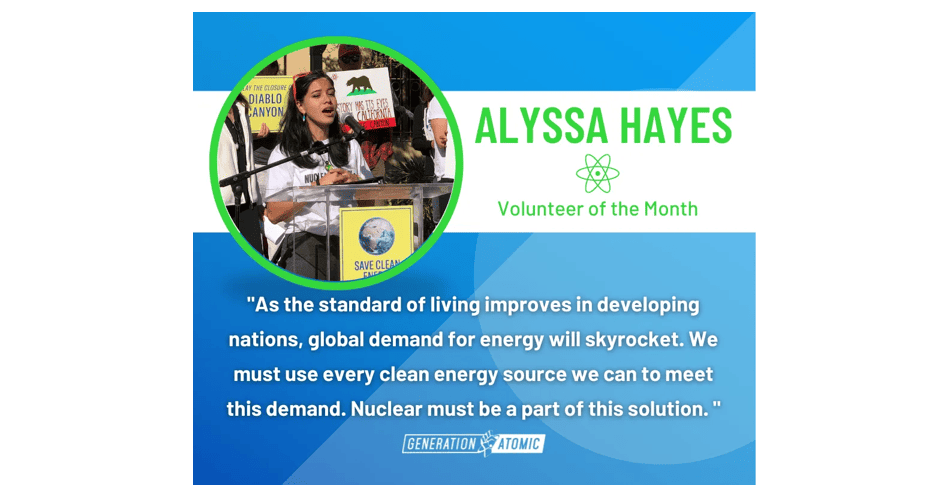
Alyssa Hayes, Nuclear Energy Advocate
Concepts discussed
Auto-linked from the episode's notes and transcript.
Show notes
Alyssa Hayes is a leader in the pro-nuclear movement. She is a PhD candidate in nuclear engineering at the University of Tennessee and she has been interested in policy making and politics since interning with her local representative when she was 14 years old.
She was involved in the successful efforts to save four nuclear power stations (Clinton, Quad Cities, Byron and Dresden) in Illinois and she was recently named the Generation Atomic Volunteer of the Month.
She visited the Atomic Show to share her passion for nuclear energy, her firm understanding of its importance in addressing climate change and providing abundant energy for everyone, and her professional interest in nuclear reactor safeguards technologies and policies that can enable nuclear power proliferation without leading to nuclear weapons proliferation.
Alyssa has a strong interest in broadening access to the nuclear industry and to its professional technical organizations. She is active in the Diversity, Equity and Inclusion committees of the ANS, but the activity that she is most proud of is her role as an organizer for a group called the Computational Research Action Network (CRANE). She is excited about that group’s focus on doing direct work to improve skills and its proactive attitude towards addressing challenges.
> When someone came up with the idea, instead of creating red tape and having discussions about the best way to do it, we just did it. That thing that we’re doing is teaching computational physics methods to primarily undergraduate but also graduate students from underrepresented backgrounds in computational physics.
Alyssa also shared a story about her recent trip to Europe and her tour of a recently closed German nuclear power plant.
You’ll enjoy the show. It will improve confidence that the future of nuclear energy is bright and that its promise is attracting energetic, committed, talented individuals who are focused on building a better tomorrow.
Please participate in the discussion here. The comment section of Atomic Insights often provides more valuable content than the original blogs.
Transcript
Read transcript
There's a way, a way such a better way today, today. The measure falls till the world, there's a better way, today, and there's a better way. This is right, Adam, and it's time for another Atomic Show. With me today, I have Alyssa Hayes, a nuclear advocate extraordinaire, and currently a PhD candidate at the University of Tennessee. Welcome, Alyssa. Hi, Rod. Thanks for having me. You're welcome. And as we discussed a little bit before the show, I like to have the guests tell us all a little bit about yourself. You know, where you grew up, what you got to end in nuclear, what your educational background is, and what's your professional interest in the topic. So I know that later in this interview, we're going to talk a lot about my interest in energy policy, and that actually came before my interest in nuclear. So when I was 14 and in high school, I interned for my local state Senator Melinda Bush in Illinois. And so at the time, I thought I wanted to go into policy and political science, and it turned out that all of that was still true. But as I progressed through high school, my parents and my teachers were like, that doesn't seem like as easy of a career path. And as lucrative of a career path as engineering, and I was doing really well, my math and science classes, and my AP science teachers, specifically my AP physics teachers, told me that it would be a waste of talent. If I didn't pursue engineering of some kind and go to school for engineering. And so I'm really glad that I listened to them. I was sitting on my bed when I was like 17 or something in my dad's house trying to decide, what do I want to do for the rest of my life pretty much. I wasn't comfortable, and I think a lot of people aren't comfortable making significant pivots once they've already started bachelor's degree in college. And when I knew that I was going to go into engineering and I had to pick a kind of engineering, while I figured, okay, there's two things that everybody in the world needs, which is healthcare and energy. And I was not a big fan of biology. It just wasn't the type of work that I like to do. So I didn't want to go into healthcare. And I figured, I don't know how I knew this, but I already knew that nuclear was the primary supplier of base load of clean carbon free energy. And so to me, like nuclear energy was like the obvious choice. I have absolutely no idea what caught that in my head at the high school level. But it was definitely cemented there throughout my undergraduate career at the University of Illinois. From Illinois originally, I'm a Warren Township high school alum. And I did my bachelor's degree in nuclear plasma and radiological engineering at U of I, which is also where I got back into advocacy. And then when I finished my degree, I elected to go to grad school here at UT and that's where I am now probably your cementing in in high school, had something to do with living in Illinois, which receives about 50% of its electricity. from nuclear. So sometime along the path, you wrote you maybe read a newspaper article, you heard somebody talk. It's probably not hard to believe that an Illinois high school student would understand a little bit about the importance of nuclear energy. Now, you mentioned the township you grew up in it. And I think I read somewhere in your biographical material when preparing for this. It's near what used to be the Zion nuclear power plant, which is now a waterfront piece of vacant land. Yeah, actually in, I think it was like September, October of last year. So it's 2023 that we're recording this. So in 2022 in the fall, I had the bright idea to invite as many state house reps and state senators as I could. only one of them ended up actually coming as well as a bunch of local elected politicians. So the mayor, the towns, supervisor, Mayor McKinney and Sherry Neal, as well as a lot of their staff and like just like the other local leadership. The superintendent, the chief of police, the fire chief, etc. The park district, supervisors or directors having their directors. And so I invited a bunch of these folks and I brought along a few other advocates as well. And we did a tour of that that Zion site as it stands now. And up until I started studying nuclear engineering, like in my bachelor's degree, I didn't even know that there had been like a nuclear power plant there that was in the process of being decommission, but pretty much for my entire life that Zion site is only 15 minutes away from where I grew up like driving distance. And it was decommissioned, stopped operating in 1998 when I was one year old. And I, for my entire life growing up, didn't even know that the plant was there, didn't know that the waste was there, didn't know it was in the process of being decommissioned. And I was really saddened to find out when it was finally grassland just flat vacant lot because it felt like a missed opportunity for me as someone from that area to have seen it and learned from it, you know, to maybe have done like a high school tour of it or something. And it was also obviously just sad to see like this clean energy asset down to just a vacant lot for no reason. And so the purpose of the tour was to kind of show my local elected officials like what was at the site and then have open up a conversation for them with constellation about what potentially could be done with that land in the future. So it's still like a super helpful tour, but at the same time it was also really sad to see what has replaced this asset. Yes, the 13 year old, Alyssa was not reading atomic insights blogs when I was writing about the Zion nuclear power station and the potential effort for restarting the plant was being led by a local resident named Nancy Thorner. Probably over this, then you get started in about 2008 until finally sometime in late 2011 the decision was was completely firmed up and cast and concrete that there was going to be no effort to restart the plant. Until 2008 when the price of natural gas looked like it was going to be high for a long time, there was actually some interest on the part of excellent to investigate restarting the plant that and interest dissipated with the crash and natural gas prices and of course the reaction to the Fukushima disaster in 2011. But anyway, the 13 year old Alyssa probably wasn't paying attention to that point. Yeah, at least not to nuclear not yet. You were just about ready to start to internship though so yeah there's that. I can't I don't think that I was ever thinking about doing any kind of political internship when I was 14 I think I was too busy doing other weird stuff. Anyway, so one of the reasons that I remembered that I wanted to invite you to this show I've heard about you and interact with you a little bit on Twitter over the years but you were recently selected as the generation atomic volunteer the month. And so on little interview about you and talked about some of your desires for the future, and what do you see is the future of nuclear and how is it going to make the world a better place. Well, not only do I want to see the like the sometimes forgotten pillar behind like the purpose of international nuclear law, the IEA and even here in the United States, the NRC be supported with like a renewed vigor which is that we need to see and encourage the expansion of. Nuclear energy for peaceful civilian purposes. A lot of the time internationally there's like this hesitancy or at least there has been historically a hesitancy to pursue civilian nuclear energy because of proliferation issues because of well what if this ally country thinks that I'm going to try to pursue a clandestine nuclear weapons program but I don't want to right. I think that there needs to be we have the safeguard technology now right so I do think that there needs to be a renewed push for civilian nuclear energy in every country not just in the United States and not just in first world countries. So we're seeing that push now we're seeing a lot of bilateral partnerships between countries that have already developed their civilian nuclear arsenal significantly with newcomer countries. And that inspires a lot of hope in me to want to continue to push this momentum forward and see that ball continue to roll. And so that way maybe we have another nuclear golden age like we did 40 years ago. So that's kind of number one is like the expansion of like this very obvious base load technology for clean energy especially as not only is the international population growing but the standard of living per person. Out of all of the existing almost 8 billion people on this earth is improving as well and with that standard of living improvement we also need more energy to support that standard of living. I like to take hot like boiling hot showers every single day and I don't see any reason why every other person shouldn't have the opportunity to take boiling hot showers every day if they want to. For us to refrigerate our food etc and so we need to be producing so much more energy and right now the cheapest way to do that is with fossil fuels. And even though China showed like I think to me China is like a great example of how they exploded their use of fossil fuels at the same time that the standard of living for their population was improving. And I think that was a good thing even though obviously it contributes to carbon emissions but now they're transitioning because they have like the technological capacity to. And so I think nuclear kind of provides the opportunity to skip as much of that time spent mass consuming fossil fuels will simultaneously allowing people to have that standard of living. So a lot of the time I think when I hear other people answer this question it's very like first world focused. But to me I want to see everybody have the same standard of living that I do and I think there's a pathway to do that. I agree with you. But here's that you're also. Pierce some of the rhetoric around non proliferation and recognize it in some cases not all in some cases people that that yell about non proliferation are really trying to make sure that it's an America first kind of argument it's we don't want them to have it but of course we have. We want in terms of enrichment capabilities use of plutonium certainly and we do have a weapons program that's not safe guard it because we're one. of the chosen five. Yeah, I agree. Unfortunately, a lot of the colleagues that I interact with have the same mindset of that, well, it shouldn't just be America first that there should be a more equitable approach to the balance between nonproliferation and the expansion of nuclear energy and therefore the demand for nuclear fuel and who gets to produce it. But organizationally, we're still at a place where it is difficult for societies that represent very large amounts of people, not just like private or non-profit societies, but also for government organizations to say those kinds of things because they're speaking on behalf of a lot of people who may not necessarily agree, even if leadership do. But there are also in some cases speaking on behalf of like parts of the American government, which depending on which part of the American government you're talking about has to have, like in America first mindset. And so this is a hot topic right now that a lot of people are talking about. I think I'm just going to come out and say it, my mindset is that I do want to see more like fuel enrichment and reprocessing capability by our allies, regardless of like their status as a third, second or first world country. If they're allies of our country, I don't see any reason why we couldn't be buying our nuclear fuel from them. So I think that the safeguards technology is there. I think that the organizational and management framework and the regulatory framework is on its way. And I'm hoping to see more exceptions in one, two, three agreements between the United States and our allies to subsection 123 A7 in order to promote and expand that nuclear fuel market, especially with the ongoing stuff between Russia and Ukraine, obviously. It's important for people to recognize that fuel production and fuel enrichment doesn't necessarily link to proliferation and that there are technologies that allow us to keep track of the material in such a way that we're pretty safe, even if somebody's enriching material. And it's also important to recognize that enrichment is really the old, is an old word. It really means purification. It's you were able to produce much smaller machines if we're able to use a pure fuel rather than one that is impure by having lots of non-fissile material in the fuel. The highly enriched uranium experiments that we did, there was EBR1, I think, was about as tall as an American football and not much bigger around, was able to produce quite a bit of, I can't remember it was like four or five kilowatts and that little bit. Anyway, enrichment is not necessarily a bad thing and plutonium is certainly a good fuel source and often is not particularly usable as a weapons material if it's been produced in a commercial reactor. Yeah, that's part of the some of the safeguards, I guess, perspective on it. I think there's a really easily relatable idea about, I forgot what the phrase for it is, but I think something that's really, really easy for anyone who might be listening to this to understand is let's say there's constantly scenarios about like, oh, does a high level waste sitting at like an ispecy, just spent fuel pad, or an independent spent fuel storage installation ispecy. Does that pose a proliferation risk? What if somebody wanted to like steal one of those casts? The answer is that they can't because it is so fricking difficult to move them because they weigh so much. So like it would either take a a lot of time or a lot of effort or a lot of people, a lot of equipment, something that would be really obvious and easy for security to catch before you were able to get even one of those casts moved like a very small distance, even like close to off the pad. Like someone would notice, you would get caught, you would not succeed. And so that same idea in terms of safeguards can be applied to a lot of our advanced reactor fuels because like the amount of effort or the types of technology that would be needed to divert that material or those technologies to something that was specific to nuclear weapons is something that would basically be very easily caught, right, by the IEA or by a neighboring country or by like satellites surveillance, right. Like that's one of the primary ways that we keep tabs on Russia's nuclear arsenal is there's all these different levels of intelligence that would allow us to catch those things. And so in that way a lot of our advanced reactor equipment materials facilities are safeguarded from diversion. Yeah, I'm glad you mentioned that there are other ways to ensure or safeguard material other than just the idea that the casts are huge and hard to move because many of us are very interested in much smaller nuclear power systems and different fuel forms that may not need those kinds of enormous concrete and steel casts that weigh 100 tons and have to be moved by a slow crawler. So, you know, we need to have other means of ensuring the safeguarding and protection of material that don't necessarily require those kinds of high density, high mass. You can't move it kind of arguments because we do want to proliferate very small reactors in many places around the world because people need them, need what they can produce. Well, the nice thing about those casts is that we do have the technology to move them. It's just that illegally obtaining said technology is very difficult. Well, the technology that's being used to move them to where they are today is a slow crawler. It's this enormous crane that lifts up the material and moves around at the pace of a of a maybe a tortoise or slow, right? It's really slow. But because they're they weigh 100 tons, 150 tons, they're huge and massive. So, let's move on to another topic. You have been a nuclear advocate since 2016. And I think your initial entry into this field was saving a couple of nuclear reactors by yourself. Is that kind of what's happening? By myself is the last way that I would describe it. It really took a village. So, in 2016, the Clinton and Quad Cities nuclear power plants, there's one reactor at Clinton and two reactors at Quad Cities. These are the two that are the furthest away from Chicago. They were at risk, both in Illinois. So, this is Illinois specific, because that's where I was at the time. We're at risk of decommissioning due to economic reasons. So, in being very far away from Chicago, they were like, well, we could just like easily replace this generation with natural gas, right? Like in-energy was the up-and-coming natural gas company in the area who wanted to slap some more plants down in that area to replace these nuclear power plants. And they were luckily saved by the Future Energy Jobs Act, which was passed due to the efforts of a lot of folks, including people from at the time, or members of what would become environmental progress and what would become generation atomic and stand up for nuclear. A lot of those folks were present on the ground doing like protests, like trying to do, or I guess communicate with local state and house representatives. I was not as heavily involved in like as much of the grass tops. I was more focused on the grass roots and trying to get my fellow students at the University of Illinois to be supportive of this issue in the first place and then care enough to then call their representatives and say, this is an issue that I care about. Please pass the Future Energy Jobs Act in order to save these nuclear power plants. I actually partnered a lot of people are really surprised by this with the student section of Beyond Coal, which was a sub campaign by the Sierra Club. So these were like Sierra Club student leadership on campus, working with us because we all had the same goal of preventing these new natural gas builds by in-energy. And so that was super cool. Like I still have like my Sierra Club t-shirt from like our quad days and trying to like pass pamphlets out and like do fun little gimmicks, like spin the wheel and see if you can answer a question about nuclear just to get people to come over so we could talk to them about Fijia. So that yeah that's kind of where where my grassroots advocacy started. There was also a march, I know there's like a bunch of pictures of this on the internet. There was a march through Chicago one day. This is where I met a lot of current advocates like Michael and Eric and Mark. And at one point like we ended at the ground level of the skyscraper that in-energy is or at least was in at the time. I don't know where they are now. And like Eric needed to stall to deal with some AV stuff. So he gave me the mic and that was like the first time I ever went on any mic about nuclear advocacy. And it was at that point for they were like we need to keep giving her the mic. You've speak very well. I can see why they would say that if I wonder if your 2016 experience with the Beyond Coal folks to fight a natural gas facility. I wonder if that caused Aubrey McClendon the primary funder of the Beyond Coal program at the Sierra Club to roll over in his grave. Maybe you know what Aubrey McClendon was? I don't actually. He was the founder and CEO of a company called Chesapeake Energy which was the largest natural gas fracking company in the US at the time. But he gave the Sierra Club about $25 million to fund the Beyond Coal campaign. I guess it checks out you know especially because I so one of the other things I was doing at the University of Illinois was that I was the head teaching assistant for like basically energy systems 101 which was like a gen ed class that taught about fossil fuels nuclear renewables throughout like a semester for mostly non engineering students just trying to get their science gen ed so it was like a very 101 type of class. And because of that class I was like the main person updating the slides year after year and that meant that I had to track what the percentage is of our energy generation in the United States from all of our energy sources was. And like over just those four years, coal and natural gas basically just like flipped numbers from being like slightly plurality, coal to slightly plurality natural gas going from like 35% or whatever, down to like 29% or something over like four to six years. Natural gas was taking markets away from coal with of course a little help with a push behind to push coal down that happens in the energy world. I think sometimes people forget that the energy industry has cared as much about demand and markets as it has about supply. You don't necessarily make your money if you're oil company by finding a lot more supply if there's not yet a demand for it. Would gas as well. Here in tennis. Which of course. Oh go ahead. No, it leads me to, and one of my, the things I've beat the drum on is how many times the competitive energy sources have been found to be doing things to push the buttons, put their thumbs on the scale against nuclear. Because nuclear is a pretty darn competitive power source that captures a market and hangs onto it for 93% of the time. Yeah, that's actually something that we're kind of struggling with a little bit here in Tennessee. Not necessarily the nuclear part, but the coal versus natural gas versus increase in demand. And so there are propositions out to build new natural gas plants here in Tennessee. And they're primarily to replace the aging coal plants here. But at the same time, they're also projecting significant increase in energy demand over the next few years. And so it's like a combination of hotter summers. But also more people just moving to the state. There's more people moving into Tennessee than moving out of Tennessee. And so they also need to create more generation to meet that demand. And there is no nuclear projects. Anytime soon there's just demonstration projects, but they're not going to be connected to the grid. And so we're most likely going to see more natural gas here, but there is also a massive, massive push to see more solar than what TVA has already promised. And then there's, I've also been working with some environmental groups here in Tennessee as well. So this is like, it's mostly all the same people, but sunrise Knoxville, I would say is like the closest to home group that I talk to regularly, as well as like, I don't remember the full acronym for. I think it's like southern Appalachians for clean energy or something along those not lines acronym wise. But yeah, I have definitely been engaging with folks that are kind of akin to the beyond cold group from the Sierra Club at U of I as well in helping them fight for increased clean energy replacements for coal because there's very, very little renewable energy going on here in Tennessee. So to me, variability is not as much of an issue here just because there's so little renewable to begin with. Yeah, when there's not very much renewable, there's room for it on the grid. And it certainly does serve as a fuel saving technology. It's that when people start trying to make renewable, do something that really can't do, which is supply 100% of the grid or even 90% or probably even 50%. Yeah. You know, once you get to penetration levels approximately equal to the capacity factor of the generation source, you're getting close to the limit of what you can do without massive changes to the grid. People that claim that wind and solar are cheap don't like to talk about the impacts they have on other parts of the grid. Because the their calculations don't include those. Yeah, I don't have the pie chart in front of me. I could probably pull it up in about 30 seconds, but I think I'm going to try to find my own pie chart actually. And while you're doing that, I'm just going to throw out a question that maybe we can talk about later. One challenge that places where there's been a high penetration of coal in the past, have in terms of 15th and natural gas, is it logically enough? No one ever built a lot of natural gas pipelines into areas that have a lot of coal. So it's not necessarily as easy as some people might think to switch from coal to natural gas, because the plants might be cheap, but the pipelines aren't that easy to construct. Yeah, because if you're looking to replace directly on site, use the same switch yard, then either you have to build new pipelines, which is slated currently to happen. Here in Tennessee, obviously there's protests against that because people don't want all that land to be disturbed, also because the fossil fuel industries tend to be significantly poorly regulated, especially in comparison to nuclear. And so there's more reports about spills, leaks, et cetera. So it's either you build more pipelines through those areas or you transport the fuel there some other way. And some other way is typically more dangerous and even more prone to issues. There's no safer way to transport natural gas other than by pipeline unless you don't transport it at all. So, but I did pull up my pie chart as of 2021, EIA numbers. So this is one year out of date, because 2022 numbers are probably out or close to being out. But the variable renewables made up only 0.6% of all Tennessee electricity generation. So that is very small and we can definitely stand to increase that percentage and eat into our coal and natural gas percentage. Absolutely. Of course, I think as I recall the maps, Tennessee's not a particularly good wind state. No. So it's probably gonna be the major portion of that. Yep. By comparison, the United States overall is this is also 2021, 9.5% wind, 3% solar. So that's 12.5% variable renewables. And then Illinois wind plus other, put us at like 10% and this was in 2020. Your former, your undergraduate university, so I should say, has got a very interesting research reactor project going here. You've been keeping up with the UIUC, USNC collaboration. A little bit. So I do know a bit about the micro reactor project there. I know that it was going to be built regardless of like the passage of CGA because like it's not going to be selling significant amounts of power. I don't, I'm not sure if it's gonna be selling any amount of power to the grid. And if it is, it's like half or less because I think that was part of the requirements to be considered like a research versus commercial reactor. Actually, I don't think they're selling any power. I could be wrong. Don't quote me on that. But I also know that it is a major area for research on thermal hydraulics. So there's a great nuclear thermal professor there, Dr. Caleb Brooks. And I know that his research group is going to be benefiting significantly from this project and that he and his students plan to publish a lot of material about coolant loops for small reactor projects. So I know that that's a major part of it. But other than that, I haven't been keeping up as much with the project. Yeah, I think it's also gonna be an important example of how universities can help train not only operators, but maintainers and management and all kinds of stuff for the upcoming commercial nuclear industry. Having a reactor that is a version of a commercial plant is gonna be huge, I think. And I think it's hopefully gonna be the first of several maybe in the first of many. Yeah, especially because while we're still in the stage of R&D or hopefully near in the end of the R&D stage and we're seeing more companies submit their designs to the NRC for review. It's a great time to build demonstration projects. So that way when it's time to debut the real thing or the commercial version of your technology, then you can use the successes and the testing from your demo to back you up when it comes time to apply for the license for your commercial facility. So that's one thing that Chiroz is doing here as well in Tennessee with their Hermes project. Either on their way through the NRC, actually, I think I saw something in like the A&S Smart Briefs recently about how the NRC recommended that they get their license to build their Hermes demo here. And the whole point of the Hermes demonstration project is for them to do all of the like heat load testing, et cetera, on the demo version of what will hopefully become their commercial technology to sell worldwide. So that's a very exciting project and I'm excited to see them break ground like 30 minutes away from me. Yeah, I'm excited about that. I think that what you read was the advisory committee on reactor safety, the ACRS recommended to the NRC that they approve the design. The NRC doesn't necessarily need to make a recommendation anybody there's the approval or the year it up. So now it's my favorite job to do this. Yeah, the ACRS review is a very important step. The Hermes is proving that you can get through an NRC process fairly promptly if you're well prepared. They did a lot of homework and did a lot of ground lane, but it's only been 20 months since they submitted their construction permit application. So I hope that they're breaking ground and building soon. And as you noted, that's gonna be a non-power reactor that will produce up to 35 megawatts of thermal energy. As part of their testing programs. Yeah, yeah, right. My bad, was the NRC advisory committee on reactor safe guards recommended approval of a construction permit for the Hermes demo. Yeah, they're going through the part 52 step process, which is in my view, the right way to go for a first of a kind system of any kind. The one step process is far that I can tell. Ties your hands too much once you get the design certification or once you get the combined opportunities to see it well, you can't make any changes to your design as you're building it. And if you've never built it before, the chances of needing to make changes is pretty high. Actually, it's about 100% as a probability. need to make changes. Well, flexibility is a good thing in a regulatory remark. Yeah, it is. Now, in terms of policy, how involved were you in helping get the Inflation Reduction Act across the finish line and getting the right kinds of nuclear incentives included there? Effectively, not at all, because there were other nuclear advocates involved in that passage. But the pretty much the only thing that I did at that time was signed the Generation Atomic petition that basically went out to every single person that they could possibly get it to send like a, okay, if you do this action, then it automatically sends like an email to your representatives and tells them that you a constituent want them to support the passage of the IRA for these pro-nuclear reasons. That was a major thing that Gen A did and was responsible for helping with like that push at the grassroots level. And so I did my part as normal Gen A member and like American citizen. But other than that, I don't recall doing anything like beyond that personally. You probably were busy as a PhD candidate doing something like studying or writing or research. Yeah, probably researching. I think this happened after I defended my thesis or like doing my pre-limbs. So it was probably doing research. How long do you have before you become Dr. A's? Hopefully you're going to have the thing that I was working on before this was actually like a summary of my research plan to send to D3D for the rest of my PhD. So it feels like it's a lot of work. I definitely have a lot to do. That does mean that I will have to scale back a little bit on my advocacy work for the next year and a half. But if it means that I can then focus the rest of my career on energy policy, then it will be worth it. He's going to be a more effective policy person, I think, with the ability to use the honorific. I think so too. I think so too. I definitely do deal a little bit with perception of me as a person, not just as a nuclear engineer. I've definitely experienced a lot of scenarios where I would be at some outreach like event for kids or high school students and their parents. And had a parent typically like a father come up to me and ask me like a question or just ask a general question about like plasma demo that we had brought or whatever and how it works. And I would explain it to him. And he would just simply like not believe me. And then I'd have to like call over like a male student and then have him say pretty much the exact same thing for the guy to be like, oh okay, which is very annoying. And so, and I look super young for my age. I'm just kind of starting to get my laugh lines at like almost 26 years old. So I think that having that honorific is going to make a significant difference. Unfortunately in how I'm perceived further along in my career. I know that there's going to be a time when you're going to be very happy to look young for your age. So don't give that up just. And it is, it is tragic and it's been a concern of mine for a long time. I am obviously not a female. But I do have an awful lot of very respected females in my life. I am proud of the fact that before I went there, the Naval Academy added women to the regative midshipmen. I was proud to be able to say I was in the first class that called other midshipmen man because we had a class above us that was women. And then I'm the father of two daughters and the grandfather of a four grand daughter. So it's an important thing for me to to think that people can be respected and recognized for their knowledge and their skills. No matter what they look like or sound like. Yeah. As long as the nose are talking about it. It's an easy thing to say, but it's not something that a lot of people really like embody I guess or like that that like penetrates the way that they think in the moment. Right. I think pretty much everybody would agree with everything that you just said. But there's a lot of times where people have unconscious biases and they don't even realize that their perception of me is influencing how they perceive the things that I say or the things that I write. And so it's definitely a concern of mine when it comes to ensuring that like the content that I want to communicate about energy policy, about nuclear power gets across and is received in such a way that people will just like hopefully believe that a nuclear engineer knows what she's talking about. Yeah, I guess we're on the topic of another interest error for you. You've been serving in the DEI, is that the correct the diversity equity inclusion? Is that the right? Within the A&S, right? Yeah. So I serve as like a DEI advocate in a few different places. So there's the diversity equity and inclusion action committee or day act at my university in the nuclear engineering department. So that group has been responsible for making fee waivers more accessible to low income potential graduate students. They've also, they're currently working on, I guess we're currently working on recruitment of black high school students in actually the neighborhood that I live in. Because I happen to live in the neighborhood that is next door to one of the largest black high schools in the city. Then there's also, as you mentioned, DIA, which is diversity inclusion in A&S, the A stands for A&S, I guess, which is one of the, I think they're technically a committee within, no, fair division, I think they're a division. I always forget which one's a committee and which one's a division. I think they're a division within A&S. Where they put the student sections committee and the diversity inclusion within A&S, it's just kind of like, there are things that have to be in A&S, but they're their own separate thing. That's not just one of the committees or one of the technical divisions, so that's why I always forget. But anyway, that's where I promote things that I think A&S could be doing to improve recruitment retention, just like a generally more inclusive and welcoming culture within the nuclear society. So then to me, the most impactful thing that I'm doing is as an organizer of this group called the Computational Research Access Network, or Crane, for short, they all have their own acronyms. I think Crane is the coolest one because it does the most direct work and it's like the most proactive. As soon as someone came up with an idea, instead of creating a bunch of red tape and having discussions about how the best way to do it, we just did it. And that thing that we're doing is teaching computational physics methods to primarily undergraduate but also graduate students from underrepresented backgrounds in computational physics. And so this is everything from intro to Python all the way through like Monte Carlo algorithms or particle and cell algorithms. It's a very, very fast-paced course, but it also teaches like how do you learn or how do you think in computer algorithms to these like the exact demographic of students that all of these different groups and a lot of like diversity groups try to target and just gives them those skills directly, as well as networking with them and then helping them feel more connected to the physics community. So those are kind of, that's like the summary of all of the D and I stuff that I do. Yeah, well that sounds like a terrific endeavor. One of the things that does come as a challenge to some of this is we really want to include more people of larger diverse body of recruit recruitment. But some will say, well you can't you can't hire somebody that never applies. You can't hire somebody who has never even started to think about going to school and of course that's part of the challenge. I mean I know that there are many people who don't aren't born with the advantage that I have about it. Two college graduates for parents and knowing how to apply and knowing what to do and knowing how to choose a major all that stuff. I think that you're the first in your family right? That's a hard thing to do when you're going to look to who are your examples? Yeah, I am blessed in that I had examples in my friends and in the faculty at the University of Illinois. The culture in the nuclear department at U of I is really like a family. I know that pretty much every department wants to say that about themselves but in that department it's real. There's no such thing as an age gap really in friendships between freshmen and seniors and undergrad. That's the department where I met the likes of Katie Muma who I credit as being like my first mentor and so having been surrounded by people who taught me how to write a resume or how to request letters of recommendation or just being close to faculty who were willing to write letters of recommendation for their freshmen undergraduate researchers to help me get positions or help me get into grad school and stuff like that. So also just encouraging me to pursue pretty much whatever I wanted. I guess made up for the fact that I couldn't ask my parents for those kinds of things. My dad was super supportive of me but he couldn't offer me like the information about like how to I don't know do it in an interview for like an internship at Exelon or whatever. It just wasn't something that like he was prepared to like advise me on and a lot of people are in that boat but I sometimes feel like I was lucky to have made some of the connections that I did at U of I and not every department at every institution offers that type of culture and so that's one of the things that we wanted to promote in crane and hopefully something that we see in other organizations and other societies as well moving forward. That was a lot of talk a lot a lot of important stuff about what happened while you were at the University of Illinois but you also had to get to University of Illinois. Yeah. Hopefully I mean from a from growing up with what I'm necessarily having college graduates or people who could help you to find a university is that my interpreting a career? So one thing that we found at Austin East, which is the high school that is like walking distance from where I live, is that their students, they know about the programs that basically fund for like your college. Like I don't have any student debt because I came from like a lower income household and like the government funded my way through going and getting my bachelor's degree. And they'll do that here in Tennessee too. That wasn't just like a woke Illinois thing. That's like a prevalent program at a lot of public universities. And they know like that the University of Tennessee exists, that there's these great engineering programs. There's two problems though. And this is this is what we found through like a lot of like discussion and like monitoring of like the situation with the students who want to be engineers and the students who don't want to be engineers at that high school specifically because their high school is in a different situation than my high school was in. The two problems are the testing scores. So their high school doesn't have significant access to like ACT prep that my high school did. And the other issue is that a lot of those students don't see themselves as being able to be engineers. And that's something that I can relate to especially as a woman of color when I was in high school. I had like my AP physics teachers like really had to like really push me and like get on my butt about becoming an engineer because I could not see myself as an engineer at all when I was like in their class. I was performing very well but I wasn't doing like first robotics. I wasn't taking like the coding class that my high school offered. I was like a band kid and like that was more my thing. And so I didn't really see myself as like someone going into engineering until somebody explicitly told me that they saw it for me and then I believed them. And so there's not a whole lot of that attitude like prevalent through that high school. I'm sure that their science teachers and their robotics teachers tell them the same thing. But there's like they have this sense of my school isn't very high performing and I go to this school so I must not be very high performing. Or while a bunch of other kids around me are planning to just like graduate from high school and then just like get a job wherever. And so it's fine if I do that too. Which that is a fine thing to think. But I do think that there are potentially students there that could be engineers but maybe don't believe in themselves enough to see it. I once spoke at a middle school a few years ago and a seventh grade teacher came up to me at the end of the day and she told me that one of the kids that saw me like speed went up to her and was like I never thought that like a girl who looks like that could be an engineer. And so there's definitely kids in those circumstances too. And I think it's they're more likely to be in that mindset if they're a girl or if they're going to a school that's like low performing and then that kind of you know that's how they think about themselves. I interviewed a student a few weeks ago who super high performing. He's like the main communicator for their engineering pathway at Austin East. And he was like when I'm taking the ACT I just get really really anxious because like something is like telling him that he's not supposed to perform well. Or that like there's so much riding on this test. And like he can't he can't like risk failing or like doing poorly because there's all this opportunity that he could lose if he doesn't perform well on this one exam. And so there's a lot of anxiety I think plaguing the students. And so that that mentality is one thing that has to be overcome but another again is the funding and the test prep. I happened to go to a high school in a blended financially blended part of Illinois where I was coming from like lower income housing slash like just like homes that didn't cost as much to buy. But the high school itself also overlapped with like some very large houses in like a very low part of town. And so those people funded the school. And I just got to benefit from all that cool funding and I got a lot of test prep just every single week from all my classes and performed well on my ACT who would have thought. So there's definitely some systemic things and some cultural things at play. Absolutely. And one of the other things that we in the nuclear world who are trying to build a workforce for our advanced nuclear economy. We have to also remember that unfortunately they don't do it very much these days. But vocational type technical training is just as viable as being an engineer. We need to get people to get interested in mechanics and welding and electric electric electricians. Yes. High fitters. All these kinds of jobs that you know we're not trying to shoehorn anybody in them. But there are people out there who are terrific smart people that just don't like sitting in classrooms. Yeah. Yeah. You're absolutely right. We like need to like get more people into those trade programs and then from those trade programs into our power plants. Later on in life they can decide if they want to you know go take you know more school and become you know something else but actually doing things with your hands is such a valuable thing. Hey, listen it's getting almost to the hour point and I like to try to not go too much facet. I want to give you the opportunity though. Is there something you want to say or some topic you want to cover that we haven't touched on yet? Well we talked about enrichment and reprocessing in non nuclear weapons and non first world countries in the very very beginning of this. And when you mentioned that before the interview that like oh I could just bring up whatever that was kind of like the main thing that I was thinking about because I've been thinking a lot about non proliferation recently. I'm also on the public policy committee in the American Nuclear Society. And so one of the things that we're currently working on is there's going to be a new position statement on non proliferation and nothing that I have said in this interview necessarily reflects on the beliefs of the American Nuclear Society just going to put that out there. So but I am excited for the new non proliferation position statement to make its way through the rounds. So yeah we've already touched on the thing that I've been recently working on. And we've talked a lot about DE and I that like those that that's it those are my two passions like pro nuclear advocacy and diversity equity and inclusion. Yeah and included in your non proliferation I think very specifically you support the idea that South Korea should be able to do pyro processing if it feels absolutely. Oh yeah. It's best interest to do that. Yeah I agree particularly I mean it's got there are people that say we don't need to reprocess we've got all this uranium available but we just need to do some stuff with the leftovers and if you're a small country they didn't have a whole lot of space. Recycling the material is one way to reduce the amount of space it takes. effect it gets people away from asserting and it's just waste it's not waste it's future fuel it's it's good stuff. And you saw that with the go ahead. Which is that I actually just got packed from Germany about a week and a half ago. And while I was there I haven't released a ton of media about this yet but I got to a tour, a rock dwarf nuclear power plant with Mark Nelson and a professor, a design professor from a local university as well. And while I was there I learned that at least that nuclear power plant in Germany if not all six of them have not yet had the order to start doing permanent decommissioning work. And so therefore the closures are still in a stage where it's reversible. And when you say all six of them you mean the six that were closed in 2021 and then the three that were closed in 2021 and the three that were closed April 15th this year. Yes exactly those six. Okay yeah those are those are the biggest and best of the 17 that they had when they started closing them in 2011. Yeah producing what a quarter of all of their electricity. Yes although they peaked at over 30% at one point they had 21 plants operating. I think that was 1997 was the peak. I did not know that. Yeah to be at over a third. Yeah the interesting part about Germany's closure was it was actually implemented in the law in 2001 not 2011. But like I do think that it obviously I think all pro nuclear people can agree that it would be great if they could just be like yeah so these six reactors reopen them just to thought. Yep it'd be great for the for the world for the atmosphere for the economy of Germany and believe it or not it would also have a major positive impact on Japan and South Korea. Hmm. You want to elaborate on that? Germany would be buying less liquefied natural gas which would in the way that the bathtub works. If they buy less that mange center is more available to other people to buy at a lower price. True. Germany's ability to go through the winter this winter by buying up all the gas it could find. Put a hurt on other people that wanted to buy that gas and use it. The world's LNG market is almost now as connected as a world oil market. It's not just isolated anymore. Yeah. Hey I've enjoyed our conversation. I'm glad that we covered the areas that you want to talk about. I congratulate you on your award as the volunteer of the month. I congratulate you on the successes you've contributed to and saving nuclear plants in Illinois and hope that your continued studies go very well and we can soon look up to the doctor of illicit haze in the nuclear advocacy world and finding good positions on Capitol Hill to influence. I look forward to that day as well. There will be a tough road to get there but it will be a rewarding one. Yeah. Thank you very much. Yeah. Thanks for having me. There's a way, a way such a better way today. Today, the nation boys tell the world there's a better way. Today there's a better way. Ooh, there's a way such a better way today. Now, region boys tell the world there's a better way. We're waiting today and there's a better way