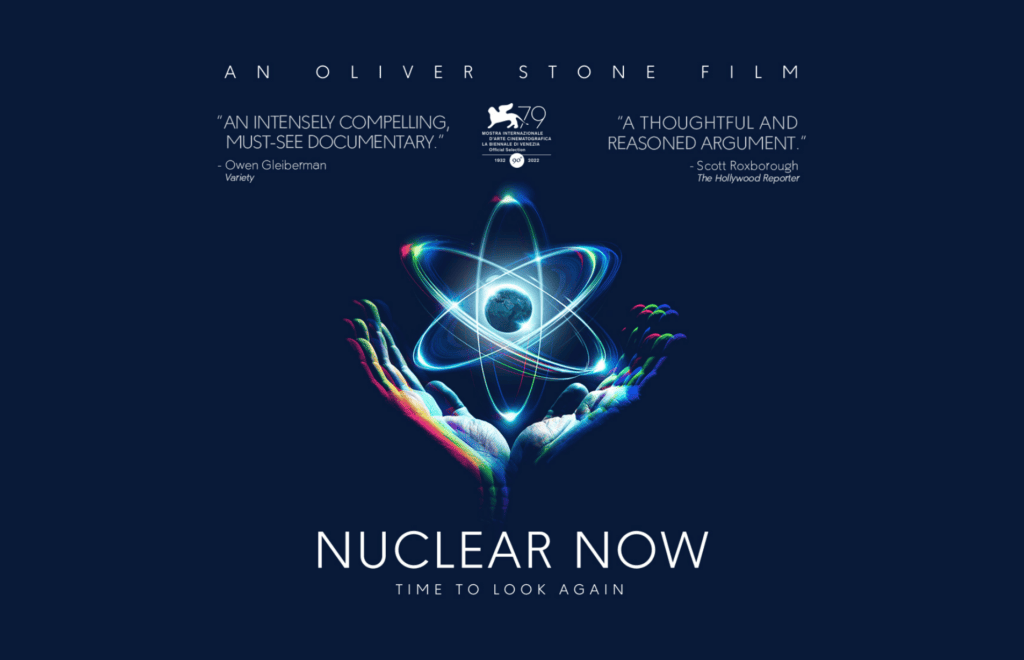
Oliver Stone and Joshua Goldstein Co-Writers Nuclear Now
Concepts discussed
Auto-linked from the episode's notes and transcript.
Show notes
On Apr 28, the much anticipated film, Nuclear Now, will premier in selected theaters in New York, Sedona and Los Angeles. It will remain available in those venues for a week. On May 1, 2023, the film will be shown at 350 theaters across the US and Canada.
The film is co-written by Oliver Stone and Joshua Goldstein. Here is a blurb about the film.
> Nuclear Now takes viewers on an educational and thought-provoking journey with legendary director Oliver Stone, as he explores the powerful impact of nuclear energy. The looming climate crisis remains unresolved, and the volume of carbon-free electricity needed over the next 30 years is almost unimaginable. This insightful documentary aims to remove the fears associated with nuclear energy and highlight the sustainability and affordability it can bring in the pursuit of restoring the world’s ecosystems and economies.
>
>
>
> I spoke with Oliver and Joshua to delve more deeply into the reasons why they are so passionate about their self-assigned task to correct long held beliefs about nuclear energy. We talk about their personal journeys from being reflexively opposed to nuclear energy to become committed proponents that see nuclear as an important tool for mankind.
Paraphrasing one of Oliver’s observations from our discussion, nuclear energy is a gift, perhaps the greatest gift ever given to man. It is currently one of our greatest missed opportunities. Paraphrasing Joshua, nuclear has proven that it can scale, and scale quickly to make a major contribution towards reducing man-made CO2 while producing high quality, abundant energy.
You can find a list of theaters that will be showing the film here. Almost all of the showings will be on Nuclear Now Day (May 1, 2023), but there are exceptions to this general rule in San Luis Obispo, Breckenridge, Fairfield, Idaho Falls, Martha’s Vineyard, Minneapolis, Columbus, and Dallas.
There is a pretty good chance of finding a venue in most metropolitan areas. Digital versions will be widely available sometime during the summer of 2023.
Here is the Nuclear Now trailer. At the 0:46 mark, you will see and hear me saying one of my favorite words.
Disclosure: I play a modest role in Nuclear Now as one of the interviewed experts.
Transcript
Read transcript
There's a way, a way such a better way today Today, the nation's voice tells the world there's a better way Today, there's a better way This is Rod Adams and it's time for another episode of The Atomic Show I'm so excited to date to welcome Oliver Stone and Joshua Goldstein, co-writers of the Blockbuster New Documentary Nuclear Now Oliver has been a fixture in the film industry for more than 40 years He's a writer, a director, and producer and he won an Academy Award for Midnight Express and another one for platoon and born on the 4th of July Joshua is a professor and an award-winning scholar of international relations He's written widely and spoken on war and society Wars effect on gender, economics, and psychological trauma And I've been in diplomacy He got excited about nuclear and ended up writing a book called Bright Future with staff and quiz on the rapid response or rapid decarbonization in Sweden and France when they shifted to nuclear power Oliver read Bright Future and got excited as well Full disclosure, I play a modest role in the film and it appears several times as an interviewed expert Joshua, you and Oliver have been working together on something quite a while But I want to start with asking Oliver what made you read of Bright Future? Why would you get into that? Yeah, I don't normally, I don't particularly like reading science books or engineering books I'm not that way, I'm more of a literary type guy And I think it was partly fear and partly concern about the future and confusion I wanted to know because I'd like to get to the bottom of things And I think it's an essential question, is nuclear energy usable? Is it can it work? Why are we all these confusions and arguments and this and that? And anti nuclear, that's why I got into that book Because it was a simple book, it was reviewed beautifully well by the New York Times I picked it up, read it, called the author who was most cooperative And basically we worked out a deal and we started about two and a half years ago off and on to work on this thing took a long time to get the script right? Took a long time to get the images right? We traveled to Russia, to France, to Idaho National Lab here in the United States And we tried to encompass the world in our thinking The book is about not just the United States, it's about the world And that's what we have to deal with this as a global issue So it was an ambitious project from the beginning And it's now complete the best we can do And we're taking our chances in this huge crazy marketplace And to make sure that the listeners understand We're talking about the movie nuclear now, which would be in theaters on May 1st Throughout the US and Canada And some international markets will be showing it also And I believe there's also a plan to go pretty quickly to streaming services This movie is one that is in some ways an answer To an inconvenient truth, which also could have been called an inconvenient question Because the inconvenient truth posed problems Talked about how difficult we're going to have it if we don't address climate change But to solutions offered in inconvenient truth hadn't worked very well, have they? I think both of us saw an inconvenient truth It really is the origin of this movie in a sense Because we both saw it, we were both scared And as you say, the solutions were absent I remember seeing it and walking out And there was someone at a table in the lobby That of the theater that was handing out information about how to change your light bulbs To a more efficient model And you've just seen the fate of the world Is that for grabs here and we're going down the wrong path And everything's like, you know, big big big big problem And then what can you do change your light bulb? And so clearly that wasn't going to work And I wasn't going to have to start a knee down the path Of learning about the problem, learning about the scale of it And doing the math, learning about the different solutions And that led me to realize that you really can't solve it without nuclear power And quite a bit of it There are other possibilities, there's some unproven things that might pan out But this is a proven solution that works at scale And we know that it can solve the problem, that led me to the book And then ultimately to the movie Now how big is the problem? What makes us think that nuclear can solve it if it's really as big as it seems to be? Well 80% plus of the world's energy system runs on fossil fuels And the numbers are just not coming down over the decades That we've been concerned about climate change, it's barely moving, it's still over 80% And all this attention to wind and solar power I don't like the term renewables because it's a mixed bag of things that are actually very different from each other But I'm just saying wind and solar, which is what people are really talking about We're building like crazy, we're spending like crazy But it's all going in on top of fossil fuels, not replacing fossil fuels Because the energy demand is growing And we expect the energy demand will grow two to four times in the next 30 years As the poorer countries of the world become richer countries and use more energy And that's a great thing, it's a wonderful thing But they've been doing it on the fossil fuel program so far And if there's something else, it's more convenient and faster and cheaper and more practical, they'll use that And to my mind that's nuclear power It can scale so fast because it's so concentrated So it makes it cheap potentially and what makes it environmentally friendly Because it's such a small footprint, uses so few resources All because it's incredibly concentrated, million times more concentrated than fossil fuel So this is what I learned, I had grown up, you know, I've been an environmentalist all my life And was against nuclear power, but then as I learned about it, I learned everything that I knew about it, wasn't true And first I went through a phase of, okay, climate change is really serious It looks like we're going to need nuclear power, that's too bad, I don't like it And then as I learned about it, it's like, wait a minute, I love it I think a wonderful way to get your energy And then as we went further into it and you see it in the film I learned that tragically we were on course to solve the problem We just literally would not have the climate problem that we have now If we'd stayed on track when we were going to build out a nuclear powered world 50 years ago And instead we spent those 50 years staying on fossil fuels, talking about wind and solar And being afraid of nuclear All right, you spent almost that whole 50 years that Joshua spoke about living and working in Hollywood What Southern California, the film industry How are your associates responding to the fact that you created this very positive film about nuclear energy and its importance in the world? Well, I can't say it's been an overwhelming rush to a sale or anything like that It's, you know, the Hollywood business, it has not been friendly to nuclear at all If you look at all the movies of the 50s, the monsters, the mutations and all that And the radioactivity was a fright, it was a horror film And it's always been a horror film And if you consider it, take it through a China syndrome, they made that into a horror film And Silkwood and other nuclear films Dr. even Dr. Strange Love is about the conflict, the nuclear bomb Of course, that's easy to conflate the nuclear bomb with nuclear, the word nuclear energy And that's the problem, certainly President Trump conflates it In Korea, for example, the Pandora film, which was very successful in Korea Drove the Korean populace to demand a cessation in their nuclear program Also, the film has had a tremendous impact and it's a shame Because no one's, none of them are accurate and don't tell the truth So here is a corrective, unfortunately, it's a documentary So we have a more limited audience, more limited interest, but I have high hopes that we will eventually penetrate By showing up again and again in the files It will be seen maybe retroactively in 10 years, it doesn't matter to me, 15 years At least it's a start somewhere to start thinking differently And using what God gave us, a tremendous gift to earth, tremendous gift This natural heat that we have, this energy that was given to us, and we had blown it We have it, it's the greatest, in my view, one of the greatest lost opportunities of history in America Yeah, you talk about the incredible density of energy that was a result of a supernova Pressing all of that matter into a very small space, making these heavy atoms It is a gift, why have we, or what was your conclusion after talking to people all over the world What is slow nuclear down? Fear. Fear. So it was fear, it's the mythology of the mythology about it not working, about it being dangerous, dangerous, dangerous Keep saying, dangerous, the press passes it on The radioactive waste issue, the radiation issue They get passed around and passed around, we examine it in detail in our film, and it's just mythology Like, what can you say, it's like the flat earth, or they believed that the earth was flat for a long time How do you change people's thinking? Sometimes it's locked in One of the things that always, it's surprising to me, is people talked about film and visual and imagery Using that is a way to scare people about nuclear But when you take pictures of a nuclear power station, it's pretty innocuous looking, it's not fearful And even after Fukushima, almost all of the images that scare people have nothing to do with a nuclear reactor You know, it's, exaggeration has worked, repetition of exaggeration has worked The, it's really high, as we say in the film, fear is a mind killer So unless we open our minds, it's very hard to We have to get to the younger generation, talk to them, I think it's working And more younger people see the difference between nuclear power and nuclear war And of course, this new climate of war in Ukraine, with talk of exaggerated talk of the reactors blowing up, doesn't help It's just, couldn't, the timing couldn't be worse in a way, just to come out Yeah, although it's interesting, we've been hearing that same story now for about 14 months I'm wondering when the, when the, the village people are going to say to the kid who keeps running and saying that the wolf is going to bite us Are going to say, you know, we've been listening to you for a long time, and the reactors are still there They've been shut down for a long time and they really don't require a lot of water flow to keep them cool anymore. They're just kind of sitting there surrounded by their thick walls of concrete. When you've got to tour around some of the facilities, you saw what was your impression? Uneventful. That they're uneventful and that's a problem because they're uneventful. People don't appreciate it. Don't appreciate the Miss Josh said in another contest. He said if we had more accidents in the nuclear industry, people would be more accepting because they would understand that any new industry is difficult. And the record of safety on this industry is a remarkable considering what the damage could have been. But it's too bad because people take it for granted. They closed down last night in Germany. They closed the last three plants, nuclear plants, since saying to do that in saying in Germany to more renewables and more coal too. It was a little bit amusing to me that on the next day, after Germany closed four gigawatts of nuclear plants. Finland started operating commercially 1.6 gigawatts of nuclear plants next door and are now less dependent on imports. Finns are very smart. They've always been distinct to their... I like to finish people. And I like to German people, but on this issue, they're nuts. They are really nuts. I've talked to a few German people. They go crazy. It's a religion. As in the film, as the senator says, what's his name? That's a different... That's 10 crews in the film saying that climate change is a religion. But it's certainly any new clear as a religion. There's the what-if problem, like with this reactor in Ukraine, like something could go wrong. What if what if what if? And this is why I say, when nothing ever goes wrong, then people, when there's this drum beat of fear propaganda going on decade after decade, then people think if anything goes wrong, it must be a complete catastrophe at the end of the world. Because we're being so careful, make sure nothing ever goes wrong. And so that was my comment that if you're better if we had more accidents, it was a little closer to civil aviation. Once in a while, playing crashes, we learned from it fewer happen over time because we get better at it. But with nuclear, because there's a few accidents, people don't have that learning curve. And I think that we can't live in a world where we try to tell people nothing will ever go wrong. They're actually the US Navy. It's the biggest offender here because in all these years of running hundreds of reactors, in the submarines and aircraft cars, they've never had a radiological incident. And so it's like that becomes the standard. And come on, got like one every few years anyway, it's still very, very safe, right? Here it was running ship on any other fuel source. But I mean, that I'm half joking about it, especially with the Navy, because Rick Overput in place, a really stringent safety culture. And that's been good for the industry, I think. But we can't go by this zero risk kind of standard, especially when it's not applied to the other alternatives. If you don't have a nuclear plant, then you're going to run coal or oil or gas. And they're all way more dangerous hundreds of times more dangerous. Yeah. And when anybody says to me, what do you do with the waste? I say, well, we've been handling the waste now for 70 years. Let's turn it around. What do fossil fuel people do with their waste? You know, it resides in our lungs. It resides in the lungs of our cats and our dogs and birds and alligators and all those other things. I say that only because Oliver doesn't really like my alligator in the backyard. Well, I was scared of it. I might co-author on the book, Staff and Fist. And I each had the same experience, but in different places. Him looking at the swimming pool and Sweden that has all the spent fuel from their whole program, they've been powering, uh, is 40% now, 30% of the grid for decades. And me with my local nuclear plant, Vermont Yankee, and now shut down standing next to the dry cask. In each case, the water or the concrete protects you from the radiation. So neither of us had any protective gear at all. And we're standing right there looking at it. And both of us said to ourselves, like, this is what all the fuss is about. You know, it's so innocuous. It's never heard anybody. And yet it's referred to as deadly radiation, deadly radioactive waste or, you know, lethal problem. There's no solution to the problem, etc. Sitting there on a concrete pad, good for the next 100 years. I say, solve climate change now. Do something with the waste in 100 years. Either burn it in a new reactor or put it underground like the fins you're doing. But right now, I'm perfectly happy with it sitting on the pad in the cask. It's sound. So if it's time for nuclear now, and we are addressing the fears, and I truly, get involved in a lot of conversations and people are even the worst offenders or worst opponents are starting to believe that nuclear is pretty safe. The answer they say is, well, it takes too long and it costs too much. What did you find people are doing to address those obstacles? Oliver. I mean, well, I mean, so the film goes around the world. This is a global issue. Climate change, which is motivating us. Not everybody is a global problem and nuclear powers and global solutions. So it takes a long time to build in the United States, the way we're doing it right now. It didn't used to, used to be three or four years and cheap to build. And now, in the United States, we've got the two plants in Georgia are going to be the first ones actually built under the NRC, which was started 50 years ago almost. So they've really shut it down. And now that we have the counter example of one being built, two reactors being built in Georgia, that becomes the negative example for the whole thing because they took so long and were so expensive because of how they're regulated and how we build it here. Part of it is the problem of large scale infrastructure, concrete projects. We're not very good at them in the West. If it's the new tapensy bridge or the big dig in Boston or the Amsterdam metro or any number they tend to go over budget and way over schedule. And the same was true of these plants in Georgia. But in China, they've built that same reactor design, basically the same AP1000. In a quarter of the time, I think, of a row, third of the time and a quarter of the cost. Just like way faster, way cheaper, South Korea, because they built a number of reactors in a row, cereal build, learn from your mistakes, get better at a grain cost down. And they're nuclear before they unwisely shut it down five years ago. Now they're trying to bring it back. But it was cheaper than everything on the grid. Hydro coal, they don't have natural gas, so they have to import it, so that's expensive. But it doesn't have to be expensive. It doesn't have to be fast. And it's not dangerous. So all these things that are leading talking points against nuclear are actually the points in favor of it. Because it's so concentrated, it's really fast to build. We know this from France 15 years take fossil fuel off the grid, replace it with nuclear power. And they've got the, among the lowest carbon emissions in the world and it's cheap. So not expensive when you build it when you do it right, it's cheap. And then we know it's not dangerous. So this is a form of propaganda where you take the strong points of somebody, this was like John Kerry in the swift boating. It's a whole style where you take a war hero and attack him on his war record, for instance. You take a source that is so wonderful because it's cheap to build, fast to build, and super safe, hundreds of times safer than the alternative. And you attack it for being slow, expensive, and dangerous. And somehow this sticks, but it's a big lie. Yeah, the big lie is something that it's, it is of concern to me that we were on the path where if we had simply kept building in the same rate we've had achieved by the end of the 1980s by 2000, there would not have been any coal left to be burned in the US, for example. Several other countries would have pushed fossil fuels completely out. France ran out of places to build in France, ran out of market. They could have expanded their building program around the world at that point, but they also stopped. So what, what do we do to convince the people who are very concerned about climate change and maybe don't know much at all about nuclear, that nuclear is a tool that can help them, help them achieve what they want to you? Well, that's what we're trying to do with the movie. That's all I could do. I mean, I can, I have no platform. I'm not a scientist. I'm going off the book. The book is, is simple, understandable, easy to read. It's fast. It's called a bright future and the film is nuclear now. Read it and think about it. Talk about it with anybody you want, but you'll find that people who are in the know who know nuclear will tell you the same thing. It's the solution. It's the most comprehensive solution. It's not the only solution, but it's certainly the it can scale up at a big, at a big pace in the next 30 years. We can build and we can build, keep building, keep building, build one, and then you can build two, then you build three. You know, it's simple. You have to have that diamond rick over attitude, get it done. It's, I don't think people realize just how fast we built submarines in the US. We were building eight or so a year, 10 a year in some cases. Well, now we have this with a very small set of shipyards. So, well, it's because of money. We have a huge industrial military industrial complex in this country. It's gotten bigger and bigger and bigger and less efficient as we go. Much less efficient. They can't meet any of the, they can't even account for all the lost money at the Pentagon. That I came out of that, that era myself and I was a frustrated budgeter for the Navy for many years. It's difficult. All right. I think you guys have produced a valuable product and where can people find out how to learn more? What, where can they find out about the film five tickets for the movie theaters? What, what is going on there? It's coming out in various cities in the United States about 300, I think in my right, 300 theaters in April 28th, you know, just in theaters and then it'll come out in digital later in the summer. But so it'll spread. It's going to, and then we're also working on foreign international sales and we have educational sales. So it'll work its way through the bloodstream gradually. It's not going to go as fast as a big series or a commercial series, but it's important series. It's not a, not a dramatization like Chernobyl was, right? Oh, yeah. One of the hard things with nuclear is that it's not very dramatic. It's not very thrilling. Unless, you know, the Chernobyl will keep going back to that like that's the one time of the bloodstream. but usually it's not, it's very routine and so it's hard to make a thriller movie out of them. But there's a website with all the theatrical listings and the trailer, which I think is wonderful and it's at nuclearnowfilm.com. So people can go there. It'll be in Los Angeles and New York for a week starting April 28th and multiple showrooms during each day. And that's a chance for people to see it and then tell their friends, hey, I saw this movie, go see it, it's still in the theater. What about the new, New York, it's going out to the other cities too. And then on May the 1st, nuclear now day, it'll be in 350 theaters in all 50 states, 10 Canadian provinces in Puerto Rico. So those listings are on the website, nuclearnowfilm.com so you can go catch it. But it's for one night only, everybody has their chance to see them in the theater. And I would say it's better in the theater, of course. It's a big Oliver Stone movie. It's got a wonderful soundtrack by Van Jealous. His last soundtrack he died last year. And it's great in a theater. But if you miss the May 1st and you don't live in New York and LA, then it will be a digital later. And all around the world because it's an international subject. Very good. I'm excited planning to go to my local theater, Bragg has many of my neighbors with me. Actually, they're actually pretty excited to go. So they just are interested in the topic because I keep boring them about it. So. Full disclosure, full disclosure, you're in the movie. You should say that to your audience. Okay, I'm in the movie. You can actually see me in the trailer. If you don't blink, you'll hear my voice say the word nuclear. But you have a big role in the movie and you're in several places and you're great in the movie. So don't downplay yourself. Well, I will have to share that it was a tremendous experience to go out, be interviewed, to discuss something that's been my passion for many years and appreciate the opportunity to participate and to chat with you guys today. I wish you all the luck in your theatrical release and thank you very much. Thank you, Rod, for all your efforts on behalf of this. You're a good man. Well, thank you. That's what my wife does me once in a while. You are. We need people like you. You reminder, the guests on this Atomic Show were Oliver Stone and Joshua Goldstein. This episode of the Atomic Show is brought to you by Nucleation Capital. We're a venture capital fund focused on selecting ventures with extraordinary promise. They're building the advanced nuclear sector and helping expand our clean energy options. We're building a portfolio of ventures on behalf of investors like many of you. We don't just take funds from the large institutions that typically allocate to venture capital. We believe that regular investors should have access to the opportunities in modern nuclear for their own portfolios. We allow people to subscribe on a quarterly basis, starting as low as $5,000 per quarter. A four quarter subscription will get you exposure to between four and six ventures. If you are an accredited investor and would like to learn more about how you can participate, please check out our website at NucleationCapital.com. That's NucleationCapital all one word.com. Our fund that all of the information you need to subscribe is available online. You can also subscribe to our newsletter, Nucleation Insights and join our pro nuclear investor network to learn about select syndicated investment opportunities. If you have questions, we're happy to chat. Please spread the word. There's a way, a way such a better way today. Today, the nation's voice, tell the world there's a better way. Today, there's a better way. Ooh, there's a way such a better way today. Today, now region's voice, tell the world there's a better way. The way is the outer way.