Len Rodberg, Nuclear New York
Concepts discussed
Auto-linked from the episode's notes and transcript.
Show notes
Dr. Leonard Rodberg spent most of his adult life being opposed to nuclear energy. A half a dozen years ago, he abruptly changed his mind. Ever since, he has been a strong and vocal advocate for the increased use of nuclear energy. On Atomic Show #304 Len and I discuss his education, career, his changing attitudes towards nuclear energy and the important role that nuclear will play in enabling a transition away from carbon dioxide-emitting power sources.
Len is one of the founding members of a small, loud and proud pronuclear group named Nuclear New York. The group came together at the time that Governor Cuomo was approaching the fulfillment of an old political promise to close the Indian Point nuclear plant. Immediately before the two-unit facility started shutting down, it supplied more than 25% of all electricity to the downstate region of New York, home to 8-10 million people. None of that electricity released CO2 as a byproduct of its creation.
Though politicians had promised that the plant’s output would be replaced by clean power sources, the reality that Len and his associates discovered and worked hard to expose was that the New York government understood that most of the replacement electricity would be produced by two newly constructed natural gas fired power stations located on the same side of a significant transmission bottleneck as Indian Point was.
The experience gained in the belated effort to save Indian Point led Nuclear NY (@NuclearNY) to begin building larger alliances and to participate in additional efforts to support nuclear energy.
I learned about Len’s efforts when exposed to his presentation about the unreal assumptions contained in New York’s current plan for a transition to a clean energy system. His talk, given to to a group of fellow Queens College/CUNY retirees, provides a concise, well-illustrated case for the need to overtly include more nuclear energy to make the ambitious emissions reduction goals described in the plan closer to being achievable.
NYISO’s plan currently places a substantial burden on an undefined power source with characteristics that match some of advanced nuclear fission’s unique attributes. The plan calls that power source Dispatchable Emission-Free Resources (DEFRs). Since the plan also expects offshore wind, a power source that is currently supplying exactly 0 kilowatt-hours to New York’s grid, to grow to a 20% share of the market by 2040, DEFRs might need to play an even larger role than the NYISO acknowledges.

_Extracted from NYISO Power Trends 2022_
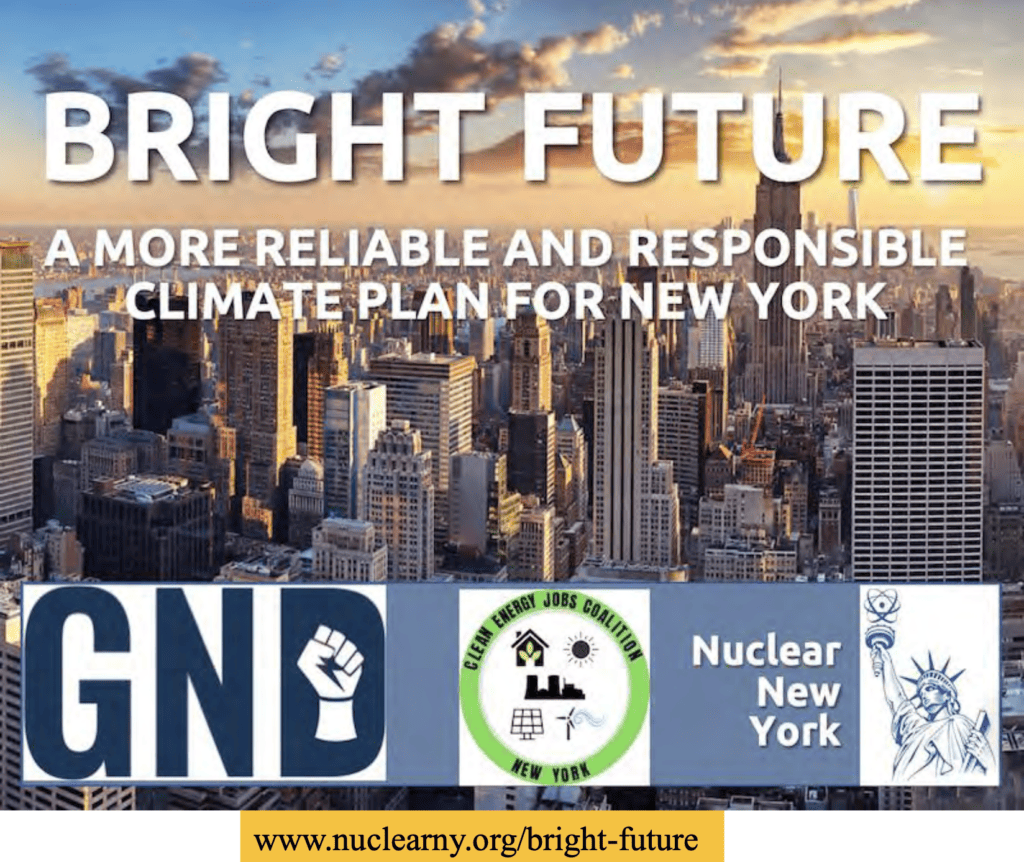
Along with Green Nuclear Deal and the Clean Energy Jobs Coalition of New York, Nuclear New York produced a report titled Bright Future: A more reliable and responsible climate plan for New York that blazes a different path than the one officially described by the state government.
Did I mention that Len is 90 years old? He’s still learning new tricks and is contributing to the continuing education of his fellow citizens.
I hope you enjoy the show. Please participate in the discussion here to provide feedback and support.
Transcript
Read transcript
There's a way, there's a way, there's a better way today, today. There's a way, there's a better way, today, there's a better way. Hey, this is Rod Adams and it's time for another Atomic Show. My guest today is Len Rodberg, who is a retired professor from Queens College, New York. Go ahead, how you doing, Len? I'm fine, I'm doing fine, I'm very happy to be with you and to be able to talk about what we're doing here in New York. I'm glad you're doing it. I'm glad you're doing it. I'm related to issues. Yeah, why don't you tell the audience a little bit about yourself, how you came to be a fan of nuclear energy, and what you're doing to try to make it more acceptable and more used in New York. Okay, this will be a little long because I've got a long history. I began, as you'll see, I began adult life, let's say, with a PhD in theoretical nuclear physics from MIT, got it in 1956, 90 years old. But I saw I did nuclear physics theoretical research for just about four years. And when John Kennedy was elected, he committed himself to creating an arms control and disarmament agency. And I got the opportunity to join it early in 1961 as the first scientist in that agency. And I stayed five years, I ran their science policy office. And that I've never, in a way, I've never looked back, I've done public policy around analysis around technological issues for the rest of my career. For 10 years, I was at the Institute for Policy Studies in Washington, which is a progressive think tank. And in 19, I was present on the first Earth Day in 1970, which much of it took place in Washington. And I met Dennis Hayes there and so on. And in 1973, we had the... I'm interrupted for a second. Dennis Hayes, that sounds familiar. Wasn't he one of the creators of Earth Day, a center of fraud? Yeah, he was a young, he was in his twenties. I don't think he's ever been a sort of collective office. He's been the head of foundations. He's still involved, at least he was a year or two. He was the creator of Earth Day in 1970. And I was very ill, it's my field as the application of technology to solve social problems. And I taught that instead of physics when I went back to the university after my time in the disarmament, I taught the social impact of science and technology. Anyway, in 73, we had the energy crisis, you know, the perhaps the slowdown in the delivery of oil from OPEC. And the rise in energy prices. And solar and renewables overall became very popular. I wrote in the 70s, I wrote a book on what state and states, particularly we're doing about subsidizing and encouraging energy conservation and renewable energy. I wrote a study for the Congress on the employment benefit. I was called, the study it's called the employment impact of the solar transition on the employment benefits of solar and solar and wind. And I was a student at the University of New York. Robert Pollan reproduced that study 30 years later for Barack Obama, came with the same result, two million jobs a year. Anyway, I was a solar and wind enthusiast. I eventually went up went to Queens College at City University of New York. I taught climate change as one of the policy issues I taught from starting in around 2007 until I retired in 2017. And I told my students that the solution to solar and wind was solar and wind. I liked the technology and I mean, looking back, I never looked at the system level issues to see what the problems were. Until I watched a talk by Michael Schellenberger that he gave in, I think it's COP 23 in Berlin in about 2017 to 2018, in which he showed my solar and wind couldn't do it. Most recent talk I gave, which led you Rod to discover the work I was doing. I gave a talk to my faculty retirees called the 2020s or not the 1970s. And the point is that what we're asking renewables to do today is very different from what we were asking it to do back in the 70s when it was just a supplement to existing sources to try to reduce the costs and keep basically keep the cost of energy under some kind of control. But you know, we would put a solar panel on our roof, but we were still connected to the grid. Now we're trying to make solar be the grid and it's impossible. It can't work. And I discovered that first with Schellenberger and then I took a relook at nuclear, which until that point I had been somewhat suspect of it. And I lived through the TMI episode, which is near about a hundred miles from where I live. And just never looked seriously at it until five years ago. And the result was I looked at said, my God, I have been totally wrong. Nuclear is safe. Radiation is not the thing to be feared that we thought it was in the period when I was working on stopping nuclear fallout by working on the nuclear test ban treaty, which is what I did when during my time in the government. And so I'm now a nuclear advocate. I helped to create an organization still very small, but pretty noisy called nuclear New York. I can talk more about that when basically we we create work we created ourselves about five years ago around the impending closure of the Indian point nuclear plant. Which then Governor Andrew Cuomo had committed to close. It's a it was a two gigawatt perfectly operating two unit facility in Westchester County, which is a upscale community with a lot of environmental anti nuclear advocates. Cuomo lived nearby and committed himself a while ago to closing that plant at the same time that the state is subsidizing three plants up on the up in the on the edge of upstate New York on the on Lake Ontario. They get what are called ZAC zero emission credits. They need to compete with low cost gas, but the Indian point plant didn't get them and Cuomo shut it down the two units shut down last in 2020 and 2021. He promised that they would be replaced with renewables with zero emission sources. It was a lot. It was a lot and we now, you know, every every few months we put out the data showing that we are now burning more fossil fuels than we have in a decade with the shutdown of that plant. The last one should add one thing about that the unit three, which was the last one to close before it closed at the point of closed. It set a world record for continuous operation of a pressurized water plant ran for two years, low more than two years without without stopping. So, it's a beautiful plant. We're actually going to tour it. I've never been in it, but we're going to take a tour of it next week because they're decommissioning and tearing it down. It's a crime. It's a shame that one of the very few things that politicians have actually promised and delivered on is an effort to close nuclear plants. Of course, they don't really deliver on the the linked promise of replacing the power output from the nuclear plant with clean sources. But certainly have had a history of following through on their promises to show you down. Yeah, it's a shame. It's a shame. I mean, this is a sister plant to Diablo Canyon. I mean, it's a identical plant. And the Diablo, you know, you know, I'm sure have had set you probably had episodes about Diablo, but at the moment it's safe for a few years. But it's a nice beautiful plan and operates and we'll keep operating for decades. It's a, I'm reluctant to call it saved yet. But it looks like it's going to be saved. There's still some tenuous aspects of that decision doesn't have a license yet. The extension extension, but we're certainly expecting it. So political, but the politics of nuclear is changing. And it's changing because people are slowly recognizing that this solar wind is a fantasy, but fantasies seem to die slowly. We're living. I want to talk a little later about this, but the high we're living through this hydrogen fantasy right now too. And well, yeah, I will talk about that in a minute, but I do I do want to touch back on, you know, the original idea of using wind and solar as fuel saving devices came very strongly from your. commentary about your, your, your path. Yeah, that was I'm the 1970s. I'm not quite as old as you are, but the 1970s were an influential part of my career path, my upbringing for loss of access to oil. A sufficient oil back in the 70s was a major reason why I thought that studying nuclear energy would be a good thing. But as you say, the wind and sun work, and they work well to reduce the amount of fuel that we burn to supply a particular amount of electricity. But they want contribute whenever they feel like it. Right. And right. It's it's not something that can be a basis for a dependable grid. Right. Right. And I think that's the real child. Now you also indicated that you're a pretty strong history in the progressive side of the political spectrum. Yep. Yep. I work. But yeah, the other area I work on is healthcare reform. That's what used to be called national health insurance is now called Medicare for all. And I was part of the anti war movement in the 60s and 70. Yeah, I'm the Institute for Policy Studies is a less liberal faith tank that I helped found that operate for 10 years. So yes. the left side of the spectrum, but trying to be, it's a little disconcerting because in New York, here in New York, our allies are Republicans. But they don't have any political power in this state right now. The Democrats in New York state are aligned with the renewable anti-nuclear side of debate. I don't know whether you want me to talk about the New York situation now in the law that was passed. Yeah, we will in just a minute. I do want to touch on this idea that there are good reasons why people who have always been progressive and always thought about things like universal health care, good wages, good family jobs, the power of labor unions, many other aspects and public education, many other aspects of what it means to be liberal. Why they should, once they've run the numbers like you have, start thinking about how much nuclear energy can benefit, can align with all the things they've always held dear to them. They don't have to change their very being to become pro-nuclear. Go ahead, go ahead, go ahead. I'm thinking that nuclear has got a lot of reasons to be attractive to both sides of the political spectrum if you look at it holistically. Well, you have to look at a little bit historically. Old left was by which I guess I mean communist and the socialists in the 30s believed in central planning and as the vehicle for ensuring equality and that everyone would have access to a decent standard of life. The new left that grew up in the 60s and 70s was more community oriented. The leaders of it became community organizers. I mean Obama is a child of that in a sense. They have an antipathy to the kind of large scale industry and power source that nuclear represents. That and the anti-war movement, the anti-nuclear movement, anti-nuclear movement of all lead progressives to be pro. They view, and I've been part of it because it fit with ideology that I supported for a while. I put out a paper report back in 1980 on community community caring and care stood for basically renewable energy and conservation and renewable energy. Community caring. And the idea is that solar and wind and energy conservation can be can be done at the community level. It's been it's associated with democracy with local control. That whole local control movement around schools in the 60s and 70s was around capturing control back in the community from large institutions and nuclear is identified with large institutions. It may be that the coming of small modulators will help change that. But that's one of of the reasons why the left has been almost uniformly anti-nuclear because they see it as the left sees it as sort of big big industry and as distinguished from you know participatory democracy. I'm always interested to find out more about how people have almost instinctively been anti-nuclear or how it has been a member being a member of a particular group or particular philosophy lends them towards being anti-nuclear. So I appreciate that. I do have one more question on those lines and we're going to talk more about your activities in New York. You mentioned that you lived through through my island. Right. And by that I always wonder what people mean because through my island did not cause any significant harm ever. And I mean it was never any discussion of it resulting in massive injuries, deaths, property destruction, anything like that. That's absolutely right. But that's not the way the media saw it and there was a lot of confusion. The press didn't know what to make of it. They got confused stories. And the real truth has never been absorbed by the culture. Of any of the three, you know, we talk about the three big nuclear accidents and you know, we still get movies like Chernobyl, one that revive all the fears. And then of course there was that the movie with Jane Fonda that came out at the same time as the three mile island episode. You know, I can't come on when I don't think of the name of the movie, but it's called the China Syndrome. Yeah, the right. Right. And so all people know is what they heard in the media and they didn't read the report. Then it when they finally came out, the presidential commission saying there was no in fact no damage, no deaths, no health impacts at all. There's still people I hear from when I talk who think that their cousin got cancer who lives someplace in their house, bird got cancer and was a result of three mile island, which is ridiculous. But that's, you know, people aren't new merit. But like you pointed out, even someone as new birth as you didn't really think about that's right. The numbers involved in something like through my island, because it just was never pointed out to you. You didn't. Until you listen to somebody saying hey, let's take a real hard look at this. Yeah, until I took a look at it. I mean, what I told my students was that nuclear is too too too much power to be controlled by ordinary, fallible memorials. I didn't understand the inherent safety of a of a water cooled, you know slow neutron reactor. It's inherent safety. It's amazing. Yeah, you know, it was my field, but I never looked at it. One might also take a look at renewables and say they're just not powerful enough to power the society that humans have created. Right, right. Right. Well, I have to, when I give talks on this or write about it, I have to explain the word dispatchable, explain that solar and wind are weather dependent. They produce power when the weather is favorable, but they don't produce power when it's actually needed. And you need a source that's dispatchable that will produce power when it's called for. Yeah, I like to use on demand. Because I think that that's a for a little term that people hear more often than dispatchable. Yeah, that's just that sometimes and I also once wrote about the fact that people may attribute the term intermittent to something that is controllably intermittent. Yep, like the intermittent setting of your windshield wipers, you can pick what speed it controlled as. So that's actually kind of a nice thing if it's only there when you want it to be there, but that's not what intermittent means with the weather. Right, right, right. Sometimes get amazed by people who tell me that they want us to be totally powered by the wind and the sun. And I simply ask, have you ever spent any time outside? If you're a gun camping and thought about, you know, using just the wind and the sun, it's available to power yourself. Because it's not there. Yeah, you know, I was once on a city street in Washington, D.C. It was October. And you're from the mid Atlantic. So you know what October days can be like. It was very intensely overcast, not a breeze anywhere and about maybe 40, 45 degrees. So I was chilly. I was damp and I really wanted some warmth. And the sun and the wind weren't there to help me. Well, they went, no, no, well, but I was talking with a Greenpeace person who told me, well, the wind and the sun is all we need. I looked around. Well, that's the official position of New York State at this point. So yeah, and then they said, we can always move it from a place where it is to where it isn't. And I say, how much transmission do you want through your neighborhood? Yeah, I mean, Mark Jacobson in your neighborhood, it's a senior someplace around there, is still pedaling and people believe it, the pedaling that you know, the east side will, the east coast will power the west coast, except when they're both, it was nighttime in both. It's not going to happen. Yeah, there's only three hours difference between the two. Yeah, yeah, yeah. But I can't have to tell you, my business information is a little deceptive. I work for a company that's on port. It's home based in Menlo Park, but I actually live in Tampa, Florida. Oh, oh, let me east coast guy. Let me tell us about what you and your comrades at nuclear New York are doing and tell us a little about the noise you're making, because as Mark said, Mark's a mead once said, I never underestimate the power of a small group of people to make a difference in the world. They're pretty much the only thing that it has. Yep, I like that. And we're certainly trying. I say we kind of got our start with the Indian point closure period. We made a lot of noise, but it's not clear that anybody heard us. We published a number of op-eds in the daily news, which, but the New York Times didn't notice the closure until a week before they ran one story on it. I mean, this is 25% of the electricity powering the downstate New York region. That's New York City and the surrounding counties, about eight to 10 million people. It was providing 25% of the power. And the New York Times didn't gain to cover it until it was too late. The daily news did, but it doesn't get the kind of power audience that the Times did. We put out press releases. We had a, when it closed, we had a kind of a funeral at the a cell of bassius. We styled it as a, and we're along with the people from green, the green new deal. You know, Maddie, Hilly and others, to celebrate the workers, the thousand workers who were losing their positions there. They had a celebration of life maybe. Yes. Yeah, yeah, with a lot of safety helmets as a display of the workers who kept that plant running. for 46 years and produced the power that's now supplied by two new gas plants that were built clearly specifically to replace it because the well clearly the I mean one person went to jail over the bribes that were involved in that anyway that was our start in 20 so those the Indian point closed first unit in 2020 and the second unit in 2021 in 2019 the state passed it's what they refer to as the landmark climate law it's probably in terms of states the broadest climate law that any state has passed but it's quite misguided there was no their deadline set up I'll give you the three key ones by 2030 70% of our electricity is supposed to come from renewable sources renewables does not include nuclear by 2040 all the electricity is supposed to come from clean sources so that does allow nuclear but by that says that the electricity sector is to be have no emissions by 2040 and by 2050 the state is to be no net emissions of any kind of any you know greenhouse gas emissions by 2050 so electrification of buildings and of transportation and of industry is supposed to be completed by 2050 a colleague of mine who was who used to work for the NRC and for the IAEA and I published an op-ed in Albany Times Union in September a month after the law passed saying that the 2030 goal 70% renewable is fantasy and won't happen can't happen system wouldn't work if it were to be tried the current let me explain that just briefly the current situation in New York is that 26% of our electricity is renewable heating water wind and solar 21% of that is water power from the Niagara River in the St. Lawrence River and 5% is solar and and wind and the get from the we're not going to get any more water power of any significant quantity so that means that solar and wind have to go from 5% to 50% of our electricity in the remaining seven years of this decade the state officials are still acting as if that's going to happen I mean it's clearly ridiculous I mean we're growing they're adding about one gigawatt a year that would be about 30 30 but I think close to 40 gigawatts of solar and wind they're adding about one a year we haven't added any wind in the last four years so anyway it's a ridiculous goal but they're still acting as if that was it's going to happen so the law that's the goals the law set year by year later they set up a climate action council which was developed to develop the plan to achieve that there was no plan to achieve that those goals were just set by sort of corning your finger in the wind and making guesses so they set up this council most of the council is solar and wind advocates not engineers or scientists they're only three people on it who have technical capacities technical backgrounds one represents the gas industry one represents or is the executive director of what's called the independent power producers which is all the power plants including nuclear plants and the gas and gas yeah of course and gas and and the third the the the third ones and engineers so they they all voted no against the plant the plan that came out the plan was released the end of the plan that came up was called a scoping plan came up with the end of December they issued their plan which we have a the state has NYSERDA the York State Energy Research and Development Authority they they they developed the quantitative aspects of a plan for the council they did this by the way by contracting with E3 which is a consulting firm in San Francisco that does system analyses of projected state power systems they did one for the northwest for Washington and Argonne which featured in addition to the existing one major nuclear plant there one or two additional ones the plan they did for New York had no mention of nuclear at all in other words well and NYSERDA the only thing that NYSERDA has done nuclear with an exception I'll tell you about in a minute is they are overseeing the this management of the reprocessing plant that was in West Valley New York upstate New York but which had some technical leakage problems and was shut down and there's big decommission so they're in the business you were talking about earlier of taking nuclear apart rather than build nuclear up and and so they came up with a plan which has no nuclear I mean I've got this quote from the plan which says when water and sunlight will power most of New York's economy in 2050 so that's like already by Mark Jacobson yep yep yep well one of his co-authors is Robert Hayworth power who is a professor of E. college the Cornell and writes about methane and methane leakage I mean it's a good work on methane these but he won't consider nuclear I mean we've tried talking with him about it I've you know the every meeting of the Climate Action Council has been public by Zoom and I and my colleagues in New New York which is a nonprofit advocacy group have attended those meetings by Zoom and we listen for the word nuclear and until the last meeting in November of 2022 never heard the word I refer to as the local N word you can't say the word nuclear and energy circles in the York State's official settings at the last time the other I call the other N word the other N word okay good good at the last meeting I sort of came in we of course have submitting comments to them about how you need nuclear how solar won't and when won't work how you'll destroy upstate New York farmland by putting in their plan 60 gigawatts of solar and how nuclear a small number of nuclear plants can do the job I mean 20 nuclear plants can power New York State but they ignore us but at the last meeting I sort of came in with a with a description of what would happen if they put in four gigawatts of SMR so small modular reactors and it was quite interesting and showed that somebody there had done some sophisticated examination of the what's happening in the nuclear industry but none of that is reflected in the final report except for one sentence in the in the in the executive summary and let me read it to you it basically says that the goal of a hundred percent emission free electricity by 2040 requires between 15 and 45 gigawatts of electricity from zero emission dispatchable resources to meet demand and maintain reliability this will require either storage or nuclear power if you look at the details in the plan in the appendices whether the numbers this zero emission resource unspecified except that it could be storage or nuclear power would provide just 2% of total electricity and it says large as this the amount of fossil fuel resources now in New York State that is 40 that we now have about 26 gigawatts of gas generation in the state and so this is saying that this plan was supposedly in which supposedly solar wind and water are going to provide our power in fact needs even more electricity from some unspecified dispatchable source than we now have from gas and this is to be established to pay to provide just 2% of the power how that's finance is not specified nothing is specified in it the their analysis uses hydrogen but they have high have 20 half the hydrogen coming from out of state someplace because it require the hydrogen has to of course be produced by even more solar wind if it's going to be clean nobody among the supporters points to this and says wait a minute what's going to provide that where's the money where who's who's studying it who's developing it we're talking 17 years from now having recreated the whole power system of New York State with a new source that's clean you can do it if we got started now with nuclear but they aren't doing anything about it they're talking about I mean the left the left the we were talking about earlier the left in New York State is pushing legislation that would take the New York power authority which now runs the dams along the rivers the large nigr dams and which ran one of the Indian point plants which built one of the Indian point plants would convert that into an agency whose only role could be developing solar wind and so long solar wind on the argument that the private sector is moving fast enough in fact we we're facing we face really a transmission blockage as well as a reality blockage that is the people who run the grid in New York State we have a we have a unlike where you are in Florida we have a we don't have a regulated system we have a D-Rage so called D-Rage related ISO system and the definitely regulated If you're differently regulated, yes. It finds that there are, that because of the distributed nature of solar and wind, that there are what they call pockets. That is, the power can be produced, but it can't get out with given the current plans for transmission of power. We have a plan, the core of their plan for us here in New York City is offshore wind. 17 gigawatts of offshore wind right now of of New York. But they're planning 17 gigawatts of it. And nobody, I mean, I published in the Daily News, an op-ed, I don't know, a year and a half ago, I've gotten no response that I can see visibly. According out that storms come right through where those turbines will be. And doesn't matter how big the storm is, they will shut down when there's a storm. Because that's the only way they can protect the fans is to shut down. So New York and the whole downstate region will go black every time a storm comes through. And if it's a big storm, it'll tear those turbine fans off. They're rated for category three. I mean category five came through Puerto Rico a few years ago and just tore the wind turbines to shreds. And I mean, who thinks of putting, and the thing is we, the downstate region is kind of isolated from the upstate region. There's not enough transmission to get all the solar and wind that's going to be built upstate downstate. It can go across. So it'll, that wind and solar will produce electricity if it's ever built. For New England on the east side and on Ohio and Pennsylvania on the west side. But there's not enough space cabling to bring it down to New York. And people with, with our country homes in the middle between the two won't let those power lines come through. New power lines come through. So, yeah, we call it the tail of two grids. So you got an upstate grid which is clean today. It's mostly nuclear and water power. And the downstate grid is all gas now that we've shut our nuclear plant. So they want to turn us on. We literally, the plan is to power the southern part of the New York state by offshore wind, which we won't have. It doesn't exist. It doesn't exist. And if it did, it would only exist until the first storm came through and that would be cooked. And we would be, we would go down with it. It's madness. But, you know, people, people, the, you have the, the solar and wind religion is, is rampant here. So we, we've been testifying. We put out an alternate plan. Very nice reports about a 30 page report called the bright future. Joshua Goldstein, who I'll bet you've had on your. Yeah. Yeah. Then forward for us. We used this title bright future. And we got the coalition of labor unions, a clean jobs coalition to co sponsor it. As well as the campaign for Green New Deal. You know, based in Chicago, I think, right to co sponsor it. Because they understand that they're, they're good union solid union jobs in, in the nuclear industry and the plan was very simple. It just said, let's have half the power come from nuclear. We didn't do a very extensive analysis of it. But we did enough to show that you could spend far less. If you use nuclear than and be far less environmentally destructive. One of the interesting things legally, I think, is that because solar and wind are installed by private corporations, you know, even though the state is subsidizing them, it doesn't have to do an environmental impact statement that it would have to do if it were a state project. And so there's no environmental impact analysis of what this plan which would blanket upstate New York, which is this beautiful farmland. We've got a country side with, you know, with solar wind. And so I should there's no environmental impact analysis being done, done of it. And there's no, there's no usable cost analysis. The cost analysis they did compared the cost. It provided costs in a totally unusable opaque form called, you know, net net present value of the expenditures over the next 30 years. And it compared that to the presumed cost of climate change. The climate change that would happen if we didn't do this. So we can do it all for free, right? Basically do it all for free, right? Right. It's net savings, but they don't compare it with what we're now spending. And they don't give it in real terms that people can understand what's it going to do to my energy bill. You know, I actually am working with a model that was developed by Reiner Cora in New England, which is very accessible and does provide you with answers on what it will cost in a sense per kilowatt hour basis of what this alternative plans would cost. And we're in the process now of running that mouth, tailoring it to New York state. And then running it to compare a sensible projection with the, this solar wind extravaganza that they're planning. So a sensible projection versus an absurd project. Yeah. Yeah. Yeah. So the strongest words that I've seen in the official documents are from the nice ISO, the New York independent system operator, which calls the state's plan unprecedented. That is the expansion of solar wind in the state. They don't say impossible, unbelievable. But they do say unprecedented. So far that's better than what they've done in the past. They, they, they, they get their funding through the state. So they don't criticize. We have a new governor, but so far she hasn't really taken any handle in this she. Huckle. Yeah. She probably had her own priorities. Yeah. She has her own, own priorities. And there's a bail bond issue and various other things. So one of the things that you're, you're the presentation you provided to your dollar retirees had a very impactful couple of slides. It had a picture of a large solar farm. I think it was in on Long Island. And your presentation said the plan calls for a hundred or 1700 of these farms to be located somewhere right in the state of New York. Yep. Yep. This is an incredible number. Yeah. Yeah. Yeah. Well, this is a 32 megawatt solar farm. It's the only one in the state right now. They're projecting 55,000 megawatts going from 32 to 55,000. And, you know, you can't put all that on roofs. It's going to be out on the farmland that what's now farmland. And, you know, farmers who have trouble with the economy are willing to sell their land or lease their land to solar developers. But it translates industrial solar to transforming farmland. And, you know, New York, New York, the fashions itself as a place for people to take their families on camping vacations and so on. Much of upstate New York actually is is the Adirondack State Park, which is huge and lovely. And they're not going to put solar. I assume they're not going to put solar farms there. But the rest of the farmland is up for grabs. And the governor, Colma, before he was basically thrown out of office for mistreating the women on his staff. And the governor passed, and passed, and passed, and passed, and passed, and passed, which allows the state to override local communities. So, the left is getting, what's the phrase, hung on its own, to tart. I mean, the supposed local democracy represented by solar winds. When you come to the real world, the state says local democracy doesn't work. It won't get the solar farms built that need to be built to meet this plan. The state can over the local communities have a year to give their ascent, or the state will override them and get it installed. So, so much for democracy. You must say yes, otherwise we're going to take it from you anyway. Yeah, yeah. And so, and I don't think people realize it. So, particularly some people upstate, but you can have this irony that the big advocates for solar and wind are in New York City, the most local visible organized. But the, the, the solar and wind facilities are going to be built under this plan are upstate. They're not in New York City or even near New York City, because there's no land there. It's out on Long Island and that's not a large area compared to what is needed for the huge extension of solar and wind that they're forecasting. As I say, 20 Indian Point Plan equivalent, you know, 20, basically 40 gigawatts of solar would meet the needs for 2050. 40 gigawatts of nuclear. 40 gigawatts, you know, 90% capacity factor solar has has a 14% capacity factor in New York. So, it's like, it's like saying, you know, one day a week, you'll get sound in the rest of where you won't have any. I mean, just the whole thing is so crazy. I just saw some estimates from Mark Mills who otherwise, I mean, it has some good things to say and some terrible things to say, but about how we got to build the. How we got to build up petroleum hydrocarbons, but I want to say something about that shortly. Okay. The points out that if we had in fact went to the electric vehicles, we'd run out of lithium. There is enough lithium to power all the electric vehicles that the world would need if we were in fact to go to electric vehicles. I mean, just the resource needs, though, I mean, you know, 140 million solar panels is what the state is claiming. I mean, it's just madness. Are you aware of the work that Robert Bryce has been doing to catalogs a number of rural communities who have put him to place restrictions on solar and wind installations. Yeah, particularly with. Yeah, he's got the database of it. He's collecting and it's quite extraordinary. I mean, there's resistance upstate, but they can't get interconnections. because the transmission, so it's a, this chicken's an egg here. The communities, some of the communities are fighting it. The solar developers put out plans are often quite deceptive of what they actually tend to do, but they're also waiting in line to get interconnections to a transmission system that is completely inadequate to meet the needs of a plan like this. So there's sort of, you know, there's some kind of lack of reality at multi-levels here. To me, you mentioned that, yeah, go on. You mentioned that New York has not installed any wind in the past several years. Right, right. Since 2019 there has been any growth in our wind development in our wind capacity at all. And yet, you know, the plan is to grow from about 1.8 gigawatts to nearly 10 by 2040. So this is, it's in Lalo land. The element that is neglected is this all assumes, as every state, every plan does, electrification of everything. And that's also unbelievable. That is, the estimate, the NYSERDA and its plans has costed some of it out. They say it'll cost $30,000 per household to put a heat pump, you know, to convert from a gas gas-fired heating system, you know, usually an air duct or steam system to a heat pump. And I mean, we're families that are living on 20,000 to $30,000 a year going to get upstate, you know, don't know get the money to convert to an all-electric system, which is expensive. You have big piping and so on. It's cold upstate too. So you have to use ground source heat pumps. And the cost is extraordinary of electrifying everything. I mean, both electrified transportation, electrifying buildings, apartment buildings and so on, with some kind of geothermal heat pump system. I've been really interested in the potential for using nuclear reactors to produce what I refer to as carbon neutral hydrocarbons. I don't know if you're familiar with this, but I call them synthetic fuels. Yeah, they will research lab has done this work on how nuclear-powered aircraft carriers could produce their own fuel by using their reactors and the Fischer-Trop conversion process to extract carbon and hydrogen from the water and make jet fuel. And it's economically feasible. And then Charles Forzberg at MIT has a whole team from there and from, I think, the University of Michigan looking at using agricultural waste to, again, use reactors as the source of heat and electricity to extract the carbon and hydrogen carbon from the biomass and hydrogen water to produce hydrocarbons. So you don't have to electrify buildings. You put in synthetic methane into the pipelines that now carry, you don't need new pipelines like a hydrogen system would need. You think this thing infrastructure, you get the gas and oil industry on your side by using their existing refineries and their existing pipelines and their existing delivery systems retail and wholesale to If you think about the whole scope of the hydrocarbon industry, the big change that you would have what they have now to synthetic fuels is they would stop drilling holes in the earth and instead produce it at a facility. You're talking about everything else, the pipelines, the machines, chemists and all the other people would still be doing the same job. Yeah. Yeah. And just surprising to me that nobody is looking at this seriously. I've been trying to get some resources together and some people together to take a serious look at it and particularly look at the economics of it. I mean, we have to make nuclear a lot cheaper. I want to note just listen to what I think was your most recent podcast with Brett Kugamas. It turns out that I gave a talk at the Johns Hopkins Applied Physics Lab in 2020 and he had spoken just before me and talked about how the nuclear industry was in fact, it wasn't trying to interested in expanding its power generation capacities but expanding its radiation protection and that nuclear could be so much cheaper and more sensible about radiation protection and what the radiation levels are and need to be and could be. And so I was interested that he's now going overseas. He said he was he was looking overseas for support because the American nuclear industry and its regulatory system was so embedded in this fear, excessive fear of radiation and this incistent that any radiation is harmful. The, the, the, the, a lower principle that really we have to get get past that. And I've been doing some teaching since retiring in my senses that young people, they don't have the fears that people of us people of our age or your age who live through the past with the fears of radiation. They don't have that same concern but they don't know what they don't know what it is. They don't know what nuclear is. I want to go back to a part of our early conversation when you mentioned that you had worked in the effort to pass the nuclear test ban treaty and the fear of radioactive fallout. It's a big part of that. Yep. Yep. You know, I've done some historical research. And one of the, if you look at the New York Times archive, which I like to use just as an accessible archive of of news for 150 years, the word fallout did not really appear in association with radiation until about 1954. And there was a hydrogen bomb test that exploded and lifted a lot of material and dumped it on another atoll. Any way talk, I think is what the name was. So that word didn't really appear until then, but even after that, it didn't appear very much until the issuance of a report by the National Academy of Sciences called the biological effects of atomic radiation. And that report in 1956 helped to get people like you energized about the health impacts of fallout and help get people interested in working through this effort to close down atomic weapons testing. Yep. Yep. In air testing. We don't understand just how extensive that testing was. Yeah. Well, between the US and Russia, we exploded like 270 bombs. Oh, yeah. Yeah. Yeah. In the atmosphere. Absolutely. It's a huge number. Huge number. And yet the the fallout was actually very small and its impact was negligible, but we didn't know that at the time. We thought this was a serious health issue. Barrett Cometer, who I later worked with was talking about the effects and others about the effects on children's teeth. Right. There's two scary projects. Yeah. Yeah. Yeah. And but now we understand so much more about radiation. And yet the you the National Academy of Sciences still does not. I mean, I've listened and you I don't know if you've had Calabrizy on your. Yep. Yeah. Yeah. You know, but I've listened to his talks and read his material and it is shocking what they did. And there's still the Academy still to this day. Shamefully. Biased in unwilling to look at alternatives to linear and no threshold. hypothesis. They put out this recent report on they were asked by the Congress to develop a research plan for low on low. You know, low dose radiation. And you look at their report and there's one citation to a paper by Jerry Cutler, who's one of the people who's done research on the actual impact of low dose radiation. And it's it's just a single paper. They make no mention in their report of looking at the data like the the fact that there are regions in this around the world where the background radiation is 10 and 20 times greater than it is normally. And there's no health effect. There's no health impact. There's clearly not the linear dose relationship. Clearly doesn't work at low doses. And they refuse to even look at that data. They don't recognize that it exists in a report that was was a year or two in preparation. It's it's it's tragic. Especially since we had in the US a pretty well run program by the Department of Energy to research the low dose radiation health effects ran for 10 years to tremendous amount of science. Actually did genetic studies that looked at the DNA of various living organisms that had been impacted by radiation. Looked at them within four hours after their dose within eight hours and then after 24 hours and showed that the vast majority of them for doses below a pretty high level actually. The repair mechanisms in DNA had worked out and corrected any challenges. And some people claim well the yeah, the repair mechanisms, but we don't think they're perfect. Well, there's not perfect, but there's several layers of them. And you layer on a high probability of repair to another high probability of repair to another high probability of repair. You get too close enough to perfect as far as I'm concerned. Yeah, well, if you saw what I said in my talk the other day was that the best evidence I know that DNA is protective is that our children look like us and even our grandchildren often look like us. And so the DNA must really have survived those millions of attacks that it took over those years from all kinds of radiation going particularly gamma rays going through us. And it survived and produces children that are very healthy and look look like us often. Yeah, I want to go back to your talk about synthetic hydro coherence. Yeah. point out to you that there is an excellent report done by a group called Terra Praxis, which is called the missing link to zero, which talks about using nuclear, particularly mass produced nuclear that can be installed on, say, floating platforms at sea to create these plug-in for one of the better terms. In other words, hydrocarbons, just like hydrocarbons we have today, surely they're perhaps cleaner because they don't have some of the contaminants. And that work is being done and there are companies that are working in that direction. It's encouraging. It's not as well discussed as it could be. No, certainly not. I mean, because I've tried for two years together in our bad published that I call, we don't have to electrify everything. And it seems like it's too far off the wall to be accepted to be accepted part of the dialogue yet. Well, we keep talking about hydrogen as if you could just replace natural gas with hydrogen, which is foolish. Yeah, hydrogen's got its own issues. Got some wonderful properties and also some troublesome properties that may get hard to handle. Yeah. Yeah. I have a little bit of experience handling hydrogen because I was a submarine engineer and we carried hydrogen tanks for various reasons. Some of them were pretty large tanks that we carried in our ballast tanks. And that stuff is is leaky. Yeah. It works its way through steel. Yeah. Yeah. Well, it's a very tiny molecule. It can slip through in a way that a bigger one can't. Lane, we've been talking now for a little over an hour. And I interrupted you several times and you said you had things that you wanted to get to. So I'm gonna be quiet right now and let you get to the things you want to get to before we close. Well, thank you. Well, I got did get to the issue of using nuclear generated synthetic fuels instead of electrifying everything. Because that was that's a James game changer because if you don't have to electrify everything, then you know, you can have some solar and wind around, but it's not as vast and not as destructive as what and it you don't expect as much of it because you're going to have a lot of nuclear base load and some of it dispatchable to make sure that you've got reliability. But the real issue we have is how do we get the public? The government seems to be the federal government, Lee, seems to be on the right track of providing support for nuclear. It's still small compared to the support is providing for solar and wind because the Democratic Party base is still oriented towards renewables and doesn't understand. As I said at the beginning that the 2020s are not the 1970s, we're talking about running a society on an energy source that's not reliable. That you can't count on when you have a dunkel flout. When you have cloudy days with no wind, you need something else and that's something else isn't going to be batteries. You can't run Times Square on a battery. So we need to get some sense into the nuclear debate, into the whole energy debate. And here in New York we're doing our best but it's a tough slot because it's polarized. As I said earlier we have some Republican who support nuclear but they aren't very concerned about the environment. So they aren't pushing it very hard. The Democrats are concerned about environmental issues but they have the wrong solution and they have the very powerful big green groups, big green organizations, the Sierra Club and here we have Riverkeeper which basically benefited financially from the closure of Indian Point. They got a community benefit fund from it. So we have a real real, you know, we're it's a tough sled but we do get hearings. I mean we meet, we meet, we met with state officials and so on. We get a hearing but we haven't punctured the bubble. But I mean as we get closer to 2030 and it becomes clearer that we are no ways near, you know, we're still at 5% solar and wind contribution. We're getting to 50% which is what the law says we should do is clearly out of reach. But the closer we get to 2030 the clearer it will be and we just have to keep telling the truth which is what we've been doing. That solar and wind can't power a modern industrial society nuclear can and it's safe and that message is we just have to learn how to we have to give that message and learn various ways to present it that makes clear that people have been misled by a lot of fear and fear of angry and people who benefit from from it right now they're they're raising a big ruckus because the decommissioning at Indian point is going to include putting some water with trinity in the into the Hudson River. I mean it's a trivial amount of radioactivity. It's like three or four orders of magnitude smaller than anything that could have any biological effect but all you have to do is say isotope or radioactive and they all come out and you know the masses come out at meetings and raise a ruckus and so that's the the latest fight that we're trying to provide some sensible facts and the information and perspective on. So I wish some of those. Yeah. I wish some of those people would recognize that the biggest beneficiaries by far of not using nuclear are the people who sell oil and gas. Yeah, absolutely. Absolutely. They've contributed to the they partner with solar and wind. Their BP is quite proud of being a partner because they understand that they need a backup solar wind need a backup and they're happy to provide it. Unfortunately they provide greenhouse gases along with their backup. BP engineers and BP are are numerous enough to know that if if their partner has a maximum capacity factor of say 30 for wind and in your case 15 for solar they're not providing a backup they're providing a majority of the power. Yep. And they can quietly keep selling their fuel. Yep. And yep. What's the profit of West of the major oil companies last year was over 400 billion dollars or something like that. Yep. Yep. That's on mobile itself earned about 14 billion dollars per quarter in profit after taxes. After taxes sure sure well. Now it's very profitable. I'd like to have them produce sent fuels with nuclear plants that they can run and can make if they make profit in a clean way. I'm for it. Yeah, I agree with you. I think profit in a clean way is great. And profit from moving in the right direction. And yeah, they do have plenty of of capital that right now they're just returning it to their shareholders instead of investing in the energy transition. Yeah. So that's that's one of my pushes. We need to get the companies that are doing the job of supplying society with energy today recognizing what they need to do to supply energy to the society in the future and really make investments in that direction. Yep. Yep. Yep. No, we're we're we used to talk about peak oil and we will be talking about it within the coming years because the fracking, you know, uses up its resource. It's a limited source and it's destroying the climate. So the combination means those they have to find a new field and we all know I want to offer them to it to them in the form of central production and distribution. Yep. I agree with you. Yeah. Hey, Len, thank you very much. It's been an opportunity to talk to you thoroughly and congratulations on reaching a magical age. Yeah, I hope to be there myself in a few decades. Okay. Good. Good luck. Good luck. Okay. I've joined it. Thank you for the opportunity. My guest for today's automature was Len Rodberg, Professor Emeritus of Urban Studies for Queens College and City University of New York. He's a co-director of community studies of New York Inc. And a founding member of Nuclear New York. This episode of the Atomic Show is brought to you by Nuclear Aviation Capital. We're a venture capital fund focused on selecting ventures with extraordinary promise. They're building the advanced nuclear sector and helping expand our clean energy options. We're building a portfolio of ventures on behalf of investors like many of you. We don't just take funds from the large institutions that typically allocate to venture capital. We believe that regular investors should have access to the opportunities in modern nuclear for their own portfolios. We allow people to subscribe on a quarterly basis starting as low as $5,000 per quarter. A four quarter subscription will get you exposure to between four and six ventures. If you are an accredited investor and would like to learn more about how you can participate, please check out our website at nucleationcapital.com. That's nucleationcapital all one word.com. Our fund that all the information you need to subscribe is available online. You can also subscribe to our newsletter, nucleation insights, and join our pro nuclear investor network to learn about select syndicated investment opportunities. If you have questions, we're happy to chat. Please spread the word. Today there's a better way.