Bret Kugelmass, CEO Last Energy
Concepts discussed
Auto-linked from the episode's notes and transcript.
Show notes
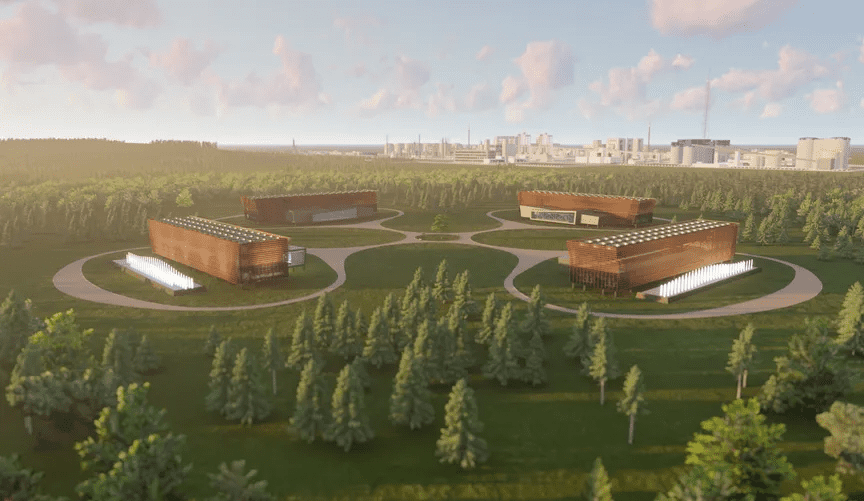
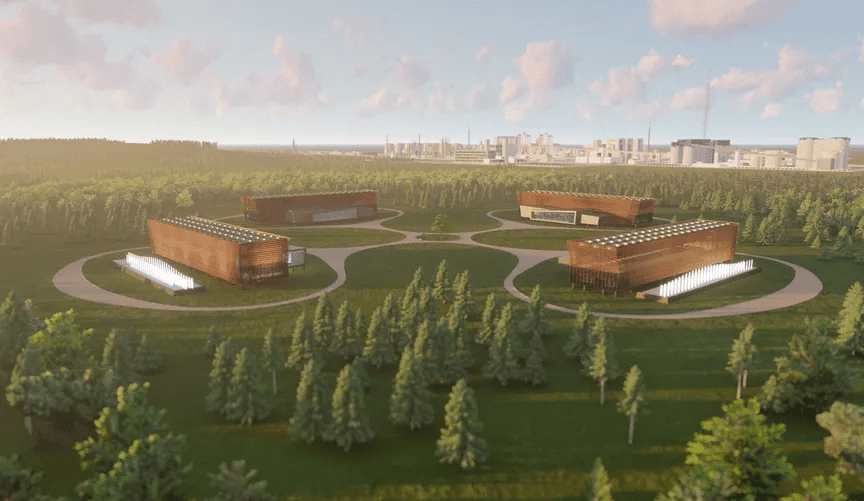
_Rendering of Last Energy’s 20 MWe installations (Last Energy)_
Last Energy is an innovative new company governed by a philosophy of avoiding the invention of anything that has not been done before. They have created a business that is laser focused on building, owning and operating small (20 MWe), modular pressurized water reactors and selling the electricity they produce under long term power purchase agreements.
On Atomic Show #303, Bret Kugelmass, the founder, president and CEO of Last Energy describes the path he took from earning a masters degree in robotics at Stanford, through the founding and operation of a successful drone company, to a highly respected podcast, through a non profit think tank and into a utility company that has designed a nuclear power plant that can begin operating as early as 2025 with commercial scale repetition starting almost immediately.
Where some believe that nuclear fission requires highly specialized equipment, Last Energy has found that pressure vessels, pumps, piping, heat exchangers and valves of similarly high quality standards are widely available from experienced, commercial suppliers. Their systems, structures and components (SSC) use well-accepted ASME codes and standards and are often identical to the SSC that have been used for decades in chemical processing, oil and gas, and other industrial applications.
Last Energy has chosen a small number of initial deployment locations, specifically in the UK, Romania and Poland. They are aiming to supply power to major industrial consumers that need somewhere between 20 and 100 MWe. They will connect to their customers “behind the meter”. From the customer point of view, Last Energy power will look and act like the electricity they currently purchase from their local utility company.
Last Energy systems will have approximately 2 m diameter pressure vessels that can accommodate full length fuel assemblies and standard control rods with proven drive mechanisms mounted on the reactor head. There will be fewer assemblies in the core, and they will be replaced as a whole unit every 6 years. Each plant will have a single steam generator and coolant pump.
Kugelmass explains the reasons behind the company philosophy and design choices. He provides a good summary of their business model and their driving motivations.
One aspect of Last Energy’s plans should motivate US politicians to modify our current export control regime. Even though their plants are designed to be well within the production capability of US manufacturers, the company is studiously avoiding the production of any nuclear component in the US. Export control processes are too burdensome to be economically justifiable.
I hope you enjoy the show and participate in the conversation.
Transcript
Read transcript
There's a way, there's a way, there's a better way today, today. There's a way, there's a better way, today, there's a better way. This is right at us and it's time for another Atomic Show. Today I have with me the Titan of Nuclear, the man who has decided that the way to learn the most about nuclear is to talk to everyone he can find. Red Cool mass, welcome. Alright, thanks so much for having me back. You still need to introduce yourself as the original podcaster in the nuclear space who I learned a ton from and I just can't thank you enough for all the work that you put in before I even came around. Well you know what they say, don't brag about yourself, let others do the bragging for you. It is encouraging to me that many things are starting to change. People are recognizing that scale doesn't necessarily mean the largest unit you can possibly build. And there are lots of other ways to develop scale because there is an economy of being a big provider. But you don't have to do it with giant units. I think that you and your company is trying to do it with pretty small units. Tell us a little bit about last energy. Yeah, so I guess the last time that we spoke, yeah, there was no real conception of a commercial entity from the work that we had done. But you know over time, you know our work has evolved. We started off, you know, energy impacts enter doing just basic climate and energy research. Doing a deep dive on nuclear with Titan's nuclear podcast. Taking some of our initial learnings through the Open 100 project where we got to collaborate with utilities and engineering firms and put together our own techno economic analysis of what it would be like to take a hundred megawatt standard PWR and put it together with traditional construction. And we took that around to the utilities and we got a ton of great feedback and continue to learn about modularity and some of the supply chain and labor advantages there. And just as time progressed and we saw the commercial interest and you know I kept giving talks at universities and advising governments on their SMR roadmaps. And it seemed like everyone was saying the same thing. Not too many people were doing it or they were adding on something that I thought. put their projects at risk. So like the basic consensus in the industry for decade now has been small modular reactors. Okay, so you take you take what the standard technology is at least that was my interpretation and you shrink it down. And then you apply modular construction techniques at the oil and gas industry is pioneered. And that's how you deliver your systems in order to reduce specialty trade labor in field and move it into a factory setting where you can have higher throughput, lower. risk of lower risk of your capital that you are typically borrowing money on before you're producing energy. Lower risk of that either being extended the period of time or the rates increasing. So that was like the basic concept that I didn't figure out that was like the with the industry figured out. But then when all the implementations that we saw were either not small so doing many hundreds of megawatts and above. or not modular or they threw some new material or fuel source or supply chain risk or constructability risk in there that might have wiped out all of the advantages of going just small and just modular with standard technology. So that became the founding thesis of last energy was create a commercial spin off of the research work that we had done to build small modular standard right standard PWR so no new nuclear innovation no new chemistry no new fuels like literally full length fuel bundles sub 5% enriched. nothing special other than just applying good modularization and constructability practices last energy is is going to produce small 20 megawatt electric is that what I'm really 20 megawatt electric exactly right. And when you you talk about standard components, who else uses pressure vessels that have to withstand 2000 I think 2500 actually test pressure for PWR so tell us a little bit about where are you going to get their pressure vessels from a standard supplier. Yeah, so pressure vessels are made by hundreds of suppliers I mean thousands if you look at all sizes around the world. One set are our size which are just you know little over two meters in diameter and there are hundreds of suppliers that are qualified according to ASME section eight standards and then you can look at ASME section three for their nuclear. qualifications and you can then combine them together essentially to produce what is a standard pressure vessel and the pressure requirements that you specify. like you know I always use word like off the shelf okay well like I should clarify pressure vessels are not like literally off the shelf there's not like an inventory of pressure vessels your exact size just sitting somewhere. But they are standard and quote unquote off the shelf in the sense that there is an ASME code book and if you specify the dimensions you have all of the. and thicknesses and performance obligations and testing obligations that a qualified shop will deliver that standardized product to you, even though yes, it could be unique in the sense that it is one inch different than another pressure vessel that has been produced or that the port holes are. and slightly a different area, but we still feel comfortable calling it standard just because this is done like tens of thousands of times a year for all sorts of applications in similar pressure and time during the company to produce those. have the standard tooling necessary to produce all the customizations that might be needed making sure that that the ports in the right place piping connections. flanges all that stuff they can they can do that with the right drawings and specifications right. yeah it's just like it's almost like you know when you go to a hardware store to get a can of paint. I would call that a standard off the shelf can of paint even though the colors you select and the exact quantities of like red green yellow whatever they mix in there might be weak to you I'm still calling that a standard off the shelf can of paint this is the same thing. Okay, okay, now how about the heads it that's one of the things it's a little bit different at least about the pressure vessel for a PWR you go these connections and penetrations at the head of the reactor for control rods and instruments and all that stuff is that something it's also relatively common in the pressure vessel world. The heads and the ports yes the control rod the CRDM control rod drive mechanism like attachment fittings that's more just for nuclear but once again we're sticking the standard PWR pressurized water reactor equipment. So it's literally the exact same control rod drive mechanisms that you see in you know 300 operating PWR is around the world today literally the same size same configuration ever. So how many assemblies are you going to put in there it can be full length so I assume they're not as many assemblies as it would be for a thousand megawatt reactor. Yeah, I want to be just careful about like export control and sensitivities around that so I'm just going to say like what we've put in our IAEA SMR handbook report I think the number three put are like 12 to 24 so I feel comfortable saying that without like. Right, you know putting ourselves in hairy territory in terms like Brett tell me what your path has been to get into nuclear you aren't a nuclear engineer. Now barely engineer anymore. I started off as mechanical engineer did a master's at Stanford and robotics started morning the early drone technology company is raised venture capital around that for five years sold it in 2017. And then you know that was around the time that climate became an ever pressing concern we crossed 400 PPM and I was like right now is the time I've got the time the resources to like really take a stab at doing something important for the world. And that's when I founded the energy impacts center just myself first and hired some consultants and hired a few employees and found nuclear saw that it was just totally. misunderstood totally under leveraged and just from like first principles basis realize this was going to have to be the foundation for any future civilization to have an abundant clean energy future. And that's when I launched the Titans and nuclear podcast to learn more and the rest of history. I think one of the things that the nuclear industry needs more of our people with the startup and company building experience that you have because as I've told my colleagues sometimes to their dismay that there really are plenty of nuclear engineers and the nuclear and the nuclear industry. Yeah, I mean, I think the thing that I pulled away most from my previous especially like frontier tech hardware tech background is change as little as possible. Every little thing that you do even if you think it's a minor change. You know, oh it's a new alloy but it's so similar to other allies okay well it's like who knows how to weld that alloy is there like a robust history of like performance and welding standards for that alloy. So you check the corrosion rate, how do you check the corrosion rates on the radiation like there's just so many or like the strength properties on the radiation for how long like there's just so many little things that go into every little change that you make to the physical world. And you know I learned that lesson, you know, very difficult and painful experience with my previous startup it's like every time you know you want to do something a little bit original a little bit unique, like just the amount of engineering and certification of required. It just becomes like just becomes like overwhelming. And this is that whole thing about like paper react you know like the nuclear industry always talk to other paper reactor paper reactors it's not because nuclear physics doesn't work nuclear physics works like there's no doubt. It's just all the other little things in terms of like supply chain and hidden costs that become absolute nightmares and so I you know I took that experience away from my first startup and hardware space. And I became one of just like the driving design criteria for last energy is nothing new like no new material science no new chemistry no new reactor physics you know nothing in the supply chain that is currently operating in hundreds of power plants on the world. So we're going to develop of 20 megawatt facilities tell us a little bit what who's your customer base who are going to buy these reactors and yeah so we're starting off with a pretty niche market. We're focused just on Europe. We're focused primarily on industrial offtakers behind the meter that are under 100 megawatts worth of consumption. So they might have up to five of our 20 megawatt plants. But then this keeps us out of the territory of like competing for contracts with let's say the new scales of the world or or the GEs of the world or the world or the world's rice is the world. We let them tackle the bigger power consumers and we're like just going after a niche market that there isn't really any other competition for that's that's been our business go to market strategy. When do you intend to seek licensing even in the foreign markets that you're going to everybody's got their own licensing regime that you have to go through. Yeah, we're currently engaged with regulators in the United Kingdom in Poland and in Romania. We're in various stages of engagement with them. You know some you might call it pre licensing others more formally in the licensing process. The more that we work with regulators the more we realize that distinctions more of a gray area in the formal a formal miles a formal milestone. But yeah, we've been actively engaged with those three regulators for over six months now in the case of UK for almost a year at this point. And I feel like we're making good progress. Do you think that licensing your small PWR is going to be easier than licensing something other than a light water reactor? I don't know. I mean, one of the good things about the UK framework is they've got these like safety assessment principles, which in theory out are like technology agnostic. And that maybe comes from their history of operating, you know, fleet of gas reactors. And then also having experience with pressurized water reactors as well. You know, in the case of Romania, they've got experience with heavy water reactors that can do type. And then in Poland, their experience is more with. It's one of the research reactor, the Maria reactor. So in all of these cases, I think that the regulators are quite competent of assessing different types of technology is. I think that the bigger advantage that they have in terms of assessing our technology is just it's not like the reactor type. It's like the lack of newness. We're just applying the same codes and standards that, you know, the industry is extremely familiar with. We're not doing anything to novel. For us, really, all of our innovation comes down to deliverability. So that's like constructability in the business model. And we're just trying to do as little new as possible when it comes to anything that the regulators really have to assess. Other than just the fact that we are so small means our decay heat to, you know, material on the low ratios are just so much more advantageous. So there's like, it's not like we're trying to convince them about, you know, very small or tight margins to make our case. Like the margins that we have are just so ridiculously over the top. It should make it a lot simpler from that perspective, even though we're not doing anything new. Have your engineers done any forward looking analysis of the kind of waste production that you might have in your small reactor. There's been a couple of papers released recently that are tempting to claim that small reactors are going to produce a significantly greater amount of both fuel waste and activated material waste from pressure vessels. Have you guys taken a look at that? Well, I mean, let's just like think about this. That question we're philosophically first, even if you were to double a negligible amount, it's still a negligible amount. And so I think everyone needs like take that in perspective first. Like the nuclear industry produces virtually no waste period and the story. And the reason that people are afraid of or hesitant around the waste handling management, living near it, has actually nothing to do with the technical merits, but rather how we communicate, you know, what nuclear waste is to those stakeholders. And so it really does not matter like how much or how little you have of it when it's not a technical problem. It's a communication challenge. Agreed with that is a minor communication challenge, but for the utilities that actually have to do something to address their waste. They have to spend money to build a dry storage parking lot where they have to figure out how to move activated steam generators, activated pressure vessels. These have been real world problems that actually cause a fair amount of expense and the more waste to have the higher the expenses. So, you know, until we have somehow better communicated to the public that this waste should be handled more routinely, the amount does matter doesn't it? I think it's like roughly everywhere you go around the world, you put a dollar megawatt hour into a fund as you're producing the power and then that goes to handle waste handling and decommissioning and that amount of money. You could be twice or half as efficient that amount of money should be more than enough to cover it. And if it's not it's because of mismanagement of that money. It's not because moving radioactive materials actually that harder expensive. Yeah. And as you say, this $1 megawatt hour produces a fair amount of money. That's what we charge utilities in the US and built a bank of $45 billion. For a dollar a megawatt hour, $2 megawatt hour still not really a significant change in the overall price of the electricity. Yep, exactly. But even so, dollar megawatt hour is more than sufficient like you were saying $45 billion. It's really not that difficult to move around radiated material. That's like folding encapsulated. It's just not that hard. It's not that difficult. It's not that hazardous. We can apply an unlimited expense if we use regulatory capture to like insist on like crazy level of procedures and you know crazy levels of, you know, minimizing activation and material. I mean, if like we're willing to be totally unreasonable, we can spend infinite amounts of money. That's what the nuclear industry has done. Well, some people in the nuclear industry love to spend unlimited amounts of money. Yeah, that's their business. Yeah. One man's cost is another man's revenue. Exactly. I mean, like why does Fukushima cost $200 billion to clean up? It's like it's not that expensive. It's not that complicated. But someone is making $200 billion and that's mostly people providing like, you know, it's like it's the nuclear industry. It's like nuclear construction companies, nuclear clean up companies, nuclear robotics companies, nuclear analysis companies, nuclear water treatment facility companies. So like, yeah, I mean, the reason that Fukushima is quote unquote hard to clean up is because it is a windfall for a part of the nuclear industry that their incentives are not aligned with creating, you know, cheap clean abundant power. They're incentivized to have ever more radiation clean up. Yeah, the same philosophy exists as to why are we spending $3 billion a year to clean up the Hanford reservation. That's wild. That's wild. But it's a windfall for the companies that are doing that. Right. And it's a protected stream of revenue for the state, which is why. Senator Cantwell is so adamant that we need to we need to keep cleaning up Hanford with an increasing budget every year. I mean, let's let's let's go everywhere. And let's just dig pay people to dig holes and fill them back up again. Why not? It's like a great idea. We used to talk about the diggers and fillers when I was going to school. You know, we seem like somebody was digging a hole and somebody else was filling it back in. Exactly. I know. But that I mean, that's not just the nuclear and this like we shouldn't be. I think that that that kind of bad behavior occurs across so many industries. I mean, I'm not an expert in those industries, but like, seems a lot like what we're doing with like ethanol production also, you know, using a ton of. fossil fuels to make ethanol to also feel. And it's like what's going on there. Well, your machines be manufactured in your target markets or they're going to be something that are going to be exported from the US or something mixed with the two. Some mixed with the two we're starting off with manufacturing the nuclear components in Europe. And then the balance of plant in Texas and having them meet. Now, when you say balance of plant, what is where is the boundary goes after the steam generator or. Yeah, the steam generator, then there's a bulkhead and that separates your nuclear island and your containment in the nuclear island from the rest of the power plant. Okay, so the pressure vessel and the steam generators would be in the nuclear part and that would be manufactured somewhere in Europe. Is that what I'm understanding you say? Yeah, we are things that are designated as nuclear components are being manufactured outside the US. So we don't have to work with the export control paradigm of shipping nuclear components from the US to outside the US. Any issue with the export controls for intellectual property, you know, it's one of the things you always confuse me about export controls. It seemed like you would have to go through part eight ten even if you were selling a valve that was useful in a steam plant because it somehow got a nuclear pedigree. Yeah, so our. Our initial. criteria or like business model criteria was to only work with part eight ten generally, you know, pen and XA generally authorized. Countries. Okay, and so our target markets remain in Poland, okay, all fall within within that scope and so what we do is we file our. Generally authorized notifications that the N and S A whenever we transfer even potentially nuclear eyes to intellectual property from our entity to another entity. Now all the markets that you've mentioned Romania, the UK and Poland have other nuclear companies and other nuclear announcements, I guess, of course, EDF is big in the UK and then Rolls Royce. And in Poland, there's they've announced AP 1000s and also looking at X energy high temperature reactors for industrial use Romania as you mentioned as can do reactors, they may even try to get more can do reactors, but they're also looking at new scales. Are these competitors to you or you guys cooperating because your power plants are really serving different customers. Yeah, like yeah we're rising tide floats all boat like I am happy to and try too as much as I can promote every other nuclear company as well. And we just figured it was easier so we can all, you know, do a little bit more like hold hands and help each other for us to just pick a niche market where we were not competitive. And so yeah, we really only focus on customer applications that are under 100 megawatts or maybe up to 200 megawatts in some cases. But we stay away from anything that might be potentially competitive with the other companies that are also trying to go to market in that space. And that's so we can have a great relationship and help each other and work together on policy reform or just general stakeholder communication. Yeah, imagine that all of you would cooperate on things like training on getting welders qualified on interactions with the public so that there's more and more comfort with nuclear technologies. Is that a good assessment? Yeah, I mean, I learned very similar lesson in my last company as well. It's like you never know who's going to be like, you know, don't treat people as your competitors because every competitor is just a future potential partner as businesses evolve and technologies and companies mature. People tend to find different niches or different like sub products to be serving. They really feel like, you know, figure out that like that is their forte. And so it's good to remain on good cooperative terms with everyone even perceived competitors because like, you know, two, three, four, five years from now, you don't know if that's going to be a company that's going to be like an incredible partner and incredible supplier for you. So better just to like, you know, divorce any like emotional connection of, you know, I hate them because they're my competitor. I just wanted to pause, the business are money and just say, Hey, everyone's a potential feature partner and look for things that you can collaborate on together now. I learned one company that I worked at before that, not only are they potential future partners or future suppliers, but they're also future customers. Yeah, they may actually be buying stuff from you, because your products will fit something that they can't necessarily provide. a customer that needs 400 megawatts and their reactor is a 300 megawatt reactor. They don't want to build two or the customer won't want two of them. But anyway, it's just a little bit of a math call. No, totally. I mean, there's just so many different business model arrangements that any two companies can have, everything from licensing deals to sales, channel partnerships. I mean, it gets like, you know, it's like this factorial tree that gets increasingly complex. And so once again, just best to be opportunistic and be open-minded towards any sort of relationship that you can have with someone in your sector. In your design, if you're 20 megawatt power plant, do you have two loops, four loops? What is the arrangement? Sing a loop. Sing a loop. the ones team dinner? Yep, just one. Yeah, it's not that much energy. No, it's not. And it's probably, and it's not one of those power plants where continuity of power is so vital. You do double. Make sure you have two of everything so you can get by with just half of it operating. Yeah, I mean, when it's last time that someone lost one loop and not the other, um, I mean, maybe if you're doing some like strategic maintenance type stuff, uh, my short-based power plants. True. Yeah. Oh, yeah. I could find good, good, if I could find good. When you're in to water, you don't want to have the possibility of losing your entire power plant. Yeah, you're trying to minimize that. I forgot. The funny thing is we always thought our reactive was so unreliable that we only needed one of those. I was talking to a Navy near a cab. There they heat sources is, I mean, fizzin works. It just, and it keeps poking along, um, you know, without much effort in the physics actually controls it, which is just an amazing thing to me. You don't have to. I know. It's just, it's so amazing. It's still one of the biggest misconceptions out there amongst not, I wouldn't say like laypeople, but let's say people who think they're extremely technically proficient, but like, you know, are just like science enthusiasts the one thing that they are like, they tend to hear pressure as water reactor and they think, oh, my God, pressure, and then they get afraid of pressure. And then like, you know, they can go control rods are governing the reaction the whole time. What if the control rods doesn't work? And they don't realize that in and out, like the moderator, the water, according to like three different mechanisms of feedback, you know, temperature, positive void coefficient and Doppler effect. It's like a self-governing reaction. What are, I mean, what are reactors are just so amazing from like a control is perspective. You don't have to do anything. Like Enrico Fermi did all the hard work, you know, early on, you know, just helping us figure out, you know, how these reactors stay critical. And then since then, like, like there's just not that complicated controls for water based reactor. No, there's, there isn't matter of fact, under most circumstances, you can very power quite a bit without ever touching your control rods. Yeah, totally. That's why I'm going water reactors do that at end of life, right? So like milk, a lot of extra energy, they just bury the temperature. There are other, yeah, there's other reactor decides blowing water reactors. It will do that to get a little bit out because as you said, there is a negative temperature coefficient of reactivity. Yeah. So if you can't stay critical at the temperature, you normally operate. Well, you can stay critical to lower temperature. Yep. You just have to have a lower pressure steam and a little bit lower efficiency of your steam plant. Yep. And so you can go a little bit, a little further without, you just know real hard stop like your tank is empty. So it's a slow down. Yeah. And I think that I think they even call it the coast down as PWRs get close to refueling. If used up most of their actual fissile material, they will coast down and end up not stopping the plant to get to be about 75 or 80% power as their limit. Yep. That's our plan too. Good. Now, so your refueling cycle, I assume, is going to be something similar to the 18 months to two year cycle that is common. That's a little bit different actually for us. We go six years. We like to think that we're not violating our own rule about nothing too innovative because fuel assemblies do 10 or they can stay in a reactor for six years. We just lose the efficiency of shuffling. But what that enables us to do is have less human engagement with activated material, which we think makes just for an easier licensing case. Not that I think that there's a safety concern that just makes it easier from a licensing perspective. Well, it also reduces the amount of downtime you have if you can go six years without refueling. Yeah. We still might have because we're not like, you know, these utilities today are like freaking machines and how good they are. But their averages, we're not going to be there for quite a while. They're just so good. They run these things like, military operations or football operation. I've watched some of it. It's just awesome. We're not going to be that good. So even though we are taking off line, you know, third as many times, it might still be three times as long that we're offline in the beginning. But we're still anticipating like a 95% off time overall. Okay. And I assume from what you just said that your cores are going to be replaced in whole, not just partial assembly replacement. Yeah. We, we throughout the whole reactor, the control rods, everything like once, once something becomes activated or system, no one ever touches it again. And we just drop in a new, a whole new reactor, a whole new reactor set up. Okay. So I imagine you pull your assembly up into some sort of shielded container. We put it into a whole thing to begin with. Everything like, we've like essentially designed end of life structure around it at the beginning of life. Okay. And it doesn't need to go into a cooling pool. The vessel itself becomes the cooling pool. Okay. Okay. Makes sense. Yeah. It's a little bit different in terms of like an operational modality. And, you know, it gives me pause as well. But, but it, you know, like, we spent a lot of time thinking through these issues that we really don't want to do anything new. But in areas where it's not a new component and maybe it's just a new operating modality, but it seems, you know, to not, you know, the hour like risk metrics, you put any risk, good terms of like system performance operation, completion, licensing, anything like that. Then we, then we're comfortable moving forward with it. So it's innovative in some senses, but we really are like, I tried to drive this message home as much as possible. We're trying to not be as not innovative as possible. But you will keep some amount of use fuel on site or you have to actually move it away from site every six years. Now end of life end of life, then it gets moved during the decommissioning. That's the first time that you're really going to be moving activated material. Okay. And your design life is 40 years or 42 years because of the six year cycles. I'm sure by the time 40 years rolls around, people are going to want to do all sorts of interesting extensions and repurposing. That's not my problem. Let's see 40 years from now. Yeah, you probably won't have to worry too much about it. Although you're pretty young guy, you may, you'll probably be retired by then. Yeah, but, you know, no, it's maybe it'll be a skydiving accent or something. Are you a skydiving? No, no, just in my mind, just a fantasy. You're bucket list, maybe. Oh, it's all my lives. Paragliding or skydiving or something like that. Should you personally spend a lot of time over in Europe these days? Yeah, I'm there every other month for at least a week, sometimes two weeks. And do you have offices in each of the countries you're talking about? Yep. We have subsidiaries. We've got general managers that are like, you know, our subsidiary CEO is that are excellent and run most of the day to day operations. And interface with, you know, local representatives and local stakeholders. But then obviously, you know, collaborate, you know, really closely with HQ here in the US in Washington, do you say? Do you have any concerns about owning and operating nuclear plants? Are they willing to get into that business themselves or do they prefer to have somebody else do that work for them? Thank you for that clarification. So our business model is we are a utility, we're an IPP and independent power producer. And so what we do is we build own and operate the units. We then, you know, for to simplify it, we just hook a power cable up to our customers and totally abstract the generation component from them. So it's as if they are receiving power from their local substation, but instead they receive power from us. And we make it that whole process invisible to our customers. So all they're doing is signing a long-term PPA power purchase agreement. Do you also intend to sell heat? There's industrial customers sometimes want their power uniformness, not electricity. Yes. This is a good one. So we've designed our plant such that we have the ability to deliver heat as well. And so we essentially have left the capabilities to hook up a heat exchanger such that we can run our steam through the heat exchanger and then be able to deliver, you know, a process fluid to our customers if they so desire. It would be an external loop. So at no point would it impact like the design of our facility. It's not like we're going to be running like our, you know, our tertiary loop hot water out of the facility. And then back again, we want to maintain that that separation from our customers. But through a heat exchanger, yes, we could theoretically deliver heat and we're planned for it. But in our early applications, we're following like the keep it simple, stupid approach. So the first one, the customers will just be electricity. So this sounds almost like you have a plant to have the ability to add a module or add an option to your plants, depending on what the customer wants. And I assume if you have that kind of connectivity, you could add an option that does desalination or hydrogen production or some other type of production like that. Yeah. But I want that to be someone else's business, not ours. Like our business is going to be maniacally focused on, you know, doing one thing, you know, cost effectively. So it's going to be about like scaling up our production of this extremely stupid dumb system rather than adding on a lot of features, but we'll make it, you know, like, you know, somebody could develop a piece of code with an API such that other people can, you do that work and create their own incredible businesses will make it available to other companies to do. Okay. So you'll have some sort of connections available at something that will be used at some point down the road. Exactly. Okay. Now mentioning that or you mentioned that you have the nuclear production is going to happen in Europe. Is there going to be a single place of production and so all your European customers from the same place or that is going to be separate production facilities in different places? Yeah, that's another really good question. And that is a lot of the work that we focus on, which is like supply chain supply chain supply chain. So it's a combination of what you mentioned in that we are going to have nuclear qualified, that component fabricators at their own shops doing their own thing. In some cases where they have integration, capability is integrating them into larger packages and other cases, moving them to a third party integrator in country that packages up and away that can connect pretty seamlessly to the rest of the facility that will deliver to site. One of the challenges that affected Vogel was that the AP-1000 was sold as a modular plant where they could produce modules in a place like Charles, Louisiana and ship them to Georgia and have them integrate into the plant seamlessly. How is your project going to be different from that? Yeah, I mean this is one of the problems with the nuclear industry is they've bastardized the work modular. I mean if you want to do modular, do what the oil and gas industry does. They've been perfecting this for 20 years. That's not what Vogel did. Now don't get me wrong, like I'm very happy that gigawatts scale plants are being built. Like, if valuing efforts, a lot of people, a lot of hard work, so please, no one at Vogel is working on Vogel project, take this as like a criticism, but it's not modular. Okay, I'm sorry, it's just not modular. I love that you're building it, but it's not modular. So what we do is we follow the best practices and even higher the same fabricators and integrators from the oil and gas and chemical industries that do this all day every day, which essentially is doing prefab skid units that connect up together on site. Whatever Vogel did it that they called modular. I don't know. I just sorry some module. So did you hire a number of oil and gas engineers to help you with your project? Oh yeah. I mean other than people who design or the nuclear component center facility every other single person that works at our company is outside the nuclear industry and most of them from the oil and gas industry. I mean that even goes down to like the people on our financing team. We don't hire nuclear financing people. We hire oil and gas financing people. Other component engineers other systems integrators other process engineers. It's all oil and gas. How big is your company now? 50 people now. Three subsidiaries have a couple people on each and then split about half engineers half something related to government affairs for the rest of the team. Do you have an estimate on when your first unit is going to be built and then when it's going to be operated? We are targeting 2025 to have it up and running. We are already starting to build certain components and certain modular skid metal frameworks right now. So technically we're already under construction. We're just kind of taking that capital risk off of our top goes balance sheet. And then by the time we get our license which is hopefully going to be in 2025 and one of those three countries. And we'll just start shipping all of the components there and then a few months assembly windows. So we're hoping yeah before 2025 is over that will first one up and running. As a small plant it seems to me that you might be able to avoid some of the integration challenges of things like seismic qualification. Can you talk about your site requirements? So as because interesting I mean there's amazing things that you can do in the seismic world, even if you were in high seismic areas to essentially isolate your system from your environment. Pulling on that word isolate you know there are these devices called base isolation systems or like you know elastomeric systems I believe that they're called. There's all sorts of devices that you can use to deal with seismic qualifications. I think yes the size plays a role in how your system responds to certain seismic conditions, but the shape also does the distribution of weight also does. And you know this is why we hired great structural engineers to design you know first for our anticipated seismic conditions. And then you know we essentially tell our business team like here are the areas that you can sell your units do based on the seismic qualifications that we're looking at. So once again we do not do custom engineering we're trying to build the same thing every single time. So you know so it's like we have certain size of a certain size become below that we fall under. That's you know that's what we're going to be delivering towards and worse comes to worse in the future then we can add some base isolation. We need to achieve other other geographies to you basically tell your customers this is what seismic envelope you need to be able to handle so you find a site that meets that requirement. You can have any colors as long as it's black. I guess you may be allowing somebody else to take on this business but it sounds to me like your units would be right sized for a ship or barge. Our units could definitely fit on a ship or barge that's not our business model though and I'm like quite wary of taking on challenges of the ocean. It's like I don't know like everything from salt water to you know how systems reform when they're like rocking around that would make me very nervous having no experience in that industry. At some point yeah we get a higher bunch of people to like advise us to see if it's possible if there's a compelling business model for it. But for now yeah be very easy to like load our whole system on a barge for transport purposes but not for like power barge generation purposes in the near future. Yeah that's why I said it would be somebody else's business they would come to you and say last energy we want to buy four of your units and we're going to put them someplace where we're not going to tell you exactly where we're going to put them because we don't know because it's going to be floating somewhere. It could be hard from a licensing perspective too I'd probably just say hey like come back to me in five years and maybe we'll talk about it. It was definitely hard for a licensing perspective in the US because our regulator can't figure out how to license something that doesn't have a site. It really is no pathway. Yeah but then I think also the other part that's challenging about that just strictly like from a licensing perspective is you know demonstrate to a regulator how your system performs under a certain like environmental envelope. Like we were just talking about size Mac but like there are other characteristics that are important as well you know when maybe like groundwater intrusion or maybe soil conditions. There's like so many other things that might go into your safety case that have to do with the environment that you surround yourselves in. Now obviously there's some other huge advantages kind of like being out in the middle of nowhere in terms of like atmosphere or dispersion models that you know are no brainer are going to be a lot easier if you put something on the water. But yeah I just be wary to take on to too many uncertain to use strictly just from like a regulatory use perspective. Tell us a little bit about your long term business strategy your financing when you know when are you going to be the next publicly available company I guess X energy just announced here doing this back to become a public company at the new scale grab hold of the SMR monitor on the stock exchange. What about last energy. I don't know I mean I think that question you know. That's a common question let's say like in the investing world and I think maybe it harkens back to an era where there was like a real status symbol around going public like that's when you made it right when you went black that's your like validation point societally of what you've accomplished. But from my perspective you know impact and being able to clean up our energy source and be able to provide abundant energy that's the real like metric of our success for company and so to be like quite frank there are many different you know eventual. financing models for the company but I'm just not actually spending that much time thinking about whether we're going to go public or stay private or. How that all my play out. We put yourself into a situation we don't need to think about that for a while as wonderful yeah we'll be raising private capital for a while yeah. Yeah I mean a lot of founders do get themselves into situation where they say I gotta go somewhere I can't keep doing this for very long. You got plenty of runway and got good acceptance and part of your your financing model I would assume would be using those PPA's as collateral. Totally totally I mean once again like we try not to innovate so we are just borrowing the same business model playbook from the rest of the energy industry. And when the renewables have gotten really good at these using PPA's to finance or to like to be able to project finance their their their projects. As long as the PPA customer has got good credit there they can be quite valuable totally. Yeah like a government or a rate regulated utility company. Yep and some of the large industrials are pretty good too. Yep yeah large industrials are great long as they're not large industrials that that may go bankrupt at any time. Yeah, we like credit worthy customers. Well I'm just referring to there's some some large gas processors in the Europe that have had a significant hit on their economic models recent I think there's other customers in that fertilizer producers and some metals producers and whatnot who've decided that their excellent business model depending on cheap gases no longer viable. Yeah, that was a big mistake on that part. Alright Brett I'm going to offer you the opportunity to bring it home what kinds of things would you like to share with the atomic show audience about your progress and your excitement about bringing a new old thing to market. Yeah I mean it's been amazing I mean I think I've learned a tremendous amount from your audience from my audience. You know it's like a lot of questions have like gone into creating the design criteria for both the technology and the business model. And so you know what we are producing is really the summation of like this like global level of experience is like not really like offs just sitting in a closet like coming up with some great ideas. So it's really like the community and everyone else that's like helped us get as far as we have today. I think this year, it was soon to be last year was you know really like run away success for us we got you know head of state endorsements across Romania and Poland. You know finished up you know like FEL three engineering work have started production already started sourcing major equipment so it's just been like this like wild ride this year it's been awesome. And then we just launched a new website too so if you want to find more information and just kind of see some new imagery about the facility itself and learn a little bit more and we're going to be continuing to update that too so if you're just always go to our website lastenerg.com. And yeah just another thank you to everyone who's helped me out along the way and to you know my team right now it's just like doing incredible work it's just like an honor to be working with my colleagues and and it's just been just an awesome ride so far. And Bretta I need to thank you for all the effort you put in the your inspiring method of self education by talking to everybody listening carefully learning the best and learning what to avoid. It is inspiring it is something that I've heard a few other people that are moving into nuclear via being a podcaster. It's pretty interesting path you've played so I appreciate that and I'm going to remind the audience and I'm talking with Brett Googlemas. Who is the founder of the energy impact center the creator of Titans of nuclear podcast and now the CEO and president of last energy, a company that is come up with a standard small pressurized water reactor. 20 megawatts electric and aimed at mainly the industrial market behind the meter. Is it that a good summary Brett it's perfect thank you so much again Rod. Alright thanks a lot take care. This episode of the atomic show is brought to you by nucleation capital. We're a venture capital fund focused on selecting ventures with extraordinary promise. They're building the advanced nuclear sector and helping expand our clean energy options. We're building a portfolio of ventures on behalf of investors like many of you. We don't just take funds from the large institutions that typically allocate to venture capital. We believe that regular investors should have access to the opportunities in modern nuclear for their own portfolios. We allow people to subscribe on a quarterly basis starting as low as $5,000 per quarter. A four quarter subscription will get you exposure to between four and six ventures. If you are an accredited investor and would like to learn more about how you can participate please check out. our website at nucleationcapital.com. That's nucleationcapital all one word.com. Our fund and all the information you need to subscribe is available online. You can also subscribe to our newsletter, nucleation insights and join our pro nuclear investor network to learn about select syndicated investment opportunities. If you have questions, we're happy to chat. Please spread the word. We're going to talk about the way such a better way today. Today, we're going to take the major boys to the world. There's a better way today. There's a better way to there's a way such a better way today. Today, our region boys to the world, there's a better way as the outer place.