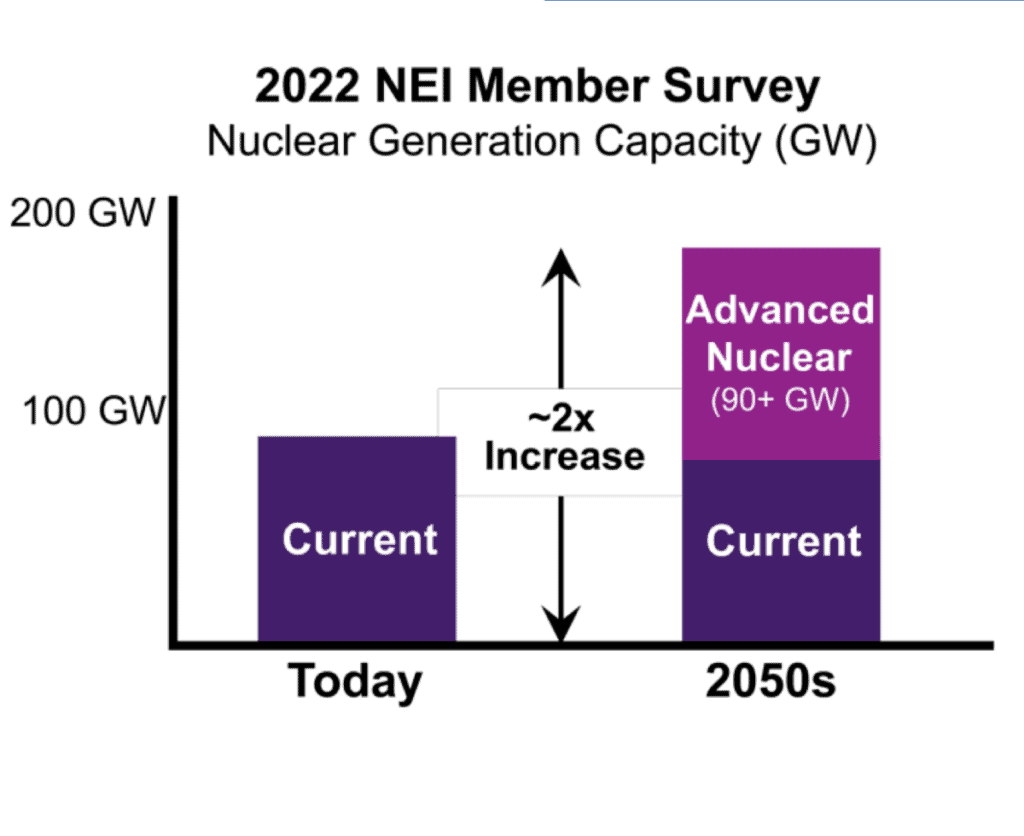
Matt Crozat, Executive Director for Strategy and Policy Development, NEI
Concepts discussed
Auto-linked from the episode's notes and transcript.
Show notes
The nuclear energy policy landscape in the US has changed significantly during the past 5 years. Once seen as an issue with enormous differences between the political parties, it has become one of the few topics on which both parties can have a civil discussion and agree on many key provisions in supportive legislation.
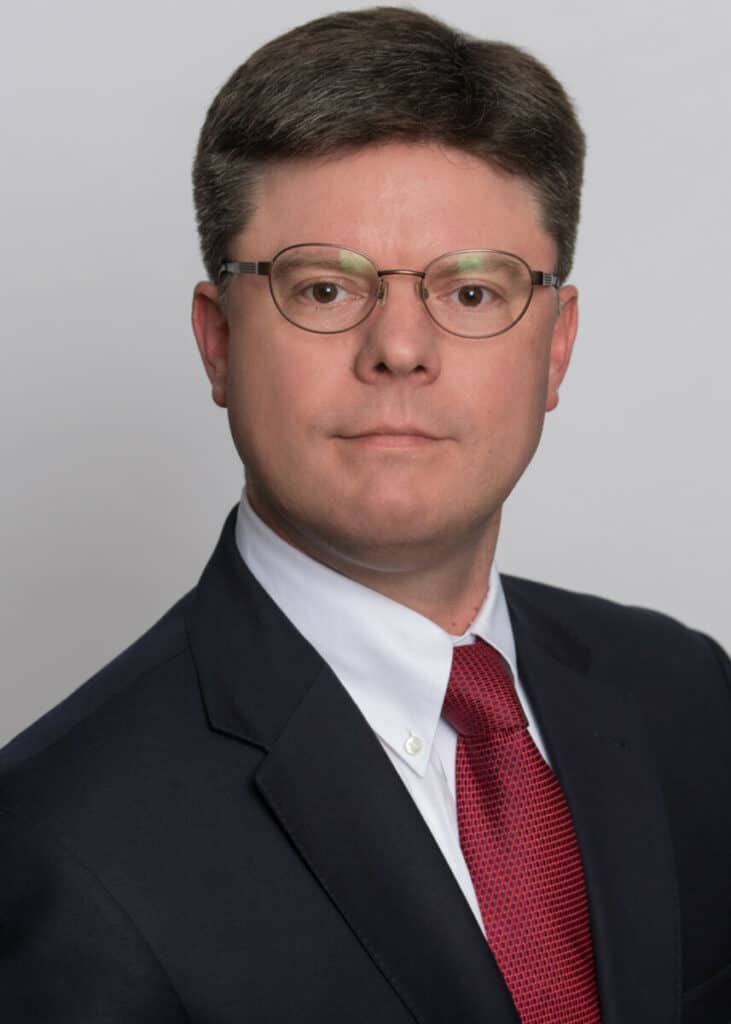
_Matt Crozat: NEI, Executive Director for Strategy and Policy_
Matt Crozat is the Nuclear Energy Institute’s Executive Director for Strategy and Policy Development. He and his supporting team have played a role in helping Representatives, Senators and their key staff members to understand the value supplied by operating nuclear plants and the advanced nuclear power systems that are being developed.
Some of the progress began with efforts at the state level and then proceeded to capture the attention of the national level politicians and leaders.
We talked about the strong financial support provided to operating plants to keep them economically viable and about the provisions of the Inflation Reduction Act that will encourage and reward the deployers of new nuclear power plants.
We talked about the results of an NEI survey of companies that own and operate the existing nuclear fleet that provided an intriguingly large number of expected new capacity additions between now and 2050. (Spoiler alert: Though representing a limited portion of the potential buyers, those companies expect to add enough reactors to double current nuclear generating capacity by 2050.)
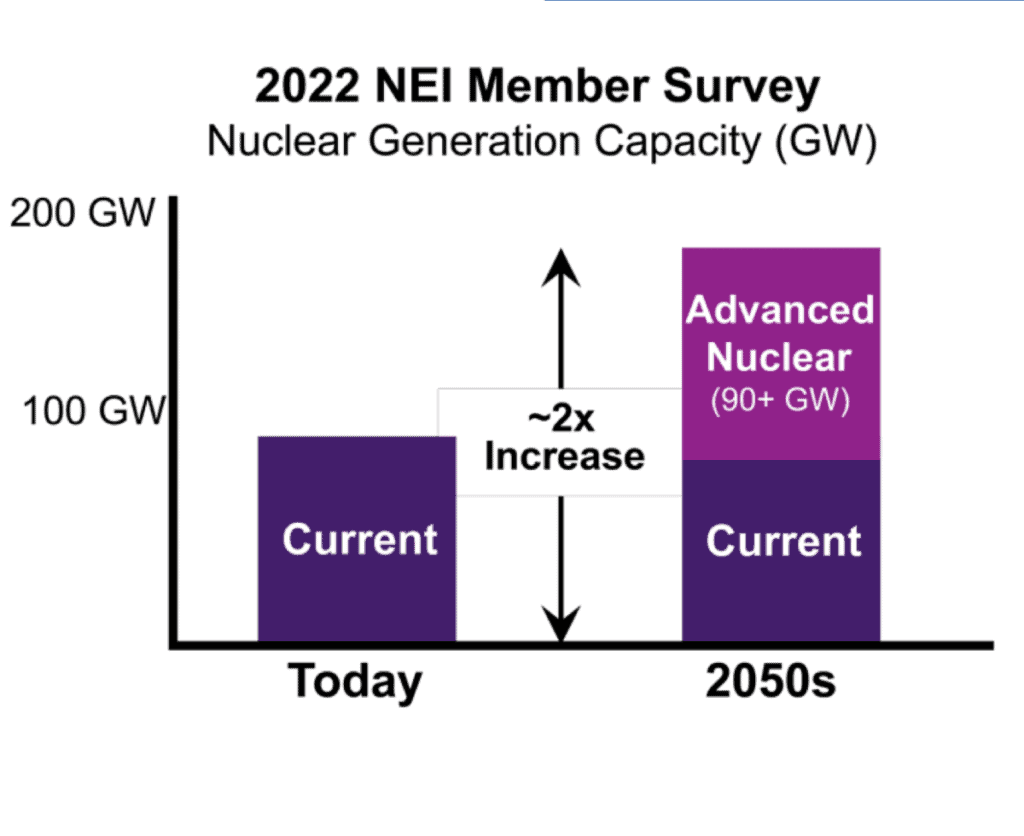
_From: “The Path to Decarbonization:
Overview of the Demand for New Nuclear.” With permission from NE_
Efforts to ensure capable supply chains and workforce development for that kind of growth have begun, but there is a lot of work remaining to be done. We discussed the importance of committed orders to convince suppliers that investments will produce product sales and the importance of jobs to ensure that workers are convinced to invest in developing their skills and education.
An important topic in our discussion was the importance of a consistent, steady effort and the extreme cost and vulnerability that can be imposed by wide swings in support that lead to bumpy, halting efforts.
We talked a bit about the potential that one or more of the companies that already own issued and active combined licenses for AP1000s may recognize that their decision matrix has changed in the past 2 years, with dramatic movements upon Russia’s invasion of Ukraine and then again upon passage of the Inflation Reduction Act.
I’d wager that construction on those project could be organized to begin within about two years from the time the corporate board is convinced that is an investment worth the time and resources involved.
For reasons of fairness and not leaving anyone out of the mentions, we did not discuss the numerous organizations and individuals that helped achieve the successful change in the policy landscape.
I hope you enjoy the episode. Please participate in the discussion here with comments, questions and suggestions.
Transcript
Read transcript
There's a way, a way such a better way today, today. The nation's voice tells the world there's a better way, today there's a better way. It's time for another Atomic Show. This is Rod Adams and with me today is Matt Crozett, a representative of the nuclear nuclear energy institute. Welcome today, Matt, and I'd like you to provide the audience with a little introduction about you and describe your background and a little bit about your current position at NEI. Well sure thing, thanks for having me Rod, I appreciate that. So I'm Matt Crozett. I'm the executive director for strategy and policy development here at the Nuclear Energy Institute. Before coming to NEI in 2015, I was senior policy advisor at the Department of Energy and the Office of Nuclear Energy going back to 2006. I was there with the start of the GNIP program, the Global Nuclear Energy Partnership, and stayed through the formation of the Smum-Ojory Actor program and a lot of other things along the way. But when we started closing nuclear plants, I decided that perhaps NEI was a better place from which to advocate for their the policies that would keep them in operation. And so I've been here since working on behalf of our members to create the policy environment that's going to allow nuclear plants to stay in operation and hopefully create the conditions to go build some new ones. Terrific. It seems to me that over the last several years, conditions have changed quite a bit in terms of the politics surrounding maintaining existing nuclear plants. And NEI is probably contributed to some of those successes. You tell me what kind of efforts it were invested in by NEI? Sure. I mean, if I go back to 2014, 2013 timeframe, we started closing plants, I think kind of add a no where. Ones like Coquani and Wisconsin in particular called attention, and realize that the economic marketplace in which these plants were operating in many cases were just not going to be conducive to continuing operation without having some kind of support from a policy's perspective to value nuclear plants what they're providing. There was not much interest in Washington to take this problem on at the time. And so the efforts immediately went to stay capitals and trying to create policy frameworks at the state level that would allow nuclear plants to be valued for the carbon free or whether always on attributes. And so in particular places like New York, Illinois, New Jersey became the front lines of the conversations for where nuclear was going to be valued and what it was going to take to keep these plants in operation. And I think it's paid out to benefit everyone concerned when those states have acted. Interesting. You're comment about it paying back. I know that in the battle over the, I can't remember the name of the act in Illinois, I clean power or clean energy act, but the battle over that there was a strong effort by the opposition, especially the American Petroleum Institute and organizations they supported to label that program as a bailout for nuclear. Yeah, I just read read recently that Illinois ratepayers are getting about a $240 per year benefit from having retained the nuclear plants. And they never actually have paid any extra because the structure of that bill was essentially just provide a floor under which the plants would get paid some supportive prices got too low. prices had been high enough that nobody's ever paid any money to the nuclear plants. Can you talk a little bit about how that happened and about what you as a proponent of nuclear, the industry is representative? What are you doing to tell everybody this is what happened? So let's start with why it worked out that way. And you got it right. And all of these state programs, there was always recognition that look, you could find yourself in a position where power prices wound up high again and this support wouldn't be needed. And so they all have a mechanism in there that says, well, look, as market prices increase, the value of the credit could decrease. And that's what we've seen especially in the last I'll say 15 months has been very much the case. And so as a result, the expectations for what it was going to cost to keep these plants in operation have been much lower because the overall price of natural gas and the power prices that go with it have increased considerably. Now, there certainly were arguments along the way that this was a bailout and the like. And what strikes me is that the opportunity at the state levels who really understand what these plants are providing both in terms of the economic value to the ratepayers who were buying electricity, but also the jobs and employment in these communities and especially for all of these plants that have states that had plans to reduce carbon emissions, it doesn't take a whole lot of back of the envelope math to realize that you close your largest sources of carbon free power. You're not going to hit your ambitious goals. You bring those together and you had an ability to have a conversation. It didn't, wasn't successful everywhere. We've lost 13 reactors over the last 10 years. Well, more than that, and that's been an important part of the story of the opportunities that state action was able to actually solve problems and create a much better position for the energy picture going forward. And it's not a surprise that we've seen a similar framework pick up now that Congress has taken an interest. And I think that the success that we had and being able to point to those state programs really gave a strong footing to reintroduce the conversation at the federal level and say, look, there's a way forward here that has worked, can work and create a much more predictable long-term environment for these plants to meet these goals. And we've seen remarkable success in the last two years on that front. Many people don't understand just how big of economic benefit it is to maintain those plants, not just for their clean energy output, but for their energy output in competition with other sources. Because what drives the price of power and the price of natural gas is whether or not there is enough supply to meet demand. And any time you reduce supply to the point where it's no longer meeting demand, the price has to go up to destroy some of the demand so that things bounce out again. So just putting a floor under the price and making sure that the nuclear plants were recognized sustained online has some impact on overall power prices and power availability. What kind of, and that's, and then we'll move on to another topic. What kind of outlook does any I see for new nuclear plants? You mentioned that you, that's part of the reason you went to any I was to kind of establish the conditions for building new plants. No, you're right. And that same set of realization that started with the at risk operating plants, those same factors have really begun to reshape how companies have looked at what new nuclear might mean for them going forward. So during the same timeframe, you've seen something pretty remarkable happen, which is just about all of the companies that own nuclear plants and the utilities in the country in general have put forward commitments to be carbon free by mid century or close to it. And what tends to happen is the CEO makes the statement that they're going to be carbon free mid century. There's applause at the shareholder meeting. And then about six months later we get a call from someone who's trying to do the modeling of how to have this system work. And they say, hey, can you tell us about those advanced reactors again? Because all of a sudden once it becomes the transition from a noble aspiration to how am I going to make this work where I can provide reliable power that's affordable and carbon free, that's a really daunting challenge. And you need tools that look like new nuclear reactors to be completely make that system come together. And so we've seen this real transition towards as companies have been starting down this journey, the recognition that the attributes that new nuclear can provide are awfully well aligned to what it's going to take to make these systems work alongside a lot of wind, a lot of solar, a lot of batteries. This isn't a one or the other. This is a challenge of I need a lot of all of it. And without something like nuclear, it gets really hard to make that system's thing together. There are some people that make the statement well, renewables can do 60, 70, 80 percent. And when we get to that point, we should go to nuclear. What's the real effective response to that kind of argument? Because I think since nuclear takes a while to build, the best time to start is like yesterday. Yeah, I think that you're thinking of it as a system and understanding where you're trying to go is the hardest thing. That's people have a hard time with this. is why we need a lot of times things like computer tools to help us understand these pps fit together. But the idea that I'm going to wait for the hardest part until the end, well, that means I'm going to be stressing the system along the way. I'm going to be taking risks until I'm getting to that last 20 percent. And there's no reason to wait to build this transition. There's no reason to have this debt that I'm building into the future that you need to pay off all at once by deploying a lot. The most reliable way to think about deploying any technology, but especially nuclear is to think about it in terms of a consistent program, being able to do one after the other without trying to do it, you're cramming for your finals kind of approach. So I mean, I think having a sustained program where you can learn from what you've done in the past, incorporate improvements and do that alongside what I'm building out for the other technologies is going to give you the most reliable strategy towards making a very difficult transition. And so trying to make it harder on yourselves in the future is a pretty risky way to go about this. Yeah, the other analogy I tell people you can get a lot better fuel economy if you're going hot straight and normal on the expressway than you can if you do stop and start driving. And of course, with the big industry like nuclear, we have proven that stopping and starting is a difficult thing to do. That's right. Very costly to start up an infrastructure that you've destroyed. No, it's exactly right. And we've also have the counter examples of places where we've seen the programmatic successes that are more reliably, and I think in the Asian particular, where we haven't seen that start and stop in quite the same way. Japan has his own case, but before that there was going to be a long program of steady build, period in the same way. And so I think an appreciation that having a consistent approach, I wait a build skills to train people to provide careers from doing this as opposed to deciding on going to all of a sudden take a whole bunch of people, give them a new job for a couple of years and then stop. That's probably not the most efficient way to go about it. And we have the ability to think long term because we have these long term goals. And you're right, nuclear is not something that works best on short time horizon. You want to be able to think strategically about nuclear. And so I think having that longer term perspective, I think draws you back to the idea of saying we need to get going now so we can create this runway towards what that expansion needs to look like. And one of the things that's happened over the last, say, 10 years is a growing realization or growing recognition among members of both parties that nuclear is important. A bipartisan approach to something like nuclear is a much better way to establish that effective long term consistent policy approach. Can you just talk a little bit about what kind of changes any I may have seen over the last 10 years with support from? both sides of the political aisle. No, that's an important part of having a long-term strategy, as you can't be tied to elections every two years, as we know. And so being able to create an appreciation of how nuclear can help meet the goals for people with different perspectives, different priorities, has been a really important part of the conversation and the messaging. And it's not something that's happened overnight, and it's also not something I have my accident. Trying to have conversations with people who might not have seen nuclear as part of the solution set they wanted to dance. I think this has been most obvious in the case of seeing how, especially on the democratic side, the conversation has evolved in the last, I'd say, four years in particular, where I think you had a traditional part of that caucus that had anti-nuclear as a part of their identity and their activation into the political sphere. As we saw, I think, more and more dire warnings coming out from the IPCC and other groups about how far off the trajectory we were for meeting our 2% goals for climate change. I think that forced a reset and a pause that, wait a second, if climate change is the biggest problem that we're facing, why is it that I'm trying to do that without nuclear? How am I having that be the thing that's holding me up? And not everyone got to at the same time, in the same way, but you combine that with new technologies, advanced reactors that were able to begin to be part of the conversation of, well, let's not talk about the technologies of the 70s and the anti-nuclear conversations of two generations ago. Let's focus on what these new technologies look like and why they're valuable. And once you've began to see how that was part of a solution, it'd be easier to see, well, there's not that much difference between making a vision and a new reactor than one that's currently running now. And I think that ability to sort of use the opening that new technologies provided to be able to reframe the understanding of how nuclear fed as part of this broader push on climate change, combined with a long-standing support for nuclear from the other side of the aisle. And the GOP has been more consistent over a longer period of time of what nuclear means, especially from an energy security perspective and national security. And so we had this opportunity where I didn't need each side of the aisle to adopt the other ones priorities. They could see a role for nuclear from their own frame of reference and their own priorities. And that really did create an opening that we really saw come to a head in the last three months with the inflation reduction act and prior to that even the bipartisan infrastructure bill. And of course, before that, there was a nuclear, the NEMA and NICA. Yes, of some number of other, I think there's a total of six bills in the last three or four years that have really kind of moved the needle and shown how much support nuclear is getting in the Congress. Because I think with the exception of the inflation reduction act, all of those were passed with bipartisan support in some cases, overwhelming, bipartisan support. And for those people that have always thought that the Democrats were the anti-nuclear party, the provisions in the inflation reduction act should change that feeling because it's definitely supportive of new nuclear is awful out of good provisions in that bill, particularly putting all clean energy sources on an equal footing. I have been saying that when I look at the inflation reduction act, I think this is the most significant set of policies to advance the use of nuclear energy in the United States since the 1950s. I have to go back to the Price Anderson Act to find anything that has been as dramatic as an opportunity as what's in the inflation reduction act. And you're exactly right. The key reason is just what you said that we're seeing now after a decade of making the argument that nuclear should be on a level playing field. I can't tell you how many times I've used that analogy over the years. Well, that's what happened. The idea that essentially you now for new nuclear projects, you have the option of taking, was essentially a bulked-up version of the wind production tax credit or a bulked-up version of the solar investment tax credit. And you can choose. This is a remarkable way to reframe what the opportunity is here. And one of the challenges I've had is trying to convince people that it really does say that. In the nuclear world, we're playing defense for so long. The idea that we're actually in a position now to be treated on an equitable basis in policy space is really hard to get your head around. And so a lot of it is trying to get the message out there, how people begin to think about what it means, if say the federal government's willing to provide a rebate for a nuclear project, about 30%, 40%, 50% when it goes into service. That's amazing. The idea that you could be looking at a production credit that could be worth roughly twice as much as what Bobo will be in line to receive when it goes online next year, that's amazing. And that's just part of it too. And so to your point, we're at this moment now where the bipartisan support for nuclear has created an opportunity that we've long dreamed of. I've modeled it many times over in spreadsheets and other models. But to actually see this as now as part of the actual law of the land is a remarkable moment and a remarkable opportunity. You bring up a point that now gives me an opportunity to launch into one of my favorite questions for those who are members of the nuclear establishment. Over the last several years, I've heard many people say, Vogel shows that big reactors are dead in the United States. We're never going to build another one because the experience had not been all that great. And of course, VC somewhere is even worse because it didn't get completed. However, times change. The economic position of nuclear compared to its competitors is different now, completely different in terms with the production taster at the ITC than it was just a year ago. And of course, the price of natural gas and other competitive energy sources is not the same as it was. So there are at least four units that have a completed construction operating light in the COOL or combined operations. And so they have a site, they have a license, and there's finally a completed detailed design available. Now that the AP1000 has actually loaded fuel at Vogel, that was one of the biggest Vogel challenges was they started with about a 30% complete design. Will anybody look at their spreadsheets again and say, you know, it now pencils out. Let's start building another couple of AP1000s at WSL and at Turkey Point. Do you think anybody's doing that? I would imagine someone's doing the math, right? But what I would expect, given the journey we've been on, is that I suspect that as we talked about earlier, the idea that boy, if you stop a process for a while, it's hard to start it back up. I think that for a lot of folks, the smaller reactors are going to look like more of an appropriate size step at first. And in particular, I think of this lesson terms of technology and more in terms of just the scale of investment on balance sheets. If I had a national utility, like say, France does, where I have one company and the balance sheet to provide all of it, that might be different. But I think part of the challenge that we've got is making sure that the scale of investment is commensurate with the scale of the assurances of the program. So I do think that the first movers were likely to be on the smaller side. However, the other point I'll make, and this is not lost to me, is when you start thinking about getting to very high percentage of carbon-free in the mix and a lot of nuclear is part of that, it's really nice to be able to move and gigawatts chunks if you're trying to move fast. And so I don't know that I expect that to be the first move, but it would be pretty short-sighted to close down that option because it's going to look, this work will look very different within a few years and having that in your pocket and being able to move faster could be really attractive. Yeah, I'll reiterate my point, you can respond or not, but the point is that there will be a demonstrated US AP 1000 operating by the middle of next year. That process is completed. There are licenses already issued for four more. And there is a, maybe somewhat damage, but there is a supply chain that has already been established to provide parts for those, especially since there are other places like Poland that are planning to build those machines. It seems to me that it's not a bad idea, particularly since both Duke and next era have large and growing customer bases to go ahead and get started on those plants before the workforce from Bogle is completely distributed somewhere else. Yeah, I think you're just a couple of interesting points there when I was going to make as well, which was the Poland, that I could really see being able to bootstrap a lot of the efforts because you're right, there is a supply chain, but let's be clear in saying that the supply chain we wound up with was not the only design going in to the B which part of that work is being sourced domestically and how you build that strategically. Because I think that's going to be a real opportunity to think in terms of not just kind of filling in because the previous supplier didn't open on time or whatever that looked like, but instead of being able to say, making a forward leaning investment towards where the industry is going. And that's why I think you can get more confidence in what that looks like. So yeah, I do believe those are going to be valuable options. It's not, as I look at the T-leas right now, I don't know that I see that in the next few years, but I do think there's going to be a realization that these technologies that are being, in this case, deployed abroad and running well at home are going to look very attractive. And there's no reason to think that there will be, surely the conditions where those are going to be the right kind of approach. The challenges I think trying to find places where I need to think in terms of two to three gigawatts at a chunk. And I think that's where I need to do a little bit more of the scale of demand growth needs to match the scale of capacity expansion in the same spot. And part of where I think this becomes really interesting is as I look towards other sectors of the economy where nuclear has not traditionally played directly, things like industrial applications and transportation sector with electrification. The way I have come to understand the growth of electricity used in the United States might begin to look quite different. And I might be on a much more aggressive expansion profile than I currently see, looking just at how the power sector itself has been growing relative to the economy. Yeah, I agree. Knowing a little bit about South Florida and South Slats North Carolina, I can say that those areas have a rapidly growing population and particularly in South Florida, there's going to be an awful lot of EVs being charged at some point. I'm going to continue being this strong weather hunt. I'm sure that any I remember, of course, next year is not even any I remember anymore. So definitely count, but, but Westinghouse is, and so it's due. And so I think that, you know, as I look at the journey we've been on for the AP 1000 in the United States, I mean, it's taken longer than we wanted, but I don't want to look past the fact that it's a remarkable accomplishment that we're on the verge of seeing. And the technology is fantastic. I think it's just trying to find to my mind the right combination of... timing the scale of investment and the scale of demand increment that needs to be added. But it's not hard, like you're saying, it's not hard to imagine conditions over the next decade or so where those begin to line up a lot more in terms of thinking of thousands of megawatts instead of hundreds of megawatts. Yeah. My view is that there's the best day to start those projects in January 1st 2025. As we look at the statute, so it has to go into operation after that point in time, which means that roughly anybody else who wants to move faster has a good incentive to do so. There's no reason to wait on a nuclear side. I don't think any nuclear plants going to be starting today and operation before 2025. So we can't do it right. And I think part of the opportunity here is that this task credits are written in a way that creates a longer horizon for their staying on the books than what a free was even expected. But also, there's no reason to wait. And so part of the evangelical part of my job these days is trying to convey to folks just what the opportunity looks like here and why it is that we need to really begin to to reach out to the math because I think that a lot of folks had gotten to the idea of they were comfortable with maybe where they thought the economics of nuclear were and that was a later decision because you needed things to change. Things just changed. And part of what I want to hoping we'll see is a reassessment of what the economics looks like. What the with the economic opportunity for nuclear is and also a better set of tools to understand what it's going to take to provide reliable carbon free power at an affordable price because part of the challenge that I've run into over the years is even as companies have sat down to do some of the analysis. They don't always have the kinds of modeling tools to understand just how to think about what happens when I have lots of wind and lots of solar and variable weather conditions. And I think we're now seeing better modeling tools come in. And that's where you really begin to see that you need something like nuclear. And it can be something else too. I mean, if you know natural gas and carbon capture gets there that that could work if you invent a long term battery that can get there too. There's still a competition here. But it's a competition for something that nuclear is well positioned to provide. And that's where I think we need to find a way to reboot the intuition people have had about the role of nuclear. It's coming along slowly in the political sense. But especially in the financial sector, I think we have opportunities to catch up in a hurry. And that's where I think this conversation is more than about just creating the policy environment now. It's also about creating the economic appreciation in the private sector that things been lagging a little bit. Yeah, the notion of redoing the math is very important. And awful lot of people have done the spreadsheets two or three years ago and haven't updated. So it's time to recognize that the inputs, the assumptions, the competition is all changed. And it's time to redo that math and say, hmm, let's take a new look. Some of the advanced reactors are pretty intriguing. What are some of the feelings conversations of feedback you're getting from your members? Have you done some surveys on how what do they feel about these SMRs? Are they going to start building them in significant numbers? So it's interesting because about this time last year, we realized we're having a lot of one-on-one conversations with our members who were saying that they were really interested in advanced nuclear as part of their future. We haven't actually found a way to get our arms around just how much we're talking about. So we put together a survey late last year of our members. These are just the ones that already own and operate nuclear plants. We've actually asked them okay, if these advanced reactors come in at about the economic targets that they're talking about, the price targets, what does your modeling say you're going to need to add to your system going forward? We added all that up and it worked out to about 90 gigawatts of new nuclear. By comparison, the current fleet is about 90 gigawatts of operating nuclear. It's about to double the fleet. And this was with the presumption that just about all of that operating nuclear is going to stay in operation. This wasn't replacement. This is addition. If I think about that, our members who own operate nuclear plants are just a portion of the industry. If you begin to think more broadly and you look at the ones who are furthest along in developing new nuclear, folks like UAMPs, folks like Pacific Corp, they don't have new nuclear in their system, if they're looking at new. So if you think about that, it's not hard to look at a system where I'm thinking not 90 gigawatts much more than that, maybe even a couple hundred. And this gave this kind of a moment of pause because you begin to realize that if I'm thinking in terms of say small-majler reactors, take a notion of one of 300 megawatts or so, 90 gigawatts at 300 megawatts each, that's like 900 units. That's a lot. That's a lot more than we've thought about in terms of what it takes to scale the regulatory process, what it means to construct new nuclear, it means a lot more numbers of things. There's a lot of reason to think there's a good approach there, but it does put in a bit of stark relief what needs to begin to happen between where we we are today and where we need to go. I'll point out that this is all before Russia and data Ukraine and natural gas prices went to the roof. And before the inflation reduction act, they nuclear look cheaper. I imagine if we would have redo that analysis, it would only be higher. And so this begins to really put an arm line a spotlight on, okay, what is it going to take to create an industry, a regulatory environment that is ready to move at that scale with those numbers as we looked into the 2030s to get going. It's at the full speed. And that's been a opportunity in realizing that in order to realize the opportunity, there's some challenge you got to work through too. As the NEI considered issuing the same survey to a larger portion of the electric industry, not just those who own an operating existing plants. Because as you said, the ones that are actually moving right now are not in the base of those who own an operating existing plants. I don't know if we've thought about it in that context. I know that as we think about how the energy landscape has changed, we appreciate this probably that what I'm saying is already stale and probably a little bit conservative. But I think even from our point of view, even with that data point and as limiting as that might be, that still implies a pretty dramatic need for a discontinuous change of how we've been pursuing nuclear today. It's not ones and twos. It's dozens and hundreds. And even if it turns out I'm off by a factor of two and what that estimate looks like, it still sort of points to the NEI that I need to create a pathway towards thinking at a scale that has just been beyond what we've had to do in the past. Let's just take something similar. So I mentioned like 300 SMRs. I know I've more than that. If I think about the total number of construction permits that have been awarded by first the AEC and now the NRC over the entire history of the US nuclear industry, I haven't done the math. I'm going to guess it's probably something on the order of 150-ish over a 60-70-year time horizon. And I'm talking about well more than that in an awfully short period of time. So we know that the way we've done things over the entire long-term history of the industry is not going to be sufficient to what it's going to be needed to create that kind of world. And to your point, you know, think about just where the current thinking is, it's going to make it more dramatic. And so this is not just about the NRC, it's broader than that. But that's how we need to be thinking in terms of the scale of what could be coming and how we can position ourselves to be ready to actually be able to, again, creating that kind of discontinuous change that we're going to need. How are we making the case to Congress that the current method of funding the NRC is not adequately supplying them, the resources needed to look ahead and to be ready for the kinds of changes you're talking about. Right now, most of the NRC funding gets, comes from the operating plants, and the owners of the operating plants have no real interest in funding the NRC to do work other than do the regulating of their plants. We've certainly seen this already as these advanced designs have come to the NRC. So it's one thing to think about the challenge of taking a gigawatts scale reactor and instead thinking of a, in terms of tens or a couple hundred megawatts. How does that change the understanding of the safety requirements and what needs to be assured to meet the safety needs as per their mandate? That's been in the self bit of a challenge, but it's way harder when you begin to think about, well, what happens if it's not a light water reactor? What if it's not water as a coolant? What if it's a different kind of fuel form than uranium oxide at five percent that trying to create the institutional knowledge at the NRC for what these technologies might mean and how to understand them and evaluate them? That takes time and resources. There's those resources have to come from someplace. And I don't think we've really broken the code yet on what it's going to take to create a, not just a funding model, but an overall way to manage both the institutional understanding of the technologies themselves, while at the same time not trying to create an NRC that's twice the size it needs to be because we think this is going to happen sometime in the distant future. So it is a difficult balancing act. We appreciate that the answer here probably isn't to go higher 2000 engineers and then train them to do things later. But at the same time, we know that workforce challenges are going to be are already hard and going to get worse. And so this is going to be a pretty careful journey of trying to calibrate what's coming and have it repair for it at a time-lina fan or that you're not just caught behind the curve. And that's what you think the real challenge that both the NRC leadership has, the industry messaging has to understand and also especially the role of Congress and creating the expectation what needs to happen and how those resources should be apportioned. Yes, probably not time to hire a bunch of extra regulators, but it's certainly time to provide the resources to hire a group of really smart people to redesign the processes so that when you do hire the new regulators they have something better to work from. There's an awful lot of excess debtory as it has been laid upon the process over the last 50 years. And that process is going to have to look very different in the future. And I think well I think that's easy to say trying to figure out how to get from where we are now to what that needs to look like. That's not an obvious journey, at least not to me. Maybe to those who are close to that world they can see more straightforward line of sight. But I need to to be thinking in terms of being able to approve the designs for understanding of the technology itself and then mapping that onto actual deployments in a way that is much more timely and takes advantage of lessons learned in a way that we just have not been able to demonstrate. You could argue, Part G2 was designed to create this kind of framework and we just have never gotten to the being able to get to the second followers through end of the behind. But it's going to have to look different when I think in terms of advanced reactors, small reactors that are trying to work on the economies of replication as opposed to the economies of scale. And that's where the industry is going at least in the medium terms we discussed earlier. So how the regulatory environment adapts to embrace that and I think the idea of these designs are being put forward. those sizes are being put forward precisely because of the safety case that they provide, ought to provide a path forward. But it's going to be, I think, a challenging set of conversations along the way as we begin to figure out what has to happen here. Well, there is some provision. There were some smart people who wrote the regulations to begin with. There's a whole section on how do you license a manufacturing process so that you can, actually, do your inspections in the factory setting and replicate things. It's not a process that's really been exercised. So that's a problem. It is an issue that I think we need to be working on. How do we properly resource the NRC to do what it's really supposed to do, which is to protect the interests of the American public and make sure that the public and the environment are safe, which leads me to say that it should be much more funded by tax money than by fees. The idea of user fees dates all the way back to David Stockman and the Reagan administration, which I think was a time when nobody wanted to say the word taxes. It really is something that should be supported by taxpayers because we're the ones who get the benefit of both safe and clean nuclear energy for utilities and don't get much benefit from it. Your regular utilities don't get extra profit because it's nuclear compared to something especially in a day in a time when nobody charges anybody for CO2. All right, Matt. So we've been talking for about 40, 45 minutes or so. And I'd like to give you an opportunity to sort of summarize where you see your organization going over the next few years, what kind of priorities do you think you're going to have to help enable nuclear to continue supplying what it supplies today and to grow for the future? So we're talking to somebody who works in the policy world. So as a result, policies tend to be what I look at first, hammer, nail, all that stuff. So we certainly have the remarkable step forward of the inflation reduction and even some of the opportunities from the infrastructure investment and jobs act to the bipartisan protection bill. A lot of the challenge now is in the medium, the immediate window to make sure that those actually get implemented in a way that they can be used in the way they were intended. So a lot of that is trying to help the internal revenue service understand the nuclear industry and understand that as they create through the guidance that's going to actually be what companies will look at, understand what taxation policies are going to mean, that that reflects what nuclear is going to bring. So we have some immediate challenges to ensure that as we now focus on the making these really useful that we get that right. And that's going to be part of the immediate challenge. But beyond that though, we need to be setting up for what this opportunity looks like and how to get ahead of. We talked about the NRC and what that's going to need to look like. But it's more than that. We're going to need to see how we build the workforce of the future. There's going to be a lot of people on a lot of skills necessary to build out nuclear at this scale and operate it. And this is more than just having nuclear engineers, those are important, don't get me wrong. But even people who work for the mechanical engineers, people who are building trades and the operations of plants as well, those skills need to come through and have a home for building long-term careers in the industry. This is part of the reason why the cold and nuclear story is so compelling is I actually have a skilled workforce there that can draw on to put electricity from a power plant to the grid to move steam around, move water around in a safe and reliable manner. But we need to build beyond that too. And so that's going to be one of those challenges. One that I think about is how we create this longer-term supply chain. Deal with a chicken and egg problem of realizing that I'm going to need to see capital investment in some of these supply chain capabilities. But I need to make sure that happens before the order comes in the door. However, I can't be putting billions of dollars at risk and plants that might not get used. And so how do we tap into the capital markets and the risk allocation that Wall Street's good at? But they've not been looking at what it takes to build out this part of the economy and this industry. And so expanding the opportunity for that kind of large scale capital mobilization to build the infrastructure and then the plants themselves. And seeing that whole journey be folded more into building sustainable economies and the taxonomies that have been trying to help direct sustainable funding into these channels is a step too. And so what I'm saying is it's going to take expanding our focus beyond just the government part and the regulator. Those are important. We're not stopping there. But expanding out into the private sector more broadly to bring to bear both the people and the resources of funding necessary to really create this path forward. And I think that's going to be quite a journey over the next five, ten years. And it should be fun. Yeah, one of the challenges that we have is having been a supplier, a very modest little supplier in a certain industry. It's very difficult to invest in equipment if you don't have at least a promise that somebody's going to buy the equipment if you can supply. You know, it's that you got to have that that ability to place orders. And in some cases put down deposits that allow the supplier to make the investments necessary in their equipment. And I think many people don't understand that factories that produce important widgets aren't as expensive as a complete power plant. You know, you can really get your factory production set up for a lot less than you can building a complete power plant. But you have to be ready to place orders. And a lot of people talk about the problem with with human capital. But I can pretty much guarantee is that if there's jobs, the people will come. But the people aren't going to go and spend the money on training themselves if they don't see a job opportunity. You know, it's one of the especially these days when people have to borrow a lot of money to their college. Yeah, and especially to that point too, it's also being able to see that there is an opportunity to go after. And so, you know, bringing that that part of the story to people still in their education years and understanding that there is something exciting and promising and long-term, it's not a fleeting moment. It's a really interesting place to put yourself and have opportunities going forward. Getting that story out in a way that was maybe a lot easier in the 1950s when you had Walt Disney putting out little shorts all the time and things like that, whereas it's a much different environment now. And we have to figure out how to tap into that. And I think that you're right that when people understand the opportunity, they'll need a whole lot of motivation to go after it. But we have to make sure that we're not waiting on them to get through junior high when I need them right now. And so, you know, there is this kind of how we accelerate this and bring this to the future. And it's in that regard, it's not that different than your story of what it takes to get a supplier up and running of having enough certainty that this is a pathway that I can invest in, whether it's myself or the capital equipment, and then making sure that that gets realized. And that's part of where I think that some of the challenge is going to be in in the short term here. And so, as you said, we need to get going on it. Yeah, it's time to start, of course, we all have been starting. And this is one of those things where I hope that people call us an overnight success and maybe they'll forget about the 30 years worth of groundwork laying we've been doing. So that's all right. And that point I'll lead with this thought. So, you know, as we've watched the inflation reduction act come into law, I've been thinking a lot about how we got here. And in particular, because if you remember a part of the reason we've focused on the states to keep plants in operation was I couldn't get Washington interested in the problem. And it occurred to me that as reflecting on this journey, I was reminded of a line from Ernst Hemingway of when he was asked about how he became bankrupt. And then said, well, two ways gradually then suddenly, that's kind of what's happened here too. That how do we get Congress engaged on this issue? Well, gradually, and then then suddenly, but the gradual part wasn't just waiting. It was a long journey of putting yourself in position, having the conversations, explaining the role of nuclear wire was important to meeting these national goals. And that took a while. But once it happened, it came quickly. And I think that that's probably not a bad model for how to think about what it's going to take to hit the opportunity where you can actually see multiple reactors come online in the same year. But it's going to feel shocking when it happens. But it's not going to be because we got lucky. It's because a lot of long-term work had to go into making the decisions possible. And so, I hope we can get ahead of that now to be ready for that as, and to be called, I just said the overnight success. With that, I think that we'll save it by. Thanks a lot, Matt. And I just for the reminder for the audience, I've been talking to Matt Crozett from the Nuclear Energy Institute. And Matt, can you remind us which your exact position title is? I am the executive director for strategy and policy development. All right, terrific. Thank you very much for your time. Thanks, Rod. And this episode of the Atomic Show was brought to you by Nuclear Action Capital. We're working hard to select ventures with extraordinary promises success. They're building the advanced nuclear sector and helping expand our clean energy options. We're building a portfolio of ventures on behalf of investors like many of you. We don't just take funds from the large institutions with typically allocate to venture capital. We believe regular investors should have access to advance nuclear for their own portfolios. So we allow people to subscribe on a quarterly basis starting as low as $5,000 per quarter. A four-quarter subscription will get you exposure to between four and six ventures. If you are an accredited investor and would like to learn more about how you can participate, please check out our website at nucleationcapital.com. That's nucleationcapital all one word.com. Our fund and all the information you need to subscribe is available online. You can also subscribe to our newsletter, nucleation insights, and join our pro nuclear investor network to learn about select syndicated investment opportunities. If you have questions, we're happy to chat. Please spread the word.