Dr. Lindsay Krall, “Nuclear Waste from Small Modular Reactors”
Concepts discussed
Auto-linked from the episode's notes and transcript.
Show notes
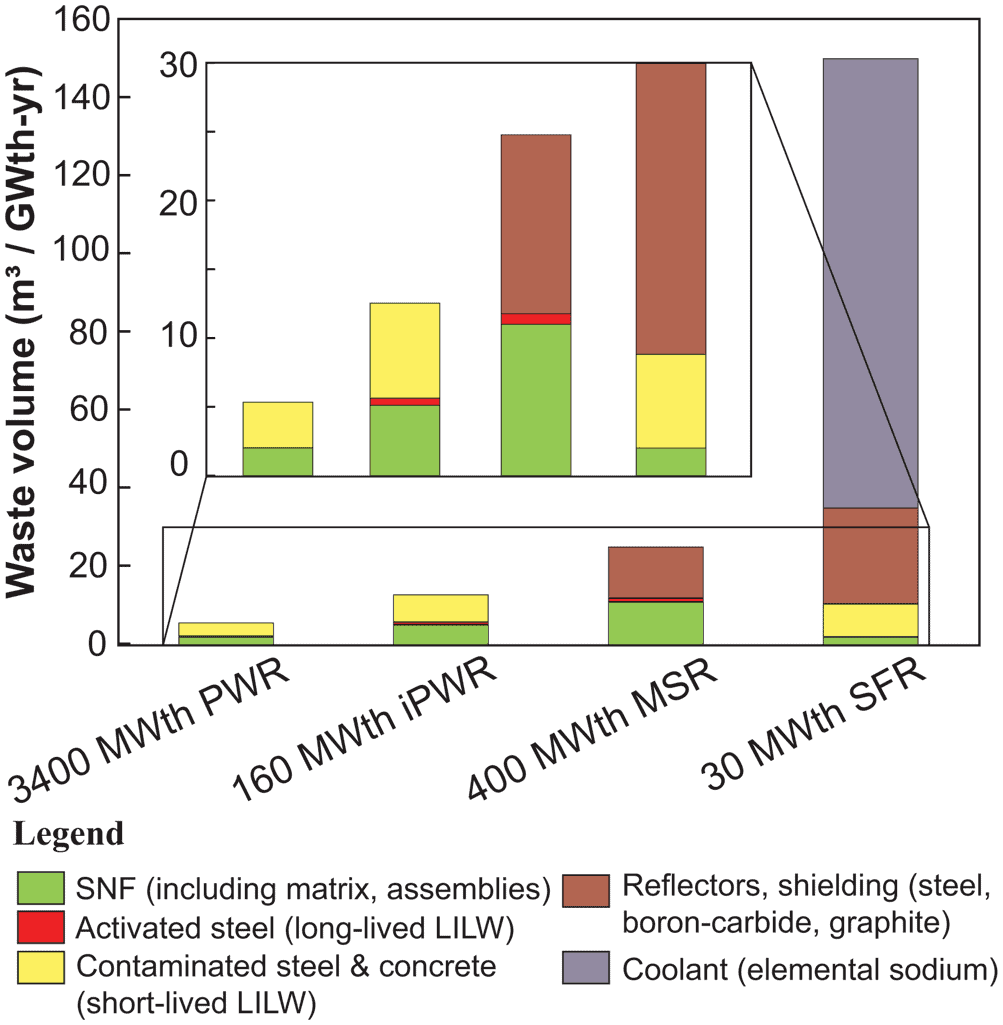
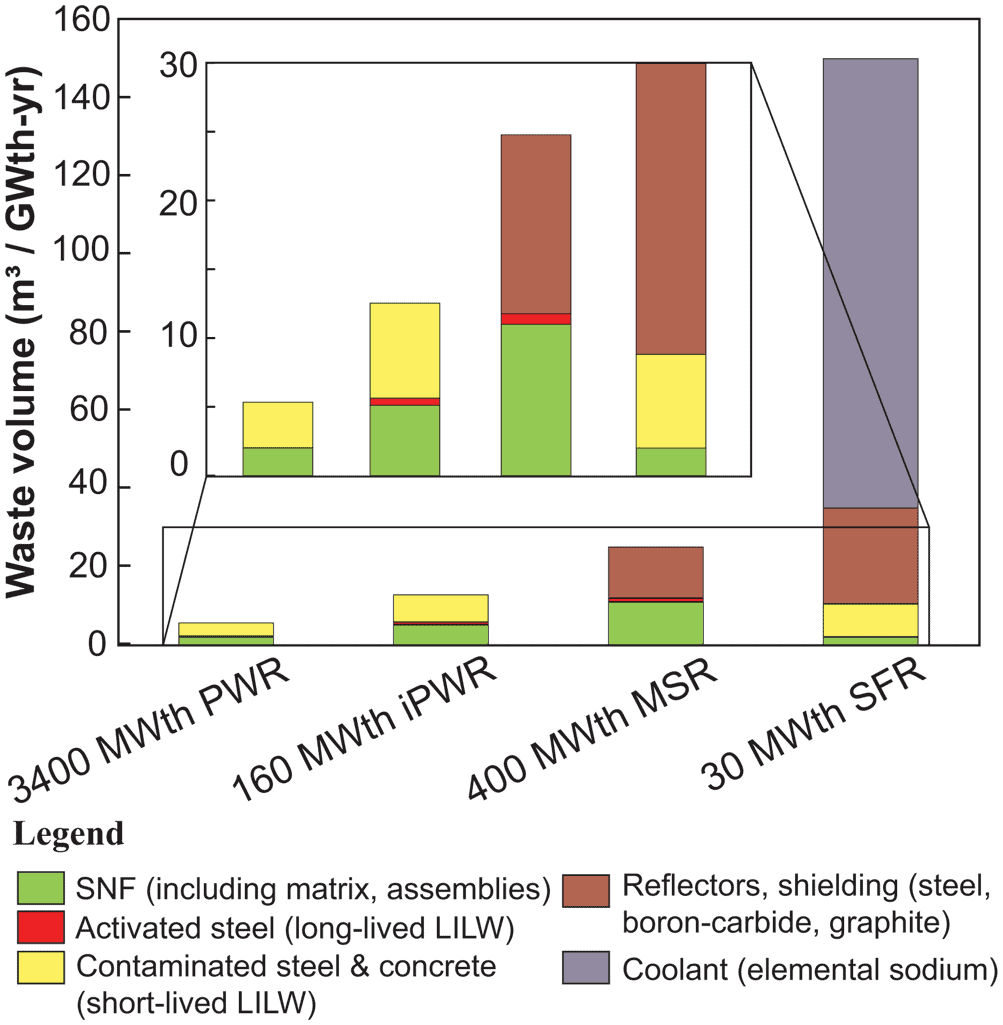
_Modeled waste volumes for selected reactor designs (From “Nuclear Waste from Small Modular Reactors”)_
Dr. Lindsay Krall is a geochemist currently working on projects characterizing the behavior of radioactive isotopes that will eventually be stored in a deep geologic repository being designed in Sweden for construction within the next decade. During a three year post doctoral period she worked under a MacArthur Foundation grant program to study the projected production of waste from small modular reactors. She received mentoring and guidance from Dr. Allison Macfarlane and Dr. Rodney Ewing, but performed most of the work as an individual researcher. As we discussed during this episode of the Atomic Show, the study topic was only marginally related to her academic and professional field.
During her post doc period, she presented various stages of her work at conferences and in journal articles. She told me that those progress reports generated few questions and apparently little interest.
But the final paper documenting her study results produced a minor eruption inside the world of people that are interested in the development and deployment of small modular reactors and advanced nuclear energy production systems. The paper, titled “Nuclear Waste from Small Modular Reactors” was published in the Proceedings of the National Academies of Science. It included the discussion-provoking conclusion that “SMRs will produce more voluminous and chemically/physically reactive waste than LWRs.”
Aside: I question the author’s choice to use the word “will” instead of “might”. There are far too many uncertainties and technology-specific conditions for such certainty. End Aside.
Unlike most of the thousands of study papers published in scientific journals each year, this one stimulated immediate attention with articles in mainstream outlets like Bloomberg, Reuters, The Globe and Mail, and the Register, presumably written by journalists that had access to a pre-print version of the paper. That active promotional effort was a bit of a surprise to the study’s primary author, though she had been advised by her coauthors to be ready for media inquiries.
Dan Yurman at Neutron Bytes published a detailed review of the paper.
The study focused on three SMR designs out of the dozens that are currently under development. The three selected systems included the 160 MWth version of the NuScale Power Module, a version of the Terrestrial Energy Integrated Molten Salt Reactor (IMSR) and the Toshiba 4S. Developers of the NuScale Power Module and the IMSR published prompt responses to the PNAS paper, the Toshiba 4S has not been under active development for at least half a decade.
Both of the responses challenged the study’s decision to use obsolete versions of designs that are still evolving and have not yet been built. They challenged some of the paper’s assumptions about neutron leakage and stated that it cannot be computed with simple volume-related equations. One statement from the paper received particular attention from Terrestrial Energy.
> “Molten salt- and sodium-cooled SMRs will use highly corrosive and pyrophoric fuels and coolants that, following irradiation, will become highly radioactive.”
Correction of Factual Errors in PNAS Article “Nuclear waste from small modular reactors”
No reactor design proposes to use pyrophoric fuels and sodium coolant activity levels are generally low enough to allow it to be handled as low level waste.
One of the key study decisions received little attention in the widespread coverage about the study’s critical conclusions. For reasons of simplification, resources and study duration, the authors chose to ignore recycling, reuse, dilution and reprocessing, even though all of those waste reduction techniques are being actively researched as part of the DOE’s advanced reactor development program.
> This study also neglects to consider reprocessing, recycling, and dilution because these treatments will not eliminate the need for the storage, transportation, treatment, and disposal of radioactive materials.
Krall et al “Nuclear waste from small modular reactors”, Proceedings of the National Academies of Science, May 31, 2022
While it’s true that waste reduction techniques do not completely eliminate waste, that statement is incongruous in a paper that quantifies waste production and numerically compares it to existing systems.
Dr. Krall and I had an enlightening discussion about her work and some of the responses it has generated. She hopes that the paper will help to stimulate more work on the back end of new reactor development projects. She recognizes the value of nuclear energy and appreciates the fact that she is currently living in Scandinavia, where there are a relatively large number of operating nuclear reactors and not very much natural gas supplying electricity.
Note: This episode was planned to be produced in a more timely fashion after the paper was released, but production delays changed the schedule. After a couple of attempts that included a gross operator error (failing to push the record button) I met with Dr. Krall on October 26th to discuss her paper, its widespread distribution and the impacts of the paper’s results.
I hope you enjoy the episode and choose to participate in the discussion here.
Transcript
Read transcript
There's a way, a way such a better way today, today. The measure for us till the world, there's a better way, today, there's a better way. This is Rod Adams and it's time for another atomic show. Today, my guest is Dr. Lindsey Crawl, who is an author of a recent, or actually not that recent or any more study on the waste production from small modular reactors published in the proceedings for the National Academy of Sciences. Welcome, Lizzie. How are you? Thanks, Rod. I'm good. Just keep it busy. Good. Maybe you could give a little bit more background about yourself and about your study before we get started. Okay. Well, I'm currently a geochemist at the Swedish nuclear fuel and waste management company. But before this, I was a postdoctoral scholar for three years split between George Washington University and Stanford University, where I was part of a MacArthur grant to study the waste from advanced reactors. So that's during that time that I wrote the SMR paper. Okay. So this is a project that you undertook after you completed your PhD. How did you come up with the topic? Was this something that you had studied during your doctoral studies? No, not directly. I have a PhD in geology with a focused on geochemistry and I studied natural radio nuclides. So there are some overlaps when it comes to chemistry and radioactive elements. But yeah, it was sort of a leap for me because the fellowship was supposed to be more policy oriented, but I made it rather technical. Was that assisted by your co-authors today help you choose the technical over the policy path? Oh, no, I would say the policy path was more encouraged, but I felt that there needed to be more of a technical basis before you could create policy from the studies because yeah, I just felt that there wasn't a strong technical basis. For policy at that point. So your study received quite a bit of attention and publicity, even a little bit before it was released. I guess some members of the press received an advanced copy and there was an article released on the Stanford University website. Was that something that you were surprised to find or surprised about the interest that was developed as a result of your study? Yeah, I mean, I was aware that there were these things moving in the background, but I really didn't think there would be that much interest in the article because I had been studying it for many years and presenting about it and writing about it and there wasn't, it didn't. It didn't seem like there was a huge amount of interest during most presentations. Yeah, I've been to some of those conference presentations where you're talking about your work and there somehow there's only two or three or a dozen people in the audience and they're all distracted by their own work. Yeah, probably. Yeah, I mean, there weren't that many questions or pushback or any last stuff. So I just didn't see any of those. Who were your co-authors in this work? Well, one of them was Alison McFarland and the other was Rod Ewing and they are both professors. Yeah, Alison's at the University of British Columbia and Ron is at Stanford University. And at the time of the paper, I think, wasn't Alison at the George Washington at that. Someone needs to. She moved while I was working on the paper. So I think she recently moved, but she started the grant at George Washington. Yeah, interesting. I just realized that this interview with you makes it 100% of the authors of that paper have been guests on the atomic show. No, well, it's heavy. I talked to Dr. Ewing. I think probably about a time issue number 60. Alison, sometime before she became the chairman of the nuclear regulatory commission. That was all of you. So, this is kind of summarize some of the conclusions that were reached in the paper and then maybe we'll talk about some of the entering assumptions that resulted in your framing the calculations. What was the results? I mean, are small and modular reactors automatically going to produce more waste or less waste or the same amount of waste? I think they'll produce more waste. But there's a lot of variation between the different SMR designs and the different SMR sizes. So one point that the paper was trying to make was that it's not necessarily intuitive. You know, we're not following linear trends with respect to waste production and reactor size. The trends are not intuitive. Is one thing I was trying to illustrate. So, reactors that are not cooled by water or not moderated by water will likely produce more waste because the coolings and the moderators have to go to some sort of geologic or moderate water. The sort of geologic repository, the low and intermediate level, waste or longer shortly. So, there are different waste categorizations that we looked into. And so, the results were put in terms of the waste categorizations. And yeah, the characteristics of those categorizations, we tried to point out that volume is not the only relevant metric when it comes to designing a repository, especially for the Spat nuclear fuel. What's more important is the radionuclide composition of these waste streams and the chemical matrix that those renewables are in and how stable that chemical matrix is in different geochemical environments. So, you know, the idea of the nuclear study, one of the entering arguments that you, it was made was that you would not consider recycling reprocessing or dilution as part of the analysis. A lot of the advanced reactor programs talk about them contributing to addressing the waste issue because they, for example, say they can recycle materials from previous generations of reactors or they can have their, their cool, their fuel because of the formation of salts or metallic fuels are easier to reuse and get more energy out of the input actinides. Can you kind of briefly describe why the decision was made not to take a look at the effects of recycling or reprocessing? Well, there were a few different reasons. Let's say one of the, the biggest reasons is that even if you are going to recycle some of these materials, you will like recycling still costs money that whole process. You need to store the materials before they can be recycled because they need some time to decay. So, there are a lot of steps before you get to the recycling itself and then the recycling itself also costs money. So, in that respect, if you're producing more waste from a smaller reactor, then it will presumably cost more to recycle that material. So, that was one of the major sort of reasons. But there's also looked into some historical reactors and I mean like sodium from previous sodium cooled reactors. But it was not recycled. It was in the best of scenarios. It was disposed of as low level waste. So, you know, that's another, you know, thing that could have been discussed when it came to recycling. And I just felt that to do a really thorough to address recycling in a thorough manner would have required a lot of text and it was already a lawn paper and we were still being told the shortness. And of course, there's still a lot of analysis that goes behind the text. It would have extended your research probably by a considerable period of time to go with them in depths. And it's just not just about the text that you have to do. There's usually many days work behind every sentence in a paper like that. Yeah. Yeah. One of the other challenges, there's been of course some pushback by the three designs that or at least two out of the three designs I found some responses to your paper. You looked at the new scale, SMR. And that was the 160 megawatt thermal version, which is the one that has a design certification. You also looked at terrestrial energy use, IMSR and the Toshiba 4S, which is a small sodium cooled fast reactor. I found responses from the first two. The Toshiba reactor, I'm not even sure if that's an active project anymore. Do you know I'm not positive? Yeah, I mean the documents I cited were pretty old. But... You know, I discussed the project with the NRC at an early stage. And they specifically said there's been a lot of information submitted about this Toshiba for us design. So I don't think they're actively certifying the design, but there was still pre-licensing application material submitted for it. But that material, like I said, was 10 years old. Yeah, that reactor design got, I think, subsumed in Toshiba's financial problems in the early 2010s, and 20 teams and got put on the shelf because they just, they actually ended up going bankrupt at the time. So I think that's part of the issue. And of course, like all other reactor projects, things, people lost interest for a while when natural gas is really cheap. Which, of course, is not the problem today. Now, one of the things that you mentioned about sodium has certainly been true in the past, because almost all of the sodium fast reactors have been essentially one off designs where they were done for research or demonstration. And then there were no follow-ons. There was no reuse of the sodium. But from what I've been reading, if you have a continuing program, the sodium from one reactor can certainly be readily used in another reactor that's the easiest and most effective way to recycle that material. The sodium doesn't really get damaged in being used as a coolant. It gets activated, but only a small amount is more than a few days long. I mean, there's still contamination. It can pick up if there are fuel pin failures. So, like, CZM, Lysotopes was one sort of issue because CZM has a similar chemistry to sodium. So, it was more difficult to separate out than some of the other CZTopes released if there's a fuel pin failure. So, that was one thing that was discussed. But, yes, if you are going to have generation after generation after generation of sodium reactor, there could be a potential to recycle the material, but that would also be a requirement for sodium recycling, as you must have, you know, some very long term plan. For having multiple generations of sodium reactors. So, so it's a... Well, you see, like, one of the things that you and your co-authors seem to want to point out or caution the industry is that they need to make some plans about what they're going to do with their waste volume. If, in fact, it's going to be maybe a little bit larger in volume, of course, the volume of waste from nuclear is much easier to handle than the volume of waste from competitive energy sources like fossil fuels. But, certainly, there needs to be some plans to address what is going to happen to this material. As you say, contaminated sodium or something, you don't want to free release to the environment. But, if it's got some radioactive in it, it doesn't really harm it, it doesn't prevent it from functioning as a cool and inside of radioactive reactor. That could be the case. But, there... Yeah, there's just... No, there's no sort of license that is being pursued to review sodium. So, yeah, I mean, it starts with a discussion of what will be produced. Yes. By these reactors. And then... So, that's what I tried to focus on in the paper. What is going to be produced? Yeah. And, of course, you have to identify what it is you need to handle as the first step. And another issue or something to understand about your study is that you needed to do it off of materials that were available to the public and verifiable, like documents submitted to the nuclear regulatory commission or something like that. And then... So, in some cases, like the choice to focus on the version of the new scale SMR that's kind of being superseded by a larger version, you focus on the one that where all the documentation is available. Is that a fair statement? Yeah, and the review. So, it's both the documentation and the review that the NRC conducted. Yeah. There's an awful lot of the information that advanced reactor developers are creating is by its very nature proprietary because people like me, I'm... In addition to being a podcaster, I'm an investor, one of the capital fund or partner, the small capital fund called Nucleation Capital, that invest in advanced reactors. I got to disclose that here in the middle of the show. As an investor, we don't want our portfolio companies to give up too much of their proprietary intellectual property. They need to disclose what they have to to get to the NRC process. But if you make things public too early, you can destroy the value of the company. Yeah, but say the new scale burn up was clearly proprietary, but why should such a sort of... I don't know, it's considered a pretty basic figure for a lot of these reactor designs. I should such a relevant figure, the proprietary defense. Well, a business person would call that competitively useful information because burn up fuel utilization is a significant input into the economics of a labor reactor design. And the history of even the large light water reactors is a significant improvement in reactor fuel burn up during the early stages of development. Once the reactors are deployed, there were many improvements to the fuel that allowed it to stay in the reactor longer and be able to go through a longer, use up more of the physile material before it had to be extracted from the reactor. Yeah, the management. Yeah, I mean, that's just a huge part of the competitive advantages that some reactors have. Another thing that, you know, and I just again reviewing your paper and it's not necessarily clear to me that the discussion about neutron leakage recognizes that power level is not necessarily the new reactor. The majority of the size of a reactor. There are reactors, particularly the high-temperature gas reactors where the core physical dimensions is much higher than the physical dimensions of a much higher power light water reactor. In other words, the fuel, I mean, the power density of those reactors is very small. Yeah, so. Yeah, so. So, a physically larger reactor can still be classified as a smaller reactor. Or as a small reactor is what you're saying, even though it's physically large, they can produce less than 300 megawatt electric. But yeah, what we pointed out the discussion was around the radius of the core. So, rather than total reactor power level. And I think even some of the, like the, the ocholol reactor, which is a liquid sodium cooled heat pipe reactor is the physical volume of that reactor is much larger than it would be. So, if it had the same power density as a large light water reactor, because it only produces a megawatt, but it has to use somewhat larger physical volume for various other reasons. And again, the thing that makes it smaller is the power plant small, not the reactor small. Yeah, so a lot of that discussion was to illustrate the impact of non linear effects. So, rather than being some, you know, rule, it was just a general trend. Because there are a lot of things that impact leakage. However, the point was that because of this leakage, a lot of the small modular reactors are integrating reflectors. They're using higher fuel enrichment, because a higher fuel enrichment, you know, you can still get achieve a higher burn off despite the leakage. So, yeah, one of the points was to illustrate that because of this phenomenon, a lot of those SMRs integrate design changes from the larger actors and then we tried to cover what are the impacts of those design changes when it comes to nuclear waste streams. The use of reflectors can result in an activated reflector that then has to be evaluated for how it has to be handled depending on the radioisetope concentrations, all those things. But it's also possible to use water as a reflector. It is a neutron moderator that does a great job at reflecting neutrons back into the core. And of course, in that case, it's not a material that has on term waste disposal challenges, I don't think. And that's what the large light water reactors use water for. It's one of the uses of water and those designs is as the neutron reflector. However, the new scale design used a stainless steel reflector and the terrestrial energy design used graphite because if you're using a non water cooled reactor, then you're not going to use water as a reflector. So I think it would be a good idea if water could be used in the SMR designs. I think that would be beneficial because. like you said, it doesn't need to be disposed of in the path of trying. Yeah. All right. So as a general comment, do you think that the idea that maybe there's going to be a larger amount of waste or a different kind of waste considerations for these advanced reactors? Is that something in your mind that should be used as an argument against developing them in the first place? I think it can be used as something to help select an optimal design. So whatever reactor design is considered for pursuit, then the full fuel cycle should be taken in consideration, including the back end. So it's not that because SMRs will produce more waste. They shouldn't be pursued. It should be how can this information about the back end be used to guide the design process or the selection process? In my mind. So what's your personal view about the importance of coming up with new ways to use nuclear energy? I think it's a potentially valuable energy resource in a low carbon economy. But my primary interest is the back end of the nuclear fuel cycle and managing the waste safely. Well, during the last few decades, the low carbon argument has been one of the ones most associated with new nuclear. But I believe you live in Europe right now. And at least from this side of the pond, it looks like you are having some serious concerns about whether or not this is going to be a long, dark cold winter. What's your feelings about nuclear and that life? I mean, I guess I live in Scandinavia. So we are already in a lot of nuclear that will keep producing regardless of the gas supply. So I think the gas. It's a nice thing to have. I mean, I guess. Yeah, exactly. That's why I mean, one of the reasons I entered nuclear to begin with when I started during the high-rack war, those types of things. I mean, oil was then geopolitical issue at that time. It's still a geopolitical issue. So I don't know that the current situation really changes the case for new threats. Just always been part of the case for it. When Sweden built most of their reactors, that was associated with the 1970s oil crisis. Yeah, way back in the 1970s when I was growing up. Yeah, the geopolitics of oil has been obviously an important issue for many, many years, at least 150 years. But I came of age during the 1970s. And that was the reason I got into nuclear was hearing people say, well, we're going to run out of, or we're going to have to pay X number of dollars for whatever. And what made me most interested in entering the nuclear field, its abundance is incredible to me. And yes, there are materials that get produced and nuclear that don't get produced anywhere else, no matter of making sure we handle this properly. Oh, yeah. For whatever it's worth, at least in the US, our default right now is to store our low level waste in shallow repositories. There's only a few of them take up much space. And they're licensed. And they're like, waste as well handled and characterized. And then the high level waste we put in engineered casks and as far as I can tell, it hasn't hurt anybody anywhere. Certainly a challenge, certainly an issue, but it's one of those things where people almost sew it down as a way to stop all argument. They say, well, what do you do about the waste? It's a challenge. And of course, the attention paid to your paper seemed to fall into that kind of category to many of us on the side that really wants nuclear to succeed. Yeah, there's always such a polarized atmosphere that a lot of the results were viewed. And in those terms, rather than I would have hoped that it would bring up more of the discussion of getting the US back on track with respect to developing a geologic repository for the existing waste. And then if you have such a program, a repository program, then it is easier to analyze the back end of new reactors. Sure. You've got a program and you know what kind of characteristics a waste needs to have to be able to go in there. I mean, I know one of the responses I read was from I think terrestrial energy where they said, we plan to use this Australian Synroct technology. Mix our molten salts up with that. And we believe that produces an even more stable, easier to handle long term storage. But of course, it has to be fully analyzed and determined if it can meet whatever criteria are set for a permanent underground repository. Yeah, I think the processing itself is going to be the challenge there. But it needs to be discussed and given. Do care in order, in case I know this is a viable pathway. But yeah, another thing, a point that some people took away from the paper was maybe large deco-at-scale reactors aren't as disadvantageous as we have been assuming. Yeah, well they certainly have their advantages. I think many of the people that we've talked to who are developing the smaller reactors and are interested in the smaller reactors aren't doing it necessarily to address the waste issue because they think that that's fairly well handled. What they're doing really is to design reactors. It can be easier to build, maybe built on a more routine basis inside a factory and using factory quality control and those kinds of things. And that's really been their focus of design, not so much to try to optimize something that's already pretty well under control, which is keeping waste volumes to a manageable level. Not necessarily to a minimum level because when you're talking about the overall optimization of a power plant, the waste handling is only one of many factors involved. Yeah, yeah, there's also the decommissioning process. Yeah, and that's decommissioning is another area where some of the re, and now every, there's a huge array of new reactor designs and different talking points that are being used to market or talk about each one. But one of the things that's mentioned in the circles that I've traveled in is that reactors that are small enough to be fabricated inside a factory and transported to a site almost intact are also small to be moved back from the site, back into a factory for disassembly, which is a little bit easier than cutting things apart at the gigawatts scale level. Yeah, I mean, cutting torches and those kinds of things. If it's true though, because these near core materials will be very highly activated. So if you have like this new trend reflector from the new scale design was very highly activated and can you transport such a large activated component? Or how long do you have to wait until you can transport it? So that's something that really hasn't been part of the discussion is that the actual composition of these materials in the state of these materials and all that decommissioning graphite moderator reactors is quite challenging. Yeah, well, the Brits are teaching us a lot about how to dispose of large graphite moderate reactors. Lots of experience available from their AGR program. Hey, Lindsay, I appreciate your time. I know that it's getting pretty late where you are in Scandinavians. It's not quite so late here in Florida, but hopefully that I think you continue to be employed as a researcher and analyst in the nuclear waste field. And that, that. I'm my chief of chemists. Yes, I'm a geochemist. I'm not doing active analysis of SMRs and no longer that's not part of our program. We don't have any SMRs in Scandinavians, at least not right now. Now, is so sweetness getting close to a repository of construction, is that correct? Yes. And so I think sometimes this decade will break round. Okay. Is that any part of your current? Remit? I'm involved in that analysis. We're geochemistry involved. Yeah. So we are like writing up a scientific program to monitor the changes and then geochemical composition over the course of repository, construction to sort of compare it with our conceptual models to verify our conceptual models of how this bedrock looks as we're constructing will be during characterization to compare to what we thought we would see based on our characterization from scoping, four holes, drill from the surface. Sounds important. All right. Well, thank you very much and have a good evening. Okay, thank you. I hope you enjoyed this episode of the Atomic Show. I was speaking with Dr. Lindsey Crawl, author of Nuclear Away from Small Modular Reactors published in the proceedings of the National Academy of Sciences May 31, 2022. If you like listening to the Atomic Show and have any comments, please leave a review on Apple Podcasts or whatever podcast application you use to collect these wonderful bits of audio. Hope you enjoyed this episode of the Atomic Show. This is Rod Adams and I've been your host for the Atomic Show for more than 15 years. Along with the Atomic Insights, I've been speaking with experts in analyzing nuclear energy for more than three decades. While I'll continue to produce new content, I am also actively investing in advanced nuclear and related ventures. As a managing partner of Nuclearism Capital, I'm expanding my access and getting to dig even deeper into nuclear energy companies. We're working hard to select ventures with extraordinary promises success. They're building the advanced nuclear sector and helping expand our clean energy options. The best part is the fact that we're building a portfolio of ventures on behalf of investors like many of you. We don't just take funds from the large institutions with typically allocate to venture capital. We believe regular investors should have access to advanced nuclear for their own portfolios, so we allow people to subscribe on a quarterly basis starting as low as $5,000 per quarter. A four-quarter subscription will get you exposure to between four and six ventures. Eight-quarters will get you eight to twelve, which is pretty diversified exposure. If you are an accredited investor and would like to learn more about how you can participate, please check out our website at nucleationcapital.com. That's NucleationCapitalAllOneWord.com. Our fund and all the information you need to subscribe is available online. You can also subscribe to our newsletter, NucleationInsights, and join our pro nuclear investor network to learn about select syndicated investment opportunities. If you have questions, we're happy to chat. Please spread the word. See you next time. Thanks for watching.