Krusty – The Kilopower reactor that worked
Concepts discussed
Auto-linked from the episode's notes and transcript.
Show notes
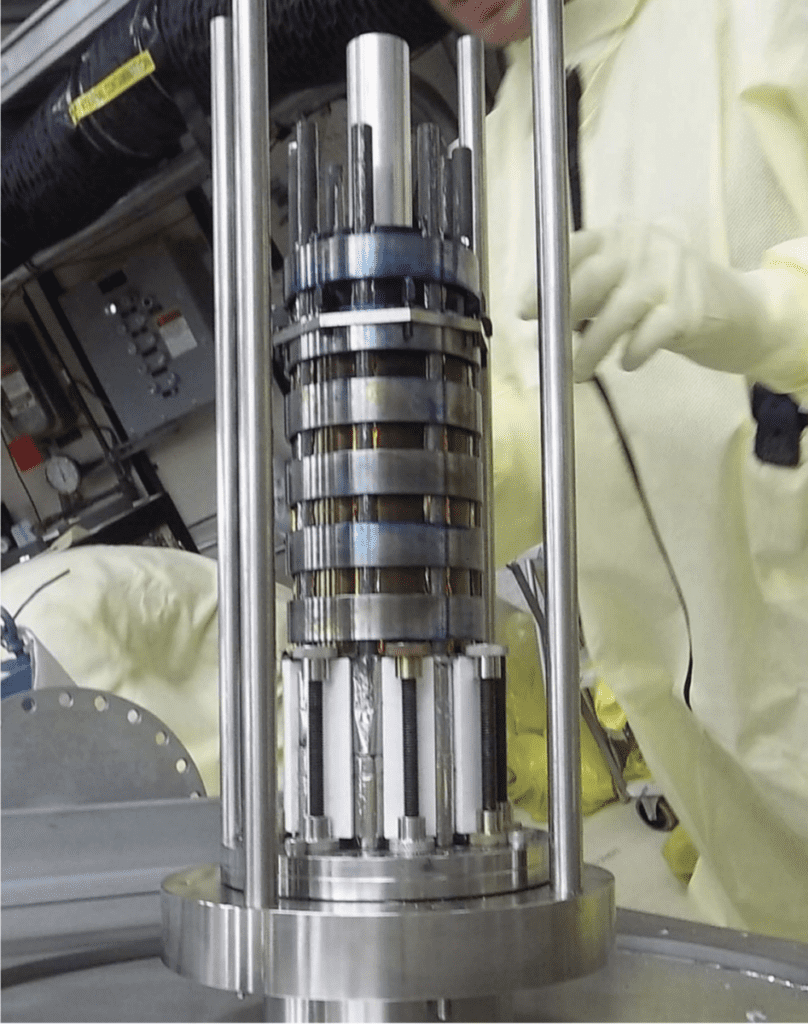
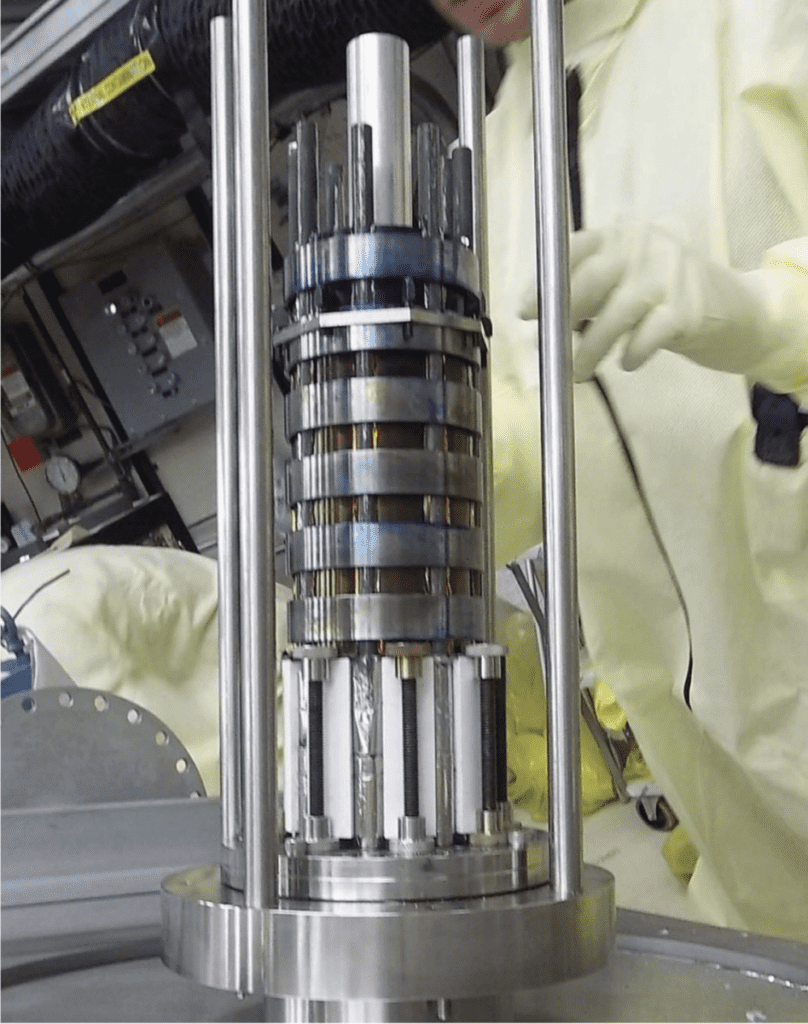
_Krusty Core showing heat pipe arrangement_
Patrick McClure and David Poston successfully developed, obtained funding, constructed and operated a new atomic fission power source that produced useful quantities of electricity during the period from 2014-2018. That puts them into a rarified, perhaps unique position. Few US-based technologists have been through that process in the past 40 years.
Aside: Without some way to frame the statement so it excludes the US Navy it isn’t accurate to say no one else has accomplished this feat. End Aside
Patrick and David – and their supporting team – developed and operated the Kilopower reactor, also known as KRUSTY. That name comes from a creatively framed acronym – Kilopower Reactor Using Stirling TechnologY.
The proposed application for the system is to produce power for space missions that cannot be accomplished using either solar collectors or radioisotope thermal generators. The former imposes operational constraints with both intermittency factors and increasing distance from the sun. The later uses rare isotopes with limited heat production that constrain individual power devices to a thermal output of approximately 300 W when the device is new.
In brief, Krusty was a tiny reactor that was operated at a power level of 5 kWth to produce the equivalent of 1 kWe using Stirling Engines qualified for space travel. Heat pipes arranged around a solid UMO alloy annular core transferred heat from the reactor to the hot end of the Stirling engines. The cold side of the engines were designed to radiate heat into the vacuum of space. Reactor reactivity was adjusted using a movable beryllium reflector on the outside of the core. A boron carbide rod in the center of the annular core provided a second means of controlling the reactor. The core was 10 inches tall and had an outside diameter of 4 inches. The center annulus for 2 inches in diameter.
Aside: Past tense is the accurate way to describe Krusty. The system, including the core used, no longer exists. End Aside.
The program cost $18 M and took 3.5 years from initiation to final testing. It was funded partly by NASA and partly by NNSA.
We will be publishing a more detailed description of the technology and the development process in the near future, but for now, please listen to the show. If the audio program stimulates questions or comments, please join in a conversation here.
If you are intensely curious and cannot wait for our coming post, you can learn more about Krusty by visiting Space Nukes Technical Papers.
Transcript
Read transcript
There's a way and a way such a better way today Today, we may should pause till the world There's a better way today and there's a better way This is Rod Adams and it's time for another Atomic Show Today, I'm talking with Patrick McClure and David Poston Both of whom were key members of the crusty project That's kilowatt reactor using sterling technology And for those who like to play with acronyms In order to make that work, they had to use the last letter of the word technology Rather than the first letter. Patrick and David accomplished something that very few people have done in the last 40 years in the US They developed and operated a new design for a nuclear power reactor And produced electricity. Patrick, why don't you give a little bit more information about yourself And then David will follow you after that. Thank you. My name's Pat McClure. I currently right now I have a startup with Dave Poston called Space Nuclear Power Corporation Or as we like to say, Space Nukes I was at Los Alamos for 27 years and I've been doing nuclear engineering for well over 30 years My primary field is regulatory I do the regulatory part of stuff while Dave does the reactor design. Dave? Hello, my name is Dave Poston. I have a long career in this field. I started out as a mechanical engineer And I was fortunate to work for General Electric on nuclear reactors And more specifically a project called this B100 that was a space reactor Couldn't produce electricity in space To me this really hit a nerve is something I'd really love to do Because I'd always been a child of reading science fiction And just a space nut And to be able to do something to help us expand into space Was really something I was interested in. So I spent a lot of time early on in nuclear thermal rockets And kind of more futuristic systems And you always have to have a balanced phenide idealism and pragmatism And maybe a little too idealistic early in my career And maybe that's come full circle and it's actually getting something done. So after that I went to get a PhD in nuclear propulsion Work to Los Alamos a long time went through a bunch of failed programs And the benefit of that was kind of learned that Yeah, I think we are trying to do too much on the first step To get anything done realistically. So that's how we ended up with crusty And the kilopar program. One of the things that I learned reading the papers that you share with me Was that crusty didn't have a lot of requirements stated Except the major requirement was it needed to actually work Can you describe a little bit more about how you determined what exactly you wanted to build And what you needed to prove through the end of the project. Go ahead. So what really got kilopar kicked off was a day poston and Lee Mason had worked with John Cassani of Voyager fame to look at small reactors And what we all realized was in the past everyone had said that developing a reactor was going to be a billion dollars And what David and I and some other folks began to realize is we thought we could build something like kilopar Very very cost effectively And so in some ways this again comes back to If you can build a reactor people will find uses And once we thought we had something that could be built people started to adjust their requirements to that And and one of our first champions was Johnson Space Flight Center The people doing architectural studies for Mars there said hey If you can build a certain kilopatt reactor we'd much rather have that of five of those for Mars than 140 kilowatt And so from that point on we actually sort of had that first person to say hey we think we've got some mission pool That led to JPL and the folks there saying hey we could use reactors and revolutionized deep space science And then we even began looking at lunar mission so in some sense we tried to tell them what we could build And then we let the requirements become what we could go get accomplished What was it that may you think that you could build a one to ten kilowatt machine far easier than building something to produce 40 kilowatts Yeah, I'd spent a lot of time in my career designing reactors ranging from 40 kilowatts to megawatts and in every case you would hit What I would call knees in the curve replace where technical challenge becomes significantly harder if you try to exceed it And that can be in all sorts of engineering phenomenon whether it's you know temperature stress Day in which other fuels to your radiation and it just everything gets so much simpler with low power That that's really when we started to think man we could do this you know pretends a million instead of a billion If we could come up with something that people might be interested in like Pat said they could also be done within a realistic talk cost and schedule The kilowatt power system can you describe that a little bit Patrick or Dave you know what what is it that is Providing producing the heat how does the heat get turned into useful power electricity What kind of environment is it designed to operate in a test at that environment as a long list of questions but we started off kind of it maybe assuming that people knew what a kilowatt reactor might look like but they probably don't Dave I'll let you do that one Okay, so yeah, I mean the first thing you start with this vision right which which is a long established Physical process where the atoms puts into two pieces and when it does so it produces energy along with Einstein's Famous equals MC squared that there's less mass than you started with and when you break these this uranium atom into two pieces And that comes out as energy and what's really nice about the vision process is almost all of the energy is deposited locally right near where the vision takes place And so that's in our fuel what we have our uranium metal fuel so energy is deposited there now we just have to get it you know out to to the power conversion system and in conduction you know he will conduct through metals pretty well because so metal Will conduct heat much better than a ceramic or other material and really what what makes kill power special is the use of heat pipes to take that vision heat Up to the power conversion system and this is nobody'd ever done a reactor Before that used heat pipes even though they were invented at Los Alamos really for that purpose in the 60s and what what the heat pipe is is a close to that Contains are liquid and you boil that liquid where the heat goes in and it condenses and gives its heat to the other into the heat pipe where your power conversion system and it's extremely efficient And people were a little bit worried about how it would perform dynamically or in a transient sense And what this test shows is that not only is it extremely efficient it's extremely predictable and simple Such that it deposits the heat at the the power conversion system which takes heat turns into electricity and there's lots of ways to do that We use the sterling engine which is the best technology choice for this size of a system it takes the heat and turns the turns that power into mechanical motion like any Any engine will do a heat engine and when that then it moves basically a piston back and forth that that will create electricity be a magnetic field So that because your system that designed to operate in space the heat engine heat conversion system the area around your sterling engines was placed in a vacuum is that correct Yeah, I you can kind of by default maybe go every other question, but yes, yeah, and so the reason we had to do it in a vacuum is is to get a realistic heat transfer because things transfer much better if there's air between your hand say and in a flag hole with burst is not And so yeah, we had to make sure we got the heat transfer correct and also our fuel would have had interacted with air and rather there was air there so yes, it's designed to operate in space and we wanted to make sure our test accurately pro trade the actual environment One of the things I noticed from your papers and a little bit surprising to me although I've read about sterling engines and heard about them is proven technology. There weren't many sterling engines available in fact you were only able to obtain two sterling engines out of the eight that your system was designed to use and the other six spots were filled up with some simulators some gas filled simulators can you help us understand what it is about sterling engines it was the current production rate what's the current inventory level of sterling engines around the world. So I'll do this one so sterling engines are actually there are many manufacturers that do them for commercial applications. So there are companies out there for right now they were making them for instance so that you could use natural gas to power the sterling and deliver electricity to your house. So those are very relevant those are fairly inexpensive in relation to the ones that NASA uses so NASA typically when they build a sterling engine has very specific requirements and very heavy QA so they get you know hundreds if not thousands of times more expensive. So the engine we chose for that one were ones that were part of a different program meant to connect to a radio isotope system which is you know runs off the decay heat from plutonium 238. But because they had already been developed and had already been purchased. In order to keep our program costs down we borrowed those two. We couldn't borrow a because they didn't have eight or we would have. But for the future we've already identified individuals are companies that will provide us sterling engines for space. What is it about the extra QA that NASA adds that causes cost factors of a thousand compared to a commercial version. Can you have an answer for that one? Yeah, so it's it really has to do with the fact that you know the when you make a prototype something for the very first time first of a kind. There's a lot of costs that go into the research and development to make that. And then once NASA gets ready to test it QA typically cost a lot because you're you're doing a lot of testing to ensure for instance like on a sterling engine that there are no. possible for material in the metal so you have to do a lot of QP on testing that the material you got is is re is the material that you asked for. They have to do a lot of QP on testing all of that quality assurance along with the fact that it's first of a kind and that cost has to be absorbed someplace if you're only. Building two, then those two units get all of that cost. Whereas if you're going to build 10,000 units, that cost gets spread over 10,000. So that's typically why something that NASA might want would say cost 1,000 times more. And I would say that they've also fallen trapped to the, you know, trying to do a little too much, even with their sterling engines. And it's a different application where they were really trying to develop the sterling engines that was for radioisotope power systems, where they're really limited on how much power you can get out and they were trying to squeeze every ounce of efficiency out of this engine, make it as light as possible and produce as much power as they could. And that kept adding and adding more requirements that made it more difficult. And so with the fission reactor, we can provide as much thermal power as any power conversion system would want, you know, first order. So we kind of remove that constraint of really trying to push the engines to advance performance. And we can just settle with, you know, average nominal performance instead. You think there's any room for a commercial dedication, commercial off the shelf type conversion. I think that's being used more and more in the commercial nuclear sector rather than specifying unique first of a kind systems. If there's already a pump or a valve or some other type of component electronics, for example, there is a way to do enough QA to prove that it's going to do what you want it to do. You think that might work for NASA as well? So the answer is yes, that commercial dedication, commercial grade dedication would work for NASA. Matter of fact, for a project we're trying to get started, we have looked at some of the off the shelf sterling. Now not always do they always comply because it would exactly what we need. And in this case, the commercial equipment we're looking at doesn't necessarily reject it high enough temperatures for us. So we may have to make changes. But there's absolutely room for commercial direct grade dedication in this industry. And the, just the fact that crusty worked is a testament to that approach. We didn't rely on any new technologies. We took stuff that we could find that could be built, was currently being built and put together. And that's really the reason the reactor worked. I mean, the power conversion system is a different animal because there is no off-the-shelf power conversion system at these temperatures that we could use. But the main reason for our success as a reactor was using that approach. We started what's available and put together the best system we could based on what was available. You mentioned that the reactor was a metal uranium molybdenum alloy. How was it configured? Did it have assemblies? Was it a monolithic single unit? What was the control? Can you describe a little bit more about the reactor? And I'm aiming at David since you're the engineer here. Yes, it is a cast piece of metal. Like you normally think of anyone pouring multimodal into a cast and it coming out of the solid piece. It is literally that simple. And part of the reason for that is they do this at the Y-12 security complex and Oak Ridge, as a matter of fact, they do this process all the time. And so that was one of the reasons. Plus, it does make it simpler. We don't have to have a lot of assembly involved. Our reactor, we assembled in the hallway at the test site without any problem, because there's so few parts and everything fit together so simply that I think that was really one of the sasselling points was the solid fuel. And it's also besides just being what we could make and the easiest to make an assemble. It's actually the best possible configuration for fission as well, because you don't have other materials in your core that might absorb neutrons. It's all fuel. So you can make it as small and compact as possible with this approach. And the heat removal is good, like I said, because it's metal conduction. So it's easy to get the heat. In this case, to the heat pipes from where the fission takes place. Now your heat pipes weren't embedded in the core itself, right? They were surrounding the core on the outside. Is that correct? Correct. It was that they were that really facilitated simple fabrication and simple assembly, because they weren't integral of the core. We did machine slots into the fuel that these heat pipes fit into. And then we had a clamping mechanism that pressed those heat pipes into the fuel. So we get good thermal contact and structural support, such that that really made of things a lot simpler. Our higher power designs will put heat pipes in the middle of the core. And there's lots of ways we can do that. But the simplest approach and the one that got crusty to work was keeping them on the outside of the fuel. Patrick, you mentioned it's your or Pat. You mentioned it's your regulatory guide. Can you explain a little bit about how you got crusty through the process of review and approval? Who licensed this reactor to operate? Great question. We spent a lot of time making sure that we could get regulatory approval for crusty. So the place that we actually did this work was the Nevada test site now actually called the Nevada National Security site. At the time, we were going to do this almost known as a critical experiment machine. And what's nice about those is they already have an approved control system. It basically brings two pieces of a reflector and nuclear material together to form a critical configuration. But they are limited in the amount of reactivity that you can have on the machine. So if a dollar reactivity inserted instantaneously to get you to operating on prop neutrons, these machines are limited to 80 cents of reactivity. But to get to the temperature we wanted, which was 800C, we were going to need at least $1.70 to get there plus some margin. So we needed to ask for $2.50. Now as part of this, like most people, you model a system before you go do the test because that's what your regulatory basis is on. And Dave was doing wonderful modeling. But the problem was because no one's ever built this reactor, we didn't have a benchmark code. So what I did was we talked with the regulator and what we convinced them was, was that we were going to run three pre-experiments before the final experiment. And we would let Dave monitor the first two experiments, make sure that his code data looks good. And then the requirement was Dave had to predict the third experiment, which was an insertion of 60 cents. And he had to actually get the peak temperature within about plus or minus 10%, and what we didn't tell them we did that in K is supposed to see. But Dave actually nailed it within one degree. And so what that did was that gave confidence to the regulator that we could predict the system well enough that we could run the test. And so that was sort of the unique regulatory approach that we used. I'm not sure this dimension. Who was the regulator here? Oh, sorry. That was the Department of Energy. Department of Energy, much like regulates government facilities like the Nevada test site. So I should have mentioned that. I apologize. Was there any requirement to do some environmental impact statements or environmental assessments or something under the the NEPA, which I personally don't think that anybody should consider that a kilopower reactor or even a megawatt reactor qualifies as a major federal action, but that's not for me to decide. So we did talk with the NEPA, the folks that do NEPA at the test site. Because the critical experiment machines live there, they are used, you know, considerate daily. They're exercise. This was considered still another critical experiment. We weren't doing anything that would have affected the environment or potential consequences offsite. Matter of fact, we were below anything that was actually analyzed in their current safety analysis report. So it was looked at and we were deemed to fit within the current NEPA. So we weren't required to go do an environmental assessment or environmental impact statement. David, you mentioned that you were able to assemble the core. I think when you said it all the way, I have this vision of a guy named Louis Sluck and who was assembling things many years ago. What it was that it made sure that your reactor wasn't going to accidentally go critical when you were doing the assembly of the core. That's a great question. And that really, that's something we're kind of proud of, that we made this design such that there was no way you could go critical unless it was surrounded by the brilliant reflector and the control rod was out. And so it became very simple. We still had to do all the calculations that I would do a bunch of calculations prepared to show. You know, if somebody stacks, we had our core was in three of these cast pieces because one piece was too big for them to make. We stacked them on whatever configuration we wanted, dropped them in buckets of water, surrounded them by lots of people. It would never come close to becoming critical. And that's really the magic of beryllium in a nuclear sense. Beryllium is a fantastic scatter of neutrons. And nothing can make this reactor go critical unless it's surrounded by beryllium. Or a fissile material. Obviously, if you put more fuel around the outside, it could go critical. But not only that it was almost a secondary benefit that it made our operation so simple. Because the main reason we do that is for launch safety. Because if this thing falls in the ocean, if the pieces get spread out or deformed, it's still not going to go critical. And so we started with that. We started with, we have to make this system absolutely, you know, a rock solid case for launch safety. And they had a benefit was it made operational safety a no brainer because nobody could do any calculation that said it was ever close to critical until it was a fully assembled. And then you have to make sure that you don't surround it with the beryllium once it's fully assembled unless you're trying to make it go critical. How big was your core? You mentioned it was a very compact core. But how compact was it? Go for it, Pat. So the core was about four inches in diameter. It was about 10 inches tall. It weighed, I think the total weight was just around 30 kilograms of what's about 28 kilograms of that was HU metal. It was cast in three pieces. The reason for that was so that we could keep below the criticality limits at the Y12 plant for casting that kept us far below any criticality concerns. And so yeah, it's that size of a paper towel roll is the best analogy. And another reason for that size was they regularly ship uranium in a container that you get has about a four inch diameter. And so if we had gone to a bigger size, all of a sudden we're trying to qualify our new shipping container and we would never count the project done. And it just kind of fortuitous that this size core can make a useful amount of power. And we haven't gotten to this point yet. But the kilopower reactor that crusty demonstrated was a four kilowatt thermal, one kilowatt electric system. The fuel itself can put out a lot more power than that overheat. It could have put out 25 kilowatts thermal if we had the ability to take that out. But since the Sterling converters, we were able to get free. Only drew about 300 watts each. You know, or up to 500 watts. And then we wanted our simulators to look like those steroids for the system test. We really limited how much thermal power we got out. But in future designs, we're looking at using the exact same fuel, but trying to get a lot more power out. your reactor used high enriched uranium. Can you explain a little bit about why that was your choice and what advantages it brought to your development and aiming at Pat here? Yeah, so really, if you look at the history of space reactors going back to 1958, all space reactor projects up until 2015 were HEU. Matter of fact, if you actually look at the UN guidance on the use of nuclear power in space, it will specify HEU as well. The one US reactor that was flown in 1965 was HEU. The 33 or so Soviet reactors were all HEU. The reason HEU has some advantages is it allows someone like Dave as a designer to play with other factors. Like one of the reasons that days reactors don't go critical in water is that he keeps the neutron leakage high by keeping the height of the reactor twice the diameter. And you can do that with HEU. That is much harder to do with LEU. Can be done with LEU fast reactor metal, but as you move to moderated LEU systems, that becomes almost impossible. So then you have to go and do things like some type of internal poison or destroying the reactor. So for us, HEU has always been the natural choice for space reactors. Recently the government wrote a brand new directive, Space Policy Directive 6, that discourages the use, but does not ban it. And we believe that for most applications, HEU is going to be a better choice with the exception of maybe some surface power reactor. The HEU allows for that compact and tall design does provide a lot of surface area for both leakage and for HEU transfer that allows your system to have that massive amount of HEU transfer via HEU pipes, it were just in the periphery of the core. What was at the interior part of your core? What was the center of the crusty core, Dave? Yeah, so the center is where the boron carbide, what most people call control rod goes. And so it's basically avoid in the fuel, it's about two inches across. And there is a difference between crusty and the flight reactor in that the flight reactor will be controlled by that rod in the center of the moves and in and out. Whereas as Pat mentioned at for crusty, where we tested, they had a system that was qualified to move large things. And so we move the reflector to insert reactivity instead of pulling out a control rod. And so that's the difference in a lot of people kind of like to focus on that distance is making it non-prototypic. But yeah, a nuclear engineer is generally aware of the term point kinetics, point kinetic reactor. And that's how we simplify all of our reactor design, especially early in the process. And a point kinetic reactor just means that all the neutrons are kind of in communication with each other. And that's another great thing about this fast compact reactor is the mean free path of a neutron is a few centimeters and the whole cores only 10 centimeters across. So every part of the reactor is notice what's going on relative to the rest. It is in the extreme example of the opposite is Chernobyl. If Chernobyl operated point kinetic reactor, there's no way it would have happened. And if you modeled it with a point kinetic reactor, it could have been the accident wouldn't have happened. Because they were decreasing system reactivity when the rods were going in. But unfortunately, they had one part of the reactor, the bottom of the reactor was so super critical and going up in criticality. The control rods were having no effect because there were different regions of the reactor. And the reason I say the point kinetics is so important in our case is it doesn't care where the reactivity is inserted, whether you pull out the center rod or raise the external reflector, the system's going to behave the same way. And the final thing is that center hole, not only is for control rod, what we really liked about it is we could put a heater in there to put five kilowatts up to 10 kilowatts of heat into the system. And that's really one of the vanishes we've always known about the heat pipe reactor is non-nuclear testing or electrically heated testing. If you have a flowing fluid, either gas or liquid, you have to penetrate that system to get the heat in. We're here, we put a heater that's not part of the coolant system, to heat up the fuel. And then the rest of the system doesn't really know if there's a heater or there's vision taking place. And that hole was really beneficial from that standpoint, even on the final assessed assembled crusty before we started it up, we did a resistant heated testing run to make sure everything was working. And that was another thing the regulator really liked, the deodorant regulator, is we could go through all these non-nuclear tests and show them what's going to happen in addition to what Pat talked about. You also were able to prove the fabrication of your core by using something that isn't HOU. As a matter of fact, it was as far from HOU as you could get by using depleted uranium. Can you describe a little bit about how that worked out? So I'll take this one Dave. So yeah, we were gonna use, first of all, how I12 cast uranium metal is they will all, it's really, I hate to say this, it's more art and science, because the cool down rate of the uranium as it's cast will really largely affect whether you develop any voids in the material. So even though I12 is very good at this thing, do it a lot, they did have to try to do it a couple of times before they got it, the recipe right. And D.U. allows them to do that with no worries about criticality or wasting good uranium fuel. But now what we wanted was we wanted the D.U. core for electrically heated testing prior to the nuclear testing. So we were glad that they cast us three pieces of depleted uranium, prove out the process, and then when we asked they went ahead and cast us R.A.T.U. core and then send it along. But the process worked very, very, very well. While we've been sitting talking, I keep looking at my 32 ounce Yeti cup and thinking it looks almost exactly the same size as your core. It's a little bit shorter, it's only nine inches tall instead of 11. But it is foreign citizen diameter. So for those of you who keep your water in a nice insulated cup, that's a good visualization for what this core might have looked like. Because my Yeti cup is polished metal. So yeah. Yeah. Anyway, that's amazing that you can get so much power out of such a small pump of metal. What kind of temperatures did crusty operate? crusty operated at 800 degrees Celsius or 1073 kelvin. So it was very high temperature, which is great for space reactor. I mean, to step back, in space, our biggest efficiency is how we can reject heat. On the ground, we got a river, a pond, or a cooling tower. In space, all we really have is radiation, right? Something gets hot and thermal radiation from it. And especially if you're going to operate in the vicinity of the sun or the earth, you need to have the rejection temperature to be well over 100 degrees Celsius, maybe 200 degrees C. And if anyone took thermodynamics, they're familiar with Carnot efficiency, right? It's how much heat you can get out. I mean, how much with the efficiency of a process will be to take heat into mechanical energy. And it requires a high temperature system. And generally, we would have said, oh, we can only go like 700C. That standard advanced reactors. But because we didn't have anything else in our fuel, and it was so simple, and the U-Molly can go to high temperatures. It really made a nice system where we went to 800C. And the other factor that we haven't talked about is how the reactor operates. And what happens when it gets hotter, the physics of the system caused the power to go down, and it wants to come back down to what it's what we call its thermostat temperature is. And so the reactor really does operate like a thermostat in many ways, as you're used to just in your house. When we set the reactivity level, we set a temperature that the reactor wants to stay at. And if it gets too hot, what happens is the, it's literally as simple as the atoms expand. Any most materials expand when you heat them up. The uranium expands because we have all this great leakage we talked about, more neutrons leak out, it causes the power to go down. It vice versa. If the reactor gets too cold, the atoms get closer together, there's more vision because less neutrons they got and it comes back up. So not only was this the only new reactor tested in the United States in 40 years, it's actually very unique and awesome reactor in terms that it's load following. So for regulating it doesn't require quote, reactor control after the startup, which is huge for operating in space that we don't have to rely on a reactor control system to power the reactor. It's all controlled by the sterling engines. How much power they draw determines the reactor power. So it's really slick in that sense. Your project started sometime in the 2014 timeframe. What was it actually funded and when did you do your operational testing? The Patrick, can you give us a timeline of this development project? So the original idea came about in 2010 with a report done by John Cassani that Dave Poston and Lee Mason worked on. In 2011, Dave and I took up the call to try to see if we could get NASA to fund this idea. And so along with the folks at NASA Glenn that would have been Mark Gibson and Lee Mason, we did a precursor test called Duff, demonstration using flat top fission. That's an existing critical experiment machine at the Nevada test site. And all we did there was we took that existing core. We put a water heat pipe in it to a low temperature sterling and show that we could get fission, that we could drive a sterling engine to make electricity. And we did that test for about 750 K, $750,000. And that's what convinced NASA that we were serious and that we knew that we could do this. So Dave and I and Lee Mason and Mark Gibson then lobbied NASA all through 2013 to that test was finished in 2012 to fund a project. Eventually the game changing development part of STM Space Technology Mission Directorate said yes. We also got the National Nuclear Security Administration on board and they actually chipped in a third of the funding. And so we planned a project that would be three years, about 15 million, took us about three and a half years, cost us $18 million. So 12 of that came from NASA, six from NNNSA. We got started in October of 2014. We actually finished the test, complete test in March of 2018. And so three and a half years, one bad, like I said, we were a little bit over but not much. As far as we were concerned for $18 million, we had accomplished a tremendous amount. Tell me a little bit about the operational test. How long did it last? What were some of the things that you were able to prove to yourself? How did the reactor respond? Yeah, that's the stuff I love talking about because that really was, the purpose was to show how it operates. But you can't do that unless you do a nuclear power test because of how everything integrates. And there was one big limitation on us was how much net energy we could produce, you know, kilowatt hours say. And not overly activate the room or the test was with radiation because they do a lot of very sensitive measurements in this building we were in. And so we were, we negotiated basically via a lot of calculations and talked that we would have 28 hours of full power operation. We're full power in this case, well, 28 hours with an average of three, three kilowatts thermal during the test. We actually got up to five for a short period of time. And that really, that was the, that's another reason why we didn't go to higher power because we were limited in this facility to how much radiation we could produce. And I think what happened was that we weren't sure, because this was a test, we weren't sure how it was going to respond. We had a pretty good idea and it's so simple, it turns out the codes nailed it. But we weren't sure how long it would take, when we do these thermostat temperature changes, like I talked about it, we changed the power drop. How long it was going to take to settle to a new steady state? And initially I calculated it might take an hour to get to a new steady state where you've comfortable trying another transient and maybe longer, but then based on the previous tests, I got better data that said, oh, I think we will settle to a new steady state probably in closer to 30 minutes. And like it's so, this was only a couple days before the test. So it was actually the night before the test, I sat on a new test plan that had more transient. And there was a little bit of debate whether we should change, but Pat had written the safety basis really was, you shall not exceed this temperature, this power, in our testing organization, there was really no test plan we had to follow, as long as we met all the regulatory requirements. And so we did jam in, I'd say, as many trends as we could. We have a chart that shows the whole 28 hours in how many different trends we did, but besides proving that it load followed the reactor power, we also showed we could tolerate a failed heat pipe or a failed sterling converter, and also tolerate a complete loss of active power draw from the system and ran it to higher power a couple times. And we had to balance how many times we wanted to reestablish a test point to make sure nothing to change versus trying to do transients. But that was probably the most fun was being able to try as many transients as we could fit in. And I think we ended up coming about the right balance of getting a lot of good data and getting as many transients as we could. Where is crusty now? Did anybody think about trying to extend the testing in the program to prove some new things or maybe get to the point where you had all eight sterling engines or whatever kinds of things you can think of. Was that under discussion or did people say, well, let's life our hands from that one and go on to do something else. So we actually did think about what we wanted to do with the reactor after we were done. Now we couldn't fly in space because once it's fissioned, although the number of long term fissioned products, the actinides are low, we still wouldn't want to take that chance. Where we were lucky was I told you in and in and say, did want to do this test and did contribute to the cost. But also, the in and in to say does a lot of work at the Nevada test site that has to do with the detection of say an improvised nuclear device. And so when we told them we were going to make this core, what they said was, well, when you're done, we want that. And that helped us get material because they will basically use that core in exercises to for where they will send up people with detectors to see if they can find something that looks a lot like an improvised nuclear device. So it's being used and no, we probably will never get it back. How difficult would it be to, or how much would it cost, I guess, to get Y12 to fabricate a couple new ones? You mean do this one Dave since I just asked this? Yes. So they already have the molds. They know exactly how to do it. So Dave alluded to the fact that we are trying to get a different agency to fly something very close to kilopower. And I have a price quote, I can get a brand new core for $5 million. Price has gone up a little, but because of inflation, they've got to be, they pay people more right now. But yeah, about five million. For a space power system, that's not bad. No, no, no, no. Obviously the system's going to have a lot of more costs, but to get the fuel for five million is about as good a deal as you're going to get. You mentioned that you operated the initial core for $28. What age you're expected life? How long would this core last before it could no longer maintain temperature? Yeah, that's another great question. You're hitting a lot of good questions. There's several things that can limit your lifetime, right? And from the core perspective, the first thing people look at is how many radium atoms do I have? At what point will my burn up? We call it burn when we burn at you, 235 atoms and we split it into two. How high a burn up can I go before I don't have enough reactivity to operate? And in that case, this thing could operate hundreds of years. It's in a lot of ways people say it's including us. It's kind of a waste of fuel, right? Because I mean, there's so many reasons why we have this system designed the way it is. But we're not really effectively getting as much energy, your total fission's out of a system as we might, if we went to higher powers. But we talked about the old banjo low power. So the core itself from a fission standpoint, reactivity standpoint could go hundreds of years. So that's no problem. Number two will then be material damage to the fuel itself. And any nuclear fuel when it burns or fission's will have some type of swelling. Because in your material, all of a sudden, you've changed one atom into two in your lattice, right? And this got to find a place to go. And the more that happens, the more it kind of pushes the fuel outward. And with uranium lifted on fuel, that swelling can be pretty drastic or dramatically high compared to others. But that's another great thing about low power is we are a long way from hitting any limits, even tankylowatts electric or 50 kilowatts thermal. We're still to the point where we only have about much less than 1% atom per cent burn-up. And so the kilowatt power system itself, the lifetime, will be determined by other factors. Heat pipe lifetime is all a QA issue. If you can make a heat pipe with strong welds and no impurities, it can last forever in theory. So with that, we design our system for failed heat pipes in case there is a fabrication air. And we generally will think, then, it's the Sterling engines where the life limiters can be. And they've operated these three-pissed Sterling engines at NASA Glenn. They have some on test of operated decades without a problem. And they really are mechanically simple and no reason why they should fail. But they're going to fail at some point. We like the idea of the early systems will give us a good feel for how long those Sterling engines will last. We will guarantee several years to maybe even up to 10, but the lifetime beyond that is pretty hard to predict. So these could be sitting on the moon providing power to experiments for decades, is that what you're telling me? Correct. And it's more likely than not that they will. And we love the whole radio isotope community in Voyager. It's like, how it's still going. Many decades later. I mean, it wasn't designed to do that. And you would never want to promise it's going to do that. But we think more likely than not, the average system, for sure, if not all of them, will, with last decades, at these power levels. That's pretty fascinating to imagine that kind of power level and that kind of longevity. I can think of a few isolated areas on the planet. This planet that might find such a power system useful, mainly places underwater. And one of the things that people know is nuclear as particular advantages when you're talking about underwater or deep space where there is no oxygen to support combustion. I've been told that the West Encounters, E-Vinci, which is a much, much larger system, took some lessons from yours. Do you have any relationship with those folks? It's a larger version, but very similar to kilopower was a design that actually we did right before kilopower, that eventually got called megapower, simply because of kilopower success. And megapower was a, we were trying to see if we could recreate what the Army wanted to do with ML1, which was a mobile reactor. So we came up with a 25 metric ton, about one and a half megawatt electric reactor. It was basically U02 fuel, still a fast reactor, heat pipes to heat exchanger. And we were gonna do open air bright and cycle for the power conversion. We really like that idea that, but initially, DARPA showed interest and then they backed away, but eventually a Westinghouse came to landl and said, hey, we like this idea, we wanna license that technology. And that became the basis for E-Vinci, although I would tell you that since that time they have in order to improve their economics, they have, you know, because fast reactor is a lot of fuel, they have moved on to other technologies, but still somewhat similar to the original megapower concept. Okay, now I'll go back to the final question, the opportunity for you to share anything you might wanna say about your project that I haven't stimulated during this conversation. You mean do that day? But you want to. Yeah, I've got something to say, you go first. So Dave and I have had, along with Mark Gibson and in our company, we have one goal. We wanna get a reactor back into space. We think that's very important for the United States because of what our adversaries are doing. We think kilopower is the perfect reactor to be the next reactor in space, because there's nothing left to prove. It's just a matter of going and building a flight unit and qualifying it and actually attaching it to a spacecraft and getting that done and getting it in space. We think we're getting closer. We've been working with one of the US agencies and they seem very interested in, and I would say that we have a fairly good chance of making that happen. My hope is within the next four years and take kilopower to that next step. Dave, all yours. Yeah, my comment is more just a general comment about the state of nuclear today. And kind of my initial point of idealism, seizing the day versus pragmatism. We have gotten away from realism and reactors the longer it's been since we built and tested them. Most people are probably aware, but maybe not. Idaho National Laboratory used to be called the National Reactor Testing Station. And then the... 50s and 60s, there were 100 new reactors built and tested. Every reactor I have today was based on several tests. And that built a whole bunch of experience knowledge and capability. Actually, when I worked at GE in the 80s, they were already thinking, man, what are we gonna do when we lose all these people that actually have designed and build test reactors? That wasn't the 80s. When I were 40 years after that, 60 years after we had all this expertise, and people have just kind of lost touch with the reality and what it takes to design and build and test the new reactor. That was our whole basis for doing kilopardon crusty. We feel it's gonna take simple steps to rebuild the knowledge and infrastructure. But unfortunately, it's going the other direction right now. People keep proposing more advanced fire out systems, especially in space, expecting them to work. Like, and it takes a lot of testing. The reactor is a system, not a technology, right? I think that's where a lot of people think, if we can build this fuel, if we can build this heat transport mechanism, we can build this park versions of some, we have a system, we don't. There's so much complex interplay in a nuclear system. In addition to the thermal structural thing, every design engineer, do you add nuclear? It just adds a whole nother dimension. And, you know, we see, right now, I think we're seeing the peak of a cycle, and over the past 40 years, we can ahead these cycles of interest in nuclear. This is the Renaissance, and then it peters out when nothing gets done. And I'm afraid we're in that mode right now, unless we can really get something done. So it's kind of just the word of caution to everyone. Because you go on social media or in the news, there's all sorts of great things happening in nuclear. But they're not really great things happening yet. There's just the bunch of projects, and we haven't seen much actually done. And so I just kind of make a plea to the engineers not to over-promise what's realistic. In a lot of cases, they don't know they're over-promising because they don't have any experience in actual reactors. And so our goal is gone completely, maybe too far to the pragmatic versus high-tealistic side, but we really think we're not gonna get anywhere unless we actually start building and testing some reactors. Well, I couldn't agree more with you. I've often, especially in the last few years, reminded people that the US may have at one time produced a lot of reactors, but those were our grandfathers working on it. Correct. I'm saying that is a 60-year-old person. Exactly. So it was a very long time ago. And just because your grandfather played in the NFL, doesn't mean you should try to get to the NFL without going to P.E. League and high school football. First, you need to practice. You need to learn how to do things, and probably suffer some failures along the way. Things are going to fail. That's almost inevitable when you're trying to do something new. And you've got to learn how to adjust and how to overcome those failures. Building reactors, building power systems is a sport that requires practice. It's an endeavor that requires continued operation. And it's a team sport where people learn to do things together and all grow their capabilities and then can pass those capabilities onto future generations. It's really a problem when you've had a huge gap in that process. We've got to the point now where we really don't even have people to learn from. One time, I wrote a bunch of articles about the Army Nuclear Power Program. And I had to stop writing them because all my sources kept dying. Amen. You've picked exactly the way we think. So I'm happy that you guys are going. I do think maybe I'll suggest to you that space is a very tiny market compared to the needs of energy around the world. But that's for another discussion. I want to thank you both for taking the time to come in. I guess one more final question. Could somebody, a couple of good engineers like you guys do crusty again today in the same kind of timeline or is something changed since that happened? I'll take a stab at that one. Actually people were kind of ignoring us because they thought we would fail. In fact, Dave and I's boss wrote 5% on the board. That's the probability of success we had. He thought we had. I think we actually shocked people when we were so successful. So anytime you want to do that now, there are going to be people that want to be a part of that and control it and tell you what to do. So I think it's doable, but it would cost more money and take longer. Unfortunately. Thank you. And thank you both. Yeah. Not a problem. I'm glad you guys wanted to share your story. I think it's an important one and one that many engineers who look into this podcast should take the heart. Maybe even listen to it twice. Thanks, Dave. Yeah. The atomic show is now a production supported by nucleation capital, a venture capital company that focuses on the role of advanced nuclear and deep decarbonization in an energy transition that will move the world away from fossil fuels and onto something that does not pollute the air, does not contribute to the accumulation of greenhouse gases and atmosphere. Projects like kilopower reactor that we just heard about indicated direction, doing something small, take incremental steps, learn how to do things right, and then move on to something better and bigger and or just develop the market for the products that you have. So that's what we are about with nucleation capital. And if you're interested in learning more, please make contact with me. We have a unique way of raising capital to invest in nuclear that makes it accessible to people who don't have millions or billions of dollars. If you're an accredited investor, I mean somebody with at least a million dollars of net worth excluding your house or income of $200,000 a year or more, please understand that you can invest in advanced nuclear. You can put a small portion of your capital to work, doing something important for the world and also potentially providing you with a superior return on investment if you're a patient investor. Nuclearation capital is a venture capital fund. Like most successful venture capital funds, we don't focus just on technology, but finding great teams who can succeed and put their products into the market, and find customers that choose their products over competitive offerings. The nucleation capital website is nucleationcapital.com. There are buttons or clicks where you can express your interest in learning more, where you can find out what it is that we are investing in, what we're about, what our goals are. See if there are match for your goals for your investment profile. Learn more at nucleationcapital.com. That's all for now. There's a way, a way such a better way today. Today, we may should pause till the world. There's a better way today. There's a better way to do that way. Such a better way today. Today, our region, boys, is still the world. There's a better way today. There's a better way.