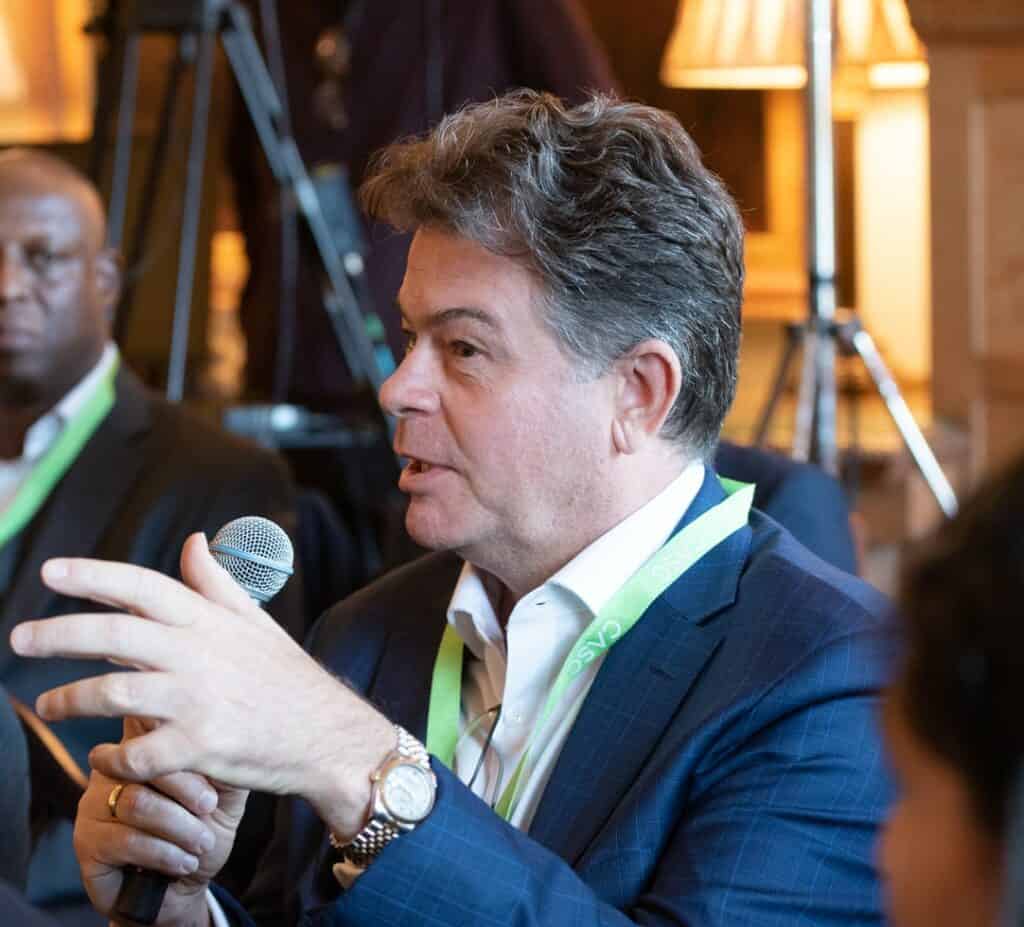
Mikal Boe, Core Power Founder and CEO
Concepts discussed
Auto-linked from the episode's notes and transcript.
Show notes
Rod Adams talks with Mikal Boe, CEO of Core Power, about his company's plans for commercializing nuclear powered ships. Includes a brief description of the technology and an extensive description of the business model, stakeholder engagement and efforts to increase public understanding of the benefits provided.
Transcript
Read transcript
There's a way, a way such a better way today, today. The measure falls till the world, there's a better way, today, and there's a better way. This is Rod Adams and it's time for another Atomic Show. This should be number 294, but I may be confused about number. Today I have a special guest, Michael Bo, who is the CEO and founder of Core Power, UK-based company that is working with some US company, Southern Company and Terra Power, specifically on a molten chloride fast reactor. They have an initial project underway with some DOE funding, Michael and his company are developing the marinized version of the molten chloride fast reactor. I'm going to now let Michael introduce himself and tell you a little bit about his background and what Core Power is all about. And a little bit of disclosure, Core Power was the first investment that nucleation capital made. Michael, over to you. Thanks, Rod. Really nice to be here and happy new year since we're really at the beginning of probably what's going to be one of the most exciting years in the market. Thanks for having me on. Just as a brief introduction, I've spent the last 30 years in the shipping industry, the commercial shipping, ocean transportation. And I started this company back in 2018 after many years of careful research into what on earth we were going to do as an industry. When these new environmental regulations were coming through and saying, well, you're going to have to abandon the combustion technology that you've been using since the second world war. and they're sort of the big driver of globalization, which has been the large diesel engine and the fuels that I used in shipping, which are, you know, pilot looting and. And it need to be replaced either with dropping fuels or without the technology. You know, it was it was almost impossible to try and imagine what we would have to do as an industry to to to get around this. And of course, it struck me like probably struck quite a few people that nuclear was the answer. And we question, of course, is, you know, why hadn't it been done before, why hasn't it usually caught on the shipping before. And I think, you know, that that was the biggest the biggest hurdle to become an issue. And that was, you know, how do we how do we do that. I mean, what is it what is it about nuclear that makes it on the current convention on nuclear that makes it unsuitable for commercial shipping either as a way of, you know, moving ships around or. providing the kind of the kind of hydrogen based fuels that we need in order to decarbonize this segment. And we realized, of course, that in that there's much more to much more to nuclear than just pressurized water reactors and like water reactors, which are the predominant technology. And we're not looking around trying to find, you know, what would the criteria that shipping would have to use in order to find the technology that would, you know, genuinely make a big difference here. And we spent the number of years trying to find that really that's that that's why we found the answer, you know, there is a number of very small number of technologies in advanced nuclear and advanced atomic that can really make a difference and can be deployed. production platforms to produce green hydrogen and ammonia water to decalinate water and also some other things that that are required for shipping. And so we decided to go out and start the company and, you know, get funding and get involved and, you know, I think being a first mover in this market has been has been highly beneficial because, you know, we've been able to get ourselves positioned in with some very large and very serious organizations that are developing some. absolutely fantastic technology, I think is going to change the world. What is this technology? What is it that made this molten chloride fast reactor so attractive to you as someone was a lot of knowledge about moving ships around the ocean. I think the first thing is really generally about the molten salt reactor which, you know, has some absolutely fantastic superior safety and operational margins that you know we just don't have in conventional nuclear. The fact is you have, you know, you have a technology here that uses an liquid fuel rather than a solid fuel. So there's no fuel assembly if you like makes it much easier and simpler to put that fuel together. It also makes it a lot more efficient in terms of its fuel burn up so that we get much less waste. We get much longer live out of these machines. But I think also importantly because you know if we're proposing as we are to put these on floating structures you know they need to be comfortable in a dynamic environment they need to be able to move around they need to be able to you know with stand the kind of you know rolling and pitching and potential vibration that you get you know when you have reactist and see. And the molten salt reactor does unique well in that sense because it has that sort of very few moving parts that that's that that's so that keeps it functioning. I think specifically the molten chloride fast reactor or the fast molten molten salt reactor is the one that you know we we have a lot of faith in because it avoids the avoids the need for a complex and in molten salt reactors that operating in thermal spectrum you tend to do that with a tend to do that with a graphite moderator and that graphite moderator just isn't durable enough to be able to last for as long as we need these machines to work. So you're talking about five six potentially seven years in between each time you have to exchange that moderate rap and see that problem coming up again again again again again if we're going to be you know. changing large amounts of highly radioactive graphite on a regular basis at sea. That's order of magnitude more complicated and I think politically more difficult than anything else with the with the fast reactor with the molten chloride fast that we're building in with the dark team members in the United States that that problem is a word and there is no more to write the new transfer moving out there at the natural speed and we also get that advantage of being able to consume the low the act and I instead are produced in the in the right. So the fuel efficiency goes up substantially. that that sort of high level of safety that you get from this high level of fuel efficiency and that sort of lack of or rather the much smaller waste footprint of these reactors we think is is absolutely the way for and it'll change not just the production of synthetic fuels for industry. change your change so many things in heavy industry and have a transportation now tell us a little bit about the first steps in testing and developing the molten chloride fast reactor what what's going on with this DOE project that you're working on with a terra power and southern company. Well, you know this this has been going on for a number of years already wrote I mean, you know the before we join this project work already started back in 2013 you know the initial sort of R and D looking at various sort mixes and how things would function and that's graduated through. This very special relationship that exists between you know our part was terra power and southern company that worked on this for an ugly years they've had DOE funding for some of the initial R and D. But to you know between 2016 and 2020 and then this new program that's we've been selected for which is the advanced ranking demonstration program the risk reduction program there were you know we're a partner we're not one of the technical partners we're one of the commercialization partners in that. So the actual the actual technical development work that's being done that I don't national laboratories conducted by you know terra power and the people at the I know so the. The sort of completion of the R and D and the sort of final selection of the sort makes the final selection of the specific metal alloys that go into making these initial the first machines as well as the electronics which of course needs to be. Is the sort that or rather to be finalized for this you know it is a program that will now go on for the next four or five, definitely six years and. Hopefully we'll co culminating all the proof that's needed in order to move to the next stage risk to make you know demonstration scale machines out of us that's. It's fantastic that we've been supported by the US government in doing this this sort of little public private pop ship you know we commit all the resources and funding that we can together with. Together with funds from the from the US government to build these new machines I think it's a fantastic way to for governments to to really build new energy systems that we need for the future it's a it's a it's a model for having should be done a very piece of the bar. The government funded project how much of the basic research the materials the salt mixture how much of that will be made available to other companies. So, I think that's a great question. Honestly, I could not answer that question and that is one of the come back to you. All right that's fair enough. It sounds to me from your description that the project that the specific phase that the project is in now will not necessarily result in an experimental reactor but I thought that that was. in chloride reactor experiment. Maybe a very low power reactor at least something it fizzens and produces new trons and and raises temperature to the operating temperatures those kind of things that am I misunderstanding. No, that's absolutely right. You know this this particular program culminates with the molten chloride reactor experiment is a small. You know low power or no power reactor that demonstrates exactly how a larger system would work but it isn't the if you like a useful demonstration reactor is not one that you can take out a laboratory and deploy some. So I guess it's more like you said it's more of an experiment or prototype but not demonstration. So you can't put it on a little terbene and run it around and proves that this is the best propulsion system available right. That's exactly right. I mean this is really there to prove the science. I'm sure I hope anyway familiar was the terbene I guess it was Parsons it showed that turbines are better than engines when it comes to steam propulsion. Well that's right you know I think that that's another thing that's quite interesting with this because you know you're looking here a very high temperature reactor so of course there are many high temperature reactors have the gas reactors and your lead cool reactors etc but you have the potential in developing of new turbine technology as well. So you know the idea that there's very promising super critical to you know a recuperative breaking cycle style turbines that can actually which are initially developed for or the concepts with developed for concentrate and solar you know with very high temperatures there but that didn't really become much of the market so you know. So a lot of the are in the stock that these new turbines can actually now be you can see a market developing for them and taking that step further as well and saying you know update that the thermal conversion efficiency from steam turbines at about 30 to 35% off towards 50% of these new these new very small footprint turbines is another very exciting part of this because I think you know when we speak to people and say well you know we're wondering do you have this. I don't know a relatively small reactor you're going to put a steam turbine on it and then you know then what happens because there will actually we think there is a there is a better way forward in creating efficiency in the system because if you can put these very small recuperative gas turbines attached to the sort of heating. change just like come off the reactors, you can create an enormous efficiency gain, you know, 30, 40% efficiency gain from these reactors, which, you know, because of this more footprint of these turbines, you can also then combine into all sorts of, all sorts of new systems that function well for, you know, everything from water desalination to hydrogen production to, you know, potentially also then, you know, propulsion of large assets. It's a whole new world opening up with these new reactors. As a guy with a lot of experience and shipping, how excited are you about the smaller footprint? What does that make a difference to a ship and is it not just smaller volume but a lower amount of weight for your propulsion system? Yeah, I mean, you know, the, if these reactors are eventually allowed to be used as propulsion reactors, if that was to be the case. Let me take an example. I mean, we've been asked to be part of a project recently, which we're looking at US coastal trade, right? So you've got the Jones Act vessels that are trading around the coast of the United States. Very interesting potential sort of testing ground for that technology in that setting. You know, you would be looking vessels that are, you know, say Afromax tankers, you know, 105 to 110,000 deadweight tankers transporting crude oil from Alaska down to the west coast, for example, inside of US waters. Would carry anything between two and three thousand tons of bunk of fuel at any time? Plus, of course, very large diesel engines, the exhaust gas systems, all the various things that come around and you shrink that. You shrink that. So the total, you know, propulsion space and the related space for the propulsion system on water ship by, you know, a large, a large amount. We reckon you could probably increase the cargo carrying capacity of ships that size anywhere up to 5%, which over time, you know, looking at, you know, 35 years of operation is a very substantial economic benefit. Of course, you don't have any emissions coming from the sites in no fuel tanks, no emissions and electrical propulsion in US waters with the US flying vessels sailing under the Jones Act. It's a very, very exciting potential demonstration of how this would function. If in the future that is something that we could then use, you know, deep seaship thing, you know, container shows and I kind of think for longer voyages, I mean, it's, it changes the it could really change the way the economics work for ships. But if you think about it in relation to it, how you would use green hydrogen and green hydrogen derived fuels of ammonia, methanol, for example, you know, you're looking at, you're looking at, you know, anything between four and five times less space used on board for the propulsion system. That makes a big difference. Trippings are very competitive, whether it's coast, lower there is international, very competitive business and it relies on continuing to be competitive. And it's not a team sport. I think that's the, that's the key thing. You know, the shipping companies like to think that they get together and collaborate on future solutions. But at the end of the day, it's a spy versus spy hand. Your potential focus on US coastal shipping with Jones Act type vessels is interesting, is that interest partly due to the concern over getting access to ports in various countries around the world? Well, I mean, it's an interesting, it's an interesting observation world because at the end of the day, it's really about, it's about the times we live in, you know, at the moment we're going through this very difficult patch of trying to understand what large diesel engines and their, their exhaust gases due to the environment. There's lots of scam on going around it. There's lots of extremes and I think potentially exaggeration both and in terms of how little or how much the effect is from there. So we're living in an era of transition. And as a result, you know, we're living in an era of transitions related to opinions and the way people approach new technologies. A lot of it was so afraid of me, you're clear for all the wrong reasons, but you know, that's, that's still the case. The regulatory landscape, the military landscape, the way that organizations and governments approach this, it's very much in flux. We need new rules, we need new attitudes, we need a whole lot of new things to us. So you know, really, what we're doing is we're focusing on two main areas. One is floating production of synthetic fuels for the shipping industry, because you know, you could use synthetic methanol in a moment. For example, in the existing engines with some modifications, obviously. That means that, you know, you don't have to, you don't have to, you know, describe large parts of the fleet. You could continue to use them, but with a new fuel, which would be zero, very low carbon, very low or zero carbon, not zero emissions per zero carbon. That would be helpful. And there is a lot of talk in the industry about doing that. We think the best way to do that is to use, you know, advanced nuclear at sea using floating production plants. And then of course, you know, the idea that you could, you could do what the natives have done for so long, and they use the reactors for propulsion is something that really ought to happen initially in, in controlled environments. It's not necessarily that ports are going to be so difficult to convince to bring these in, but really it's a question of jurisdiction. Right? It's like thinking about moving, moving a react of between between two countries. That there has to be a very specific agreement between those two countries and how that can be done. Back to the one example between the UK and the US. But if it's done in US waters with US technology on US flag vessels manned by US officers, regulated and controlled by the US authorities overseen by US Coast Guard with the permission of the US Navy, etc, etc. You know, it creates, I think, a very good initial sort of test case for how all of these agencies and departments and various sort of stakeholders approached the solution. Because at the end of the day, we have to prove that this works not just technically and economically, but also politically. And, you know, from a regular perspective and from anything sensitive to the needs or the military, for example, which is, which is obviously one of the actually main uses of nuclear technology at sea. So we have to do this in a careful and measured way. And remember that we live in 2020 to begin in 2022. There are still many years ahead before this becomes a mainstream solution and we need to take steps to get this. So I think, you know, the first steps would perhaps be floating production and then domestic shipping. And, you know, as an example to the world, I mean, what better place to do this than the United States can show the world how it can be done than, you know, than export it from then. Yeah, we do have this rather unique isolated shipping area with lots and lots of coastline and lots of travel. And also, as a former ship engineer, I'm believing that people who power ships or or own ships or or go to sea on ships are interested in making sure that the propulsion system has been proven to be very reliable because you never want a failure out in the middle of the ocean. It's a little bit easier if you have a failure when you're a mechanical problem when you're pretty close to the garage. I think that's absolutely right. You know, you want to be sure that you can rely on the on the systems. You want to make sure that, you know, you have a sufficient pool of qualified personnel, you know, who are vetted and, you know, properly trained, etc. That they can work on this. So you want to you want to take baby steps and you want to make sure that, you know, it's done. I mean, look, at the end of the day, we're talking here about ships that are built to a superior quality to anything that exists out there today. We're talking about ships that are built to last for a lot longer than ships that are out there. I think that's beneficial as well because if you could, if you could, you know, you can operate a Jones Act container-shaped or tanker for, you know, 30, 40, 50 years whilst maintaining its competitiveness and maintaining its, you know, its structural integrity and its energy efficiency, etc. for all that time. I mean, yeah, that's that's a win-win for everyone. But you also want to be able to make sure that, you know, the entire, if you like, the classification, the insurance, the financing, the the the pool call structure, the benefits that a stakeholder's in the ports for these vessels call, as well as the sort of the constantly proven environmental create credentials of the technology is something that can be demonstrated through constant communication, engagement with stakeholders. I mean, at the end of the day, this is not something that can be done in the back where we're done under the radar. It has to be done in the light of the day, you know, in fully in the open, with all stakeholders that are involved and engaged and concerned or excited or whatever they might be about this technology, you know, actually, you know, coming to engage with it. It's crucial. And thinking about this, you know, if you've got, you've got ports going up, sorry, the ships going up and down the coast and calling it ports and as each, any each port call, instead of having, you know, diesel power, or gas power, shore gear, load and discharge those vessels, say on the US East Coast, for example, the ship is the power plant that is actually running the shore gear that's that's either loading on the discharge from the vessel. You know, you're starting to clean up the port environment as well. So each one of these ports start to become greener, less polluting, better places to be and, you know, the positive impact on the environment and the stakeholders around those ports and the environments around it, you know, should be, should be clear if I want to see it. We need to demonstrate that. We need to show how those systems interact and how that can function. I don't think we're, I think it's a positive future for this. Yeah, recently here in the US, there was a well understood example of how damaging it can be if you've got a lot of ships that are kind of piled up waiting to come into port and they're all having to run their diesels to provide shipboard loads, hotel loads that we used to call them. And this will happen in Port of Los Angeles. It was actually a period of time where they were trying to figure out what they were going to do to meet their air pollution standards as these ships were waiting and their, their discharges were wafting ashore. Yeah, and it's a major problem, right? Because, you know, the fuels that are burnt in large diesel engines on ships today, you know, incredibly polluting. There's a huge amount of particulates, even though the self-assandered or the self-en limits have been introduced, you still have a lot of socks, you know, a lot of knots coming out of them. It is, you know, it's a noxious, a noxious make that comes from from both of you. At least the dirty is, is the cheapest, the most efficient, but also the most dirty fuel there is out there. Yeah, you know, the question is, you know, whether these ships sit there and idle with, say, ammonia as a fuel would be, would be substantially better, is, is of course a, a question that, that, that, I don't think there is an answer to it. There's a lot of knots that come from, from ammonia. How that works, you know, for international ships to come in, we'd have to, we'd have to see, but I think we've got to start somewhere. I think if we can, if we can use the, use the US coastal fleet really as a, as a test vent for how this technology can function, you know, it's, it's a question of taking the next few steps and then making that an international trade. The, the other thing that of course is important with it, this is that, you know, during, during COP 26 here in the UK, Glasgow back in, back in October. on November or whenever it was. There was a number of nations that got together in sign, some people would climb bank declaration. We tried bank declaration is one of these attempts at trying to create a network of green corridors between ports at either end of large trading lanes. So it was one of the trading lanes is a use Gulf to North-West Europe, to encuse them to Rotterdam, for example. You can imagine that tan girls and dry car, the vessels and the townships and gas tankers, are moving on this transatlantic route. And the idea is to try to then create the infrastructure at either end to provide the kind of zero carbon fuels, initially, that would enable some decarbonization of that particular trade lane. And then if that can be proliferated out and creates a large network of these green corridors, the aim would then be for that to have a more substantial impact on how a shipping would decarbonize. But because that focus on carbon isn't everything, a carbon isn't the one thing that are making people's eyes of water and Los Angeles and Long Beach, when ships are idling inside. It's all the other things as well. So, but if you go back to then this idea with the private configuration and the building that's infrastructure is, how has that then done? One of the proposals of course has come forward as being, again, well, let's use offshore wind, for example, to generate hydrogen or decarbonate water than generate hydrogen and turn that into ammonia on land-based refinery projects. But all of our offshore wind capacity, of course, is busy being fed into the grid. And the idea that you could use the excess energy from those at the times when there is too much wind to produce these fuels. In our opinion, there's rather ludicrous because you can't have ships sitting around waiting for the wind to be right to produce fuels when that injury isn't needed for anything else. I mean, it went back to the bad old days of sailing ships. We need resilience. We need systems that can function 24 hours. The idea of having a floating production facility, X amount of miles offshore, say, off because the Houston, anywhere near as Gulf, that sits there, produced reliable amounts of cheap, clean green ammonia on my thermal, from seawater, not my thermal, ammonia from seawater and nitrogen from there. Good, then be an example of how this can be done. We can, for example, on a single floating platform, we've calculated we can produce about one to 1.5 million tons of green ammonia. That should feed a fairly large portion of the traffic that moves in that green corridor. And if that can then be replicated on the other side, say, off because of our non-Europe English channel, IRC, off the case of what, et cetera. We could start to demonstrate how these things can be done. The amount of green and drop in fuels that are required for, don't have a substantial impact on the industry. It won't actually mean a huge amount of these production facilities. I mean, you're looking at hundreds or around thousands. And that's something that can be done. We have a lot of offshore oil production facilities and FPSO type installations around the world that are order more complex than these would be. So I think definitely has to be part of this whole solution that we're looking at, that floating production part. I know it's probably too early to determine this. But would you envision these floating production platforms to also be a fueling station would ships come up and get their fuel directly from your floating platform? Or would that fuel be moved to shore first? No, I think you definitely try. I mean, depending on the sea state and the conditions around where they are, I mean, you don't want to be doing ship to ship, transfer of toxic materials like ammonia in very heavy seas and some practical. So depending on where they are, I think that can definitely be done. We would initially see these structures being placed slightly apart from each other. So, you know, if you have advanced reactors on a floating platform that was also producing hydrogen, we think it is something that probably want to avoid the safety implications of and hydrogen explosion on the same hole as we have a lot of reactors is probably not, not, not going to be acceptable. So, you probably want to separate these things. Yeah, I think that we've all seen pictures of what happened when you have a hydrogen explosion near some reactors. Yeah, you don't really want to go there. And it's got nothing to do with the reactors, right? You just want to make sure that they're not affected by this. And that's of course what you get with hydrogen and hydrogen is highly explosive and it's a dangerous material. It's a work with it. So, you know, we think of splitting these things up. So you potentially have to like a power island and further away from that, you have the hydrogen production and ammonia production. And then you have the off-take platform, if you like, or the single-boy mooring type structure where you have a submerged tank, which keeps that liquid ammonia cool. And you could then, you know, transfer that onto bolodus. For example, then take, take that into shore. You could have a bunkering station where ships would come alongside and get their fuel out at sea. But again, it depends a little bit on the kind of sea state around there. You've told me to lay waves. It's, you know, want to be bunk right. But it's nice and calm like where you are in Florida. Yeah, maybe. And I'm quite off. And it's just, it's one of those practical things, you know, when you think about it. From a performance perspective, would a ship that would shifts from diesel fuel to ammonia, have to have larger bunker tanks or a sort of range or does it, ammonia have roughly the same energy content available as a diesel fuel? Yeah, and that's, that is the key point, right? I mean, if you're going towards hydrogen, the right fuels like ammonia, you know, you have to sacrifice both energy content and the specific gravity of these fuels. So effectively, what you get is you get about 40% of the energy content. So, you know, bunk of fuel has, you know, a, a calorific value of somewhere between 42 and 44 megajoules per kilo. Whilst ammonia has any on the composition of it, somewhere between 18 and 21 megajoules per kilo. So you, you've got about 40% of the energy content in ammonia versus what you have in the re-infused. But that, that, that basically says you have to use about two and a half times as much fuel to get the same power at the familiar engine. The, the second issue, of course, is that you've got much lower specific gravity. So the density of the ammonia is lower. So bunk of fuel has a maximum specific gravity or 0.99 watts, which is what you find in this 380 centric fuel, most commonly used grade of marine fuel. Whilst ammonia is down in the 60s, it's zero by 63 is 64. So you've, you've got, if you combine the two together, you effectively have to carry about 3.6 times more volume of fuel on a ship than you would if you're using 380 centric thick bunk of fuel. So, I mean, then you have to factor in things like what's the fuel consumption issue? Take it very large container ship, you know, by the effort given stuck in the sewage canal. You know, she's a 240 ton a day ship at full-to-sign service fee. 240 tons a day multiplied by two and a half, which is your consumption of ammonia if you're going to convert it to it and keep it the same speed. And then adding the additional tank in some board, I mean, she wouldn't be a 20,000 TU internship anymore. She'd be, you know, much smaller ship using substantially more fuel and having to rely on very heavy duty infrastructure or whatever she went in order to fuel that. Now, it's unlikely that ammonia is going to be a fuel that's suitable for large ocean-girling vessels that travel long distance in them to carry large amount of fuel with them. But, you know, there's a, so remember that there's 100,000 ships out there over 100 great ranges to the tenants. And 20% of those ships produce about 80% of all the pollution. So that means you have about 80,000 ships and sort of everything for sure was up to medium-sized ships. That produce about 20% of the pollution. So there's still a lot of ships that need to be bunkered, but we're attacking 20% of the pollution. So, you know, we are going to need, well, we're going to need, you know, more solutions for this. Which again, that stepped approach towards demonstrating that you can use nuclear advanced nuclear technologies in better ways than just producing electrons on land is a key part of this. Definitely agree with the stepped approach. Although I'm somewhat of an impatient person, how long do you expect it would take roughly to get to the point where we will see nuclear-powered commercial ships other than icebreakers making their way up and down the U.S. coast and then maybe across the Pacific and the Atlantic? I could see, I could see this happening on the U.S. coast inside U as waters, you know, and all the conditions that we've set forth in the late stage of this decade. I can see this happening much faster than most people think. I don't think necessarily going to see very large ships with these up, but I think you have anything up to about, say, 15 megawatts on the shaft requirements. So that should take you, well, I mean, those Afro-Max tankers that we talked about, you know, there's 110,000 deadweight crew-doc tankers that do prudor bait down to the west coast. They could easily fall inside of that, but then you've got to spoil, you know, you're the best source of military sea lift command. You've got your, you know, your row rows and relationships that move up and down the coast. Could easily be retrofitted with some of this technology by the late part of this decade. Question is, is it worth it? Or is this an opportunity to revitalize, you know, some districts instead of having retrofitting ships that are 30, 40 years old, how about, you know, coming up with new ways of designing better, lighter, more efficient ships, and potentially providing a bit of a leg up for the U.S. ship early industry. And again, it's so far to the funk, it's up. It's not in a competitive, and it doesn't function in a competitive environment. So it's a close market. So, you know, is this a way to kill two boats of one stern and try to create, if you like, more competitive and a better future for that industry rather than gradually letting you slip away the way it is. So I think, I think it's gonna happen, you know, potentially have a quicker than we think internationally. That's something that we'll have to see. That's this, you know, important people to be convinced of the merits of that. One of the things that I've always seen in the shipping industry, as I would say, slowed the use of nuclear energy at sea, is the interest that the shipping industry has in continuing to move hydrocarbons around the world. Quite a lot of the bulk shipping in the world is moving oil, gas, and coal. And it's always seems to me that there are some people in the shipping industry that object to the use of nuclear, because it doesn't require much in the way of movement. Have you run into that? Yeah, you know, I've been really out of a shore. But it's kind of... It's almost too high level to be valid, Rob, because if the argument is, we did have one big tanker, who objected loudly to our proposal sort of using vast atomic in the shipping industry. So, you know, if the world went to nuclear, we wouldn't need new tankers, and therefore the tanker industry, with our company. would go past. As of all, it's sort of a little bit above everyone's pay rate to think if the whole world moves away from fossil fuels. That's kind of what's being talked about. It's kind of what governments are saying that they're going to do. We're not going to be able to do a wind and solar. It's going to be part of the solution, but it's not going to be the whole thing. So, as a result, nuclear is becoming... It's having a renaissance into its coming back. And it's not just conventional nuclear. It's always fantastic in new ways of doing nuclear. It's going to make this big difference. So this idea that the old guard will stand in the way and say, if you use that technology, then we will suffer. We can't continue to do what we're doing. It's... Yeah. We kind of crossed that a lot, but I don't think it's a sort of thing. It's going to stop it. I don't see how the... I don't see how the big oil companies, the oil and gas lobbies around the world can retain their ability to stop the advancement of the nuclear. I don't see that happening anymore. I don't see young people having the respect of the... or respecting the oil companies and the large energy companies to the extent that they'll buy that kind of thing anymore. I think nuclear is on the march and it's coming back and providing we don't have any real unforeseen events in the next couple of years. I don't see that coming through. I definitely agree that the younger people won't respect the activities of people trying to protect their business. But it's really hard to ignore the fact that those interests are quite strong and have a lot of money. And there's an awful lot of people in the world who will do what their employer tells them to do. When it comes to politicians, oftentimes the employer is the contributor to their campaigns, regardless of whether you're in the US or outside. Now, the other thing I would say is that tanker owner who objects to the use, the direct use of nuclear energy because it would eliminate the need for tankers might be real excited about a fuel source that requires two and a half times as much tankards to move it around the world or three, six times as much tankards. That would make his eyes glow and a shimmer was green-green. But it's incredibly important that we always remind ourselves of the basics here. If advanced nuclear cannot be competitive and it cannot provide the benefits to go with the costs of it, that clearly demonstrated superiority over incredibly efficient gas turbines and diesel engines, then it's not going to work. And the absolute need for us to continuously focus on things that are commercial, that are launched into the market to be better, faster, for longer, do it for less and be better for the environment. And then with that, of course, comes the immunity from carbon pricing, all those things taken together. All those things taken and placed into a super competitive environment that says, are you going to be able to do the job better, faster, for longer than the existing technology? That's the key thing. And if we can't do that, if it's going to be, and this is why this is why conventional nuclear has no work on this industry before, because it just costs more money is more difficult, it's more regulatory burden. It's something that hasn't been able to produce the kind of results that large diesel engines have been able to do and gas turbines may have today. That's really the big challenge here. It's not ideological. It's not whether governments think you should be doing it or whether it's promoted by one administration or another. It's really at the end of the day. Is it going to be better than what we have today? And that's a combination of course of economic and better and environmentally better, and if there's a cost to produce, you should well add the team together and there's your answer. Honestly, I'm thinking that if you put something out there, that's going to cost five times more than what the current solution costs. It's going to fly. I don't think people will voluntarily pay five times more for anything. I agree with you. Your focus on product that is superior is one of the things that excites us about your technology and the traditional, the conventional, the established nuclear industry, lost side of the fact that cost is a big part of making an attractive product. It's not just the initial cost, but the overall cost. How much time and effort do operators have to spend dealing with regulars? How much time do the owners have to spend? How difficult is it to sell this technology to the public or the people that own the poor or whatever? All those things come into play and I think that you've talked about some of the real benefits that nuclear brings instead of using a fuel that's less dense and has less energy per unit weight. You have one that's much more dense and much greater energy per unit weight on the order of millions of times better. So instead of having to refuel more often and move bigger amounts of fuel with you when you're going, you have a smaller one. You have a system that can be immune from the idea of slow shipping when the price of conventional hydrocarbons does what it does and oscillates. If you only have a couple of solutions available, one is described as propulsion, the other one is you use lower energy drop-in fuels, the user money as an example. You don't have to really think very long and hard about the total life cycle footprint or what it is. If you're using a nuclear reactor for producing electricity that's going to, whether it's going to power something on land or it seems doesn't really matter. You can have to think about from birth to a threat from wealth to weight, the whole thing. What is the environmental impact of that? Same thing if you're producing a money. This is about 150 million tons of produce, I think it's 150 million tons of years produced worldwide. And it's used in fertilizers and it's used in cleaning products. That's a little too main market for this. It is produced at 99.7% of the water and the better ammonia is produced using a process because the methane will form it, which basically takes the hydrogen out of atom methane. So you take methane, which is CH4 and you take the hydrogen out of the using steam methane, we form technology. It's been around for an awful long time. It's very efficient, it's very cheap. But of course you release all the carbon from that methane into there. Some people say that we're going to capture it, but they haven't done it so far. And it seems that the technology that's going to capture all that carbon just keeps all the looting us. I don't know the capture the carbon atom and the nitrogen is awful and it's difficult to do so. So you have this incredibly dirty process of producing this fuel. So even if the fuel itself might be clean when you're using it, the actual footprint in the production is larger than what you would have used. What you would have produced if you just used the methane in the first place, for example, in an efficient castor line. So this idea that, you know, because the fuel has some green criteria, it's okay. It's a bit like having an electrical vehicle, you know, electric vehicle powered by a charged up by electricity, the customer, a dirty coal-fired pass station. It doesn't compute. So if we're going to make green and stuff that comes from the electronic process of water that we have to be able to do that, we're simply going to say, you know, if we're using solar and wind, we can't do it because it's intermittent, then we need something green. And the only green thing we have if you're going to have abundant amounts of hydropower, etc. So the ability is of course nuclear. So then advanced nuclear that sort of smaller mass manufactured shipyard constructed lower cost way of doing nuclear, we're in a more efficient way because you're using liquid fuel crack, liquid fuel reactors, etc. So this is one that really speaks to the total life cycle of all of these things, and whether it is propulsion or whether it's the electric fuel. So you know, advanced nuclear plays in the indispensable role, whichever way you look at it. There's really no alternative here if we're going to cut out fossil fuels. That's actually a pretty good way to conclude here, but I'd like to offer you the opportunity if there's anything else you'd like to talk about your future, your plans or your immediate future. Now's the time. I think, Rob, that as we stand at the threshold of 2022, hopefully finally getting shot of this COVID pandemic that's going around. But two things that I think I'd like to shine a light on. The first one is that on New Year's Eve, the 31st of December, a couple of days ago, the European Union put out the final draft paper of the EU taxonomy, which actually properly included nuclear and energy or natural gas as green fuels. Basically, open the door for European ESG investments and, you know, fund investments into nuclear as a certified green technology. That is something that has been tumbling around in the background for so long that I created so much division and so much ideology on both sides of the fence. Coming down now looks like decisively on the side of that deciding that the nuclear is green and you can invest in it and count as a green investment, hopefully should open the door to open the flood gates rather to a enormous amount of pent-up money that's sitting around desperately waiting for a green home to go to. There's only so much offshore wind you can build in this part world. The second one, I think is trying to offer a little bit of a vision of what maritime looks like into the future. I can see a real shift actually in the way things work. Today we have a shipping industry that is naturally unregulated, it's dominated by a few kinds of convenience. It's dominated by companies that, you know, hide their arcane structures into tax havens, etc. It's actually very difficult to know who actually owns most ships and operated in the absolute cheapest possible way with crews from around the world, etc. I can see that changing into one where we have a month start soft in the US as a US fleet of coastal ships gradually growing into one way. The predominance of the US flag, the UK flag and potentially the Japanese flag, as the three main flags of highly superior quality vessels which are regulated carefully in those jurisdictions with careful export controls or the technology between them. No counter-parter risks sit. with the ownership of those best hospitals, because they're controlled centrally by regulated organizations, and they're leased out to the operators who are running those ships. They're crude by well-educated people from those countries and it becomes, if you like, a sort of grown up OECD shipping industry, rather than one that has a sort of mercuropitation that it does today. I see those ships being of superior quality operated that an extremely high standard. And of course, then being available to the navies of those countries in the case of needing to be requisitioned for military purposes, that building, rebuilding the US fleet is, I mean, it's not hard. It's very, it's become very small. The UK fleet, the UK flag fleet is tiny. So is the US fleet. Japanese fleet is still there, but, you know, when it comes to providing, if you like, a new way forward for a shipping industry that takes the Chinese to task, this is a vision for the future. I can see that with ships that operating for longer, they're going faster, that are more efficient, that provide incredible environmental benefits and provide that, if you like, that sort of green beating heart inside of global trade and their value chains of all of those goods that we buy, that are transported at sea. I've seen it as a great future for this industry. And as you pointed out, people won't necessarily buy into a vision like that, unless they can see that those high quality, well maintained, professionally managed ships can actually do the job at least as cheap and maybe even cheaper than the poorly run amateur seam and type fleets that are out there, because they have a superior propulsion capability that doesn't have to pay carbon taxes in those kinds of things. Exactly. And then you've got, you know, you've got extremely well-trained, highly educated, highly motivated goods, crews that come from the US and the UK, they're work on these ships. I mean, this is great careers for young people, and I've got education, so I want to be working on some of the greatest industrial assets that exist in this world. What a career. Yeah, sounds great to me. As a former operator of a high quality ship like that, it was one, it was a great time, although it had its disadvantages. All right, thank you very much for your time. Good luck to you and happy New Year. Thanks very much for having me. Happy New Year and everyone listening. You just have been listening to Michael Bo, the founder and CEO of Core Power, a UK-based company focused on commercializing molten chloride fast reactors for use in maritime operations, both shipping and floating production platforms for hydrogen-based fuels. Hope you enjoyed the show. There's a way, a way such a better way today. Today, a ratio of oil is till the world. There's a better way today. There's a better way, ooh, there's a way such a better way today. Today, now ratio of oil is till the world. There's a better way today. There's a better way.