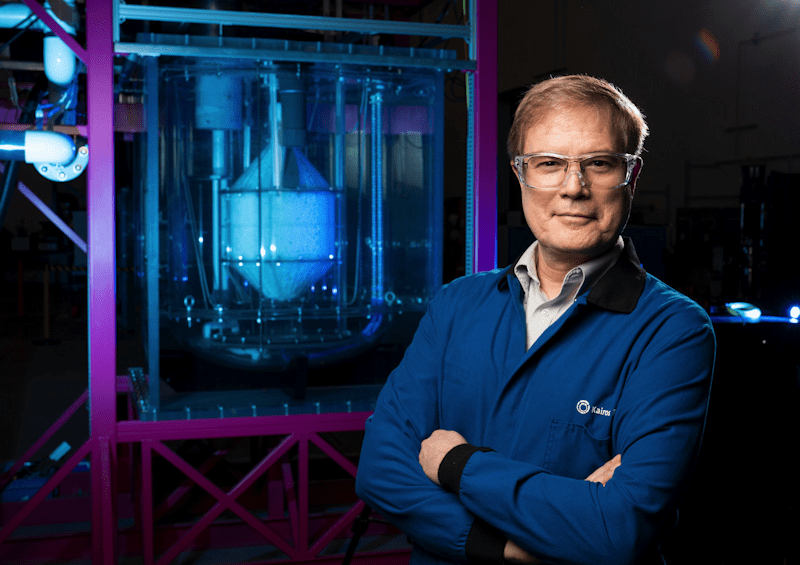
Per Peterson, CNO, Kairos Power
Concepts discussed
Auto-linked from the episode's notes and transcript.
Show notes
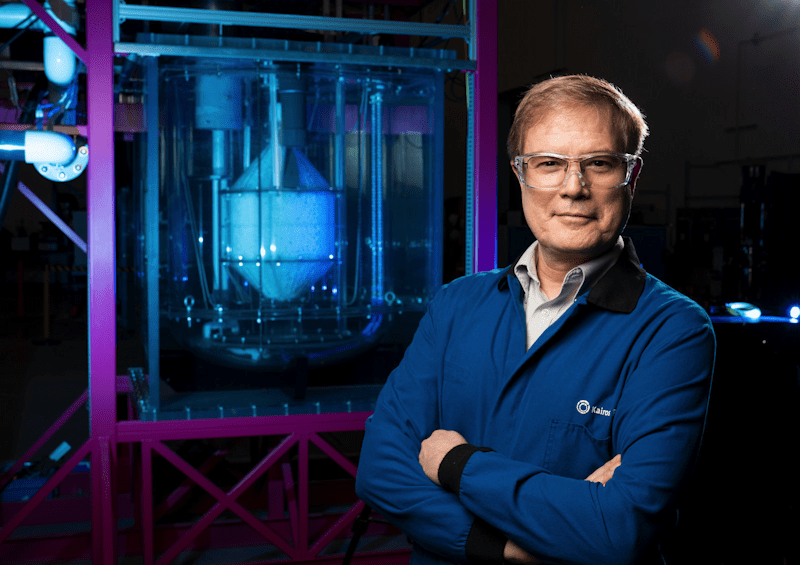
_Per Peterson in R-Lab with ETUDE, the scaled water test version of the Engineering Test Unit now in construction in Albuquerque
Image provided by Kairos Power_
Kairos Power Is developing a truly new nuclear fission power technology. Their KP-FHR (Kairos Power – Fluoride Salt Cooled, High Temperature Reactor) combines the solid fuel form usually associated with gas-cooled reactors with the fluoride molten salt often associated with fluid-fuel reactors.
For Atomic Show #288, my guest was Dr. Per Peterson, Kairos Power’s chief nuclear officer (CNO). Per explained the technical logic leading his company to make its ground-breaking choices.
Before describing process of making technical choices, Per provided a brief summary of the KP-FHR technological development history. The FHR originated in a conversation with MIT’s Dr. Charles Forsberg and later became the subject of an integrated research program between MIT, University of Wisconsin, and Dr. Peterson’s academic home at University of California’s Berkeley campus.
As Per was careful to point out, the program was primarily funded with Department of Energy (DOE) academic research grants and involved a number of both graduate and undergraduate research students from each of the participating institutions.
This type of project grant program is aimed at giving students practical design experience and providing purpose for experiments, equipment design and testing. Sometimes, as in the case of the FHR, members of the research team recognize that they have a product that can be commercialized because it has characteristics that are superior to similar products in the market.
Three members of the FHR integrated research project team, Per Peterson, Ed Blandford, and Mike Laufer founded Kairos Power in 2016 as a venture-funded Silicon Valley company to refine their ideas and commercialize the technology they had helped to develop within the academic setting.
In 2018, I talked with Ed Blandford and Per about Kairos Power, this show is part of my promise to provide updates on an intermittent basis.
Brief description of the KP-FHR
The nuclear fission heart of the KP-FHR is a pebble-bed reactor with 4 cm diameter fuel elements that each contain thousands of TRISO fuel particles in a graphite matrix. Fission heat generated in the reactor is moved by a pumped flow of fluoride salts through a heat exchanger that transfers the fission heat into nitrate salts similar to those used in concentrated solar thermal power systems.
The nitrate salt is pumped through a second heat exchanger (steam generator) that functions as a water boiler to produce steam with temperature of 585 ℃ and pressure of 19 MPa. As Per explained, that combination of temperature and pressure is equal to the most modern coal fired steam plants.
In fluoride salt the fuel elements have a slight positive buoyancy. To provide long operating periods without a large amount of excess reactivity at the beginning of core life, the KP-FHR includes an online fueling system that removes pebbles at the top of the core and replaces them with fresh or slightly used pebbles at the bottom.
The pebbles move slowly and have very low frictional contact with each other in the bath of molten salt. The reactor operating temperature is approximately 1000 ℃ lower than the temperature at which the TRISO fuel particles would begin releasing even small quantities of fission products, giving the reactor a broad thermal margin. As Per described it, the pebbles are so relaxed that they are almost meditating during their residence time in the molten salt.
What happened to the gas turbine concept?
Some listeners might remember that Kairos Power initially planned to use a Brayton cycle heat conversion system with the potential for using natural gas co-firing to produce peak power. Like many academic ideas, the system that looked good on paper or on computer screens turned out to be more complex and difficult to develop than expected. The current design is the result of numerous studies done with both technical and market parameters included.
Per provides a more complete version of the story and also shares the excitement that comes from working with a large, growing team of talented and motivated technologists.
What is Kairos Power’s near term plan?
One of the more exciting developments that Per shared was the fact that Kairos has been selected as a recipient for a grant under the DOE’s Advanced Demonstration Reactor Program (ADRP). Kairos will be filing a construction permit application in approximately one year to build a reduced scale version of its KP-FHR that it calls the Hermes project.
The project will be constructed on a site at the East Tennessee Technology Park near the Oak Ridge national laboratory.
DOE has promised to provide a little more than $300 million over a five year period (subject to future appropriations); Kairos will provide at least a 1:1 match of that DOE money for a project total of a about $600 million.
As might be expected, Kairos hiring and will continue to expand as it moves past laboratory scale and into a nuclear construction project.
I hope you enjoy the show. As always, comments are welcome. The conversations here often stimulate new ideas and thinking.
Transcript
Read transcript
There's a way, a way such a better way today, today. It makes your voice tell the world there's a better way, today there's a better way. This is right Adams and it's time for another Atomic Show. And when we today have Dr. Para Peterson, a longtime professor at the University of California, Berkeley, and now serving as a Chief Nuclear Officer for Cairo's Power, an exciting small modular reactor company. Welcome, Para. Thank you, Rod. It's a pleasure to be here. And for those of you who've been following Atomic Insights or the Atomic Show for a long time, you've heard of Cairo's before, I guess the last time I covered Cairo's who was maybe back in 2018 or so, when Dr. Peterson and Ed Blanchford joined me for a, I guess kind of a meal at an American nuclear society meeting, and we chatted about their company. And a lot of things have happened since that time. I'd like to let Para tell you a little bit about Cairo's history and what they're doing these days in the period since we last spoke. Thank you, Rod. And it's a real pleasure to be here and to be able to describe some of the progress that's occurred with Cairo's power. The Cairo's power actually originates out of DOE funded research at universities and national labs that's occurred over the last decade. And in particular, back in 2012, the Department of Energy funded a large scale integrated research project at MIT, Berkeley, and University of Wisconsin to investigate the potential that high temperature reactors and the cooled using molten fluoride salts as opposed to the conventional coolant which has been used in the high temperature reactors to date which is helium. And the work that we did in that multi university program, there were a couple dozen graduate students, lots of undergrads engaged as well. conducted series of workshops with external experts from national labs and industry and government to ask the questions about the scientific and technical feasibility of using liquids to cool high temperature reactors with solid fuel. And also how one would approach the various different activities that would need to be needed to do to in order to license these reactors and to validate the approach to implementing passive safety. Because this was a very successful effort. And so by the time we'd reached around 2016, it was pretty clear that in order to progress at the necessary rate, it was going to be necessary to move this activity into the private sector. And so this is when we spun out the startup company, Kyros Power, which the CEO Mike Laufer, the CTO, Ed Blanford and myself, we were the co founders of the company. We started up basically in December of 2016 opened offices in January, we had a chance to talk in I think it was November of 2018 and at that point we had some 62 employees and we were advancing rapidly and getting we just moved into the new laboratory and headquarters facilities that we built in Alameda at the former Naval Air Station there. And so we were giving you an update at that point. Of course, we've been moving forward quite rapidly since then and again I'm looking forward to being able to go over and discuss some of that progress with you. And maybe you could start off with a little bit of a brief description of what Kyros concept is in terms of how it's different from others. It's a solid fuel using the based on the trisotype, high temperature reactors and uses a molten fluoride salt to cool it or to transfer heat and what is the how is the power converted into electricity. Those are excellent questions. The big difference here is switching from the use of a high pressure helium as a coolant and gases, gases have very limited heat transport capability both in terms of the heat transfer, convective heat transfer from surfaces that extract heat out of the fuel as well as the ability to circulate heat around just because you need to move pretty large volumes and you're doing this at high pressures. So, we're going to be having the atmosphere is switching to a liquid coolant that has intrinsic low pressure so that you're at ambient pressure does allow you to go to to thin walled structures that are very similar to what's used in the sodium cool reactors. So, it allows you to get better heat transfer, which means that both you have a lot more circulating power and you also get substantially better heat transfer meaning you can run it significantly higher power densities. And those two attributes of the molten salt coolants make them perform substantially better than helium does and we can go into a few more of the technical details maybe a little bit later on. The original idea that one might do this dates back to 2002, 2003 and the generation for program at that point in time. Charles Forzberg and I were at a meeting and Charles came to me Charles Forzberg was at Oak Ridge at the time then moved to MIT and came to me with an idea that one might look at using the same types of molten salts that have been studied at Oak Ridge for liquid fuel molten salt reactors. As a coolant for solid fuel reactors and this idea was quite intriguing because on our side we've been working a lot on the use of these molten salts believe it or not for cooling of fusion power plants which remains a future potential application. And so we discussed this and realized that it was sufficiently intriguing at Meredith some work and we did enough investigation to publish a paper in 2003 that concluded that it was feasible to design high temperature reactors that could be cooled by molten salts and that would have the necessary safety attributes negative coolant void reactivity feedback, coolant temperature reactivity feedback. And furthermore we began to realize that the amount of power that you could get out of reactors designed this way is pretty large it was it was started to look really really attractive. Furthermore we were able to confirm that we could design the reactors to achieve fully passive safety under shutdown conditions and essentially to use purely gravity driven forces in order to remove decay heat after one would shut down. And this resulted in some significant levels of sort of single investigator type of research up until 2012 where the promise of the technology had been shown to be sufficiently high. The DOE actually went forward with this is one of the first integrated research project topic areas and Berkeley MIT and Wisconsin put in a proposal that was accepted and we move forward with that IRP and that of course leads to where we are today. But that's the background behind this the incentives to take a look at this combination but of coolant and fuel but it's really important to also emphasize that this is happening in parallel with a lot of other US government investments and advanced nuclear that were important and directly relevant. To to standing up you know this this new technology a really critical one was that we had the next generation nuclear plant project which was tasked with with developing and re qualifying new forms of this trisophule this coated particle fuel. That the kpfhr uses as well as re qualifying and developing new types of graphite that could be used for reflector and moderator structures in these types of reactors. There was extensive work underway to update ASME division five for high temperature design which enables sodium reactors liquid metal reactors but also molten salt reactors to be designed. And to use use more modern materials and then I think another really important set of activities that was underway at that time was was a set of things that were focused towards in our sea licensing and figuring out how it was that one could update the approach to in our sea licensing such that you could license non water pool reactors. And because there's been tremendous progress in all of those areas today chiro's power actually is poised to submit a construction permit application for the first. Hermes reactor which will be 20 to 50 megawatt thermal FHR and one of the first truly new reactor designs to be built in I would say the last three to four decades. We'll talk a little bit more about that project because I think there's some interesting details about one thing I would like to investigate is a lot of people lot of companies are interested in molten salt liquid fuel reactors were the fuel materials actually dissolved in the salt. Can you help us explain what some of the considerations are for your molten salt as a coolant but not as a fuel carrier. That's an excellent question and of course it's very common that we will get asked that question why not use a fluid fuel in your reactor concept. There's a set of reasons why solid fuels allow you to move faster that that is for one thing it's because it's closer and more conventional the approach to licensing this type of reactor is easier when one is working with solid fuel because the design and the safety analysis. Overlap more closely what's been done with previous types of reactors which which simplifies things. The other thing that's important about liquid fuels is that you do have very high circulating activity lots and lots of vision products and we know that it's technologically feasible to work with liquid fuels. This was this was proven in the molten salt reactor experiment. But it's a real challenge to at least an our judgment to make that the first way that you deploy reactors that use molten salts. So when you when you start to look at what the benefits are of working with molten salts as opposed to your other coolant options. Those those are largely independent of whether the fluid that the fuels fluid or it is solid form. The thing that really makes the molten salts highly attractive particularly the fluoride salts is that if you control chemistry properly you can get very low corrosion rates with high temperature structural materials such as graphite and 3 16 h stainless steel. And this is attractive they have very high chemical stability which means that you don't have to have concerns about chemical reactions. They also have intrinsic low pressure and this comes about mainly because they do have very high boiling temperatures for the for the fluoride salt that we focus on which is called fly. The boiling temperature is 1430 degrees centigrade which is which is well above any temperature that you can reach in any kind of transient or accident with this class of reactors. And so the intrinsic low pressure means that you don't have sources of stored energy that can mobilize vision products in in the case of having an accident. It also makes it much easier to design the reactor to use something that we call functional. containment, which is a really important advance over water cooled reactors, which require high pressure, low leakage containment structures, which are big clumsy and heavy. And so these are the attributes that make the molten salts attractive as coolants for advanced reactors. And the fact that they have excellent capacity to retain radioactive materials, which is why they can work also for liquid fuels, further enhances these safety advantages. I think the key parameter that we've looked at in comparing the different coolants is what's called the volumetric heat capacity of the coolant. And this is the amount of heat needed to change the temperature of a volume of coolant by a certain number of degrees. This volumetric heat capacity is directly related to the capability to move heat around from the reactor to the power conversion system. So the fluoride salts like fly have extraordinarily large volumetric heat capacities. That is, for example, for fly, it's 4,500 kilojoules per kilogram cubic meter, which is the best way to put it is that that's even larger than pressurized water. It's about 4 and a half times larger than the volumetric heat capacity of sodium. And it's actually, it's just a lot larger than the volumetric heat capacity of high pressure helium. And that in turn, when you look at the size of these reactors, makes FHRs remarkably compact, because they're also operating at low pressure, we can design them to use thin walled structures, which is one of the reasons why when you go back to the origins of studies of using molten salts as heat transfer fluids and reactors, it actually takes you all the way back to the aircraft nuclear propulsion program. And if you ask the question, if you wanted to have a reactor that could produce very high temperature heat and it could be lightweight enough that it could credibly get up into the air and power and airplane, when you look through the set of candidates, you come back repeatedly and you end up concluding that molten salts would actually be what you would pick for that application. As you end up with this intrinsic low pressure, very compact system, you can operate and deliver heat at high temperature. The only problem with that of course is that putting reactors and airplanes is not the best thing to do. What we did need to do back in the 50s would put reactors into submarines. And the most logical coolant for submarines was water. And therefore, water got ahead start and we ended up down selecting and using water as the primary coolant for commercial reactors as well. And with that, there's come a set of challenges because water cooled reactors do get into trouble if you get fuel damage in terms of their capability to release radioactive materials and mobilize radioactive materials in ways that other high temperature reactors and other coolants don't have those set of issues. So that's a bit of background about the origins of the technology and basically the benefits the benefits of using the molten salts as coolants really come about from their fantastic thermo-physical properties and also this intrinsic low pressure and high temperature that you can operate through reactors at. Now, can you help me understand once you get your molten salt moving around, it has to go through a heat exchanger and transfer that heat to something else? What is something else free for your design? So basically this is one of the really important and traditional questions what to pick as an intermediate coolant to use with molten salts. There's a couple of additional differences when you're using the coolant as a coolant, as opposed to a fluid fuel. And one of them is that you have a different design approach for that intermediate heat exchanger which is that you maintain your primary coolant at a higher pressure than the intermediate coolant. This internal opens up a much wider range of potential candidates to use for the intermediate coolant than as feasible for the fluid fuel designs where you have to design in the opposite way. That is, you need an intermediate coolant that you're comfortable with having get back into the primary salt because you can't design the pressure difference so that the fuel salt would leak out of the system and into the intermediate loop. What we've identified is that salts that have oxidizing type of properties and the most straightforward and appropriate one that we've been working with because there's already a large experience base as nitrate salts. Those salts are very attractive for the FHR application for the intermediate salt because they can deliver the heat at high temperature. You have this experience base from the concentrating solar industry on their application. And also they have tremendous capability to oxidize and immobilize tritium that can then be stripped out. And this is one of the things that one needs to do when you're starting to work with fluoride salts that can generate tritium and larger amounts, say comparable to what heavy water reactors, the can do reactors do. One of the key questions is how do you control and recover that tritium and using these nitrate salts as an intermediate salt or other types of oxidizing salts is quite attractive because it makes it quite easy actually to manage the tritium that is generated working with these molten salt coolants. Okay, so after your intermediate system, what's your power generation? That's what I'm trying to do. Of course, so as you know, when we're working on this problem under the integrated research project, we were looking at advanced power conversion cycles, including things like reheat air combined cycles, which could give you the ability to do things like natural gas co-firing for peaking power and have high flexibility. When you come into the environment of looking at deploying reactors on accelerated time scales, the truth is that you come back and you say steam cycles are pretty good. We've advanced that technology quite far in terms of ability to get high thermal efficiency out of steam turbines. And with one of the interesting points about FHRs is that we can deliver heat at very high average temperatures, actually somewhat higher even than what is feasible with helium and higher average temperature than it's feasible with most of the liquid metals. And that allows us to get to steam conditions that are actually comparable to some of the best in class, coal plants. That means you can then grab the coal plant type of steam turbines that have been developed and you're looking at turbines that can get up into the thermal efficiency range of 45%. And that's a pretty good place to be starting from when you're talking about high temperature reactors because we know that with further work and advances, we'll be able to drive the thermal efficiencies of power conversion even higher. But if you're starting out at 45%, you're already almost 50% higher than what's conventional for the water full reactors, which are generally like 32% to 34% thermal efficiency. And the other advantage is you're using more modern technology that's more widespread rather than just the few manufacturers of saturated steam turbines. Yes. It's not that many. And Rod, as you know, also, the other thing that people that companies, when you start to look at the private sector and especially start up companies coming into the nuclear sector, the other thing that you're doing is you are looking at developing smaller reactors. And there's a whole set of important reasons why focusing towards smaller reactors deployed in multi-unit configurations gives us the ability to advance the improved the technology faster. I think that one of the things that happened with the early technology lock-in to water as the preferred coolant for commercial plants. And again, there's a lot of logical reasons why that happened. But to manage properly the safety questions associated with fuel damage, you did end up having to add active emergency core cooling systems, which were complex and expensive. And also you need to put those kinds of reactors into high pressure, low leakage containment, both of which are which are feasible of course. But the problem was that that added cost. The solution back in the day was to make those reactors larger to capture economies of scale. And this work, I think, up to a threshold of about 7, 800 megawatts of lecturers. But as we continued to scale them up, the big problem was that they became more and more difficult to construct on sort of reasonable schedules and at reasonable cost. And so the other issue with making them bigger and bigger was that it made it much harder to make changes or to innovate both because the amount of money that you were putting at risk to build a single plant was so large. And also because the construction time and development time are so large for these really big reactors, I do think that by moving back to non-water cooled reactors and looking at smaller multi unit configurations and even I'll have to say going back to smaller water cooled reactors, but multi unit configurations. This is where you open up those opportunities to do the rapid more rapid iterative development. And the one thing that's true about innovation is that the only way you can innovate is to do things differently. Which of course sounds, I mean that's obvious. But it's surprising how frequently you'll see people saying I'm being innovative, but they're not doing anything differently, right? So yeah, change is part of innovation. You can't innovate without changing. That's correct. But you can't change everything all at once. Oh, that was one of Rick Overs' main engineering philosophies was you can't change everything at once and people who tried to do that got themselves in real trouble. This is, Rod, I have to say this is one of the reasons why we benchmark extensively with SpaceX. Because that SpaceX is a really big success story on many different fronts. They were founded in 2002 launched their first Falcon 1 rocket successful launch in 2008, literally delivered cargo to the space station with the nine engine variants. So if you think about multi-unit reactors, then you can begin to appreciate the strategy of going to this multi-engine architecture, delivered cargo to the International Space Station in 2012. And then by 2018, it had captured over half of the commercial satellite launch market. This is really remarkable. There's many things that contributed to that. I do think that that kind of innovation remains something that the United States, it's just in the DNA. to want to do that sort of thing. But one of the really neat things that space X validated is the idea of iterative development. That is, design cycles of plan, design, build, and test where you would assemble integrated systems and test them and find out what the interactions are that would make them not work and then fix those problems. And it's by that iterative process actually that space X has been able to develop an extraordinarily effective rocket technology with the Falcon Rockets. And you've got the Falcon 1 Falcon 9 Falcon Heavy. And now we're looking at Starship being deployed in Texas. Those same types of iterative development cycles are fundamental also to the strategy that chiros is employing in developing KTFHR. And it's enabled by these properties of the molten salts. And the fact that these reactors are quite compact. And within world construction, it's more practical to build and test your components and iterate. And this is also fundamental to the chiros strategy in terms of developing and deploying advanced reactors that use fluoride salts as cool. Well, now that brings us to a perfect transition to tell us about your building project, your combined operating license. As you said, you guys are getting ready to more construction permits, you're getting ready to do. Because I know you've done a lot of iteration in the laboratory for your components. But it's about time to get the integrated system done, right? Oh, yes. And I think it's important to emphasize that the iterations that involved integration need to start from the very beginning. So let me give a little bit of background about how chiros has laid out its testing program and capabilities. Because that's important. And I want to emphasize that this is coupled with really world-class computing and modeling capabilities as well. The team at chiros is absolutely remarkable. When you look at the quality and expertise of people that have come to work at the company, we now have 162. And chiros is a heavily engineering-oriented company. So 90% of our staff and as actually people who come from different engineering disciplines. The basic strategy in the company was deploy first, what we call the rapid lab, our lab, which is focused on doing experimental work, both using stimulant fluids. This is an experimental methods that we'd prototyped mainly at Berkeley. But we can use water and heat transfer oils to replicate most of the key fluid mechanics and convective heat transfer phenomenology that are important in the molten salt systems. And because the scaling fidelity in this experiments are so good, we can actually resolve many of the technical questions on things like how to get a pump to perform properly, how to control free surface dynamics, how to predict flow distribution and pack beds of pebble type fuel and such. We can resolve those questions in scaled room temperature experiments where you can get in good instrumentation and really understand what's going on. In parallel with that, in our lab, we also have set up and are working, have been working at high temperature with actual molten salts. And moreover, an integrated flow loop type of systems where we have force circulation and we use these experiments also to perform corrosion testing. But they're fully integrated. They have all of the heating, the pumps, all of the different components, the complexity of the controls required for these experiments is actually comparable to what's needed for the reactors. And so these smaller scale tests enable you to resolve a whole set of questions around things is diverse as I and C and materials performance to fluid mechanics and such. The next step for chirosthen is to deploy a intermediate scale non-nuclear testing facility. And this is being deployed at our KP Southwest campus which we recently are now in the process of constructing an Albuquerque, New Mexico. And this is where we'll have deployed the engineering test unit, which is nominally about a half height, half diameter version of a full scale commercial reactor. And it allows us to do the integrated testing of all of the major reactor components in a prototypical environment, graphite reflector structures and working with the actual prototypical coolant salt and the solid slob, but in this case, not enriched. And then the ETU is very similar in size to what you would do if you wanted to do a test reactor, which leads to the next step which we've announced recently is that we are proceeding to deploy a nominally 20 to 50 megawatt test reactor that will be located at the Eastern Tennessee technology part. This is just a fantastic site. It's adjacent to Oak Ridge National Lab, which has a long history of working in nuclear energy technology, high temperature reactor technology, molten salts and essentially everything that's relevant. And then of course you've got other fantastic labs as well. So the Eastern technology, the park, this is the location also that historically there had been gaseous diffusion plants. And so we're also implementing beneficial reuse for that site by using it to host this Hermes reactor that we will be licensing and deploying over the coming five years or six years. Now as I recall, you were a recipient of one of the awards for the Advanced Reactor demonstration program for that construction project, right? That's correct. And so this was also, of course, has been very good news and it's part of a broader national strategy in the Advanced Reactor development area, which is to support multiple concepts going forward to be successfully deployed in the United States. And in our case in December, DOE did announce that Cairo's power has been awarded a risk reduction grant. It's a 50% cost share for the cost to design license and deploy the Hermes reactor at the ETP site. And the total amount is $300 million of cost share for the total program cost of 600 million. So it sounded though from your description of the time, it's you may be racing some of the primary recipients of the award albeit on a somewhat smaller scale. Is that reasonable interpretation? Well, of course, basically it's important to proceed expeditiously. We've already, another thing that we've recognized in this industry is that we do need to modernize the licensing process. And this doesn't actually, it doesn't mean changing regulations as much as it means changing the way that we approach the licensing problem. You might have heard and talked about in some of your previous podcasts, the ideas around phased licensing, which is sort of a more step-wise approach. That's feasible to implement within the current licensing framework that NRC has. It just up until new scale got started, it had not been commonplace. So Cairo's power is already very well along in licensing interactions with the nuclear regulatory commission with multiple topical reports that have been submitted and multiple final safety evaluation reports that have been returned back. And those FSCRs and the topical reports have resolved some of the most important sort of fundamental questions about how to approach licensing, which retire a significant amount of risk. And this places Cairo's in the position of being able to develop and submit construction permit application followed by operating license application for the Hermes reactor. And of course, our licensing team is working actively with engineering and the others in order to develop these materials. And there's routine communication with the nuclear regulatory staff, commission staff, so that they're already have completed quite a bit of review on technical and licensing issues that are important for the reactor. This goes back again to the basic strategy using an iterative approach and in biting off the technical and other types of risks and small enough chunks that you can address them and retire them. And that enables you to make better decisions going forward in the development of the reactors. I do think this is much closer to how things were being done back in the 50s and 60s, then it has been in the last 30 or 40 years since we've, since this question of innovation has been a challenge in the nuclear field and all of the people that are spreading forward now with new reactor concepts, I think, have recognized that we need to have a different strategy to get advanced reactors deployed on a time scale that matters in terms of addressing climate change. And you touched that real briefly, but we didn't really talk about your reactor, that what form is a solid fuel, how what's your refueling cycle, that kind of stuff. So talk a little bit about the reactor that you're gonna cool with your flood. That's a wonderful question, Rod. The thing to back up to first is, is the physical form of the trisophule because it's a really wonderful fuel form. It consists of very small kernels of uranium-oxy carbide and people have worked with other types of materials as well. These kernels are the order of size of, say, poppy seeds. And using chemical vapor deposition, you can, one can deposit alternating layers of pyrolytic carbon and silicon carbide onto these kernels, which creates just an extraordinarily rugged high temperature fuel form that can retain, these particles can go to temperatures of up to, say, 1600 degrees and retain the radioactive materials inside. So they're quite ceramic. And then you embed them into a carbon matrix material to form the original form of the fuel. The work that the Department of Energy has done under its advanced gas reactor program to modernize the manufacturing of those trisoparticles. And in particular, they've been able, working Oak Ridge and Idaho to implement much more effective controls on these coding processes. So you end up getting really, really high quality coded particles. And then the methods for compacting them into the final fuel forms have also been advanced significantly. And all of this leads to really wonderful high temperature fuel form that's very rugged. In the case of chyros power, we've elected to use fuel that is in the form of pebbles. The alternative could be prismatic blocks or other sort of fixed fuel forms. By using a pebble fuel, we can circulate the pebbles through the reactor core and perform online refueling. And there's a set of benefits from doing that. The other key thing that differentiates our fuel is that it's slightly less dense than the coolant. That is, these pebbles want to float. And therefore, when we circulate the fuel through the core, unlike a... clearly in cooled reactor. You know, like the Pebble Dead modular reactor, in our case, when we circulate the fuel through the core, we're actually extracting the fuel from the top of the core. And then we insert it into the bottom of the core. And in our lab, using scaled experiments with water, because with water, we can replicate all of the forces that act on pebbles in a scaled sense, that the buoyancy forces, drag forces, viscous forces, and such, we've actually at this point, circulated over a million pebbles through our experimental systems in our lab. And we have high confidence in our capability to do this type of online continuous refueling, which opens up the whole set of benefits, I know that you're familiar with, because you don't have to run with a lot of excess reactivity if you have online refueling. And that actually means better fuel utilization, as well as very good reactivity safety characteristics for these types of reactors. And of course, the traditional Pebble Dead reactor has a 6 centimeter diameter pebble, which I always thought was a little too large for good heat transfer. And I think that you guys have made a similar choice, right? We are, so this is an important difference between the helium and the liquids. Anybody who's been out in 50 degree Fahrenheit weather, it's chilly, jump into 50 degree water, and it is outright cold. The heat transfer characteristics are much better. So what we find when we switch to using the liquid coolant is that we can first of all go to somewhat smaller pebbles. So instead of being the 6 centimeter billiard ball size, the fuel form for KPFHRs is a 4 centimeter pebble that is a ping pong ball size. And that gives us more surface area. We still have much, much lower circulating power, but this enables significantly higher power density than is feasible with the helium cool reactors. We'll maintain excellent heat transfer and safety characteristics. And so the power density that FHRs run at is about four to five times higher than what you'd have in a corresponding helium cool pebble bed reactor, which in turn means that the reactors are going to be just much, much smaller physically in size. And also of course we'll have them all construction because they don't have to run at 70 atmospheres like you need perchilium. And that we were very comfortable at this point with the pebble fuel form working well for FHRs. So one of the other nice things about your reactors, we talk about the floating pebbles. One of the big things on circulating bed pebble reactors has been the dust creation. And that was a problem in the thorium, I tend to reactor, but with floating pebbles it shouldn't be much of a problem right? Absolutely, actually it's quite interesting because the pebbles are nearly neutrally buoyant. The contact forces between the pebbles is well over an order of magnitude smaller and because wear rates are proportional to the contact force and sliding distance, this reduces wear greatly compared to what you would see in the helium cool pebble bed reactors. But the other neat thing is that the salts actually act as lubricants. And so you see very high friction coefficients for high temperature graphite pebbles in helium environments, friction coefficients can be above 0.5. And they drop tremendously when you have the liquid coolant. The combination of those two things means that life is much, much more gentle for fuel pebbles in an FHR. You know that there's these places where you can go and sort of be in a tank of water, kind of floating and it's very restful and gentle and you can do meditation and stuff. That's a bit like, but it may be a bit of an exaggeration. But the near-neutral buoyancy does help quite a bit. And what we do is we tune the density differences so that we can maintain that buoyancy, that positive buoyancy over wide range of temperatures. And then you get this wonderful safety attribute of substantially less wear on pebbles because of the fact that contact forces and the salt lubrication features greatly reduce the wear rates. So I'm never gonna get the image out of my head of your pebbles meditating. So we want them to work. Well, but they're gently working in your transformation and you're floating up to be replaced in necessary, right? Now, there's lots of other things to talk about, compared I know that you told me before we started that you have a hard end time. I really want to respect that because actually I would love to have you back on another time. And if I overstay my welcome here, you won't come back. So hey, let's close with a couple of things. Are you hiring? Yes. Okay. And the project to build a reactor in East Tennessee, when do you think your construction permit will be submitted? So in order to meet the schedule, the submission of a construction permit has to happen fairly soon. I would, I can't go into a lot of detail but the goal is to support start of construction in 2003 and operation in 2006. Those are the target dates. And that does mean that we are and need to be working actively on construction permit application work right now. And of course that's what we're doing. I think you meant to say 2023 and 2026. Yes. Yes. I'm. I'm. I'm. Yeah. Thank you. Yes. In 2023 and 2026 absolutely in the, if we could shave 20 years off, obviously, we have wonderful things. I don't. You know the best time to plan a tree was 20 years ago. Well, you know, you know, if you think about it, we did that. And it's not just that original paper and stuff. But I am so impressed with what this nation has done. You know, having been in the university system in the 1990s when nuclear energy research essentially came to a complete halt about 1997. And then the way I think the president called it something unnecessary. That what we've done since then is quite impressive in terms of rebuilding the competencies. But, but also extraordinarily bright young people have been coming into this field because they believe they can make a difference. And and we're benefiting from those investments that we've made over this last couple of decades. Anormously, if you look at all of the different efforts that, that are underway in the advanced nuclear space, not just high-risk, but, but all of these other companies. The reason that's feasible is because we've got this fantastic young people that want to work in this field because they believe they can make a difference. And that, that I believe it's the people that have gotten into this field ultimately that are going to make that major difference. And we will see successful development of multiple advanced reactor types. And I do believe that they will make a major difference in terms of how humans can manage carbon emissions and save the climate this coming century. It's just really exciting to be on this field in this period of time. It just things are moving so fast. It's tremendous. What a great way to end up this conversation. Thank you, Para, for your dedication and your leadership. You've been one of the people that's been out there inspiring young people in this field for a long time. It's great to see in the private sector and moving forward. And look forward to talking with you again sometime soon. Well, that sounds good, Rod. And since it was like 2015, then 2018, and now it's 2021. Let's make sure it's not quite such a long time before we have our next conversation. Hey, well, we did talk. I just didn't produce an episode. I did talk when I came and visited you in Alameda. Exactly. The fantastic. And so you see that we're making progress. Rod, it's always wonderful to catch up. And I look forward to doing so again in the near future as this, as we continue to make progress. All right. And as promised, I got you out here right on time. Fantastic. Appreciate the thanks, Rod. Take care. Right. There's a way, a way such a better way today. Today, it makes your boys tell the world there's a better way. Today, there's a better way. Ooh, there's a way such a better way today. Today, now it's your boys tell the world there's a better way. Today, there's a better way.