Darren Gale, VP Commercial Operations, X-Energy talks about Xe-100
Concepts discussed
Auto-linked from the episode's notes and transcript.
Show notes
X-Energy is the lead recipient for one of two industry groups selected to receive $80 M in Department of Energy (DOE) funding as part of a public-private partnership program to demonstrate advanced nuclear power plants on an aggressive time table.
Its primary partner in the endeavor is Energy Northwest, which currently owns and operates the Columbia Generating Station in eastern Washington. Energy Northwest will be the owner and operator of the demonstration power station, which will consist of a four-unit installation of X-Energy’s Xe-100 high temperature gas cooled reactor.
Each unit is designed to produce 80 MWe, resulting in a power station output of 320 MWe.
Advanced Reactor Demonstration Program
The award is part of the Advanced Reactor Demonstration Program, which also includes two additional development pathways with longer horizons. The $80 M in FY 2021 funds is a down payment that will provide funds for completing detailed design work and beginning the licensing process.
Future appropriations will be required to complete the projects; the funding opportunity announcement for the program included an award ceiling of $4 B to be shared among three different development pathways.
For Atomic Show #287, I spoke with Darren Gale, X-Energy’s Vice President for Commercial Operations. Darren is the company executive with direct responsibility for executing the company’s contract with the Department of Energy and delivering on the promise to design, license and construct an advanced nuclear reactor power plant.
The ADRP has an aggressive target date for beginning to deliver electricity to the grid is the end of 2027. During our conversation, Darren explained how his company is positioned to deliver on its promise.
Xe-100 Design history
We spoke about how X-Energy has been working on its high temperature pebble bed reactor design for more than a decade. X-Energy was founded in 2009 by Kam Ghaffarian, a successful entrepreneur who founded Stinger Ghaffarian Technologies (SGT) in 1984. Dr. Ghaffarian remains the owner of X-Energy, but is being joined by additional investors.
The design is mature and the company has been engaging with the NRC for several years. It expects to be able to submit a license application within the next year or two; part of the uncertainty includes determining the most appropriate and streamlined licensing pathway.
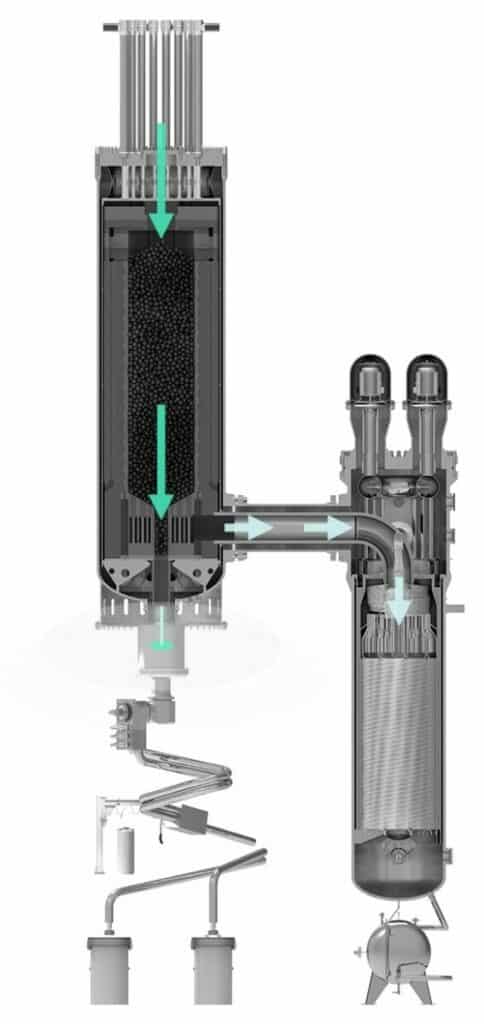
The Xe-100 is a helium-cooled, high temperature pebble bed reactor that has a number of similarities to the Chinese HTR-PM. They share a common heritage tracing back through the South African HTGR program and to the German AVR demonstration reactor.
As Darren explains, the Xe-100 includes a number of refinements in its fuel design and in its fuel handling system that enable more efficient fuel use.
Another design difference is that each Xe-100 reactor/steam generator modules are connected to its own Rankine cycle steam turbine. In the HTR-PM design, two reactor/steam generator modules feed a single larger turbine.
The 80 MWe power output selection was influenced, in part, by the availability of off-the-shelf steam turbine power plants. Unlike light water reactors, the Xe-100 will produce steam at temperatures (565 ℃) and pressures (16.5 MPa) used in modern supercritical steam systems.
Like the HTR-PM, Xe-100 reactors are continuously fueled while operating, eliminating the need to schedule refueling outages. There will still be a need to periodically shut down the reactor for inspections and steam turbine maintenance. X-Energy expects that there will be more requirements during the early years of operation while the company and the regulator gain experience and understanding of operational effects.
Eventually, though, the company expects to achieve somewhat higher than average availability than conventional reactors that require unavoidable outages for refueling.
Project location
The project will be built in eastern Washington at WNP-1, a site that was licensed for construction of a nuclear power plant in 1975. Using a site that has already been reviewed and approved for use as a nuclear plant greatly reduces the amount of time and effort required for long lead time environmental impact reviews, seismic surveys, and site pre construction surveys.
Though the original plant was never completed, certain civil structures, including a water intake system and pump house were completed before the project was cancelled. Darren explained that the existing infrastructure at the site would require refurbishment, but it enables a more rapid timeline than a greenfield.
Employment opportunities
X-Energy is in the hiring mode. The Xe-100 team head count is approximately 50. Some of the necessary tasks will be completed by contractors. But Darren expects that the permanent team will expand to include 200 or more people within the next year or two.
Most of the project design work is taking place at X-Energy’s Rockville headquarters, but current restrictions related to COVID-19 have required some creative uses of remote work, multiple buildings, and video conferencing. As a result of the learning that has come with that experience, X-Energy will be somewhat flexible in allowing some employees with key skills to work from remote locations.
The Xe-100 demonstration project is an exciting opportunity for advanced reactor designers and supporters to turn ideas and concepts into functioning equipment that generates real power and heat.
I hope you enjoy this episode and participate in the comment threads, especially if you have questions that are not addressed. As you will hear towards the end of the show, Darren expects to be able to return several times during the course of the construction project.
Transcript
Read transcript
There's a way, a way such a better way today, today. The nation's voice tells the world there's a better way, today there's a better way. There's broad atoms and it's time for a time-achode number 287. And my guest today is Darren Gale, the vice president for operations for ex-energy, a company that is developing high-temperature gas-cooled reactors and was an awardee on the recent advanced reactor demonstration program announcement. Welcome, Darren. Thank you very much. I appreciate the time today and look forward to speaking with you. I'm looking forward to hearing about your project and I will disclose to the listeners that Darren and I have known each other for a while because we crossed paths when we were both working for BMW M-Power back in the 2000, I was here 2010 to 2013 and I think Darren was there when I got there and was still there when I left. That's correct. It was the M-Power program was similar to the ex-energy ARD program and it's a cost share opportunity with the Department of Energy. They are looking to partner with private and public companies who are developing and deploying nuclear power plants and knowing full well that it's going to take some government involvement and government investment in order to get through these first-time plants. So very similar to before-rod we're doing this with an advanced reactor at ex-energy and looking forward to the next several years to make this happen. Well, I'm cheering for you guys to have a little bit better success than what we ran into with M-Power. Hopefully you don't have any activist investors who are knocking at your door saying you better perform more quickly. Yeah. Yeah, so the model now is we are actively looking at investors outside of the ex-energy. So ex-energy is privately held right now. Kim Gefarian is the founder and financial backing at this point in time. But he is he and several of those folks are looking at other outside investments. So he is getting in front of this as opposed to sitting back and waiting. He is lined up several folks to help with the investment as it goes along. So clearly this program, several key parts of it. So first right now we're in the licensing phase. So we'll complete the final design and licensing over the first two or three years. And then you get into the construction of a plant aspect of that. And so energy northwest to their partner in this, they would take over most of the financing them when you get to the point where they're actually building a plant. So initial phase is investment from ex-energy and other investing partners. And then energy northwest will take over just to get them out of cost after that. So the Department of Energy investment is going to be about a 50-50 cost share. That's correct. You know at the end of the day there may be some of the costs that you know are not to be covered by the department. But for the most part of the appropriate costs, they will share 50% of that cost. As you remember, you spend the money and then you get 50 cents back on the dollar. So you do have to line up the financing and the funds to fully pay the costs up front and then get reimbursed 50 cents on the dollar after that ideally. Yeah. And of course, like any government program, there's going to be some annual appropriations. But it looks like the incoming administration has a strong emphasis on climate change and clean energy. And they have included in their platform that they want to support advanced nuclear or so. And that's right. Yeah. This is, you know, it's interesting. And this goes back even during the empower day, you remember Rod. This was really a bipartisan effort and has been for many years. I think the security of the U.S. being in the, you know, globally in the lead in nuclear technologies and keeping up with some of these other countries that are pushing forward with nuclear. It's a very important issue, both executive and, you know, in the congressional realm. And so this program really has been strongly supported by both the Republicans and the Democrats. And so we feel pretty confident that so long as we're doing our part in funding and getting this pushed, pushed along that DOE is going to have the ample funds to help make this happen. So we're pretty confident that that so long as we can continue down the path of getting the design completed in license that DOE is going to do their part to help make it happen. Now, one of the things that is a big part of the advanced reactor demonstration project is a pretty aggressive timeline. Can you talk a little bit about how you're going to make that five to seven year timeframe? Yeah, so, so it is very aggressive and we, you know, all along the way, it's a lot about communications and making sure everyone understands, you know, how they fit in. So it's continuously having the interactions with NRC and knowing what they're going to need from us and the timing that we're going to be presenting things to them. So that that clearly that's one of the key things is getting pushed through the design to a point that we can author a very good license of middle to them, whether that is the, you know, design certification or for the construction license and you know, and then, you know, construction application and operating license application. We're still in discussions about exactly what's the best way to go, you know, with this short timeframe, but we certainly are in constant communication with the NRC and then also. Rod and constant communications with the long lead item vendors. So we are, you know, working with them already on the timing of, you know, the initial. You know, orders with long lead material items, long lead forging items. So, so clearly, though there are some key things like that that we have to certainly be in constant communication and understanding of when those particular orders need to be made in order to meet a, you know, a seven year schedule like what we're talking about. I would tell you at this point in time that's the most significant keys to the success of making this happen is, you know, getting the design licensing, some middles, you know, done and performed in a time and manner, constant communication with the NRC and then constant communication with these long lead vendors. So, I don't imagine that the long lead vendors are going to need some upfront deposits to get them started. Is that correct? I mean, you know, it's clear that, you know, they, they have to pay folks for materials. They have to, you know, pay folks to get in line and some of the four genes, you know, all those types of things. So, again, between energy Northwest, between investors and, you know, obviously the cost share with the Department of Energy, we have to get all of that lined up. And that has, you know, that's part of the, any project like this that's part and parcel of the making it successful is making sure that we have those various monies lined up ahead of time. So, all the while your community can fit in our city all the while we're making these those types of things happen. We'll have the group of people on the sides working on the investment in the timeline of the cash flow and that's as big a key, big a part of this project is the technical side of it. Am I correct in remembering that the other awardee for the advanced reactor demonstration project, the the Natrium partnership between Terrapower and General Electric. Aren't they also using energy Northwest as an operating partner? So, you know, again, for what I know and again, I'm not partial to anything in particular than what has been publicized. Energy Northwest is a part of the group that was put together with, you know, the Terrapower lag. Energy Northwest is not going to be the owner of the plant. There will be others who will own the plant that Terrapower is proposing. The WNP4, you know, foresight of the current, you know, site that has Columbia generating stage and operating on it now. WNP1 and fore were both BMW design plants being built, you know, back in the 70s and 80s, when they when they stopped construction of those two plants. So those those two sites are still, you know, still exist. They had site licensing going on, you know, the the energy of the environmental. And now, you know, impact statements all that was done. So that the WNP4 site is one of the potential sites for Terrapower. But I don't believe that they necessarily specifically chosen it as of yet. But from what I know, it is one of the potential sites, but maybe not necessarily the final site that they've chosen at this point in time. But certainly, yes, Terrapower is considering it and potentially then energy Northwest would be an operator of the site down the road. Have you chosen it well so so X energy and W and energy Northwest have chosen WNP1. So that site is where X energy will put the XC 100 and energy Northwest is the owner operator of that or will be the owner operator of that. So, you know, again, though the partnership is is different in that energy Northwest is chosen to be the owner operator of our plant at WNP1. They are a part of a group that is still picking or still deciding on where the Terrapower site would be. So for those people who aren't familiar with your Z100, can you give a brief overview of what kind of power plant you're considering building and how many modules and power output that needs stuff? Certainly, so the power plant itself is what you and I would call a high temperature gas cool reactor. So helium is the gas if you will. That's the medium that you basically carry the heat from the primary nuclear reaction in the core. So it's a graphite moderated core. So the reactor core itself has graphite are, you know, in an annulus around the core. The graphite pebbles if you will. So small uranium kernels are embedded in a graphite ball the size of a cue ball or tennis ball roughly. They're fed continuously down the reactor core with helium flowing down through these pebbles. So as the uranium. visions and the heat is created from those visions. Helium then takes that heat, carries that heat through a cross channel over to a steam generator. So that steam generator then uses helical coils. The helium transfers its heat to water. You know, on the other side of the tube, it's a water, you know, basically a rain-keen cycle where you take you heat water to create steam that goes to a turbine generator, a degree of electricity. Our power plant will have four of these units. So each unit contains one reactor and one steam generator. We will put four of those to make the full power plant, if you will. Each nuclear reactor pressure vessel is responsible for 200 megawatts thermal. And the total plant itself is net 80 megawatts electric. So this four pack, if you will, four unit power plant will be equivalent 320 megawatts electric. That will be the output of the plant. So that's the plant itself. It looks like there's an awful lot of similarities between the Z100 and the HTRPM. It's being finished up in China and should be operational sometime in 2021. Is that a fair extent to say? It's similar but the fuel is quite different. I think their fuel is a single path fuel in their reactor. and we have our triso-exfuel is a multi-pass. So we're getting a much, much higher burn-up on our fuel and much more effective and non-proliferation. Because it's essentially using up whatever you could have used from weapons down the road or fuel down the road. It's essentially getting used up because of the multi-passor. So the equivalent burn-up and our fuel is on the order of 165,000 megawatt-dazed per time. Burn-up and so it's a much more efficient plant than I believe what the Chinese are doing. And so this fuel online refueling seems like it would provide you with the ability to be up even more than... Yeah. It's a very efficient style of plant and with the four units you're essentially being able to run this around the clock for days, years and years on end. So the refuel you will have certain, obviously, turbine generator maintenance that will shut the plant down. But other than that, turbine generator maintenance, this plant is continuously refueled and can be operated for many, many days consecutively. That's correct. Yes. So the Z100 is a plant to the XE100, not the Z100. The four modules, 320 megawatts when they're all running full blast but and you can refuel them online so you don't really have refueling outages but you will have some outages for inspections and maintenance and that kind of stuff. Is that... That's correct. That's what we're assuming at this point. And I assume that whereas we don't... We believe we'll be using the latest and greatest materials. And so steam generator inspections may not have to be every year or every 18 months or whatever. But certainly there'll be the eye-tack that we get from the NRC as we first start up this plant. Well, I'm sure the first few years of operation will have to shut some things down and look and make sure that it's responding as we plan it to or we design it to. But ultimately we believe that this plant will be able to operate for long periods of time. Well, that's part of the demonstration project. You get a build it and actually get some operating experience and show how your assumptions pan out in reality. Exactly. Are you in the hiring mode? That's one of the things that my listeners always ask. Yes, yeah, we certainly are. We are... You know, to do this most quickly, Rod, there will be over the next you know, 12 to 15 months. It'll be a combination of us using some sub-contractors. So some of the other reactor vendors out there, you know, will have some resources that will likely utilize until we get a full, full cadre of people hired index energy. But yes, absolutely. We are hiring, you know, specific licensing folks at this point, you know, are some of the key folks who are hiring, but also, you know, technical designers as well, some reactor, reactor designers, plant designers, civil structure designers, you know, all of the above over the next several months while we complete the design and then get into a mode of preparing the licensing documents to hand into the NRC. So the answer is a big yes. You're definitely in the hiring mode. So how has COVID affected your operations? Are you guys working remotely? For the most part, you know, we follow our offices in Rockville, Maryland. We've been following the Montgomery County protocols. And so we've been, you know, at times of the year, we were limited to only 30% of our, you know, our office workers to be in the office at any one time. So we would, you know, kind of like a take turns situation for a good number of folks, but, you know, a significant number of folks were working remotely for a good portion of that time. And, you know, for the, and we've, we've coped with it for the most part. We've actually, there's kind of a new normal that you will. People have gotten used to being able to do a lot of their work from, from home. And, you know, in keeping, keeping the pace of design, you know, as you will know, there's, there's a lot of good with designers working in close proximity to each other to get, you know, to have little contemporary, you know, impromptu discussions. I brainstorming ideas about something that you just have to learn to do that with physical space, right? Knowing that you may be in two different buildings, you may be in two different houses, but you just got up, you have to learn to get that same brainstorming, uh, effect and impact through zoom meetings or through other, other means in order to continue to proceed down the path of completely designed. So, uh, COVID has, you know, it's been a, it's just brought about a different way of doing business, but we've certainly learned to do that business differently and are still, uh, still making progress on the wrong. Yeah, well, there's a lot of times, once you've done the brainstorming, where you send everybody back to their cubicles and they have to put their heads down and do a lot of work and I would imagine that part may be even more efficient when you don't have people having a commute back and forth in the DC area. Yeah. So, so that's clearly the, the case, uh, you know, we're actually getting more useful time out of some folks when they're really, really in the mode of doing engineering work, uh, you're exactly correct. There is, uh, even more time in the day to, uh, to get work accomplished. So that's, um, exactly what, uh, what we've taken advantage of. Yeah. I mean, I was in, I worked in DC for nine years and average about two and a half hours a day on the road being totally useless, other than trying to keep myself from being hit or listening to, uh, the podcast on the radio. Well, that is where I got hooked on podcasting. They were a lifesaver because it hit was more interesting to me and it gave me the ability to stay awake better than listening to music, uh, listening to somebody, uh, actually talking about topics that were of interest to me. So, uh, what kind of team size do you have already? We have roughly, uh, I guess it's on the order of 40 to 50, uh, you know, specific XE, you know, X energy employees and we've already been working, you know, had, uh, you know, some handful of, uh, subcontractors working too, but we will quickly get up into the 150 to 200 people working, uh, working on the design and licensing documents. So there is a good number of people, you know, again, that we'll bring in as a subcontract basis and then as quickly as we can get people hired on. So there is a good amount of, uh, ramping up that's going to be going on over the next several Yeah, and X energy's got several other projects in the works. And I know you are one of the contractors working on the project, payload, micro reactor program and then you also have your fuels, uh, manufacturing line, the, the Trisox arm of your company. So right. So you guys you're growing quite a bit over there. And then the space, you know, the space program, the space support fuel for, uh, you know, moon, moon ventures, uh, space travel, uh, the Trisox is being considered for several of those things. So yeah, Kim, obviously made his way early in his career with, uh, with SG, SGT supporting, uh, NASA and the space program. So he has kept ties to that pretty significantly. And, uh, so as much as we're a reactor fuel designer, uh, for the nuclear commercial power industry, we're now quickly becoming that same support for, uh, obviously you said the micro reactors for the department of defense and then also for, uh, you know, supporting space travel. So a lot of things going on with the company, several successes and we're, uh, you know, we're happy to be, uh, be ramping up with employees. We're glad to be able to do that and provide a place that people can, uh, can apply and, and come, can work for some exciting things. Now most of your jobs are, uh, in the rock fill area, right? That's correct. Uh, but we've been, you know, there's some consideration for remote working, you know, again, the, the COVID is really, really redefined how I think we're all going to be working going forward. Um, because it's, you know, it may not just be COVID in the future. There may, there are other reasons why we're going to have to stay, stay remote. So it's, it's certainly opened up our eyes and our minds to how we're going to work going forward. But you're, you're correct. The, the main office is located in rock fill and he would certainly like most of the engineering to, uh, to be done there ultimately, but that we've certainly, uh, we certainly not closed the door to, uh, the other, uh, other resources being, you know, being utilized around the country. Yeah, it's going to be somewhat of a, uh, adjustment for a guy like you who's been in the industry for, well, about 35, 40 years to see so much remote work happening. It is certainly different. And, uh, but, you know, having now grown up, and growing up in the industry and knowing how important it is to have the resources, you know, have the right resources for the work that you're doing. And if it just so happens, that some of those resources have to be tied in remotely, then, you know, at the end of the day, you need the, the right things accomplished. And, uh, so I think it's, it's really opened up our eyes to how, how work needs to be done and where it can be done from. And I think, you know, when you think about, uh, the engineering resources on the, you know, in the country of India, the Asian conference, and how much work that they've been doing now for the past 10 to 15 years remotely. And so I think it just began, you know, again, it opened up everyone's eyes originally from that support. And now with COVID, it's really driven home the point that, you know, we don't have to all be sitting in the same room or in the same building to get the work done. And so, again, we just we have to set up the work scope, set up what we need to get done, get the right resources on that, and then, you know, have supervisors and managers that are flexible to be able to handle, you know, people that are working on these in different locations. So it just required all of us to look at things a little bit difficult. Yeah, you got to find people that aren't those demanding folks that believe that if they can't see you, they don't think you're working. Right. Right. And so what, you know, for instance, in our schedule of activities and the work scope that we put together, you have to set up maybe more inner a milestone so that you can check on the progress of people who are working remotely. And I think that's, you know, that's the flexible difference that we have is that everyone needs to understand that, that, you know, maybe not just the end product will be looking at, okay, let's see some interim milestones as you go along to make sure you're that you're making the progress that we all expect. So just, you know, some differences that way. So going back to your technology selection, one of the things that you're website emphasizes is that the fuel is the containment. Correct. How does it make it easier to build your plant? So Rod, what, what it will do is that, you know, both from, from the standpoint of how, how complicated the safety systems need to be in order to guarantee, you know, public safety to not having, you know, in QA1 requirements on the actual manufacturer of the components themselves. So if you are able to clearly show the regulator that this fuel is going to contain all of the radioactive elements that could be harmful to the public and contain them in that fuel element. And you show them that that fuel element is not going to get away from you and it's not going to be destroyed and be able to spew this out into the public. As you can imagine, that simplifies significantly what you have to do with your systems and ultimately how you would store this fuel at the end of the day. So that's, that's the great benefit of, you know, of this steel product itself is how simple it can make everything to make your safety case and then to make how, you know, how you are specifically handling the fuel and the, and the radio activity, you know, as you operate the plant. So that's the, the most significant benefit of this type of fuel for, for our reactor design. So you're not going to need a giant, four inch, or four foot thick concrete reinforced dome over your plant. Is that, yeah, that's fair statement. That's the fair statement, right? So the, the dome in and of itself is not a part of the safety, you know, of the plant. Now, obviously from an economic standpoint, you know, containing this so you're not ruling the plant from an economic standpoint of something where to happen. You know, there's also that to consider, but certainly it greatly simplifies how you build the, the, the building, the reactor building, because it's not, you know, it's not a significant part of the safety cases, because you like to say. So yeah, absolutely. It will simplify it lowers the cost to, to build it and shortens the timeframe that will take to put it together. Now, you still in the mode of surfing for suppliers for things like your turbines and circulators and all that kind of stuff. Yeah, so we got, we are, we are down the road pretty significantly on most of that. I think, you know, the, the, the seemances of the world, the general electics of the world, right? So we are already looking at, for instance, the turbine generator, it's going to be an off the shelf system. But we are, we're not having to design something specifically the size of it. So we looked at the size of our, you know, our thermal, you know, output of the plant in order to kind of match up with an off the shelf turbine generators so that we could kind of take that worry out of the equation. So, but helium circulators, the fuel handling system, we have been talking with folks who supply those types of things, and, you know, are probably farther down the road on final selection with post types of vendors than maybe some of the, some of the other things that, that those critical items we have been discussing. So the, the turbine, there's a ranking system that you're going to be connecting to, looks like it's at supercritical type temperatures and which is an improvement over some of the conventional reactors because you guys produce steam temperatures in the 560 right, searing is that right? That's correct. Yeah. So well, like we like to say high quality steam, right, so that makes it very easy. If you do have a multi-purpose plant and that you might be supporting food processing or some other type of processing plant that goes on that needs high quality steam, but can then also use it for the electricity as well. So again, the multi-unit plant gives you the flexibility of, you know, having a full amount, you know, or a full turbine generator output for your electricity, but then maybe one of the other units is used specifically for steam for a processing plant. So that, you know, again, we'll, we'll talk with our ultimate customer, you know, an energy northwest or whoever it might be about what their potential use is that at this point in time, this demonstration plant, we believe is fully for electrical output. There have not been any discussion at this point in time, but there is the possibility. There is actually out in, on the Hanford site there may be the need for use of steam and some of the other activities that are going on out there, but we have not, we have not made any of those decisions at this point at this point in time, we're still going down the path of all, like, of all lecture-cloud. I'm thinking of, I've been to the site before thinking of exactly where you are. There aren't too many heat customers nearby, but like you said, they might be some on the Hanford reservation, but they're, they're, that's a big place. And some, and some very long steam lines, if you wanted to send it someplace else. So what, there, are there anything, anything else that you'd like to share about your project that I haven't talked about so far? Yeah, so one of the things, so I was just out there last week, as a matter of fact, I visited, visited Richland. We spoke with a lot of community leaders, the municipal leaders. I got to tell you, the community is very, very excited about this. They, they see, you know, from, from their history of what they, what they did with, with Hanford and the plutonium production, you know, back in the day, they now see them, you know, kind of being a gateway to the beginning of this advanced reactor demonstration, you know, is a gateway to the world for this. So if this is the first one up and going with, with the Trisofu, and with all of this, they are very excited and supportive to be the place to get this going. So that, that was one thing I would, you know, just like to share. It's a very, very pro-nuclear place. They're very positive about making this happen. And then also the site itself, you know, again, they were well down the road of construction of other nuclear plants back in the 80s when they, they stopped construction. So for instance, the, the water intake from the Columbia River already exists. We're not going to have to disturb the river in order to be able to get water to this plant. And then back that there's even a pump house that has all of the, the pumps for, you know, for a nuclear power plant that's a lot bigger than the one that we're, you know, getting ready to do. So there are significant resources that already exist. There'd be some refurbishments, obviously, going forward. But as far as the environmental impact for some of the things we have to do, this is a pretty minimal impact to the environment that we would be doing because of using a site that was previously under construction for a nuclear plant already. So that's, you know, it's a real benefit to us, you know, from a demonstration standpoint, having the ability to use a site that was previously, previously targeted for a nuclear power plant that back had gone down the road, you know, somewhat before, yeah. And from a scheduled point of view, the NEPA processes, one of the long poles and attempts. So I would imagine you're pretty far down the road on that already. Yeah. So we, you know, again, we're pulling what had been done previously. We've been in discussions with the NRC about, you know, just doing an update to what was done previously is opposed to going completely down a new path. So you're absolutely correct. We've already been in discussions and are starting to pull, you know, all the documents that, you know, have been handled previously. And so we'll be going from there. That's pretty exciting stuff. I'm looking forward to keeping track of you guys and, and hearing that you're remaining on schedule to deliver an operating reactor by what the end of 2027 or that's correct. That's correct. That's the, that was the original, we actually put in a schedule that even accelerated it from that. But that's certainly, that was the expectation with Congress and the DOE is the, they put this all together. So that that ultimately is the target is getting something to the grid by the end of 2027. Well, I'm thinking about it in a complaint if you accelerate it. I think the doe be some really happy people to do it. Yeah. I think we did that for them so that we'd have some contingency space, you know, some contingency time and place. So as you well know, something like this gets started. Well, Rod, I'd be, you know, I'll be happy. We can, we can do this, you know, multiple times during the project. I'd be glad to get on and give you updates and talk about where we're at. So that'd be great. It'd be great. Got another time down the road to do this again. Yeah. And maybe at some point in the, in the not too distant future, we'll be in the same place. It's the same time and be able to keep up to date face to face. Absolutely. But I appreciate you coming on. I think the listeners of the Atomic Show will be happy to hear that there is some real serious movement happening in in advanced reactors and, and, you know, something to we've been following for a long time. Yeah. Yeah. We're starting to get close. Yeah, we're, we're really looking forward to it. The, you know, the XE 100 is some people affection like call the Z 100. The XE 100 plant is, you know, we're, we're very excited about it. You know, I would just say, you know, it's certainly for the significant part of it. It is not new technology. Right. They've been operating high temperatures gas reactors for decades. Right. But certainly the combination of the advancements in in the fuel, being able to, to re circulate the fuel multiple times through the core, making it much more efficient. The quality of the steam, it'll be coming out of this generator. You know, it's we're very, very excited and we think it's the package that's going to be very popular once we get this up and demonstrated. And I'm sure there are lots of customers around the world who are just eagerly waiting for you to be able to show them something operating. Yeah, yeah, absolutely. There have been, you know, multiple people again, nobody, nobody likes to be the first, but they certainly are excited about the potential once they see it up and going. So yeah, we're looking forward to having multiple plants around the world and then not be this future. All right. Thanks, Derek. Rob, have a great day. Such a better way today. Today, now reach you boys to the world. There's a better way today.