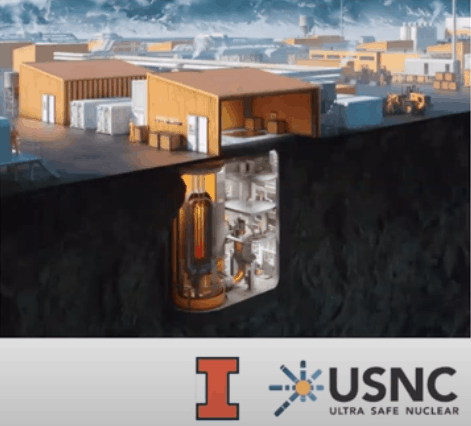
MMR at Illinois
Concepts discussed
Auto-linked from the episode's notes and transcript.
Show notes
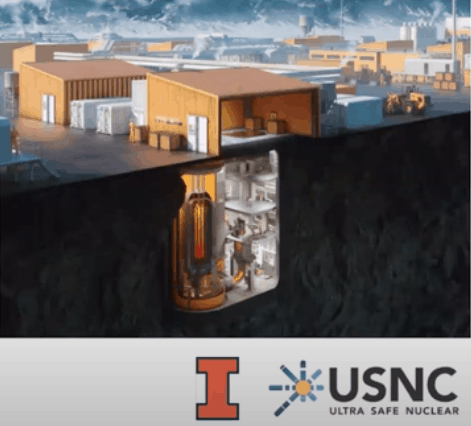
The University of Illinois at Urbana-Champaign has a stretch goal of completing its next research and test reactor by the end of 2025. It has assembled a team that includes several other major universities, national labs, and industrial partners.
It has selected the MMRTM, a product that is being developed by USNC (Ultra Safe Nuclear Corporation), for its ability to meet most of a long list of important attributes that will support a wide range of university research and development goals.
For this Atomic Show, I spoke with Dr. Katy Huff, Dr. Caleb Brooks – both of whom are on the UIUC engineering faculty – and Mark Mitchell, the USNC executive leading the MMR development program.
They explained the history of their visionary project and provided the basis for their firm belief that they can license and build a new research and test reactor within the next five years.
Why does UIUC need a new reactor?
The University of Illinois at Urbana-Champaign (UIUC) has a long tradition of leadership and innovation in nuclear science, technology and engineering. For 38 years (1960-1998) it proudly operated the Triga-Mark II research reactor to support student development and to contribute to the advancement of nuclear science and technology.
But that valuable asset was, like so many US research reactors, decommissioned during the Dark Ages of US nuclear power development in the 1990s.
By the end of that decade, student enrollment in nuclear engineering and science majors had dropped to near the fiducial level, there were few, if any prospects for new nuclear power projects, and federal support for nuclear research had been completely eliminated in during several budget cycles.
Universities didn’t see any reason to keep supporting research reactors, so they shut them down.
But concerns about fossil fuel sustainability and climate change have helped to renew global interest in nuclear energy development and deployment. Students are again selecting nuclear focused majors and are developing new ideas about ways to use nuclear technologies to improve the human condition.
Even though student interest in nuclear has been growing in the US for at least 15 years, university research reactor shutdowns have continued and no new ones have been built.
Leaders in nuclear at UIUC decided several years ago that they need to take aggressive action to address the growing challenge of increasing student population and fewer physical reactors for them to use in their education, research and professional development programs.
Why the MMR? Why now?
University research reactors have always been modest in their thermal power capability, and they have generally been designed with passive safety features that make them appropriate for student learning and management.
Even though the 15 MWth MMR is designed to provide useful power and electricity, it is also designed to be extremely safe without operator action. With its molten salt heat storage separating the nuclear reactor heat source from the adjacent plant heat conversion system, it is also designed for flexibly shifting its production from electricity to heat or to other useful products.
That flexibility is attractive to a large university that has a variety of student research endeavors along with a large physical plant that includes on-campus power and heat generation. Like many US universities, UIUC has a district heating system that supplies more than 200 buildings with steam heat. The total load during winter months is more than 50 MWth.
In addition, the university power plant supplies 50-75 MWe from a growing assortment of renewable energy systems as well as the coal and natural gas that provide the majority of the power.
UIUC students have expressed a great deal of interest in moving their university away from fossil fuels and have targeted their campus steam and power supply as something that needs an emission-free replacement.
Since Illinois is home to more nuclear power plants than any other state in the US, many of the students and town residents already have a favorable view about nuclear energy as a tool for addressing CO2 emissions.
In the FY2020 budget, Congress and the Administration included funds for the Department of Energy to create an Advanced Reactor Demonstration Program that included pathways amenable to university research, demonstration and test reactors.
That funding potential stimulated the already developing team to move forward faster. They put together what they hope will be a winning proposal for one of the Risk Reduction awards that will be announced in December.
How can UIUC expect to complete a project by 2025?
UIUC has several advantages that enables a reasonable opportunity for successfully completing a new research and test reactor by the end of 2025.
The system fits well within the established parameters of a research and test reactor that can be operated with an NRC class 104 license. The process for these license applications is well established and can be completed in significantly less time than a commercial class 103 license process.
As a university research reactor, UIUC has access to a DOE fuel leasing program that already has an allotment of the high assay, low enriched uranium (HALEU) fuel used in the MMR design. Fabrication services for the Triso and FCM fuel elements is already available on the research reactor scale.
With its large campus heat and power system, the university can be its own customer and has no need to engage in the lengthy process of arranging for off-take agreements for the heat and power that will be produced.
Project leaders have already begun the process of building community interest and support for hosting a new nuclear research reactor that can also help in efforts to reduce CO2 emissions.
The site of the existing power and heat plant has adjacent space that will enable the new thermal heat source to help reduce fuel consumption.
Other programs in the Grainger College of Engineering can also lend support and obtain value for their students.
How can I learn more about the project?
If our discussion piques your interest, you can find out more about the MMR at Illinois by visiting https://npre.illinois.edu/about/nuclear-powered-uiuc. You and also contact the project team at micro-reactor@illinois.edu.
As always, you can also engage in the discussion here. There is a good chance that one or more of the project team members will participate and address your questions or comments.
Transcript
Read transcript
There's a way, a way such a better way today, today. The nation's voice tells the world there's a better way, today there's a better way. This is Rod Adams and it's time for another Atomic Show. And today we're going to talk about the MMR at Illinois. This is a university research reactor, a brand new one probably the first time in the last 30 years. And it will, is destined, we hope to be built at the University of Illinois at Urbana, Champaign. UiUC, today I have with me two representatives of UiUC, Dr. Katie Huff and Dr. Caleb Brooks. And then a representative of US NC, Ultra Safe Nuclear Corporation, Mark Mitchell. And those of you who have listened to the Atomic Show in the past, you've heard Mark before, but we'll get some more information from them on this interesting project of building an MMR at a major university. Welcome, Katie. Thanks for having me. I'm Katie Huff. I'm an assistant professor in nuclear plasma and radiological engineering at the University of Illinois. And I lead some research in advanced reactors and fuel cycles. And I'm really excited to be a part of this proposal to the Advanced reactor demonstration program. So excited to talk to you today, Rod. Rod. I'm excited to hear. Kim? Yeah, I'm Caleb Brooks. I'm a associate professor in the same department in the Department of Nuclear Plasma and Radiological Engineering at the University of Illinois at Urbana, Champaign. And my research focuses on nuclear reactor systems and reactor safety within the context of the full system as well as thermal hydraulics and Mark. Yeah, hi, Rod. Thanks for having me on again. Mark Mitchell, from Ultra Safe Nuclear. I am responsible for Mike and the Reactor, or MMR program. All right. So I heard about this fairly recently. I guess just before you all got together, or Katie gave a presentation on a webinar called University's Going Nuclear and described the exciting prospect of having a MMR, which is a high-temperature gas reactor with molten salt, heat transfer between the reactor and the ultimate power source of the adjacent plant. As Mark described it to us several episodes ago, this will allow the University of Illinois to have a research reactor on campus for the first time ever, I believe. Katie, can you tell us a little more about the background of the project and what you all are planning to get done? Yeah, sure. So actually, the University of Illinois did have a research reactor, but it has been decommissioned. And so we are in great need of having one again to train our students in a next generation technology and to support the industry and the brand new advanced reactor industry in particular with tests and auxiliary technology. So what we're proposing is that, you know, on MMR at the power level of about 15 megawatts thermal, which is their standard design at UltraSafe nuclear would be really perfectly sized to both do some advanced reactor training for students interested in becoming operators, as well as a whole fleet of other research activities that can support advanced reactor deployment, including hybrid energy systems. Because we have the opportunity at Illinois to connect this reactor to our steam system and potentially decarbonize our existing fossil fuel generation. How big is your current thermal facility? I know that you like many universities have a district heating system and already have a heat plant on campus. How big is it? I have a power plant supplies about 70 to 75% of the energy demand on campus and the average steam demand is around 50 megawatts thermal. Okay, so the MMR would help you decarbonize it wouldn't be a complete solution, but certainly would assist in that effort. Yeah, Rod, the energy mix at the University of Illinois is quite diverse and the university has really been working to decarbonize its energy portfolio. We have very large projects happening on campus around solar. We have wind power purchase agreements. We are instituting even low grade geothermal to support HVAC systems and different buildings on campus. This push, which to decarbonize our energy portfolio, it really comes from this climate action plan to become carbon neutral by 2050. But again, as Katie Luiz to and Julele to our large steam demand for campus buildings to be heated. So over 200 buildings on campus are heated with steam that comes from added power plant. I have a power plant as a hybrid coal natural gas fired power plant. And that services all of the steam demand for campus as well as a sizable percentage of our average electric demand, which is about 55 megawatts electric. So our overall campus needs are about 50 megawatts of thermal steam for building heating and then another 55 or so electric for for campus utility. So this this reactor, again, it's a it's a research and test reactor. So the primary purpose is not the production and the offsetting of those costs. But we do feel it's it's really central to the technology and the University provides a great opportunity to demonstrate the ability of the technology to integrate into existing energy systems. So we would look to deploy this reactor on campus as a research and test reactor, but its power would feed into our existing infrastructure within abit power plant to help offset some of that coal natural gas use. So there is a production capability of what we're envisioning a lot of that is around the demonstration of the capability of this technology to integrate with these system systems. Our major focus is around the research that can be done with the device and and the need to train the next generation workforce. You know, it sounds like you have the opportunity to do research in areas that are outside of just nuclear engineering. I mean, there is a tremendous amount of effort and need for research and integrated power systems and and in using nuclear heat for other uses using the ability to very power and and integrate with a kind of kind of your own little microgrid there. And it sounds like it's going to be a great way to get some people who are not in the nuclear program interested in what this emission free heat source can do. Yeah, that's absolutely right. You know, our our university is certainly very forward thinking when it came to, you know, allowing us to go after this this proposal within the OE ARDP program. And really, the university is step out there is, you know, came back to this acknowledgement of really the broad research that could be done with this technology and throughout the whole process. And so, I've been talking about not just the traditional uses of a nuclear research and test reactor, which is often to play with neutrons and gammas and maybe to produce men to close to toes. But here we are really trying to broaden that vision for what can be done with the next generation research and test reactor. Across the grandeur college of engineering, which is has many, many strength areas that align very well with this technology and then across the campus as a whole, you can see things like advanced microgrid technology is advanced energy conversion systems hydrogen production. So, you know, the next instrumentation and control security, the nexus of food, water and energy, all of these things that are strength areas for the campus and the college really find a nice alignment with that technology like the NMR. So, Mark, tell us how you got involved. Did you go out and actively seek a university or did the university come knocking at your door? Yeah, right. I think we've been working with Illinois probably for two, two and a half years now looking at various options and feasibility and support and NMR there to support the brain jazz, School of Engineering's overall mission. So, this isn't a new opportunity. I think what catalyzed the possibility was the DOE's advanced reactor demonstration program, which made some matching funding available for us like this. And I think it really does excite us as kind of one of those perfect projects, which works very well on its own. It has a very big mission. It has a lot of social benefit. It has great benefits for the university and it also does some really interesting things. I think your introduction you mentioned, this would be the first university research test training reactor brought to you in 30 years. But also it's going to do something really exciting. And I from my perspective as just an engineer who works in power and energy. Is that'll be the first example of actually replacing coal-fired power and displacing it with the EPA heat without, you know, totally removing all of the infrastructure and starting to scratch. Which is something that a lot of opponents of nuclei have talked about. This would be one of the first time to see it. I think that's one of these projects that, you know, the more we think about it, the better it looks to us, the more exciting it works. And it's built on a long history of us working with the university, as well as looking at them for an opportunity to do something for us. The things that's interesting about your reactors is that they are designed with ultra safe operations without much operator intervention from the very beginning, sort of like the trigger reactors that traditionally dominated the university research reactor market. And so it seems to me like this is a great opportunity to demonstrate that your power source is similar in terms of being able to be operated with student type operators. Is that one of the things that you've been thinking about? In fact, in fact, you know, we were the previous reactor was one of the first triggers deployed. I can leave up to Calibra or Katie to talk about that, but you know, we sort of see this as a, you know, not just a successor in place, but kind of a successor in philosophy to trigger. And so I was bringing a bit more utility than a trigger which was very much focused on cure physics, but really, you know, the same kind of philosophy towards safety and robustness and really creating good opportunity for people to learn how nuclear power exists and integrate into integrated systems. And so, you know, we've got about that original reactor and we'll say, you know, the university of Illinois operated the trigger mark to for 38 years before it was decommissioned and, you know, being the second of its kind in the nation. Illinois contributed substantially to the early stages of that. and electronics, trigger design, you know, with some interesting flow systems and whatnot. And that is really like aligned with what we envision for this next generation technology. You know, those test reactors, in addition to being great training devices, were really pivotal to cutting edge advancements in nuclear technologies, by allowing universities kind of safe space to test and, you know, do experiments. And that, you know, I would also just say, in addition to there not being new research test and training reactors being deployed, we've seen a decline in how many are available to universities like the University of Illinois, much like ours was decommissioned in the sort of slump where there was little enrollment in nuclear. Many other research reactors around the country were also decommissioned during that period. And that has not, we've not recovered from that in terms of reactors. We've never, you know, we just allowed those to be decommissioned. Meanwhile, there's a lot of growing enrollment and enthusiasm in nuclear energy because of its carbon free promise and the excitement around engineering in general. And so we see that while, you know, a bunch of shutdowns occurred along with the decline enrollment when that enrollment came back up. No new nuclear research reactors and test reactors were built on campuses. And so the gap in training is really, you know, two-fold, not only are there no new next generation reactors for students to work with, but also there are more students than there were when we were shutting down reactors like the one at the University of Illinois. You know, and they have really great, strong, safe operation and they've contributed substantially. And I think there's a real opportunity here for us to contribute in the same way. You know, the University of Illinois really hopes to contribute to the kinds of prototype tests and support of the commercial NRC license that USNC will be pursuing for their MMR. We're an excellent environment here on university campuses to conduct those kinds of single and multiple effects tests, the startup and operations tests. And we can potentially complement the kinds of prototype tests that USNC plans at the Canadian Nuclear Laboratory in Canada. So I think there's a real sort of everything old is new again, kind of view of what's happening here and what should be happening on campuses all across the country. So I'm assuming that this reactor or this whole power system is going to look an awful lot like the commercial version that USNC is producing. And as a matter of fact, isn't there another one that's gonna be built around the same time somewhere else? Yeah, if I can answer that right. I mean, this is the our the project offers a great opportunity for us to essentially accelerate our commercial deployment plans probably five to seven years. So what we intend to do is the project team, which includes ourselves, University of Illinois for banishing and I know as well as somewhere around eight, leading nuclear companies and laboratories and some other universities as well. And this team plans to deploy the research training test reactor, which will be somewhat similar to what we do in Canada, of course, use different applications. And then on that build up to this sort of second generation of the map to version of the plant, which would operate at higher power levels and would see core replacement from time to time and perhaps probably along the night, you know, the amount of power variant would be put down to run for 20 years at a moderate power level in commission this mantle. And this would be sort of bridging over from this remote power of patients to something more industrial starting to access process heat and sort of, you know, it should be an item to type of patients. So from a control room instrumentation on that kind of point of view, it's going to be essentially the same as what you're planning to build as a commercial offering. Is that correct? Yeah, I think we expect the Illinois react to have a few special touches. We haven't been entirely explicit about that yet on that something that during the development process and figuring out how they use it, we would work with Illinois to the bottom. Yeah, I think a critical area there is really looking at micro-reactors and the new opportunities that micro-reactors present, but then also some challenges for micro-reactors, right? This is a very new model for nuclear. Instead of the large centralized power generation model of the large additional power plants, micro-reactors provide more of a distributed energy source where perhaps they're co-located with the need or maybe even they're in remote locations like some of the early commercial ones that are projected to be, but just this kind of philosophy brings with it some new opportunities and some new vision required for the operational as reactors, the staff and of those reactors. And in order to establish those practices, it's going to take the nuclear regulatory commission approving them. And we believe that to deploy on the University of Illinois, we could start, you know, very early, we could start addressing those technical opportunities of the operation and the instrumentation of these devices. So Katie and Kayla, maybe you can answer this question. How are you going to get your students excited about having the reactor as their neighbor? Well, a great question. So of course, the nuclear engineering students are extremely excited about the possibility, but the rest of campus is excited too. And I think the thing to keep in mind is that, you know, on our campus, like many other campuses, some of the biggest protests in the last few years have been about the divestment from fossil fuels on our campus. You know, that Abbott Power Plant is an exceptionally, well-managed device. They have a very low emissions per megawatt. You know, compared to other coal and fossil plants. However, it is right there on campus. And it is a fossil burning facility. And the students know it. And they frequently march up to the chancellor's desk and say, no, we want to be carbon neutral as soon as possible because they care about the environment. And they care about emissions. They want their healthy clean air. And that clean air is so important to the students that actually, you know, the president of the university has signed a commitment to become carbon neutral by 2050 and has a really active sustainability institute called IC and not IC Institute on our campus. It has produced these climate action plans. And in the 2020 climate action plan, this particular reactor project is one of our sort of stretch goals in the energy sector. And so the students in a sense, you know, are really a sort of broad driver. You know, I haven't had any sort of major pushback from students on campus that couldn't be satisfied with the discussion about the thing that they care about the most, which is that clean air pursuit. You know, and the university's been thinking about small modular as a displacement for our coal power since 2015 before I was even on campus as a faculty member. So, you know, it's been in the minds of the University of Illinois that really has, you know, that we should have a vision for a next generation, clean energy future that, you know, takes all of the options and puts them together into something new. Yeah, I think I just had to say that our campus is really this microcosm of the national landscape's push for carbon neutrality. And the University of Illinois recognizes that this is a major grand challenge problem. And, you know, we can use the campus as a great laboratory to explore creative and really technical solutions to this problem. And so by providing nuclear into the mix, it gives a really nice real world demonstration, but can still be done under this umbrella of research and training, which is really so critical. And so, while we're excited about the production capability of the device to offset fossil fuel use, really the training and the broader research that can be done with such a deployment, all these things kind of come together and make for very enthusiastic faculty and students and even broader community members. We've done several outreach events to give community, the broader community and opportunity to weigh in and ask questions. But we'll be continuing, though, certainly ramping those up if awarded. But there are several that are already posted on our project website. Yeah, and although I don't like to, you know, in flame university rivalries, have y'all been talking at all to University of Michigan's fastest path to zero folks. They've got some really interesting thoughts about community engagement and establishing a ground swell of support and welcoming that is not just acceptance, but it's, hey, let's get this thing done kind of thing. Yeah, you know, we're very aware of the exciting stuff happening in fastest path to zero. In fact, you know, I know that they are also aware of us and the lessons they've learned and are expounding around that kind of not just community acceptance, but sort of community driven and energy choices. You know, that's really inspired us. We as transparent and open and proactive as possible. You know, long before we had, you know, even put this proposal into the Hopper, you know, we were socializing this in a lot of channels. And now that we're able to talk about it really freely, you know, we've really ramped way up and the students have full access to us and other faculty are engaged in that conversation. And even the broader community, you know, all of our legislators and mayors and stuff have been, you know, Captain the Loop and Disgust. And, you know, some of them have their own initiatives that we've been able to incorporate, you know, it's important to note that, you know, we have a big West hydrogen initiative across campus that's a collaboration with Argonne and our mechanical engineering and other departments and, you know, their interests are our interests and that collaborative spirit really lives in Illinois. And the community is a really, you know, really receptive to this kind of open and transparent discussion that we've been trying to have. And a lot of that has been sort of, you know, definitely flavored with the kind of lessons that have been shared by, you know, Susie Baker into Hopper and others in that passes path to zero initiative. Yeah, also, you know, Illinois is the largest nuclear power state in the country, right? With plenty of reactors to point to in the state, as well as, you know, Clinton power plant within 40 miles of campus already. So we already have a nuclear reactor quite close to campus. And I'd say that the broader public in Illinois is quite informed about nuclear, about the benefits of nuclear, about the technology. And what we've found as we've engaged the public is there's been a very wide support, but then also most importantly, a really wide openness to learn more about the technology. How is, you know, the MMR that a US and C is proposing? How is that different? How does that address concerns? How does that extend the safety considerations and the economic considerations? The... the waste considerations. How does this technology differ from the technology that has already found widely throughout the state? So Mark, what is a U.S. NC's point of view in terms of how quickly this project could come to fruition? That's an excellent question. I think you know, one of the requirements in the AERD program was to be able to explain a pathway to deploying the reactor within five years. And we found in our analysis of that that we had several advantages which made that extremely easy. You know, one of them is making use of the progress SUS made Canada and the memorandum of cooperation between the U.S. and RC and the Canadian National Hazard, the Canadian Nuclear Safety Commission. And that would enable us to transfer our license and work in Canada effectively, not actually transfer the benefit from the view and consideration for that. And you know, then various elements of supply chain with progress on design, all of those things would contribute. We believe to be able to feel this reaction earlier, 25. I hear that right. As early as 2025, that sounds pretty exciting. That's almost almost in the turnaround of someone applying to go to college. They might say, hey, by the time I'm a senior, I could be operating this same. They sure could. Absolutely. I mean, you know, that's one of the joys of micro reactors as well. You know, these incredibly simple concepts with really robust safety cases. We expect that to help a lot with the technical portion of licensing. Of course, a lot of licensing is a discussion and things like environment, permits, and as you were discussing in the earlier question of getting community buy-in. The technology itself is not eliminate the need for those discussions. But we believe there's places where consent discussions. So yes, you know, this timeline is, you know, if you were looking at a renewable project or similar size, that would be very long. So, you know, that could be a still work for us to do to get that shorter. But for the first deployment in a huge jurisdiction for us, that's going to be a really good talk to me. So Katie, what do you, the university think? Today, ready to hit the ground running and try to get this thing built and operating within a reasonable period of time? Yeah, we're extremely lucky at the University of Illinois to have leadership with a real vision. You know, we've been very lucky in the department to even be able to consider a project of this type and size. It requires a great deal of commitment and enthusiasm from administration all the way up from our own department and, you know, junior faculty, like myself and Kayla have all the way up to actually Kayla's no longer junior faculty. Kayla has standing up. Congratulations, Kayla. But then, you know, all the way from faculty in the department level all the way up through the chancellor, you know, past the deans and whatnot, you know, into the chancellor's office and the president's office, we have support and we've been very lucky to have that. And then, doozy as for a real game-changing vision. I have to say, you know, I did not expect from a university, but everyone in Illinois is like really interested in world-changing vision, particularly for a clean energy future. And, you know, I think we've been really lucky to experience that. Yeah, I think it can definitely happen within the timeframe that we proposed in the project and that that Mark alluded to, you know, again, it comes down to a lot of synergies across not just in our department, but in the Granger College of Engineering and then across campus. There are a lot of folks that will benefit in their research program and in education and training programs with this reactor, reactor-sided at Illinois. So that together, I mean, the potential for this from a research and training perspective as well as the production capability will really help drive that timeline. But then also just the nature of a university actually allows us, I think, to better meet this 2025 deadline that others, other sectors may have challenges. For example, the fuel. In the case of the fuel, you know, research reactors at university campuses actually don't own the fuel. It's least from the Department of Energy. And so actually this ability, right, to work with the folks in the research reactor infrastructure program at DOE, which we did throughout the proposal really hopefully to align the appropriation so that we can have access to fuel that a commercial, a commercial reactor deployment may not have the similar access. Again, because of our public mission, so the fuel is a big piece that I think will enable our very aggressive timeline as well as NRC. So, you know, the stipulations in the Advanced Reactor demonstration program was that this needs to be an NRC licensed technology. And by going the research reactor, research and test reactor I believe that that has many advantages for the timeline to see this reactor turned on in operational. Again, because it's not a commercial activity, even if the electricity is used and the steam is used by our own our own university grid and thermal supply system seems to apply system. It's not commercial because we own and operate that grid as well as the reactor. So, the research and test reactor licensing is a much cleaner and clear pathway for a technology like a micro-actor. As you mentioned before, which has a very similar, it has more similarities with traditional research and test reactors than it has with traditional commercial nuclear power plants. So, that similarity between the MMR and research and test reactors that have been licensed provides a major benefit in the timeline. At this point, there was some audio interference. We had to restart and recut, so you may hear some repetition. Yeah, sure. So, I think just the timeline deployment of a new reactor technology benefits from a university site. And that's in the advantages that the university has in terms of access to fuel, as well as benefits under the licensing pathway of research and test reactors. That's one of the things that excites me most about this project is that people have finally recognized the need and the logic that the Atomic Energy Commission created a long time ago when they had this section 104 licenses for research and test reactors that weren't commercial, but could be built more quickly and be used as the prototype, the actual operating plant that could be used as a reference for the design and licensing for a commercial plant. Yeah, and I think the NRC guidance has also reflected that. You know, they really suggest that, you know, in these advanced reactor cases, a research and test reactor type license under 104Z would be perfectly appropriate for supporting the kinds of tests they might require for a real commercial license in that pathway. Yeah, because without operating reactor, you know, we can do a lot of great coding, but how do you validate that the assumptions are correct unless you've got physical models and it makes it much more difficult to design an experiment to prove that your your assumptions or your coefficients are correct compared to simply running a test on something that looks just like what you're going to build. Yeah, exactly. So Mark, are you guys excited about having a prototype here in the US that could be used as a reference to commercial application? Oh, yeah, absolutely. I think it's you know, and as kind of pointed out, the using the approach of building out as a research and test reactor brings a lot of advantages, which can add a whole lot of flexibility to how you can use it to how it works and, you know, enable you to get a lot more benefits out. And beyond that, you know, I think we're also very excited because we we expect to deploy micro reactors sort of the same way aircraft I've also deployed and, you know, in large numbers. And that puts a whole different pressure on the need to supply qualified people, experience people. You know, we're no longer staffing up 100 reactors. We could be staffing up, you know, that many again. And so, you know, that the whole collaboration with Illinois has the possibility of creating a pipeline, not just of having the demo reactor and learning everything from that, but also having a lot of people learn everything from that. What you're talking about sounds an awful lot like what the Navy's been doing for the last 70 years or 65 years, building a prototype and then running students through it. Is that what you've got kind of in mind? Yeah, I guess so. You know, Rod, I think you have much more experience than me in that. But I'm, you know, I think that would definitely put us in good company, right? Yeah. And it's the prototypes that the Navy's built has always been the way to to test out new improvements and new modifications. It could then then be deployed to a whole fleet of very similar reactors. So this is an exciting prospect. Now, the next question I have is maybe is maybe uncomfortable for the university professors here to answer. But has anybody decided they're going to get their name on this reactor and do like they do with buildings on university campuses and donate a big pot of money. Kill them all that you take that one. So, you know, we do have an advancement office here at the University of Illinois. And this is a major initiative. I mean, for the university to step out and say, you know, we want a micro reactor. That's a big step. And certainly in doing so and in winning the approval of campus, we do see there's a really big potential for gifts similar to what you mentioned that again, address this need for a clean energy, advanced clean energy research and and training laboratory. And that's really what we've proposed within the RDP that along with the reactor system, we will build up an advanced research and training platform with with state of the art facilities. And so we hope that that message, that capability, will resonate with folks, particularly folks that that see the need for clean energy technologies to to come online soon. And and hopefully that they will join us in and really achieving the next generation, you know, and clean energy future. So Caleb, is this brings where we insert the please call now if you want to to give a gift. Yeah, I think our advancement office would be thrilled to hear from anyone who is interested in being a part of this project. We would be thrilled in particular, of course, but our advancement office is ready to hear from anyone with a name for this device. Yeah, I think that I think that goes without saying that we would we would welcome partnerships on on, you know, in the synergy of clean energy. And I think that goes beyond just nuclear, but you know here at Illinois. They're very serious about our goals to become carbon neutral by 2050 and really even before 2050. And that's been the university's perspective. We certainly would welcome partnerships that help us achieve that and help us demonstrate for the rest of the world. How can you do really clean energy at scale for a system, you know, a university network that is as large as ours. The decarbonization is significant. Not just in the buildings that are heated and empowered, but we have a rather large vehicle fleet and we have a bus system, you know, for our university campus. And so we've looked at ways to leverage this technology to produce hydrogen, which could then power those, those vehicles. So really I think the university Illinois is taking a very holistic view of what it means to decarbonize. And they're very serious about it and people out there who would like to be a part of it. You know, financially or otherwise, we would welcome discussions around those partnerships. So how do they get in touch with you if they want to express their interest? Yeah, they can email me. My email is csbrox.illinois.edu. You can find me online too under Caleb Brooks and Yari. And also obviously the advancement office, maybe Rod, I can get you that contact information if they want to go directly to the university higher ups. Yeah, if you want to give me that content information, I'll put it on the the post company this podcast. So people can look it up and find it any closing remarks that any of you would like to offer. Yeah, I'll just say that this proposal is under review with DOE and we hope for a successful and positive response in December. But even outside the RDP program at University Illinois, we're doing a lot around micro reactor technology and nuclear technology. And we're really excited about the potential for US and C's MMR very broadly and we hope that our messaging of you know, research, education and production demonstration Illinois resonates with DOE in this proposal. And we are, you know, we're kind of all in at Illinois on nuclear as a carbon free energy source. Do you have a project website that people can go and get more information about maybe the partners that you have and those kinds of things. We do. We have we have a website mpre.illinois.edu. Slash about slash nuclear power, you see I'll put it in in a link if gay doesn't beat me to it. And on that page, you'll find a lot of details about our project. We also link to several things of US and C's there's also frequent ask questions where we've collected a lot of feedback from the community through a public forum. That happened in early September as well as a Reddit AMA that we did. And we're, you know, we're always adding and building new content on that on that page. So that's the place to go for the most up to date on our project. Cool. You could even have a link to an atomic show podcast episode. Absolutely. Yeah, we got the real. And Mark, how about you? You got any concluding remarks for this particular project and I'm sure that you and I are going to be talking about other projects sometime down the road. But what what excites you most about having a university partner. Yeah, right. I look forward to to our future discussions. You know, this project. We really like it's a novel approach to achieve all of Congress and the OEs objectives. From the RDP in an extremely economical fashion. And I think that that's only made possible by extremely close collaboration with the university like the University of Illinois. Extreme exciting and I said we've got a long history of working together and we hope we've got a long future working together as well. Very cool. I'm excited for all of you and look forward to the opportunity to to send students your way when people say, where can I go to study nuclear engineering or or emission free energy or power systems and power system integration. So I'm going to go and study the stuff and actually get my hands on it. Maybe even maybe even get some dirt under my fingernails when we're building something wouldn't that be cool. Absolutely. Absolutely. All right. Thank you all for your time. Good luck to you. I hope that the selection process goes well and I also hope that you have a backup plan that even if the selection process doesn't give you the right answer that you're not going to slow down. to me like the project as the momentum that we'll press it forward. Thanks, Rod. We hope so too. Yeah. Thanks, Rod. Yeah. Clearly. Thank you very much.