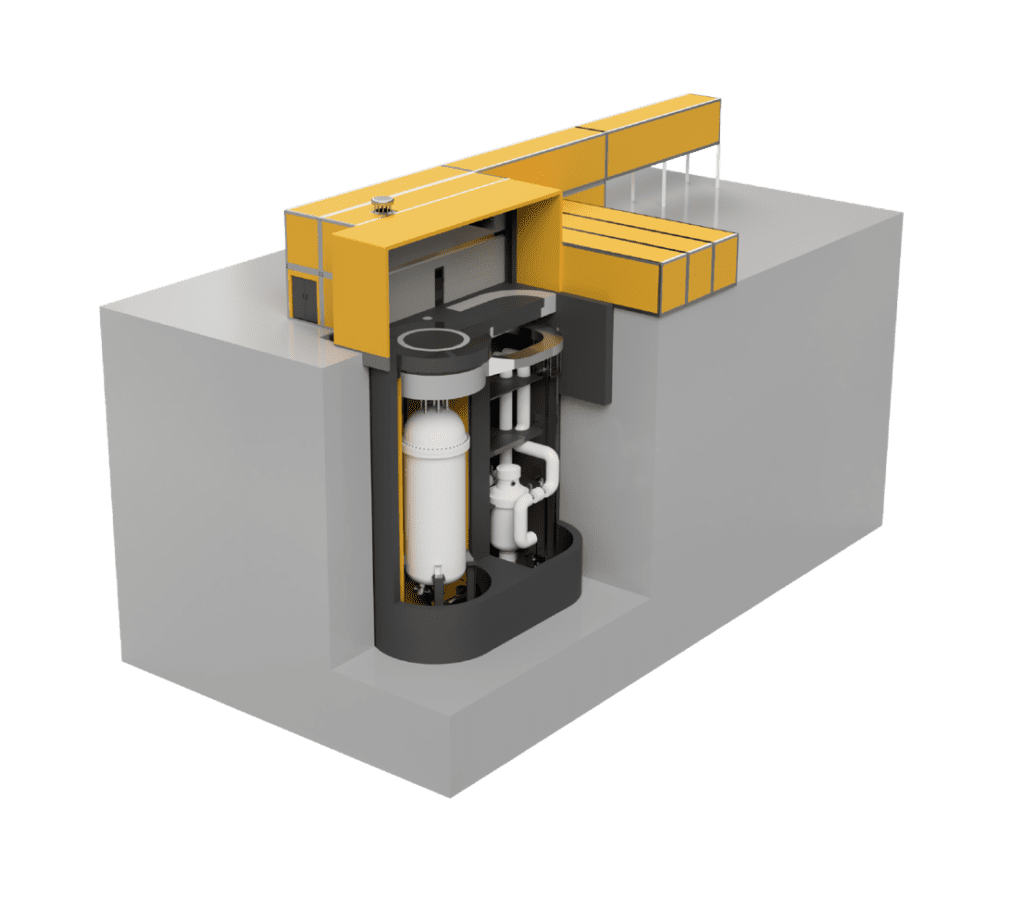
Micro-Modular Reactor (MMR) project partners USNC, GFP and OPG
Concepts discussed
Auto-linked from the episode's notes and transcript.
Show notes
Global First Power (GFP), Ultra Safe Nuclear Corporation (USNC) and Ontario Power Generation (OPG) recently announced that they had formed a joint venture called Global First Power Limited Partnership. That venture will build, own and operate an installation called the Micro Modular Reactor (MMR!™) at the Chalk River Laboratories site.
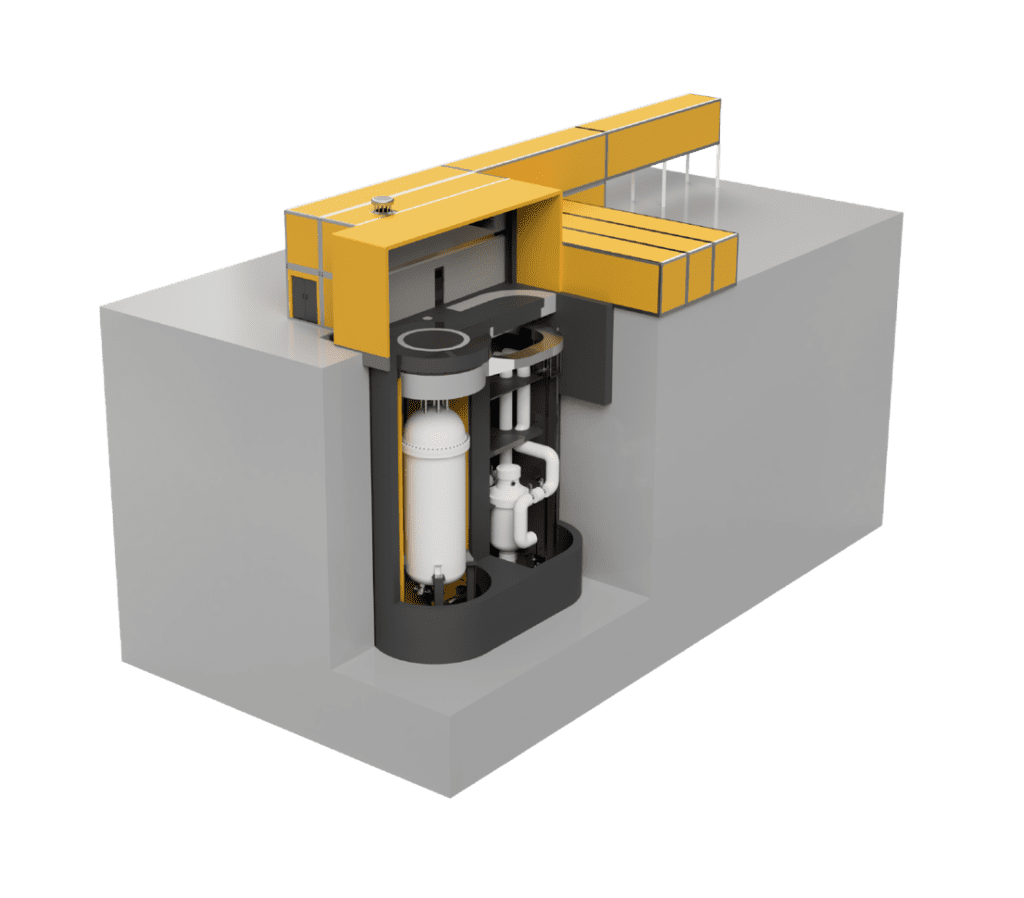
_MMR!™ nuclear plant_
Mark Mitchell and Eric MGoey joined as guests on Atomic Show #278 to provide depth and background information about the technology and the project that was not included in the press release.
Mark is USNC’s director for the MMR project. Eric wears two hats, one at GFP and one at OPG. For GFP, he is the director of outreach and communications. For OPG, he is the director of remote power generation.
We talked about the project’s genesis and the joint venture’s mission of proving through doing that the system design can be licensed, manufactured, assembled and operated in a cost-competitive way.
Eric provided a brief overview about OPG. He explained that it is committed to providing clean, reliable power both to grid-connected customers and to customers in areas that are not connected to the grid. He described how OPG has a current charter to serve markets throughout Canada and into the United States, and how it hopes that the MMR project will open new markets to the company.
For this first of a kind project, the MMR is a 15 MWth, 5 MWe power system with essentially two main plants. The nuclear plant is a helium-cooled, fission reactor-heated system that circulates helium through a heat exchanger. The adjacent plant is a conventional steam plant that circulates water through a heat exchanger/boiler and a steam turbine/condenser.
Between the two plants is a molten salt heat storage system that acts to buffer heat supply and steam demand. It gets heated by helium that has passed through the reactor. Hot molten salt transfers heat to boil water, creating high pressure steam to turn the turbine.
This arrangement allows the supplied grid to rapidly respond to load changes while enabling operators and control systems to vary reactor power output in a more gradual and efficient manner.
The reactor heat source differs from other high temperature gas reactors. It uses the same Triso coated particle fuel often chosen for gas cooled reactors and some molten salt cooled systems. Instead of using a random graphite matrix material to produce fuel elements from Triso particles the MMR uses USNC’s patented Fully Ceramic Microencapsulated (FCM) fuel.
That innovation replaces random graphite with densely packed silicon carbide (SiC) as the matrix used to produce fuel elements. According to corporate literature on this feature, FCM fuels can retain fission products without failures at temperatures approaching 2000 C.
MMRs are designed to operate for 20 years between fuel system replacements.
While we talked a bit about the technological specifics, most of my conversation with Mark and Eric revolved around business considerations, the importance of developing manufacturing competence, the importance of effective cost controls and the importance of transparent engagement with regulators and potential customers.
Your participation in the comment thread is always welcome. If questions arise that need more details, I will seek assistance from the show guests.
I hope you enjoy listening.
Transcript
Read transcript
There's a way, a way such a better way today, today. The major boys tell the world there's a better way, today there's a better way. There's a way to try that, and it's time for a Timexshow number 278. Yes, these Timex shows are coming almost regularly these days. Guess it helps to have not only myself but all of my guests working from home. Today I have a show planned to give you more information about what maybe the world's leading very small reactor project. There's a lot of people like to claim that title, but this is a combination of ultra safe nuclear corporation, U.S. NC, and Ontario Power Generation, which has a joint venture called Global First Power. Today I have with me Mark Mitchell, who is the head of the NMR project for U.S. NC, and Eric Magoey, who is the Director of Communications and Engagement for Global First Power. He also wears a second hat for Ontario Power Generation as the Director for Remote Power Generation. And of course, a very small reactor is well suited for remote applications. Welcome to you both. Thanks very much, Mark. Thank you very much, Rod. I try to make sure that each guest introduces themselves and speaks a little bit, so as people listen, they can tell who's talking. Now we'd have to introduce yourself every time. All right, Mark, tell us about the NMR project and how it's progressing with the development of the first of a kind project in Canada. Thank you, Rod. Since he has been developing the Micro-Moggillary Actor, or MMR since 2014, that was when we were approached by our then partners in Canada to look at using our unique proprietary, fully ceramic micro encapsulated fuel as part of a design for a nuclear reactor that could provide power to remote mines and settlements in Northern Canada. We've been very successful in this development because we've been focused very much on a niche market. The Micro-Moggillary Actor is tailored for remote power and mines. At this point, we experience an audio hiccup. You'll hear Eric taking over. OPG, of course, has been in the nuclear business for over 40 years. And we've been primarily focused on grid generation. In fact, that's been our bread and butter for some decades now. We produce about half of the electricity in the province of Ontario, which is Canada's largest province. And about 60% of that power comes from nuclear. That's true at both the provincial level in terms of the overall provincial supply and also in terms of OPGs on production. We are diversified in addition to our large nuclear plants at Pickering and Darlington. We also have 66 hydroelectric facilities across the province. We have a number of gas plants. We have a thermal plant that used to be a coal plant that we converted to biomass, wood waste, in Northwestern Ontario. And we also have a solar installation, a Southwestern. So in recent years, OPG has been looking at growing our business diversifying and really turning our mines to what the next generation of nuclear is. And when we look at that, we really see three distinct opportunities for streams, as we call it. So stream one to us is on grid nuclear technology. It includes SMRs. It could be ready to get going and produce power before 23rd. Then we see another generation of advanced reactors that we call stream two, which were probably not realistically going to be in service until probably the mid-20s. So really interesting stuff happening there. We have lots of promise, but nothing that we think would be ready this decade. And then stream three, which is where the MMR project at Chalk River Fitson is about off-grid generation. So Canada, of course, is a vast country. And although much of it is very well served by provincial transmission grids in the southern portion of the province of the cross country. And once you get to the far north, not just the Arctic, not just the territories, but even the far north of Ontario, for example, doesn't have a transmission grid that covers all of the community. So there are many remote First Nations or indigenous communities and also a number of remote mines. So when USNC came to us to talk about partnering with global First Power on this demonstration project at Chalk River, it was really interesting for the company because we could see a clear alignment between USNC's technology and vision for deployment of off-grid SMRs and our own experience dealing with the regulator and doing community engagement, project management, and indigenous engagement, environmental assessments and so on. So it really was a good fit and it's great to be formally partnered and moving ahead on this project. So Mark, tell us a little bit more about the specific technologies that make your MMR well suited for off-grid applications. Sure, the MMR is an interesting mix of conservative design and innovation, which enables us to do this. We have very deliberately tried to keep the design as simple as possible to make it easy to firstly to license and deploy, but also to field and support in remote application. The MMR is based on USNC's proprietary FCM field, which we believe in this application especially will bring unparalleled and previously unimagined levels of efficient product retention to a nuclear reactor and basically mean that these facilities are both inherently and intrinsically safe. And these are packaged in a high temperature gas pool reactor for gas pool reactor probably because it doesn't operate at particularly high temperature. And this reactor configuration is enveloped by the two operating high temperature gas pool reactors in the world today. And by combining these these factors we get to a very small modular reactor that is extremely easy to deploy and to support. And we believe will be very much acceptable for both to the communities we're deploying in the nearby and the regulator. And the basic technical specs of a single unit is about a power output of about 15 megawatts thermal, which translates to about five megawatts electrical. And the idea is that these units would be deployed singly or in groups of say 1 to 10 and this would cover probably 80 to 90% of the sizes of applications inside this market we're focusing. So I know there's a method of separating the primary nuclear heated portion of the system with the power generation steam plant using molten salts. Can you describe that separation a little bit? I'd love to really there are only two innovations in our design in terms of the big I innovations of changes to who what's common in the UK today. The FCM fuel as I mentioned in the second is using a molten salt intermediate heat transfer and storage. And that is actually we believe an incredibly powerful innovation. It brings a lot of benefit some of the benefit are the separation of the nuclear plant that is the nuclear reactor and helium that cools of the transfers need to the molten salt from the application. And that means that with a standard license unit we could serve many different applications and that's because the molten salt the transport and storage. And so we could be told whatever is happening at the application from the reactor. The reactor doesn't have to know about the application. We have generating electricity with steam or just providing the street heat or processing. And you know with the storage there's a buffer. So if we happen to switch the application off or change the load the reactor carry on. And basically this simplifies and eliminates a lot of the questions about designing reactors to operate in the sort of dynamic environment that is inherent to a micro grid. And when you're on a micro grid and you're the only generator you have to absolutely match the load continuously second mistake. And that's essentially the most important flexible generating factor. You know that really drives on design for flexible electricity generation. That point out is that a lot of these settlements and mines have also got renewables deployed and that means that we would be acting in concert with renewables that are operating on the market here as well and be able to address to ensure that the user gets effectively utility quality power at the sort of best possible price. And while the nuclear plant is basically making sure it plays a sample. Do you have a large amount of storage to the point where you could say have a reactor be secured for some maintenance for a period of time while still providing power? Not actually. You know normally you would talk of storage in terms of hours of storage at rated load practically achieving very large storage ratings is prohibitive. So what I mean by that is typically a large concentrating solar power plant would operate with enough storage to make it through the night at the nominal generation or the main fate bed. And that is already a very large amount of storage that you would have to face large amounts of salt thanks and fight a lot of complication. He would typically not choose to do that. We can follow other approaches to ensure that there's reliable power up for if we take down a reactor for for an off edge which are a lot more economic and center. Okay, and if your load trips off your reactor can adjust to that loss of load and throttle back to some sort of steady state power. Absolutely. So in the scenario where you're load trip though you would have the option to keep running if you have four hours of storage for instance you could keep the reactor running potentially at full power if that's what it was operating at for four hours and if it was operating at least and full power side 50% how you could keep operating for eight hours. That's really very beneficial because what it means is any operator working with the reactor will essentially have a lot of time to be able to deal with things. that are happening far away from the reactor without needing to pay specific attention to the reactor. Realistically, we imagine in a scenario like that, you would throttle the reactor back effectively and you would probably run for a significant amount of time. Probably enough, especially if it was a spurious trip, to be able to bring the adjacent launch as we call it, back online and to get generating the game. So Errant, your company is a specialist in dealing with the Canadian regulator, or at least has a lot of experience in that. How is your process going right now for the first of a kind unit? In Canada, there are three regulatory licenses that have to be sought and received from the Canadian Nuclear Safety Commission. So the first license and that's the one that we're in the process of right now is the license to prepare the site. Then you can move on to a license to construct an ultimately a license to operate. Now interestingly enough, although those are three separate licenses, the environmental assessment process covers the entire life of the project right up to the decommission. So we're simultaneously in the licensing process for the first of the three licenses, the license to prepare the site, but also doing an environmental assessment that covers everything. So our public engagement is really a blend of talking about introducing people to the project, talking about what we're trying to do right now, what the short term plan is, but also really making sure that people understand the picture, which after all isn't just about establishing a single reactor at Chalk River. Instead, of course, it's a demonstration project. And really what we're trying to prove is the commercial viability of using an SMR as an alternative diesel generation. That's a high bar to clear. It's really cheap to burn diesel. And so that's a significant challenge for us to demonstrate a commercial model that can be competitive. What we're optimistic for a number of reasons though. What is that our design is built to run for 20 years on one load of people. That allows you to give some price to customers over a 20 year lifespan. Whereas you can't buy diesel futures and lock in your price of diesel 15 years from now, which you could do that if you were using an SMR. It also simplifies the logistics. You're not having to ship and move millions of leaders of diesel over the lifespan of a combined community, for example. And so we're pretty excited about not just telling this story of this specific project to the folks in the Chalk River Valley area, the Ottawa Valley area for a neat, but rather to talk about the potential for the deployment of SMRs across Canada and ultimately makes the expert market. Because of the nature of the communities where your deployment will eventually be, are you involving indigenous representatives first nations and getting them interested or excited about the potential for having nuclear in their community? Yeah, well that's definitely the vision. I would say a couple of things there. One is that Ontario Power Generation has had a lot of success with our non-nuclear fleet. In the last decade, every single Greenfield project that we've built has been an equity partnership with local indigenous communities. So we've done three hydro projects like that, one in Northwestern Ontario, two in the Northeast, and also a solar project, most recently. And that track record of real indigenous partnership and equity ownership is a really interesting one to try to bring to the nuclear side of the country. And so I think that's our vision. That being said, we have to be honest about the track record of engagement within our industry. And the fact that indigenous communities have not been able to benefit quite the same way that municipalities, for example, have with a big large plant that they can get property taxes on and a lot of highly compensated employees with good union jobs. We haven't had that kind of impact on indigenous communities. Certainly not an Ontario. There are some encouraging success stories. If you look at the Denny communities of northern Saskatchewan, for example, that have done quite a lot of business in the supply and services sector related to uranium mining. And have used that to branch off into more involvement in the nuclear sector more broadly. So there are definitely some success stories. But the average indigenous community is not the milieu with nuclear in Canada. And so we've got a lot of listening to do to really understand communities and their aspirations and their concerns. And so we're doing that locally in the Ottawa Valley region or the chakra project specifically. But I think we also understand that there is a broader pan-Canadian story to tell and engagement to be done. And we're still thinking our way through the best way to do that. So more, you've described the fact that you've used a fully and cap, fully micro encapsulated fuel. And then also mentioned that your reactor operates at a rather modest temperature among high-temperature reactors. I think it's somewhere in the 650-degree sea range. That's the result of the temperature limitations of the salt that you're using. What kind of margin do you have between where you're operating and what the failure point of your fuel would be? I think we are still completing scientific studies to understand the real failure point of the fully ceramic micro encapsulated fuel. So this fuel is based on tricer fuel, which is quite commonly known. And tricer fuel being understood after this and answer for that already. We expect the FCM process to improve the failure tolerance of tricer fuel. But typically, a tricer fuel would start to see meaningful numbers of failures at about 1800-degree Celsius. And failures are the minimus or an acceptable low rate at temperatures of up to about 1600-degree cells. What's interesting in gas-quality after safety as well is that when looking at situations where you put your fault of cooling to the floor and rely only on passive-condaction, convection and radiation to take the heat up, the situation is normally that the fuel temperature immediately after you stop the force-pealing starts to increase. And a lot of the safety design on passive gas-portrait is about finding the peak temperature, which may take days or weeks to reach and comparing it to a lot of about 1600. And that way you can say, well, there's no fuel failure expected or additional fuel failure to be heating up. In an MMR it's completely different. In reality, in an MMR at the power levels we're talking about for full-river, the fuel is hottest when it's operating. And the moment we stop operating and we remove cooling or shut the reactant down, the temperature of the fuel only decreases. And that gives us exceptionally large margins. So we're looking at margins of 40 or 50% on the 1600, which is really pretty convincing. And I think that is a very convincing part of the safety argument. So in your safety argument, it seems to me that you might not have very many components that are critical to ensuring this kind of physical performance. Is that correct? Absolutely. I think we look at it from a safety philosophy approach where we put a lot of effort and quality into the fuel and the fuel is comparatively per giga-jou energy content, more expensive than the fuel used in a light-water reactor for instance today. And but it enables a lot of all-state. So in initial discussions with the CNSC, we've put forward a case and I think this is something that's been verified by the talker of the project. Well, that we have no dedicated safety systems on this one. And by that I mean in the Canadian context, because that term, that phrase is used slightly differently, but no system that exists solely for the purpose of assuring safety. And that's a big potential improvement to the approach to reactor economics that a lot of other reactors follow. They will of course be the systems and structures that are important to safety, but probably there are more structures than systems. And that's just going to, you know, knowing the state of the core at all times. Sounds pretty good. Have you done some cost analysis and either one of you or both of you can answer this. I understand first of a kind is a challenge, but what are your end-to-be kind goals? Rod from our side, these reactors are not going to work last today as reactors. They are designed to be fully factory manufactured and tested and then transported a site and integrated on the site, or basically installed. And that is actually very interesting because what it means is that the breakdown in cost for this reactor is very much in line with a renewables project today where 70 or 80% of the cost, the capital cost is effectively in the equipment that's both to site and the on-site construction cost is pretty low, say 20%. And what's exciting about that is when you've got 70% of the value of what you're doing being built in the shop and the factory, that provides a very powerful way to apply learning to improve the production of the product process. Today we think we're, and when I say we think I should say that one of the objectives of the truck with a project from our perspective in terms of demonstration is demonstrating our construction methods and the economics of it. So today we expect that the total cost will result in of a fully fuel reactor, which is often costs that are 30% or more in this expense of the diesel and would come pay very very much to the cost of renewables about things. But more than that we expect that the trajectory as we scale out from the poi more of these reactors and learn lessons and get better at holding them more reliably to higher quality and cheaper will basically result in a cost profile of the trajectory that looks a lot like what you see in the various renewable technologies today. Eric, can you thoughts on this particular topic? I'm coming out from a, I guess a bit of a more skeptical egg. because I've heard a whole bunch of different vendors make pretty ambitious claims about cost. And what I found, looking back when I first started to get my toe into this side of the business a few years ago, is I didn't find many of those projections terribly helpful because if you said great, I'd like to buy one when we'll be ready and how what much will it cost, you were always greeted with silence at the other end of the line. So the way I look at this is this project is about answering all of those questions. If we come in and a commercial model, despite everything working well and technology functioning as promised and at the end of the day we realized that we're going to come in at 10 times the cost of diesel. Well that's just not going to work. But there's no way to know how we can actually land that with certainty and sign contracts that won't be either impossible for us to deliver on or bankrupt the company if we don't do this work. So it's really about answering those financial questions with certainty that I think is the value proposition of this project itself. Nice. Yeah. And I assume Ericsson's OPG is an owner operator of nuclear plants that somehow the consortium or the joint venture of global first power will be an owner operator. Is that a good guess? Yes, I think so. Absolutely. We feel really strongly, I think it's true. Across the partners, there's no light between Mark and I or anybody else in the project team. We want to make sure that this initial reactor we're building at Chalk River is the first of many. And that in the decade to come we would love to see a number of I would say a dozen is reasonable to think that you'd be able to get to within the first decade after we got first power at Chalk River. And hopefully you could get significantly more traction once I think the first sales are really going to come from mining companies. That's a natural alignment when you look at the average life of buying and the ability to run for 20 years on a single load of fuel. There's a lot of synergies with mining projects, particularly given that most of the mineral deposits that are close to infrastructure, transportation infrastructure, electrical infrastructure in Canada have already been exploited. So when you're finding new promising mineral finds, they're often in the middle of nowhere where you don't have any infrastructure at all, maybe some fly-in communities nearby. And so that's where we think there's a lot of potential. But after you get those initial customers from I think the mining community, I think it's really interesting to think about how communities might start thinking about wanting to power themselves, not just their industrial applications, but our remote communities with SMRs. And so that would open up another whole category of potential sales for this technology and is quite exciting. As a demonstration project, will the first plant at Chalk River have a vision, maybe after a little bit of testing and demonstration for your own say, will you be training operators and training maintainers and people who might be used in the expansion process? Yes, absolutely. And that's part of the vision is to build a project team and and the skill sets within GFC so that we can immediately pivot from the demonstration to the commercialization and deployment. And that's the kind of thing that makes sense to start thinking of early on. So even now, years before we anticipate having first power at the site, we're having business development type conversations with industry partners and really trying to make sure we understand their needs so that we can move quickly to deploy and have the people in the skills to do that. Do you have a goal at this point for when the first power will come out of global first power? Yeah, Mark is welcome to correct me on this, but I think we've got ambitious internal goals for the mid-2020s that we think are achievable as a project team. That being said, one of the big factors here on time is the regulatory and licensing process. You can't assume that the CNSC is going to be happy with your first draft and assume that the environmental assessment is going to be really streamlined and convincing the first time around. And so we're trying to make sure that we are listening carefully to what the regulators' expectations are and to what communities' expectations are to make sure that we can put forward the most credible case for this project and for the licenses and environmental assessment. So we're optimistic that we can do that, but we recognize that that's probably the most significant risk to schedule the way. Does that make sense, Mark? Absolutely. I think that as you said, the biggest risk comes from things we cannot control. And we know a lot about how to design it, how to make it. But what we don't know a lot about is how to license it. This is an unusual thing. We're probably the first commercial fourth generation reactor to go through this process in the world. In Canada, it's been quite a while since a new reactor construction was licensed. Perhaps a global phenomenon or at least a Western world phenomenon. And I think that there's a lot of consideration that we need to give to the process of getting buy-in, public acceptance, which is a very high bar in Canada. And we're not rushing it. But we're also not going to solve it from on a whiteboard or in a boardroom. We have to get out there and actually go through the process and learn from. My final question for you is, are you yet considering licensing your system in other locations? Are you going to go straight with Canadian license first and then maybe start somewhere else? So from US and C's perspective, the Canadian project is the one project we have in the field of climate. And we're a startup and we're pretty lean. And so we don't have resources assigned to be able to successfully license in other jurisdictions. So I guess our current focus and this may change over time, but our current focus is on the success in the Canadian project. And I would say that we may add to that, but I think we're pretty much pretty committed to success in the Canadian project. Yes. And I would say the same thing from OPG's perspective, we have a mandate to be competitive and do business across Canada and in the United States. We as a company do not currently have an international mandate that goes beyond Canada and the US. But certainly this is one of the projects that I think could take us to new jurisdictions. When you look at the global market for SMRs, it seems pretty clear that Russia and China have their own technologies, their own markets, and they're going to do their own thing. We probably aren't going to play in their spaces. But the rest of the world, I think, is essentially up for grabs and could be quite interested in technologies like this. And so once we, I think, prove this technology and the commercial model in the Canadian market, they'll be some really exciting opportunities that we'll develop from that. Okay. I'm going to give each of you a chance to say whatever you think you need to say, has it been stimulated by one of my astute questions? So I think what I would say is that we are extremely excited by this progress, Canada. And we think it's indicative of a long path that we've worked on microreactors and in partnership for cooperation with OPG. We're extremely excited that we think this will lead to the first microreactored avoid on a commercial basis. And I think we're kind of excited because we think it is a great prospect in terms of improving not just only deploying nuclear in a way that hasn't been deployed, but improving the lifestyle and economic position of many people in these remote communities and around remote industrial, remote industries and mines over the future. I guess the lens through which I look at this is, you know, I don't come from a nuclear background. I've worked, I've only been on this project for less than 18 months. But what has me really excited about this project is really climate change feels like the collective action challenge of our generation of our times. And to really move the needle on carbon and on climate change, we're going to need to do an enormous number of things simultaneously. We're going to have to electrify, you know, large parts of the economy that currently aren't electrified, putting transportation and building sectors. And we're going to have to significantly reduce our dependence on fossil fuels, not just for electricity generation, but definitely in electricity generation. And when you look across Canada, you can see that there are jurisdictions that can easily do that using hydropower alone. You've got British Columbia, Quebec, Newfoundland, Labrador, Manitoba. They're unlikely to need nuclear to hit their climate change and carbon emission pools. But the other jurisdictions are likely going to have to follow on tearoes, when Ontario phased out coal, which we did entirely by 2014. We did that by leaning really hard on nuclear. And that looks like the best path forward when you consider the limitations around the variable nature or intermittent nature of renewables like solar and wind. And so if we can make a good case for nuclear to be that base load reliable steady power supply for jurisdictions that aren't rich in hydro resources, we'll do a lot to fundamentally change the Canadian story about on climate change. One of the things that OPG is most proud of is our whole phase out is remains the continents single largest climate change action. And that's a legacy that we want to build on and projects like this are the way to get there. Those are both terrific final words. So thank you both very much for your time. I wish you the best of luck and keep charging forward. Thanks so much, Rod. Yeah, thank you, Rod. today there's a better way.