Liz Muller, Deep Isolation
Concepts discussed
Auto-linked from the episode's notes and transcript.
Show notes

_Liz Muller, co-founder and CEO, Deep Isolation_
Liz Muller is a co-founder and the CEO of Deep Isolation, a company that makes the modest claim of having invented a solution to nuclear waste.
The politically unsolved waste issue has plagued nuclear energy development since the mid 1970s. That was when it became abundantly clear that the original plan to recycle used fuel wasn’t going to be easily achieved.
During the intervening half century, it’s accurate to declare that there has been essentially no measurable progress made. Steps have been taken to move forward, but just as many steps have been taken in the opposite direction.
Until recently.
Inspired to think differently
The bright idea that forms the basis for Deep Isolation came to Richard Muller when he heard that there was interest in using boreholes as a way to achieve geologic storage. That is the solution path that most responsible scientific organizations have recommended.
In lingo common among my former shipmates, Muller experienced a BFO – blinding flash of the obvious.
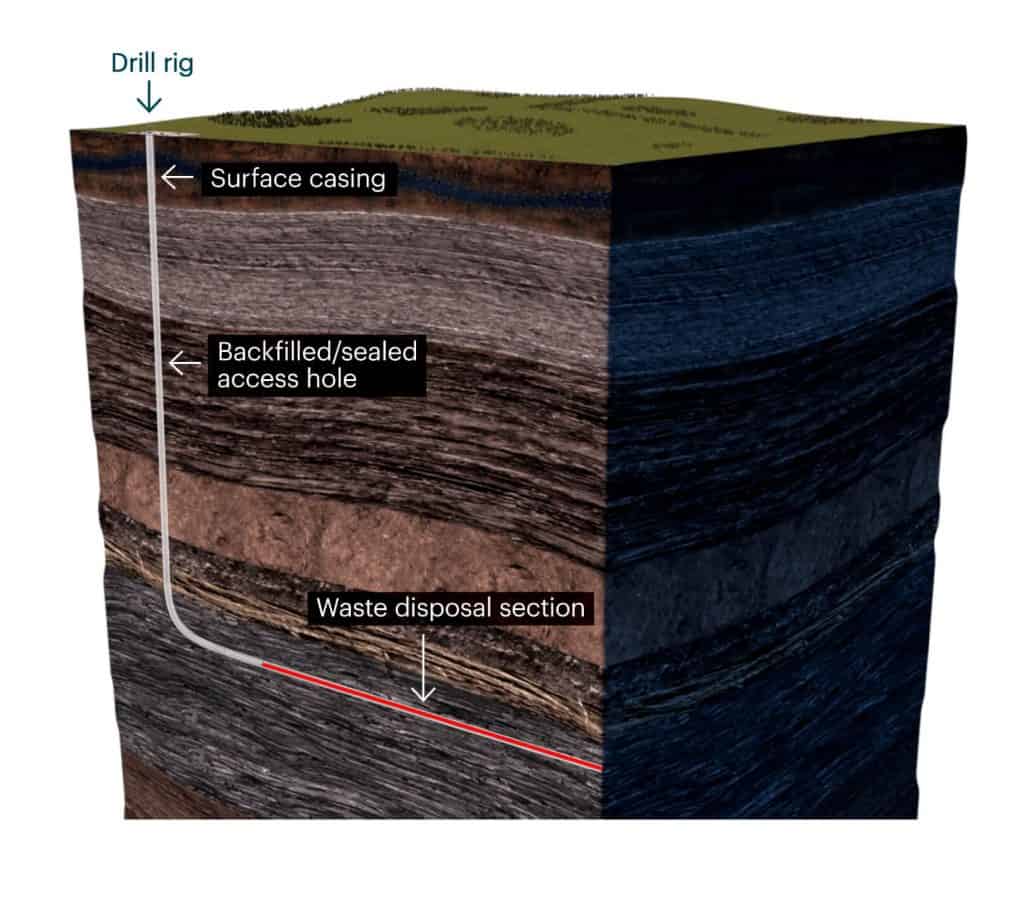
But soon Muller realized that the people who had restarted the discussion about boreholes, a rather old idea for nuclear waste disposal, weren’t planning to use horizontal drilling. Instead they were thinking of very deep vertical holes.
He had initially thought they were taking the obvious – to him – step of capitalizing on the refined technology used in almost all state-of-the- art oil and gas wells in the United States.
Though he had not previously considered how boreholes might help solve the nuclear waste issue, he recognized that horizontal laterals mitigated most of the challenges that plagued vertical holes.
Partnering with a specialist in community engagement
Once Richard Muller had been inspired to think of using horizontal drilling to address nuclear waste disposal, he turned to Liz Muller, who was a specialist in environmental issues and related community engagement.
After several months of focused technical evaluation efforts, the pair realized that their concept had sufficient merit and patentable intellectual property to turn it into a company.
Deep Isolation believes that its solution is not only technically sound, but it is uniquely well-suited to deployment. It’s a modular, local or regional solution to an often contentious problem that is gains political complexity when handled on a national level.
From a project management point of view, boreholes can reduce costs, risks, and schedules compared to a centrally sited repository. From a community point of view, they can address issues of equity, proof of safety, and community benefits.
Acceptance building rapidly
Like all newly formed companies with a great idea, Deep Isolation realized there was no direct linkage between having a uniquely valuable idea and achieving success in implementing that idea.
During the past year, however, the company has been successfully attracting a talented team, building an impressive roster of advisors, obtaining $14 million in seed capital and attracting solid partners in the form of Bechtel and NAC International.
Liz Muller joined me on the day after the 50th Anniversary of Earth Day to describe the company that she and Richard have co-founded. She explained the technology, spoke about the continuing efforts to engage with communities and Deep Isolation’s approach to meeting customer needs.
She told me a bit about the company’s finances and provided a direct point of contact to her for people who listened to the Atomic Show. To protect her from spammers, I won’t include that information here, but it’s in the audio.
I hope you enjoy the show. As always, feedback is welcome.
I’d also like to encourage Atomic Insights listeners, especially those who love to get into technical details, to take Ms. Muller up on her request for comments and feedback about their recently released safety calculations.
Here’s a link to a video that illustrates Deep Isolation’s technology.
Transcript
Read transcript
There's a way, a way such a better way today, today. The nation flies till the world, there's a better way, today, there's a better way. This is Rod Adams and it's time for another Atomic Show with me today. I have Liz Mueller, co-founder of Deep Isolation, which is a company that is aiming to solve the nuclear waste issue. Welcome, Liz. Thank you so much, Rod. I'm happy to be here. So Liz, let's start off with just a little background. Tell me a little bit about how deep isolation came into being. I know you're a relatively young company, maybe a couple of years. And you're talking about solving something that has stymied thousands of people for decades. How are you going to do it? Yeah, it's a good question. And I think it was actually helpful in that we were coming from outside of the industry. I think people who have been in nuclear waste for decades believe that nothing ever happens in this space. When we came in, we were warned again and again that this is a very depressing business to be in. And nothing really ever happens. And I think because we were outsiders, we didn't necessarily believe that that was true. We got into this. And my background is much more in the environmental space. So I was running a nonprofit for a clear earth and had been deeply involved in that, looking at big environmental problems, global warming, air pollution. We were aware of the nuclear waste problem, but it wasn't clear that there was anything we could do to help solve the problem. And until we first heard about the borehole solution for nuclear waste. And we did have a bit of experience working with drilling, directional drilling in particular. So hearing that my co-founder had an immediate vision of course, you put it in deep horizontal boreholes. And it turns out that that's not what we were hearing about. You're hearing about the vertical borehole program. But it seems like there's many advantages of going horizontally that aren't that aren't as easy when you're looking at vertical boreholes. So that was the reason we created deep isolation. With vertical boreholes, you have to drill a hole for each place. And the other way to get more stuff in the hole is to go deeper and deeper. Horizontal drilling though seems a little different. What a seed advantage of horizontal drilling over vertical in this application. Yeah, so I think the space is a real point. And to be totally clear, I think that vertical boreholes would work too for many applications. But horizontal means you don't have to go as deep to have more space. And that means that you don't have to get into where the rock has very high pressure, where there's very significant heat loads. And you can get deep enough that you are in layers of rock that have been and will be isolated from the surface for millions of years. But you avoid the pressure issue. The other thing that's come out more recently in some of the safety calculations that we've done is the fact that there is no direct path to the surface through the vertical shaft. So when you're looking at a purely vertical borehole, you have to be very careful about possible migration upwards through the vertical shaft. When you're looking at horizontal, then there is no direct path. The waste is not in the vertical portion. It's somewhat along the way of the horizontal section. And so if it migrates up in the rock, there's no shaft for it to migrate through. One of the things that the oil and gas drilling revolution that we've had in the last 15 or 20 years, as shown is that horizontal drilling allows you to go from the same vertical hole and drilling a number of different directions of these multiple laterals, allowing one hole to act. One hole to access a much larger geologic area. Is that part of what your technique will do? So we're thinking more about having separate holes. So each hole would have one horizontal section. And the reason for that is primarily because of the retrievability requirement. You can retrieve things potentially from multiple directions as well, but it is significantly more challenging. So if you really want to have security in the ability to retrieve something, it is significantly better to have just one single horizontal section per hole. Interestingly, I mean, the drilling an additional hole and a drill hole near the first one does not add significant expense. So there's not really a strong reason to have one vertical with multiple directions as opposed to just doing separate holes. Well, one of the questions that reason I asked that is, as I understood some of the documents I read in your site, a horizontal would be able to hold roughly five years worth of waste for a BWR or 11 or 12 years worth of waste for a PWR. So say it's a boiling water reactor. You might need 20 horizontals to store the waste of a long live nuclear plant. Yeah, that's correct. So we're typically looking at somewhere in the range of 10 holes per nuclear plant. And that'll vary somewhat based on the length of the horizontal section and the specifics of the waste. But that's something that can be done and the footprint of that is not particularly large. So we think in most cases we would be able to do this within the perimeter of an existing site. So that's one of the things that's intriguing to me about your solution is that it doesn't require everybody to transport their waste hundreds to thousands of miles to some central repository. The waste could be permanently stored either on or very near the site where it's generated. Yeah, I think that's one because deep isolation has a modular system. We have significantly more flexibility in terms of how it's deployed. So if a particular community is open to the idea of taking the waste that's there right now and putting it into deep isolation at that site, that's something that we probably could do. We'd have to make sure that the geology is adequate. But in the cases that we've looked at so far, there's a good chance that it would be. This means that you're no longer requiring one site or one community or one state to be the, excuse the term, but the dumping ground for the whole country. Instead, what you're what you're asking is for for people to look at what is best for their own community. And in cases where they may not have the option of just getting it out of their community, which is something that some people are still insisting on. Then you can look at a solution that is more home grown that is closer to where it is right now. Well, one of the equity issues that has always come up with the central repository in Nevada is people could legitimately say wait a minute. You want us to store all the waste, but we haven't even operated nuclear plants here. We've never had any benefit from this waste. Why should we be the repository? Whereas if you store it close to where it's been generated, the people they have, or in some cases, many decades, been receiving the benefit of operating a nuclear power plant. The equity issue is a real one. I think that we are allowing more flexibility for the disposal of nuclear waste. I think it's important to be careful about how we talk about the benefit of nuclear power for specific communities because it varies. But that's what we're seeing. And as we're out there talking to communities, we've seen that there is a variety of feelings about both the plants and closed plants in some cases and the waste that is still there in most instances across the country. There's a, I can't remember her name right up my head, but there's a pollster who has spent the last 25 30 years doing surveys of receptiveness for nuclear power around the country. The things that her surveys consistently show is the closest closer you get to nuclear power generating facilities, the better the community support is does that make it potentially easier for your community engagement team to talk to the people locally and help them understand what it is you're trying to do. One thing that is pretty clear is that the closer you are to the nuclear plant, the more people tend to be informed about nuclear power and nuclear waste. It's not always true. There have definitely been places where you can't see the nuclear waste from the nearby town and people. Many people may not even really appreciate that that it's there. But yeah, I think generally speaking, when you have people who have been working at the nuclear power plant who are familiar with the issues. It's a very different conversation from when you're starting from scratch with a place that has no nuclear power, no nuclear power and isn't familiar with the issues. I'm going to ask a question and I know the answer to but I'm pretty sure some of our listeners don't know why is it you can store more. Years worth of PWR fuel in a horizontal than you can be WR fuel are PWR is that much more efficient. It's just the size of the waste. So different sized fuel assemblies means that you assuming you're still putting in one fuel assembly per canister than they take up more space. That's the simple answer. Yeah, PWR fuel can fuel assemblies have a smaller number of rods in them. They're usually maybe a seven by seven or nine by nine, whereas a PWR is a 17 by 17. So a PWR fuel assembly is larger in diameter. So it requires a slightly larger diameter canister and maybe even a larger diameter hole. Is that correct? Yeah, so we're not necessarily looking at different diameter holes. We're potentially looking at putting them both into the same size hole just because designing a canister is complicated enough that we may not want two different sizes. This is something that we're still thinking about. What it does definitely mean is that unless you want to do repackaging, you're not gonna be, you're gonna be using, you're gonna be using fewer holes for the larger diameter waste forms. Now it seems to me that I looked at your team, you're almost evenly split right now between engineer slash scientists and community engagement specialists. Can you talk a little bit more about debt strategy? Yeah, I mean, if you look at why nuclear waste projects have failed in the past, the reasons are not primarily technical. I think that nuclear waste is, it's a controversial prospect. People aren't comfortable necessarily with just the technology. You need to understand mindsets and how people think about these problems. And you look at some of the failures for nuclear waste demonstration programs in the United States. Again, not failing because of technical reasons, but because of core communication and not building in the needs of the people that you're working with in local communities. We've taken that very seriously. So deep isolation, maybe the first six to 12 months were exclusively technical due diligence. We didn't want to create a company if we weren't sure that there was a there there. But pretty early on, we started reaching out to environmental groups and doing a lot of listening. So this was before we even had a concrete plan for anything that we might do in the US or internationally. And we wanted to understand, what are the concerns of communities that currently have nuclear waste in their backyard? What are the concerns of environmental groups who may have protested other efforts for nuclear waste disposal in the past? And we've been talking to these groups very regularly now for years and it is informed what we're trying to do. This is something that we're gonna have to continue to do. So this is not a tick box. We talked to environmental groups and communities. We now move on. This is a fundamental part of who we are as a company and something that we expect to continue to staff for and to prioritize for the entire lifetime of our company. Who are your partners in this endeavor? I know you guys are a brand new startup company. You've got maybe a few dozen people involved when you include your advisors. Who's gonna do the heavy lifting? Yeah, so we've recently partnered with both Bechtel and NAC and that has greatly extended our capacity. So Bechtel has a lot of heavy lifting ability. They've been working in this space with government clients for many, many years, many, many decades. NAC has capacity when it comes to designing canisters, designing casks, transportation systems. And so we think that really the two partnerships are really important in order to be taken seriously. A startup company going to a government and saying, you trust us to solve your nuclear waste problem, may not be very compelling. But when we have partners like Bechtel and NAC, then all of a sudden, people are able to take us more seriously. Does NAC manufacture, as well as design casks or canisters? That's really a question that we should be asking NAC. My understanding is that they certainly design them. They may manufacture some of it themselves and they may outsource it. I'm not entirely sure. Of course, it's hard to know everything you're partners do. I won't even ask you what Bechtel's capacities are because they just have been doing everything for anybody for years. The very large scale of the problem, even though it's a fairly small amount of material, we have 450 or so nuclear plants operating around the world. And how are you going to expand to be able to solve this problem in a reasonable timeframe? Yeah, the interesting thing is that there isn't a lot of work able solutions out there right now, other than temporary storage. So you look at globally who has been really progressing to solve the nuclear waste problem. Then there's not a lot. I mean, you're looking at the fins and the Swedes. And some other places that have started to make progress, but no country anywhere in the world has actually disposed of high level nuclear waste or spent nuclear fuel. So in some places, you're really starting from scratch in terms of what the solution might be. We're talking with many governments already. We, and those conversations are going well. I mean, we're doing work now with governments. And I think that there is an appreciation for the sorts of time frames that we can move forward in. Typically, this has been a problem where people talk about 50 years to get something that's actually operational. Because we're using mature technology, so directional drilling has been around for a long time. It's been proven in thousands and thousands of wells around the world. And we're not doing much on that front that is technically different from what's been done before. So the time scales to build a repository are short. And we're talking about months, it's not even years to drill the facility. The licensing will take longer. So we're looking at a couple of years, at least, in order to show that we can demonstrate safety. But because the physical construction costs are so much lower, we think we can really move forward in time frames of three to five years to get our first piece of waste into disposal, which is very different from that of a mind repository and makes it very attractive for some of our international customers. You've helped the listeners understand why it's so much cheaper to drill holes, bore holes, narrow diameter, long lateral holes, than it is to create a mind repository that may have to accommodate human beings below ground. Yeah, so I think you hit on one of the first reasons. The first is there's no humans underground. That significantly reduces the cost and it also improves safety. You don't have to use, but the related issue is because you don't have to have humans underground. You don't have to remove as much rock. So we're looking at removing only as much rock as needs to be removed to put the canister down, deep underground. So the cost is very significantly less expensive than when you have to mine out a very large circumference space with people and trucks and stuff going underground. It seems to me the difference between unmanned space exploration versus manned space exploration. In terms of the reduction of life support, all those other very expensive things when you get humans involved in these unusual environments. Yeah, I think that's a fair comparison. You've mentioned in your materials that this is taking advantage of very well proven, well used technology of horizontal drilling. And horizontal drilling, of course, is also very closely linked to three dimensional seismic evaluation of geology where in the case of oil and gas, they're using that 3D seismic to find places where there is oil and gas. Do you use three-decisement to find places where there isn't oil and gas to where there is suitable rocks? Yeah, so we have a process to start to think through whether a site is suitable before we would actually go out and drill a hole. And we can use typical tools that are available to geologists for this. So there's logging data, there may be seismic data, there may be other sorts of information from wells that may be nearby or maybe some distance out. So this allows us to take a quick look at whether or not a particular site is likely to be suitable for the disposal of nuclear waste before we actually need to start digging. At some point though, if there is serious interest, we will need to drill a hole and to take rock samples from depth. And that's really the best way, the only way to show with a reasonable degree of certainty that the rock formation that we're going to be drilling into has been isolated from the surface for a million years. There's a lot of drilling companies out there. Do you expect that you'll be contracting the actual drilling in some cases? Yeah, I mean, we don't expect to be a drilling company. So like you said, there are lots of drilling companies out there. We've been working closely with one for the development of the detailed plans of what we expect to do. But there are lots of drilling companies that have real expertise in this. So we could work with a number of them. Yeah, speaking on a very topical and timely manner, it seems like there's an awful lot of under employed drilling companies right now. Do you think you can move fast enough to start taking advantage of the large number of rigs that are not even doing anything in the large number of people who are twiddling their thumb somewhere? Yeah, I mean, I think we can move quickly. I think that we can certainly start to work with people who have the right expertise that we need. What we do need right now is a, if we're going to do this in the United States, we need the government support for doing that. We need the customer, if you will. But certainly we are ready to respond to that demand. And we will need drillers and rigs as soon as that happens. You touched on something that's important for people to understand who is your customer or disposal of used nuclear fuel, at least here in the US? Yeah, so it's very clear that for disposal, the customer is the Department of Energy. And there's, that is a sole customer for disposal. There's a little bit more flexibility when you start talking about temporary storage, which is also something that we can do. So we can do temporary storage in the isolation that might at some point then convert to disposal, if and when we are able to do so. But yes, for disposal, it's the Department of Energy. And of course, everybody's been told the Department of Energy is, or at least somewhere in the government, somewhere in the spreadsheet, there's this thing called the Nuclear Waste Fund, which supposedly has a whole bunch of money in it. But of course, it's just numbers on the spreadsheet. How much is available in the Nuclear Waste Fund to pay for permanent disposal of used nuclear fuel? Yeah, I mean, this is where it starts getting really, really complex. So I mean, there is on the order of $40 billion supposedly in the nuclear waste fund. As you said, it's not that easy. It's not like this is a fund that physically exists in a bank account somewhere that can be used. It's also the added complexity is the 1987 nuclear waste policy act and amendments that said that Yucka Mountain is the disposal solution for the United States. So accessing that fund is tricky. Doesn't mean it can't be done, but it's not a straightforward process. So right now, in order to get paid to do this from the Department of Energy, you have to maybe some legislation to get that moving. Is that correct? I mean, disposal in the United States is especially challenging for us. We're looking at disposal internationally. We're looking at interim storage in the US and possibly a bit of a gray zone when it comes to defense waste. There's also advanced reactor fuel. Now, of course, they don't have waste yet, but many companies are trying to be responsible and trying to think about the waste issue upfront before they've actually created the waste. So there are real opportunities in the United States, but if we are going to eventually call it disposal. So if we wanted to do disposal of commercial spent nuclear fuel from existing reactors in the United States, we will eventually need legislative change. And your papers talk about the very special case of about maybe 2000 small containers of waste that's left over from recyced reprocessing of defense materials. Right? There's some caesium and strontium in canister somewhere. Yeah. I mean, the caesium and strontium is one of the forms of waste that is a very small container. So when we did the demonstration about a year ago, we sized the canister for caesium and strontium waste. So that is something that is even easier than spent nuclear fuel in terms of drilling the hole for the appropriate size. So that is something that we've looked at specifically. So for those people who are adamantly opposed to disposal of commercial use nuclear fuel because it still contains 95% of its potential energy, T5-slais, and still has a role to play in a disposal of the materials that may be not usable as fuel. Is that correct? Yeah. That's correct. And even if you did and for some places that have recycled and reused types of fuel, there are still some waste that's left at the end. So we can certainly help with defense waste in addition to spent nuclear fuel and also with the waste that's left over after it's been reused. Yeah. So you've also looked at the porosilicate glass and the, I can't remember the other forms. But there's one in Hanford and ones in Savannah River. Those containers can be put into the kind of containers that can fit in these horizontal boreholes. That's all part of the universe of waste that you've looked at. Is that correct? Yeah. I mean, we're looking at many, many, many different forms of waste. One of the key criteria is the diameter. And the smaller the diameter generally speaking, the easier it is to dispose of it with a debisolation type of method. We are looking at some larger diameter waste forms. But I think it's important to recognize the distinction between small diameter forms that we could probably dispose of in a reasonably straightforward way without a lot of R&D required. And some of the larger diameter forms that we really can't say right now that we would be able to dispose of in any sort of short timeframe. The current limits of the technology, as I understand it, are somewhere in the neighborhood of maybe 50 centimeters in diameter is about as big as you can make a hole. Is that correct? Yes. So the standard, so the oil and gas industry, the drilling industry, typical horizontal sections are smaller than that. So we're looking about somewhere in the five to eight inch range. Our drilling partners are comfortable getting out to around 18 inches. I'm sorry, I know you used centimeters. You should probably switch that over. But they are comfortable in that range. Once you start getting out beyond about 50 centimeters, now you're talking about something that is more experimental and would need some real testing before it could be done. Sounds like you guys have got something that's important for the world. Can anybody, do you have franchise opportunities available? We are looking for, we are looking at partners. We don't really call them franchise opportunities because I think that the, there's a certain amount of quality control that we're gonna need to maintain. I know that can be done with franchising too, but we are looking for partners, international partners, particular people who help us with the drilling side, with the fuel handling side, with any construction work. We of course have our partners lined up and ready to go. So this is really an opportunity if there is a local group with a local situation that can complement our existing team. We are very open to those conversations. Okay, so how about investors? Do you need people to buy stock in your company? Can they, how can I make it take advantage of this great opportunity? Yes, so we are an American and looking to see the waste issue goes away or the go away is solved. Yes, so we are, we are a startup company, which means we are always talking to investors. It's sort of a full-time job in and of itself. And we are, we're in the middle of a round right now and we are talking to both VCs, strategic investors and also individuals. So so far you are in the middle of a round, would you call it a series A round? Yes, yes, call it a series A. Up to this point you've been on maybe some early stage seed investors, those kinds of things. Can I ask how much money you've officially raised so far? We've raised about 14 million so far and that has been entirely from individual investors. So no VCs have invested yet, no institutional investors yet, though that's something we expect to change in the near future. Terrific. Liz, can you think of anything that I haven't asked you that it should be asked and made available to people listening? Well, I'll mention that we have just recently posted some preliminary safety calculations on our website. So these are, they're preliminary, but they are basically the fundamental calculations that we do to show safety over a million years and more. So we welcome anybody who listens to this to go take a look at what we've done to provide us some feedback to, you know, we want to know if there's anything in here that we didn't do as well we should have. We do want to know that. So really welcoming any feedback that we get from your listeners. And I noticed there's a webinar coming up May 12th or something to discuss those safety calculations. Is that correct? Yes, yes, that's correct. And this one is aimed at time zone is aimed for US and potentially European listeners. We had one aimed at Asia and Australian listeners yesterday actually and there will be more coming up. So there will be other opportunities for people to jump in and participate. So how can people find out more about deep isolation? What's your website? URL? Those kinds of things? So we're deep isolation.com and there's a lot of information on there already. I'm also happy to give your listeners my direct email. So it's just liz at deepisolation.com. And we're always open to having conversations. And having conversations is something completely different than the, forgive the youth or the, anyway, the screw in the Vatabil. This is not that right? This is definitely not that. This is the engage with the communities. Listen to what they have to say. Help them understand a universe of solutions is a little different than what they've heard before. Let them ask questions, you answer questions, they ask more questions. That's right. Continue to engage. So that sounds terrific. And I really do believe that those communities that are near currently operating or recently shut down nuclear plants, maybe some of the most receptive to your engagement strategy of all, because they already come into it knowing a little bit about the stability of the material you're talking about. Maybe quite willing to think about ways to permanently put it someplace where they can then re-use the site. Yeah. I mean, we're an option. We're a new option for people who haven't had a lot of options at their disposal. Yep. And from my own personal belief, and I know you're, as I heard you on another podcast, I think it was my climate journey podcast, you all may be agnostic. But from my own belief and maybe for most of the listeners, we hope that this removes the blockage that has slowed down the development of nuclear power for so long. So I'm cheering, Jan. Thank you. Hopefully for great success. And when you engage with communities, hopefully, they can use this podcast as a resource for helping them understand more about what you're doing. So thank you very much, Liz. I appreciate it. And I hope please soon, maybe the rest of us will get out of deep isolation. Yes. We're all hoping for that right now. All right. Bye bye. Bye bye. Thank you so much.