Energy density: why a little fuel goes a long way
What does "Facts / Science" mean?
Broad expert consensus — not seriously disputed.
A fingertip-sized fuel pellet holds about the energy of a ton of coal. This single fact gives nuclear its tiny footprint, minuscule waste volume, and unmatched fuel security — no other clean, firm source comes close.
Canonical explainer
2010-06-06 · Rod AdamsEnergy Density Comparison
One of the primary advantages that nuclear energy sources have over chemical energy competitors is energy density. Using our current, rather primitive technology that essentially obtains nuclear energy from the 0.7% fraction of uranium that is easily fissioned with a single, low energy neutron, uranium contains about 16,000 times as much energy per unit weight…
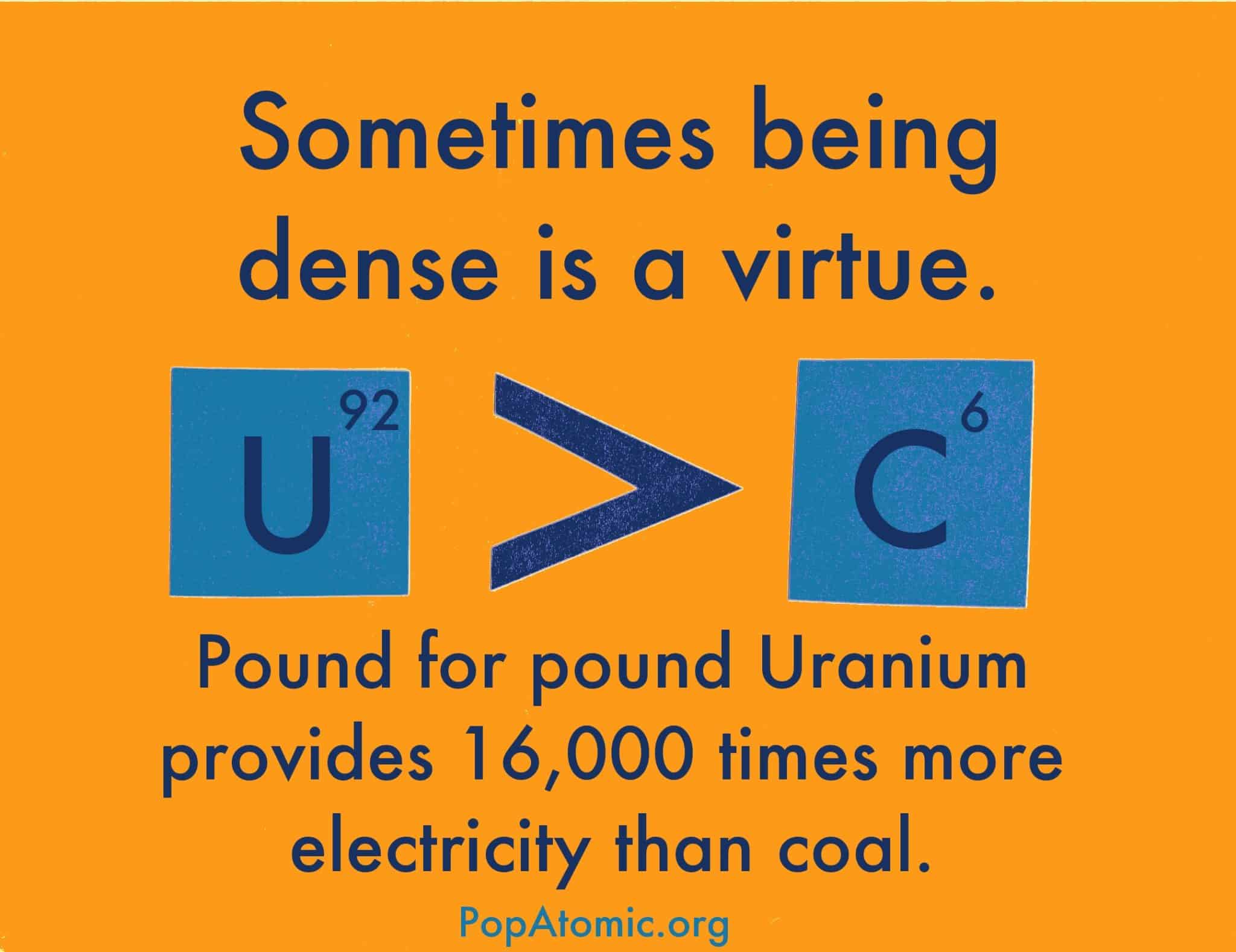
One of the primary advantages that nuclear energy sources have over chemical energy competitors is energy density. Using our current, rather primitive technology that essentially obtains nuclear energy from the 0.7% fraction of uranium that is easily fissioned with a single, low energy neutron, uranium contains about 16,000 times as much energy per unit weight as coal. As we improve our technology, and the need for improved utilization increases, we will begin using high energy neutrons with repeated interactions to break the far more common U-238 into smaller pieces plus energy and we will take advantage of the excellent properties of Th-232 to fission after being hit with two low energy neutrons.
When those known techniques reach the commercial stage, the ratio of energy content per unit mass between nuclear fuels and chemical fuels will be closer to 2,000,000 to 1 and even that measure understates the advantage that nuclear reactions have over chemical reactions.
The understatement there is caused by the fact that combustion fuels are not self contained; they will only release their energy when combined with oxygen. If you count the mass of all required reactants, which is often not done since our common atmosphere contains sufficient quantities of oxygen to support combustion, the ratio of energy density between nuclear reactions and chemical reactions is closer to 10,000,000 to one. The implications of very dense fuels for machinery and support equipment design can be incredible if the engineers and accountants can learn how to take full advantage of the physics.
All those numbers can be complicated to explain to people. My artistic friends at PopAtomic.org have produced a poster that helps visually explain the first set of numbers. Comments are always welcome; I will admit to pride of authorship, but also a desire to learn and improve. Based on what I know about PopAtomic, they feel the same way.
Roughly how much coal does one uranium fuel pellet replace?
- ✓Nuclear releases ~a million times more energy per atom than burning fuel.
- ✓This drives nuclear's tiny footprint and minuscule waste volume.
- ✓It's why a reactor can run for years between refuelings.
✓ Active recall
1. Roughly how much coal does a single uranium fuel pellet replace in energy terms?
2. What part of a reactor slows neutrons so the chain reaction can sustain?